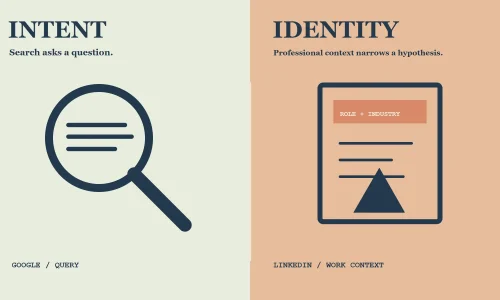

The short answer: LinkedIn Ads for manufacturers should be planned around the companies and roles that influence a purchase, then measured against meaningful sales progress. Define a narrow group of target accounts, map the people who evaluate technical fit, commercial terms, risk, and implementation, and give each role useful proof rather than repeating the same brochure. Make the offer match the buying stage, connect lead data to the CRM, and agree with sales on what qualifies as a real opportunity. A form completion is an early signal. It becomes commercially useful only when the company can follow up, validate fit, and track whether the account advances through a long industrial buying process.
LinkedIn Ads for manufacturers must account for buying committees
Imagine an overseas manufacturer of custom pumping systems receives a request for quotation from a company evaluating a new production line. The project appears simple in the form: one person has asked for a catalog. Behind that request may sit a plant engineer checking pressure and compatibility, an operations manager comparing downtime risk, a procurement lead assessing supplier terms, and a finance or executive stakeholder reviewing investment. A campaign that optimizes only for the person who submits a form can miss the buying committee that actually decides.
This is not a claim that every industrial purchase uses the same roles or process. The people involved depend on product complexity, price, risk, company structure, and the customer’s procurement rules. It is a planning scenario that shows why manufacturers should define the account and buying task before choosing creative or lead forms.
LinkedIn’s advertising products, targeting options, and lead formats change. Review the current LinkedIn Marketing Solutions documentation and account interface before specifying available audience attributes. This article treats role and account categories as a strategy map, not a promise that every selection is currently selectable in every market or account.
Start with the account, then map the people
An industrial campaign needs two definitions: which organizations could plausibly buy, and which people in those organizations influence the decision. An account list might be organized by geography, industry, plant type, production process, installed equipment, facility expansion, or another business condition. These are hypotheses that the manufacturer should validate with sales history and market knowledge.
Do not define an audience as “manufacturing executives” and assume that resolves the problem. A buyer of an industrial component may be a process engineer, maintenance manager, project lead, distributor, OEM sourcing manager, or plant owner. Seniority can matter, but a senior title alone does not establish technical authority or active purchase intent. Conversely, an engineer may shape the specification even if they do not sign the purchase order.
Build a role map from actual deals and customer conversations. Ask account managers who participated, what each person needed to know, which objections delayed progress, and who approved the next step. If CRM records are incomplete, interview the sales team and label the initial map as a working hypothesis. Update it as the team learns.
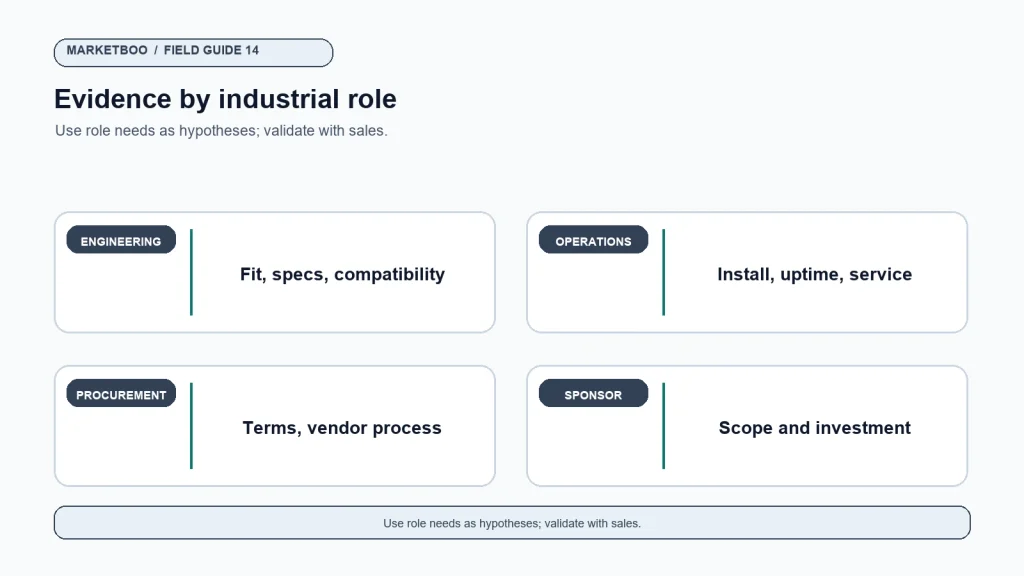
| Buying role | Typical question to investigate | Useful proof or next step | Signal sales should record |
|---|---|---|---|
| Engineering or technical evaluator | Will this fit the system, process, specification, or operating condition? | Technical data sheet, drawings, compatibility review, application note | Application, constraints, specification status |
| Operations or plant leader | What will installation and ongoing operation require? | Installation plan, service capability, uptime or maintenance details where verified | Site, operating window, stakeholders, operational risk |
| Procurement or sourcing | Can the supplier meet commercial and delivery requirements? | Supplier capability, quality process, lead-time range, purchasing contact | Vendor process, bid date, commercial requirements |
| Finance or executive sponsor | Is the investment justified and aligned with the project? | Scope, options, lifecycle assumptions with evidence, decision summary | Budget status, sponsor, approval path |
| Distributor, integrator, or OEM partner | Can the product be specified or resold for a customer project? | Partner terms, documentation, integration support, channel contact | Relationship type, account owner, project stage |
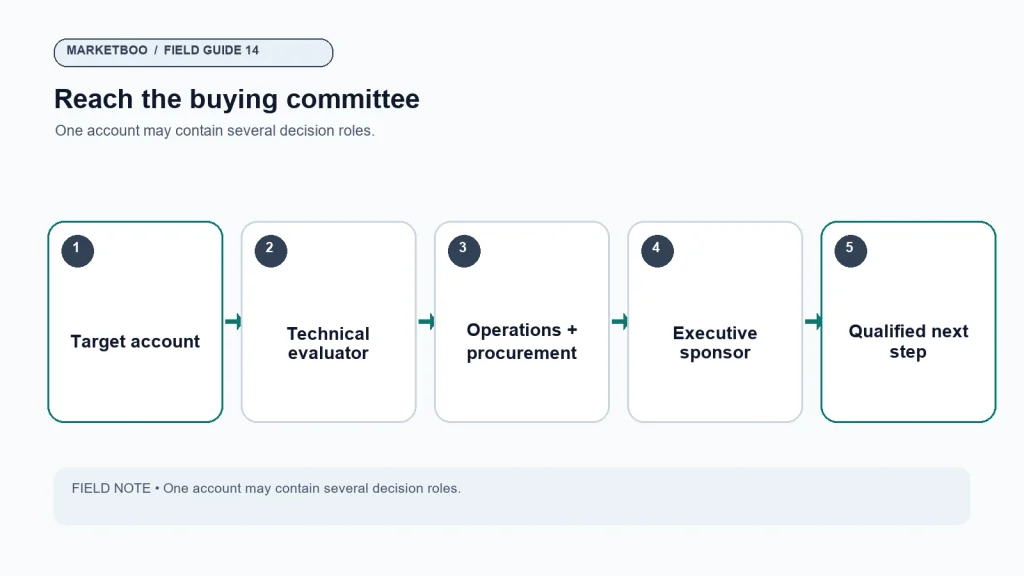
Treat this as an interview guide, not a universal org chart. A small manufacturer may have one person in several roles. A large project can involve several technical and commercial reviewers. Design messages that help people share the same evidence internally. The campaign should make it easier for a buyer to answer a colleague’s question, not make every role fill out a generic contact form.
Choose a buying stage and offer that belongs there
An account can be in early research, active specification, vendor evaluation, procurement, or post-sale expansion. These stages do not always occur in a neat order. A manufacturer may enter the process when a project is already underway. Another prospect may need to understand whether a solution is technically possible before discussing a quote.
Match the offer to the question. A technical guide may help someone frame an application. A product comparison worksheet can support specification work if claims and comparisons are accurate. A sample, consultation, or engineering review may be appropriate when a buyer can provide enough detail. A quote request is useful when the prospect has a defined project, but it can be an awkward first step for someone who still needs to understand the product.
| Buying stage | A useful campaign offer | Qualification that helps sales | Avoid |
|---|---|---|---|
| Problem recognition | Short application explainer or checklist | Process, material, industry, or operational issue | Demanding a detailed RFQ before the problem is defined |
| Technical evaluation | Specification guide, drawing request, compatibility review | Required range, interface, operating conditions | Claims that imply universal compatibility |
| Supplier shortlist | Capability overview, quality documentation, referenceable proof | Project timing, location, vendor requirements | Unverified customer logos or unsupported certifications |
| Active procurement | Quote discussion or scoped engineering meeting | Quantity, delivery need, bid schedule, buying contacts | Treating every form completion as a sales-ready project |
| Existing account expansion | Application review or related product information | Installed base, service need, contract constraints | Sending acquisition creative that ignores account history |
The right offer reduces friction without hiding the next step. Explain what information the prospect should prepare, who will respond, and what happens after submitting a form. If the manufacturer cannot meet a requested lead time, service location, or product specification, the ad should not imply otherwise. Sales follow-up should confirm facts before discussing a quote.
Build proof for technical and commercial reviewers
Manufacturing buyers need evidence that matches the decision at hand. A product image can help recognition, but it rarely resolves an engineering question. A general “built for performance” headline says little about operating limits. An attractive form may produce a contact record without giving sales enough context to route the inquiry.
Useful proof can include a clearly labeled product range, published technical specifications, documented manufacturing capabilities, relevant certifications when current and verified, installation requirements, maintenance information, available support geography, or a case study that the company has permission to use. Provide context for each claim. A performance figure needs a source, test conditions, or qualification; a delivery estimate needs a date and scope; a customer result needs authorization and a description of what the result measures.
Content should be specific enough to help a person make progress, but not so specialized that it excludes the broader committee. A technical document can include a one-page executive summary. An application note can describe the relevant process and then direct qualified readers to a technical contact. A sales deck can show scope, assumptions, and open questions rather than only product advantages.
The destination page matters as much as the ad. If an ad promises an engineering checklist, the landing page should make that resource easy to find and provide a clear explanation of the business that produced it. A quote request page should identify what details are helpful and whether the company serves the prospect’s region. A page that requires a lot of personal information for a basic document may create unnecessary friction. Decide what information sales truly needs at that stage.
Distinguish a lead from an account opportunity
A lead is a contact or inquiry record. A qualified opportunity is a sales-defined situation with an account, use case, need, and plausible next step. The exact qualification rules vary by business. For a manufacturer, they may include geography, product fit, required quantity, technical conditions, timing, budget process, or an active project. The marketing team and sales team should agree on these definitions before the campaign starts.
The CRM should preserve enough information to support a handoff: campaign, offer, account, contact role, product interest, geography, inquiry date, consent or communication status where required, sales owner, first response, disposition, and next activity. Keep field collection proportionate. If the form asks for ten details and sales ignores nine, reduce the form or explain how the information is used.
Create disposition options that allow learning. “Not a fit” is too broad if the reason could be geography, application, timing, distributor routing, missing project, duplicate record, or unavailable product. A clear reason can refine targeting and content. Ask sales to return the record’s status; otherwise, advertising reports may stop at the form and miss the value of account progression.
A practical pipeline map for a long sales cycle
| Stage | Evidence to record | Marketing question | Sales action |
|---|---|---|---|
| Ad engagement | Impressions, reach, clicks, video or content response where available | Did the intended audience encounter the message? | Usually none until an inquiry or known account signal appears |
| Content response | Resource request, event signup, or meaningful page action | Did the offer answer an early-stage question? | Route only when the interaction matches agreed rules |
| Inquiry | Contact details and stated interest | Does the company and use case plausibly fit? | Validate account, role, region, and request |
| Qualified conversation | Sales-confirmed need and next step | Which message or account path led to a useful discussion? | Discover process, technical needs, stakeholders, and timing |
| Opportunity | CRM stage with scope and accountable owner | Are target accounts progressing, and where do they stall? | Define evaluation, quote, and stakeholder next actions |
| Closed outcome | Won, lost, delayed, or no decision with reason | What can be learned without overstating attribution? | Record outcome and competitive/context notes |
Measure both source and influence carefully. A lead may first come from a distributor, later engage with LinkedIn content, then attend a trade show before requesting a quote. A “first touch” view and a “campaign influenced” view answer different questions. Neither should be presented as complete causal proof. Set attribution rules, reporting windows, and CRM field definitions in advance, then describe limitations in the report.
Set the campaign up so sales can use the signal
Before the campaign, make a compact sales enablement packet. It should tell sales who the target accounts are, what the ad promised, which asset was downloaded, what the form asked, what follow-up is appropriate, and what evidence is available on the landing page. Include an approved first-response message and a path for technical questions that the salesperson cannot answer alone.
Agree on response timing based on the company’s actual capacity, not a made-up SLA. If a sales engineer is the only person who can assess a fit, confirm their availability before driving inquiries. If the campaign spans time zones, specify coverage. If the team cannot answer every inquiry individually, establish a respectful nurture route and a way for people to request contact later.
Do not assume that the most senior contact is always the best lead. A technical evaluator can be an effective champion who brings evidence to the buying group. A procurement contact can route the supplier through a process. A plant manager can identify a near-term issue. Each role can be useful if sales understands how it contributes.
Make account-level reporting usable
Industrial opportunities often span contacts and multiple months. Reporting should therefore let the team see both the person who engaged and the organization that may buy. Keep the account identifier consistent across marketing and sales records when the organization has a legitimate way to do so. Do not merge contacts into one account merely because their names look similar; use the CRM’s account rules and have an owner resolve uncertain matches.
The report can group by campaign, offer, account tier, geography, and CRM stage, but every grouping has a limitation. A campaign may influence several people at one company. A contact may move employers. A trade show or distributor can introduce the account before the ad interaction. Report which events are direct source, which are later engagement, and which are sales-created. If the organization cannot reliably connect a platform interaction to a CRM account, state that rather than implying person-level identification.
Document the join rule the company uses to connect a person with an account. It might rely on a business email domain, a manually verified CRM relationship, or an existing account record. Each approach can fail: groups may use shared domains, subsidiaries can have different buying teams, and a contact may use a consultant’s address. Label automated matches as provisional until the sales owner confirms them. That small qualification prevents a list of engaged contacts from being mistaken for a list of confirmed buying companies.
Sales enablement should follow the same buying-role map. Give representatives the campaign asset, source facts, and a short note about the question it addresses. Invite them to report which roles respond and what new objection appears. This feedback can improve both the targeting hypothesis and the next technical resource. If sales changes the qualification criteria, record the date and reason so marketing does not compare old and new leads as though they were identical.
For management reviews, separate leading indicators from business outcomes. Target account reach and technical-content engagement can show whether the campaign is reaching a relevant audience. Qualified conversations and opportunity progression show later commercial movement. Won revenue is important, but it may arrive long after the campaign and be influenced by many touchpoints. A short reporting window should not treat pipeline that has not matured as a failure, and a long window should not credit an ad without explaining the attribution rule.
Build a monthly account review around a few questions: Which intended companies engaged? Which roles responded? Did sales confirm a real application? Where did the opportunity stall? Which campaign offer helped a buyer move forward? What evidence is missing? A concise review of those questions can reveal whether the next improvement belongs in targeting, technical content, sales follow-up, or product availability.
This process is especially valuable when a campaign is intended to create demand before a formal RFQ. The absence of an immediate quote does not mean there was no effect, but engagement alone should not be called pipeline. Use stage-specific outcomes and keep the distinction visible to leadership. If the team has no reliable CRM stage, improve the data process before building a more elaborate return-on-ad-spend story.
Avoid common targeting and measurement traps
Targeting job titles alone. Titles differ by company and country. Use account context, seniority, function, skills, and other currently available signals as hypotheses, then compare results with actual CRM fit. Keep targeting settings aligned with the relevant platform rules.
Treating form completion as pipeline. A person may request a document for research, school, a competitor review, or an unrelated project. Qualification happens after the form. Report form volume separately from sales-accepted accounts and opportunities.
Optimizing toward the cheapest lead. A low-cost inquiry from an out-of-market or technically unsuitable company may consume sales time. Compare cost with downstream qualification, account fit, and progression.
Showing every role the same message. A product specification and an executive summary serve different questions. The content can share a clear central explanation while varying the proof and next action.
Launching without an account list or definition. “Industrial” may be too broad. Set a working account profile using actual market, customer, and sales information; state what makes a company worth pursuing.
Overstating product or company claims. Verify technical specifications, compliance statements, quality claims, shipping capacity, and customer evidence before using them. Platform approval does not prove the claim is accurate.
Failing to return CRM outcomes. If no one records whether leads were qualified, the next campaign cannot learn from business fit. Keep the required fields few, clear, and owned.
How to plan LinkedIn Ads for a manufacturer
- Choose the commercial goal. Decide whether the campaign should support specification research, a qualified inquiry, a quote request, a partner conversation, or account progression.
- Define target accounts. Use sales history, service geography, product fit, market priorities, and known buying conditions to create a reviewable account profile.
- Map buying roles. Identify the technical, operational, commercial, and executive roles involved in real deals; label assumptions that lack evidence.
- Select one buying-stage question. Decide what the reader needs to learn now and choose an offer that helps with that question.
- Prepare substantiated proof. Confirm specifications, comparison claims, certifications, customer permission, delivery details, and technical content with the appropriate owner.
- Check the destination. Ensure the landing page matches the ad, works on mobile, explains the next step, and does not imply unsupported availability or results.
- Set qualification and routing rules. Agree with sales on account fit, role, geography, use case, owner, response path, and CRM dispositions.
- Confirm platform options. Review LinkedIn’s current campaign, audience, and lead-format documentation in the account; do not rely on an outdated screenshot.
- Launch with a bounded test. Record audience, account set, creative, offer, budget, dates, and the question the campaign is intended to answer.
- Report progression, not just forms. Compare account fit, qualified conversations, opportunity stages, and outcomes while explaining attribution limitations.
When a manufacturer should bring in outside help
Outside help is useful when the company has a clear market and offer but lacks campaign ownership, account mapping, creative production, CRM handoff, or reporting capacity. A provider should be able to explain how it will work with sales and engineering, how technical claims will be checked, and how the company can retain control of advertising and lead data.
Marketboo offers global paid media planning and management that can include LinkedIn advertising within a broader acquisition plan. For teams that want to build internal skill, hands-on ad coaching is a separate path to consider. Ask about scope, account access, responsibilities, reporting definitions, and what must be supplied by your own technical and sales staff before agreeing to work.
Frequently asked questions
Are LinkedIn Ads a good fit for every manufacturer?
Not automatically. They may fit when the target companies and roles can be reached, the product or service has a clear business audience, and the company can support follow-up. Compare the channel with trade media, search, distributor programs, events, and direct sales using your own market and account data.
Which LinkedIn job titles should manufacturers target?
Start with roles observed in actual buying committees, such as engineering, operations, procurement, sourcing, plant leadership, or executives, depending on the product. Validate the titles and audience attributes currently available in the platform. Job titles are an imperfect proxy for authority, project ownership, and technical fit.
Should manufacturers use LinkedIn Lead Gen Forms?
They can be considered when a short in-platform inquiry fits the offer and the business has a reliable follow-up process. Explain what the person receives and what happens after submission. Ask only for information the team needs at that stage, and test whether the lead quality is acceptable after sales qualification.
How should a manufacturer measure LinkedIn campaign success?
Use a staged view: target-account reach, meaningful engagement, inquiries, qualified conversations, CRM opportunities, and closed outcomes. Set source and influence definitions before reporting. A form count or attributed revenue figure alone does not explain account fit or prove that the campaign caused the sale.
How long should a LinkedIn manufacturer campaign run?
The period depends on the buying cycle, budget, audience size, and how quickly sales can qualify inquiries. Define a review point and a stopping rule rather than applying a universal number of weeks. Long-cycle programs should track interim evidence without claiming that early engagement equals pipeline.
What should an industrial ad offer besides a product brochure?
Offer evidence that helps answer the next question: an application note, specification guide, compatibility conversation, process checklist, maintenance information, or a clearly scoped engineering review. The right asset depends on product complexity and buyer stage. Do not publish technical claims that the company cannot substantiate.
Why are my LinkedIn leads not turning into sales conversations?
Check account fit, offer-stage match, form friction, routing, response capacity, and the information sales receives. Review disqualification reasons with the CRM owner. A mismatch may come from targeting, but it can also come from unclear content, incomplete product fit, slow follow-up, or a qualification rule that was never agreed.
Put the committee ahead of the vanity metric
LinkedIn Ads for manufacturers are strongest when they help the right people inside a target company move a real decision forward. The engineer needs evidence about fit; procurement needs supplier facts; operations needs to understand implementation; the sponsor needs a clear scope. The campaign need not serve every role with one ad, but the wider program should make the evidence consistent and shareable.
Before launch, make three things explicit: which accounts matter, which buying question the content answers, and how sales will define a qualified next step. Then measure through the CRM as well as the ad account. A higher lead count is not a victory if the sales team cannot use the contacts. A careful program may produce fewer inquiries and still provide better evidence about which accounts are worth a conversation.