Quick answer: Facebook Ads training can help an export beginner when the course teaches a repeatable decision process, not a list of buttons. Before enrolling, check whether you can bring a product, target market, landing page, and a safe practice environment. A useful course should cover campaign objectives, audience geography, creative briefs, budget guardrails, measurement events, lead follow-up, and how to diagnose weak results without changing everything at once. Ask for a syllabus, a sample assignment, the instructor’s verifiable background, the account-access policy, and the limits of post-course support. Training can improve skill; it cannot guarantee impressions, inquiries, sales, or a profitable campaign.
For market context, IAB and PwC reported that U.S. digital advertising revenue reached $259 billion in 2024, up 15% year over year. [1] This is an industry-wide measure; it does not show export lead costs, course effectiveness, or the likely return for a particular company.
Begin with the decision the course must help you make
A beginner does not need every campaign setting memorized. They need to connect a buyer, offer, destination, and response owner. For a distributor inquiry, the business must verify product availability, specifications, and market serviceability. A trainer teaches workflow; the company owns these facts. A syllabus that treats every objective as “get more leads” skips the first decision.
Write down the practical task you expect to perform after the course. It might be preparing a brief for an agency, building a draft campaign in a training environment, reviewing a lead form, or explaining why one result should not yet be treated as a sales forecast. Make the task observable. “Understand Facebook” is too broad to assess; “map one buyer question to an offer, destination page, measurement event, and follow-up owner” can become an assignment with a clear review standard.
This is also the cleanest way to compare courses. If two providers describe similar topics, ask what participants will create, who reviews it, and how the review identifies a weak assumption. A course can list targeting, creative, and analytics while offering no practice that connects them. The learning outcome should be expressed as an artifact or decision, not as a promise that the participant will produce a particular return.
Who should take Facebook Ads training for export beginners?
A first course can suit an export business owner, junior marketer, sales-and-marketing generalist, or product specialist who will work with a paid-media teammate. The right starting level depends less on job title than on the work the learner owns. Someone responsible for approving claims needs to recognize the difference between a supported product fact and a broad promise. Someone building campaigns needs enough familiarity with account roles, objectives, and reporting to ask precise questions. A leader commissioning an agency may need a shorter literacy program instead of a full operator curriculum.
For an exporter, the course should make room for international context. The learner may need to distinguish country, language, buyer role, distributor status, and shipping availability. A campaign can be technically configured and still be unsuitable if the offer speaks to a market the business cannot serve or if the landing page omits the information a buyer needs. Training should teach the participant to surface those dependencies before launch, rather than treating them as ad-platform settings.
Some learners are not ready for account-level practice. If the company has not assigned an account owner, defined who may approve spend, or documented which product claims are allowed, a class cannot safely fill in those organizational decisions. The course can help reveal missing prerequisites, but a manager must supply them. A responsible instructor says when the learner should stop, gather facts, or request a second review instead of improvising access or policy.
Before enrolling, ask whether the course assumes prior marketing experience, spreadsheet comfort, a working website, analytics access, or an active ad account. If the provider cannot state those assumptions, request a diagnostic call or sample lesson. A beginner course should define the unfamiliar vocabulary and show how the concepts fit together. It should not shame learners for not knowing acronyms or imply that access to a live account is the only way to learn.
A short glossary makes the syllabus easier to judge
Campaign objective is the outcome a platform is asked to optimize toward; the name and available choices can change, so verify the current interface before a live build. Audience is the group the campaign is intended to reach under the platform’s current targeting and delivery rules. Creative includes the message and media a person sees. Destination is the page or form that receives the response. Event is a recorded action used in measurement, such as a page view or submitted inquiry. Attribution is a method for assigning credit to advertising interactions; it does not prove that the ad alone caused a sale.
Keep these definitions connected to the business task. If a class says it will teach “pixel mastery,” ask which measurement question the exercise answers and what information is required to verify the event. If it promises “advanced targeting,” ask what constraints, market knowledge, and policy checks the student will need before choosing an audience. A glossary is useful when it lowers confusion; it becomes a distraction when it is a page of acronyms detached from the decisions a learner must make.
Terminology also changes over time. Training materials should show their revision date and identify which interface version or product area they cover. A screenshot may help explain a concept, but a learner should not assume every button remains in the same place. Ask whether the instructor explains how to find the authoritative current documentation and how to distinguish a strategic principle from a temporary interface detail.
In a mixed team, agree on common terms before work begins. Sales might use “lead” for any form fill while marketing uses it for a person meeting a qualification rule. The difference affects reporting and course assignments. A useful course asks the company to define terms such as inquiry, qualified inquiry, opportunity, and customer within its own workflow. It does not present a platform’s event label as a complete business definition.

What a practical course should cover
NIST’s 2024 learning-program guidance recommends a lifecycle approach with defined audiences, behavior goals, and evaluation. [9] It addresses cybersecurity and privacy education, so use it only as a general instructional-design analogy. An advertising course still needs current platform materials, a verified product brief, and review by people who understand the export market.
Use a curriculum map to see whether the course moves from business context to campaign decisions and then to review. The order matters. A learner who starts with ad formats but has no market, offer, destination, or measurement plan may leave with screenshots and still be unable to judge whether a campaign is coherent. A course can vary in length; the important test is whether each module produces work that can be checked and improved.
| Module | Practice output | Review question |
|---|---|---|
| Business and buyer brief | One market, buyer role, product, offer, and sales action | Can the business serve this audience, and is the offer useful? |
| Campaign planning | Objective, destination, owner, and draft structure | Does each choice serve the stated task? |
| Creative and claims | One message brief with evidence notes and variants | Are product statements accurate and clear? |
| Measurement basics | Event map and reporting definitions | Can the team distinguish a platform signal from a qualified inquiry? |
| Review and next action | Decision log with keep, test, fix, or pause recommendation | Is the next step tied to evidence and within the learner’s authority? |
The business brief should do more than name a country. It should record what the company sells, which applications are supported, what the buyer needs to know, which languages the business can review, where a lead should go, and what happens after a response arrives. An exporter with several product lines may need separate briefs because the buyer, application, and proof differ. An instructor should show learners how to scope one manageable exercise instead of compressing every product and market into one campaign.
Campaign planning should explain the relationship between objective, audience, creative, destination, and measurement. A participant should be able to describe that relationship in plain language before clicking through a setup flow. For example, if the business wants distributor inquiries, the course should ask what qualifies an inquiry, what information a distributor must provide, and which page explains the commercial terms. It should also identify what the learner cannot decide alone, such as spend approval, legal review, or sales coverage.
Creative work should start with a buyer question and an approved product fact. The learner can then develop different openings or visual approaches without changing the underlying claim. A useful assignment asks for a primary message, the proof available, the audience it is for, the next action, and the unanswered questions that need a product specialist. The instructor should review relevance and clarity, not reward the most dramatic wording. A course should explain that a variation is a test idea, not evidence that it will outperform another version.
Measurement belongs in the curriculum before launch. Students should identify the action they want to observe, where that action is recorded, who checks it, how the team names the result, and what can make the record incomplete. A report might show delivery or clicks, but these signals are not interchangeable with an accepted sales inquiry. The learner should practice stating what the evidence supports and what remains unknown. That habit is more durable than memorizing a single reporting view.
Finally, a course needs a review loop. Each exercise should end with a short decision note: what was expected, what was observed, what could have affected it, what should be checked next, and who owns that check. If the only closing activity is a screenshot of a campaign setup, the learner has demonstrated navigation but not judgment. Ask the provider to show how feedback is given and whether corrections are part of the course scope.
Practice safely without borrowing a customer’s account
“Hands-on” should describe a defined learning environment, not an unexamined request for passwords. The provider should say whether practice uses a sandbox, a demonstration account, a training scenario, or a learner’s real business account. These are not the same. A live account can expose company data, spend, audiences, creative assets, and access permissions. A student should understand who owns it, what the instructor may see, what changes are allowed, and how access ends.
If an exercise uses a real account, decide scope in writing before the session. Name the learner, account owner, reviewer, allowed changes, approval point, spend boundary, stop condition, and restoration plan. Do not use another company’s data simply because it makes an exercise look realistic. When the business cannot authorize a live build, a fictional practice brief with clearly labeled assumptions can teach the sequence without pretending to be a customer result.
A good exercise does not require the novice to publish an ad. The learner can prepare the campaign brief, map the choices, check the proposed destination, and identify missing measurement information for review. A trainer can use a screen demonstration to explain a concept while the student works from a separate worksheet. Before the learner changes an account, the instructor should distinguish an educational draft from an approved campaign and confirm that any action with financial or data consequences has an accountable owner.
Ask how the course handles learner files. Does the provider need account identifiers, customer lists, sales records, or contact details? What is necessary for the stated learning task? Who receives the files, where will they be stored, and when are copies removed? Unless the provider can answer from its current policy and terms, use fictional or minimized training data. Do not assume that a class, a screen-share, or a platform setting automatically resolves privacy, consent, or contractual obligations.
Build an export-market brief before choosing audiences
Advertising to an overseas market requires more than translating a headline. Begin with the commercial reality: can the company ship or serve there, which products are available, who handles inquiries in the relevant time zone, and what evidence can the business provide? A campaign brief can list the target country, buyer role, language, product application, sales action, page URL, response owner, and any regional restrictions the business has confirmed. Mark unknowns instead of filling them with assumptions.
Then translate a buyer problem into an offer. A buyer may want a specification sheet, a sample request, a technical consultation, a distributor conversation, or a comparison of supported configurations. Choose one useful next step rather than asking a cold visitor to complete a long form with questions the business does not need. If the offer depends on minimum order quantity, certification, lead time, or customization limits, make sure the destination page addresses those points accurately.
Students should learn to ask whether the campaign’s geography and language match the company’s ability to respond. A form submission from a country the company cannot support is not a success just because it appears in a platform report. Similarly, a language chosen for an ad should be supported by a suitable landing page and a person able to review replies. The course can teach how to document this handoff, but the business must confirm local service, legal, and sales requirements.
A first assignment can use one representative product. The learner writes a buyer question, records the source of each product claim, sketches the offer, names a destination page, and defines who will handle a response. A reviewer checks for unsupported statements and missing buyer context. The assignment should not pretend to predict reach or lead volume. Its job is to expose whether the organization has enough information to build a controlled test.

Creative testing should answer a question
Beginners often hear that they should “test more creative” without learning how to make a test interpretable. A course should teach the learner to state one hypothesis, identify the element that changes, keep the core offer and destination understood, and record what observation would prompt a next step. The hypothesis may be that a product demonstration will make an application clearer than a static product image. It is not a declaration that one format always wins.
For an export product, useful creative may explain a component, show a production capability the company can substantiate, answer a buyer objection, or point to a technical resource. The business should approve every product statement and image right before use. A visual can be attractive yet unhelpful if it hides scale, omits a relevant limitation, or implies a certification the product does not have. In the course exercise, ask learners to identify what a viewer could reasonably infer from each frame.
Keep the brief practical: audience context, buyer question, key fact, supporting evidence, format, caption, destination, and reviewer. Ask the student to produce two distinct approaches only when the difference is meaningful. Changing the image, audience, offer, headline, and page at the same time may make it hard to understand what the result means. A small, documented experiment is more teachable than a large list of variants with no reason for existing.
Course feedback should address the thinking behind the message. Does the opening make sense to the intended buyer? Does the copy use technical language accurately? Is the next action clear? Is the image consistent with the product? Are claims sourced and approved? A reviewer can flag ambiguity and request evidence without claiming that a particular creative will generate a specific outcome. That is an important boundary for a beginner who may confuse critique with a performance forecast.
Learn to read results without turning early signals into promises
A first course should separate delivery measures, engagement measures, site behavior, lead records, and sales outcomes. They answer different questions and may come from different systems. A click can indicate that someone opened a destination; it does not show that the person is a qualified buyer. A form can be submitted with incomplete details. A sales opportunity may have been influenced by several contacts and channels. Training should not imply that one platform’s attribution view is a complete account of the customer’s decision.
Ask the provider to give each metric a definition, source, owner, observation period, and business use. A learner should know whether a report shows a total, a rate, a modeled estimate, or a partial record. If two reports disagree, the course should teach an audit path: check the date range, filters, event definitions, naming, destination, and handoff before drawing a conclusion. “The number changed” is not yet an explanation of why it changed.
A useful decision note keeps three things apart: the observation, the possible explanation, and the action proposed. “The form count fell” is an observation. “The form may be harder to complete” is a hypothesis. “Review field requirements and test one approved change” is an action. Labeling the layers prevents a novice from turning a guess into a fact. It also gives a manager a concise artifact to review after training.
Early results can be noisy or incomplete. A course should explain that volume, time, offer relevance, page performance, response speed, market conditions, and sales qualification can all affect what is observed. No universal minimum spend, number of days, or lead target should be presented without a documented reason and context. Ask the instructor how they decide that there is enough evidence for a particular recommendation, and what they do when there is not.

A worked classroom exercise, clearly labeled as hypothetical
Consider a fictional exporter of industrial valves that wants more qualified distributor conversations in one supported country. The exercise begins by writing down the product range, the distributor’s likely question, the pages available, the person who responds, and the information required to decide whether the inquiry fits. All of the company details in this scenario are invented for instruction; it is not a Marketboo client case, a performance report, or evidence of an advertising result.
The learner drafts two offer concepts: a concise selection guide and a request for a technical conversation. They note what each offer asks the buyer to do and what the company must be ready to provide. The learner then outlines one message using a verified product attribute supplied within the hypothetical exercise, an image that does not imply unsupported use, and a destination page that repeats the same promise. The trainer asks which fact needs technical approval and which part is merely a proposed framing.
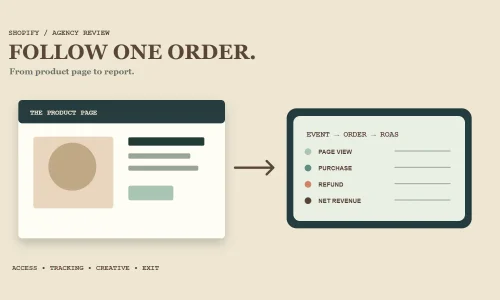
Next, the student sketches an event map. They label the page visit, guide request, and accepted distributor inquiry as different stages, then state who owns each record. They do not assume that a page event equals a qualified sales opportunity. In a no-live-account version, the class reviews a fictional report card with labeled sample values and an explicit note that the values are invented. In a live setting, any real account change would need the company’s authorization and an agreed stop point.
The final submission is a decision memo, not a forecast. It says what the business would need to verify before launch, which signals it plans to review, what would trigger a correction, and which decisions remain with the employer. The exercise is successful if the beginner can explain the setup and its limits. The assignment does not show that the creative will convert or that the campaign should receive a particular budget.
How to evaluate a course before paying
Do not compare offers only by class hours or the number of platform terms listed on a sales page. Compare the scope that a learner can verify: instructor background, syllabus date, learning outcomes, practice conditions, feedback, accessibility, file handling, support limits, cancellation terms, and what the learner retains. If a provider mentions credentials, ask which credential, issuing organization, date, and current status. Do not assume that a platform course or badge proves a trainer’s independent experience with your export category.
Request a sample lesson or assignment that resembles the work your team needs. The sample should be specific enough to reveal how the instructor handles missing information. Does the trainer ask for product proof, target-market capability, or a clear sales definition? Do they identify an assumption rather than hide it? Do they explain what cannot be determined from a short exercise? The questions a provider asks before teaching may tell you as much as the slide deck.
Ask who receives sensitive materials and whether the course requires real customer or account data. Have the trainer explain the practical boundaries of screen sharing, account access, copies of learner files, and post-session follow-up. If details depend on a contract, privacy policy, or the company’s internal security rules, review those documents before enrolling. General course language cannot replace an organization’s legal or compliance review.
Marketboo’s current hands-on ad coaching page describes account review, campaign setup, creative testing, measurement, optimization, and team training as service areas. It is an enquiry page, not proof of an individual instructor’s credentials, a fixed curriculum, fee, class size, or guaranteed outcome. Ask for the current syllabus, named trainer biography, access model, and a written scope before making a decision.
| What to check | Evidence to request | Reason to pause |
|---|---|---|
| Instructor fit | Relevant, verifiable work history and the date it was checked | Vague claims such as “expert” with no supporting detail |
| Course currency | Revision date and the platform areas covered | Old screenshots presented as current instructions |
| Practice method | Demo, sandbox, scenario, or authorized live-account plan | Unclear request for passwords or spend authority |
| Feedback | Sample rubric or example of a reviewed assignment | Only completion certificates; no work is checked |
| After-class support | Named channel, duration, response scope, and exclusions | “Ongoing support” with no written limits |
Put the course to work in the first month
Learning fades when the participant does not have a next task or a manager who can review it. Before class, assign a modest application project and reserve time for practice. The project can be a campaign brief, a product-page audit, an event map, or a reporting glossary. It does not need to involve publishing a live ad. The manager should decide which work the learner can perform independently and which requires approval.
After the session, ask the learner to explain one decision in plain language: the business goal, intended audience, selected offer, destination, expected event, and known limitations. Then ask what evidence would cause the plan to change. A person who can describe a click path but cannot explain who owns the next step may need more coaching. A person who can identify missing facts should be encouraged to document them rather than guess.
Keep a learning log with the question, lesson, artifact, reviewer feedback, follow-up owner, and date. Record corrections to platform instructions separately from strategic principles. This helps the team update materials when an interface changes without discarding useful reasoning. It also prevents an old screenshot or one person’s memory from becoming the company’s only training resource.
Review the course after a short interval. Did it answer the original task? Did the student produce the intended artifact? Did the reviewer identify a gap that needs more support? Was the practice environment appropriate? These questions evaluate the learning experience, not the campaign’s revenue. Advertising outcomes depend on additional factors and should be evaluated with a properly defined measurement plan.

A practical enrollment checklist
- Write the job the learner needs to perform after training.
- Confirm the learner’s role, starting knowledge, and manager support.
- Ask for the current syllabus, revision date, lesson outcomes, and sample assignment.
- Verify the instructor’s relevant background and ask how claims are supported.
- Choose a practice environment and define access, spend, review, and stop boundaries.
- Check that the curriculum connects market, offer, creative, destination, measurement, and follow-up.
- Agree on what feedback is included, what support ends, and what files the provider retains.
- Set a follow-up task and review date without turning course completion into a performance promise.
FAQ
Is Facebook Ads training suitable for someone new to export marketing?
It can be, if the course defines advertising terms and teaches market, offer, destination, measurement, and follow-up decisions. The learner still needs company facts and an accountable reviewer.
Do I need an active ad account to learn?
Not always. A demonstration, sandbox, or clearly labeled scenario can teach planning. Use a live account only with the business owner’s permission and written limits.
What should a beginner learn before choosing an audience?
Start with the buyer, market the company can serve, offer, language support, and response owner. Audience settings cannot replace that business research.
Can a course guarantee more leads or lower acquisition costs?
No responsible course can guarantee results across businesses. Outcomes depend on market, offer, creative, destination, budget, measurement, and sales follow-up.
How can I tell whether the instructor has relevant experience?
Request a dated biography, verifiable work examples, the instructor’s role, and the limits of any cited case. Do not treat a credential as proof of a promised result.
Should a beginner use real customer data in class?
Only when the company has approved the use and the provider explains access and retention terms. A fictional or minimized exercise is often enough to learn the workflow.
What is a useful first assignment after a course?
Prepare one campaign brief with a buyer question, approved product fact, offer, destination, event, response owner, and assumptions that still need review.
Conclusion: buy a learning outcome, not an advertising promise
Facebook Ads training for export beginners is most useful when it turns terminology into a set of decisions the learner can explain and document. Look for a syllabus that connects market fit, offer, account practice, creative, measurement, and sales follow-up. Check the instructor, course date, practice environment, feedback, and support scope before paying.
Choose one bounded assignment that the learner can complete with approved business information, then ask a reviewer to check the work. Treat the assignment as evidence of learning, not as evidence that a campaign will succeed. A course can build capability; the company still owns its product claims, access rules, spend decisions, customer data, and sales process.Need a practical next step? Review Marketboo’s hands-on ad coaching scope and request the current trainer biography, syllabus, access plan, and feedback boundaries before enrolling.Have an existing course outline to compare?Contact Marketboo with the audience, market, and learning task you want the program to cover.