The short answer: A useful Meta Ads creative testing framework starts with a specific customer question, changes one interpretable creative variable, and records what the business will do with the result. Before launch, write a hypothesis, identify the audience and product group, choose the primary outcome, and define what evidence would justify keeping, revising, or repeating the concept. After launch, check delivery and measurement before interpreting performance. If spend or outcomes are too limited to distinguish noise from a meaningful difference, say that the test is inconclusive. The purpose is not to produce a winning ad every week; it is to make the next creative decision better informed than the last.
A Meta Ads creative testing framework starts with a question
A creative team can produce a dozen files and still learn very little. The problem is often not the quality of the work. It is the absence of a clear question. A video, static image, carousel, and rewritten headline may all be launched together. If the campaign improves, the team cannot tell whether the improvement came from a stronger opening, a better product demonstration, a different audience, a discount, or a landing-page change.
This framework borrows the useful habit of a lab notebook: preserve the reason for the test, the conditions, the observation, and the interpretation. An ad test is not a controlled scientific experiment unless the setup supports that conclusion. Platform delivery is dynamic, audience exposure may vary, and small budgets produce uncertain observations. The notebook is a practical way to avoid forgetting what changed and overstating what one result proves.
Write the starting hypothesis in plain language. “People need a better ad” is not a hypothesis. “First-time shoppers who are unsure about fit may respond to a short demonstration showing how the product adjusts” is better. It names the audience, barrier, and message. The test can then ask whether that message is associated with more qualified visits, product-page engagement, completed purchases, or another defined outcome.
Meta’s advertising tools and campaign options change over time; check the current Meta Business Help Center before selecting an experiment or reporting feature. This article focuses on the creative decision process rather than promising that a particular platform testing tool will produce a statistically conclusive answer for every account.
Define the hypothesis before the asset
Start with a real buying friction found in the store, customer questions, sales notes, reviews, support tickets, interviews conducted with permission, or product-page behavior. Separate observations from interpretation. “Customers ask whether it fits in a carry-on” is an observation if the support log confirms it. “People will buy more if we say it is travel-friendly” is a hypothesis. The creative can then show a size reference or demonstration, while the test checks whether the new proof changes the intended outcome.
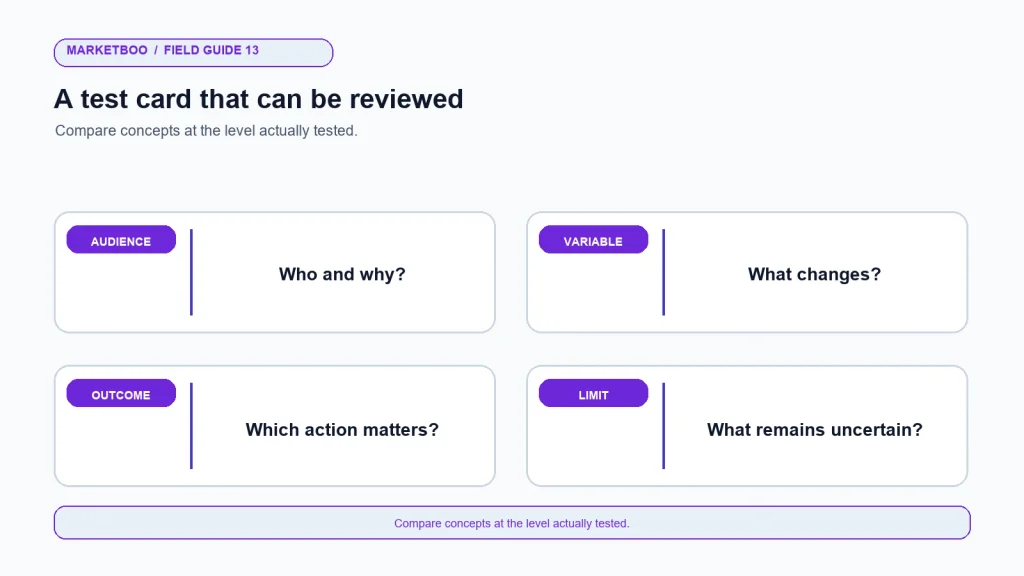
Use a hypothesis card:
| Card field | What to write | Example |
|---|---|---|
| Audience context | Who is the person and what do they already know? | New visitors who have not purchased this product family |
| Customer question | What uncertainty or job needs an answer? | Will the item fit a small travel bag? |
| Creative change | Which one part of the message will change? | Add a measured size demonstration in the opening seconds |
| Control or reference | What will it be compared with? | Current approved product demonstration |
| Primary outcome | Which business action matters most for this test? | Completed purchase for the eligible product group |
| Diagnostic metrics | What helps explain the outcome? | Video hold, outbound click, product-page session, checkout start |
| Interpretation rule | What will count as useful evidence? | A clear directional signal with no tracking or offer mismatch |
| Next action | What will the team do for each result? | Keep, revise, retest, or stop with a reason |
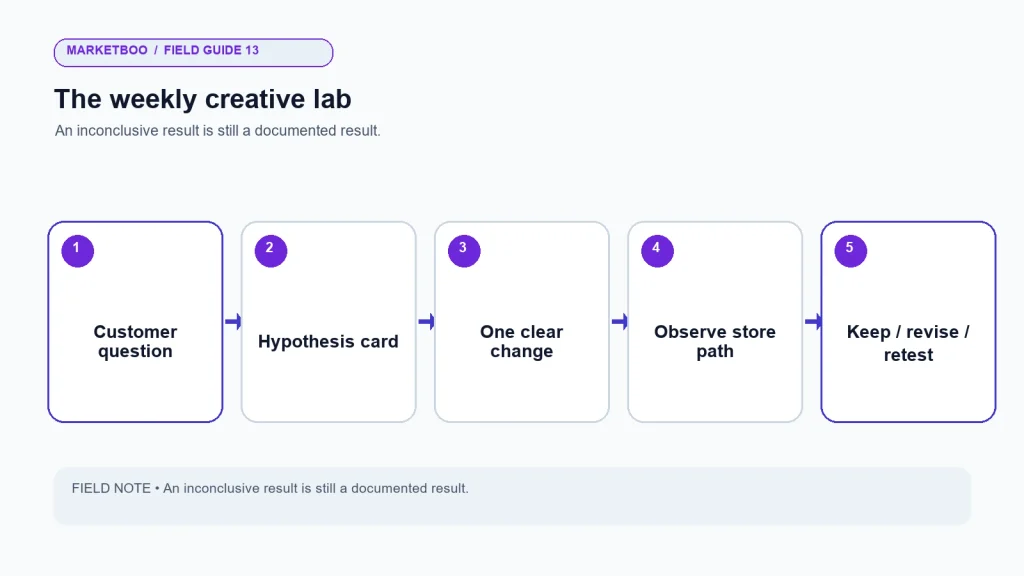
The “control” may be the current ad, an approved alternative, or a documented baseline. A team should not imply causal certainty if audience exposure, delivery, and other conditions were not comparable. If the platform’s experiment feature is available and appropriate, review its current setup guidance. If the team is simply comparing ads in an active campaign, describe the result as an observed comparison under that campaign’s delivery conditions.
Keep the variable small enough to learn from
Creative has many dimensions: the first frame, opening line, speaker, setting, product demonstration, proof, offer, format, soundtrack, length, caption, call to action, and landing page. You can test any of them, but avoid changing several major dimensions at once unless the deliberate question is about a complete concept package.
Two practical test modes help:
- Single-element test: Hold the audience, product, offer, and destination as steady as possible while changing one creative element. This can help isolate a message or proof point.
- Concept test: Compare two complete creative ideas because the team needs to decide which direction deserves further development. Interpret the result as a comparison of packages, not proof that one individual element caused the difference.
The mode must match the decision. A single-element test is useful when the team has a developed creative platform and wants to tune it. A concept test is useful earlier, when the team is deciding which buyer problem to address. Problems arise when people use a concept test but later claim that a specific headline or color produced the result.
| Test type | Change intentionally | Keep stable where possible | Appropriate conclusion |
|---|---|---|---|
| Opening hook | First line or opening image | Product, offer, audience, destination | One opening showed a different observed response in this setup. |
| Product proof | Demonstration, comparison, specification, or use context | Main promise, audience, price, destination | The proof variation merits further review or refinement. |
| Format | Video, static, or carousel treatment | Core message, offer, eligible product set | The format package performed differently under observed delivery. |
| Audience context | New versus returning shopper or defined account segment | Creative and destination where feasible | The audience/creative pairing deserves a separate plan. |
| Offer | Discount, bundle, shipping promise, or no offer | Creative framing and destination | The offer changed the result; margin impact still needs review. |
| Landing page | Product detail, collection, or campaign page | Ad and audience | The destination path changed; do not attribute the result to creative alone. |
When there are multiple simultaneous changes, document them. The record is still useful, but the conclusion should stay at the same level of certainty as the test. “This concept package earned a review” is more accurate than “the new hook caused the sale” when several things changed.
Select metrics in order of the decision
Start from the decision and work backward. If the team needs to know whether a creative attracts qualified shoppers, click-through rate may be a diagnostic, while product-page sessions and purchase behavior provide deeper context. If the goal is to reduce size uncertainty, landing-page engagement with the fit information could help explain behavior. If the business goal is completed purchases, purchase events and store records need to be trustworthy.
Do not let the easiest metric become the goal by default. A video can attract attention without creating product interest. An ad can generate clicks from people who are curious about a discount but not a fit for the product. A lower cost per click does not prove lower acquisition cost, and a higher click rate does not guarantee higher contribution. Treat every metric as evidence about one stage of the path.
Keep the measurement definitions on the test card: date range, time zone, currency, attribution settings, event definition, and whether the order value is gross, net of discount, or adjusted for later refunds. If a campaign has low outcome volume, avoid a binary winner label. Use “directional,” “inconclusive,” or “needs another test,” and explain why.
An example helps show the distinction. Suppose concept A received 500 landing-page visits and 10 orders, while concept B received 430 visits and 12 orders. The observed purchase rates are 2.0% and about 2.8%. That difference may be interesting, but it does not establish a winner by itself. Were the audiences and dates comparable? Did both concepts have the same offer and product availability? Were orders mature and measured consistently? What is the contribution after discounts and refunds? In a small sample, two extra orders can move the ratio meaningfully. The result should trigger a closer review, not a confident claim.
A weekly rhythm for creative decisions
The rhythm below is intentionally light. A small ecommerce team should be able to maintain it without spending the week preparing a report. Use a fixed day for review, but choose the review interval to match delivery volume and the sales cycle. Do not force a weekly winner if the campaign has not accumulated enough usable evidence.
Before the week: Review inventory, product pages, offer terms, approved claims, prior test notes, and current measurement status. Select one or two test questions that can receive adequate attention. Assign an asset owner and a reviewer who can check the final ad and destination.
At launch: Record creative IDs, ad names, audience or campaign context, budget, date, destination, and the intended variable. Save the exported creative and source file. Confirm the correct product and offer appear on the page.
During delivery: Check for broken links, stock changes, inaccurate claims, delivery issues, or an obvious event failure. Avoid making a creative judgment from a short, incomplete window. If the ad requires a material correction, record the change and treat the next observation accordingly.
At review: Compare the primary outcome and diagnostics. Check store orders and reversals. Ask whether the test answered its stated question. Record uncertainty. Decide whether to keep, revise, retest, or pause.
After review: Update the creative library with the learning in a sentence. Make the next brief reflect what the team observed, not merely whether an ad was labeled “winner” or “loser.”
The weekly observation sheet
| Week/date | Hypothesis | What changed | Primary result | Diagnostics | Confounders or limitations | Decision |
|---|---|---|---|---|---|---|
| Example only | Fit demonstration may reduce first-time uncertainty | Added measured product demo to opening; offer held | Store purchase event and orders | Video hold, outbound clicks, product visits | Small sample; inventory changed midweek | Retest after inventory stabilizes |
Use one line per concept or creative cell. Add links to the asset and landing page. Note when the data is incomplete or when multiple changes occurred. A short honest record is better than a polished chart that strips away the context needed to interpret it.
Recognize creative fatigue without inventing a universal threshold
Teams often call an ad “fatigued” when its results worsen, but several issues can look similar. The audience may have seen the ad repeatedly; the offer may have expired; product availability may have changed; a competitor may have introduced a stronger alternative; the landing page may have slowed; or the event path may have changed. A decline in one metric is a signal to diagnose, not a complete explanation.
Look at trends in context: frequency or repeat exposure where available, reach, outbound response, conversion by product group, and changes in the store path. Compare to the same campaign’s earlier period only when the audience, offer, season, inventory, and tracking are reasonably comparable. Avoid a rigid rule such as “refresh every X days” unless the business has evidence that the rule works for its own account and campaign type.
When creative wear-out appears plausible, do not merely swap a color or crop. Revisit the original customer question. Can the next iteration demonstrate a missing detail, address another objection, show a different use context, or clarify who the product is for? A genuinely different proof point is more likely to teach the team something than a cosmetic version that carries the same unresolved promise.
Keep a claim and rights review inside the workflow
An effective test process includes a quality review before an ad reaches a customer. Verify that product claims match the item and the landing page, discounts are current, comparison language can be supported, and any testimonial or creator asset has proper permission for its intended use. The team should confirm usage rights for music, images, footage, and creator content in the relevant format and period. Platform approval is not a substitute for the business’s own claim and rights review.
Keep the approved version and the source asset with the test record. If a claim changes, update both the ad and the product page. If content includes a creator or employee, obtain the appropriate release and clarify paid-media usage, territories, duration, and editing permission. Do not infer that a file shared in a folder grants a business unlimited rights.
The review may be simple: a checklist showing the claim, evidence owner, destination consistency, rights status, approval date, and expiration date. A time-limited promotion should have a named owner who pauses or updates the ad. These safeguards make iteration safer and faster because reviewers can see what has already been approved and what needs a fresh check.
What to do when the test is inconclusive
Inconclusive does not mean useless. The test may show that the creative attracted attention but did not generate enough downstream evidence. It may reveal that the landing page is the bigger barrier. It may show that the product sample or delivery was too small to distinguish concepts. Record the strongest learning the evidence supports and state what remains unknown.
Choose among four next moves. Continue if the campaign is within budget, delivery is healthy, and more evidence is likely to change the decision. Revise if a clear customer objection or execution flaw surfaced. Repeat if the test was contaminated by a fixable issue and the original question still matters. Stop if the test has reached its risk limit or the product economics cannot support the observed cost. Do not keep spending simply because the team has already invested in the creative.
If a test can’t separate two ideas, that may also mean the business has not made the question concrete enough. “Lifestyle versus studio” is a difference in setting. “Show the product solving a recognized problem versus show the finished aesthetic” is a difference in customer proof. Make the next brief about the second distinction, then choose a setting that supports it.
A lightweight system for naming and storing creative
Creative learnings are hard to retrieve if the file library is organized only by export date. Use a consistent naming rule that lets a teammate connect an asset to the test record. One option is: product group, audience context, message or proof, format, version, date. Keep it short enough to read in Ads Manager and preserve a fuller brief in the asset folder.
For example: travel-kit | first-time | size-proof | vertical-video | v03 | 2026-10. Store the original source, final export, copy, destination, rights note, and reviewer sign-off in the same project area. If a similar asset is reused later, record the campaign context and what changed. A content library should preserve decisions, not just files.
The naming system should help answer three questions: What does this asset claim? Who is it for? What did the team learn when it ran? If the file name cannot help with those questions, add the missing context to the record. Avoid stuffing keyword phrases into internal asset names; readability for the team matters more than artificial naming length.
One additional capacity check belongs before production: can the team give each asset enough thoughtful review? Testing more concepts takes time from product, merchandising, analytics, and customer support. If those people cannot review the offer, destination, or results, the bottleneck is not a shortage of ad files. Reduce the batch to the questions the team can answer responsibly. A smaller calendar with complete records and prompt fixes is more valuable than a busy calendar whose decisions nobody can explain a week later.
How to run a useful Meta creative test
- Choose a customer question. Use store, sales, or support evidence to identify a real uncertainty or need; label interpretation as a hypothesis.
- State the decision. Name what the team will decide after the test and which business outcome matters.
- Choose a test mode. Decide whether this is a one-element test or a complete concept comparison; limit the conclusion accordingly.
- Hold the context steady. Keep product group, offer, destination, audience, and timing as comparable as practical. Document any unavoidable changes.
- Create and review assets. Confirm product accuracy, offer terms, claims, usage rights, accessibility, and destination-page consistency.
- Write the measurement rule. Define the primary metric, diagnostic metrics, time zone, attribution setting, store order definition, and data maturity needed.
- Set a budget and stop condition. Choose a learning cap and approval owner. Do not define a result threshold that cannot be explained by store economics.
- Launch and verify. Check the live ad link, correct product, event path, and creative version before interpreting performance.
- Review evidence with caveats. Compare delivery, response, site behavior, orders, and contribution; mark low or contaminated samples as inconclusive.
- Record the next action. Keep, revise, retest, or stop. Save the reason, the asset, and the evidence behind the decision.
When an outside team can improve the learning loop
Outside support is most helpful when the team has a defined business question but lacks a repeatable way to produce variations, coordinate product and media changes, or interpret results. Ask a prospective partner who owns the hypothesis, creative source files, audience and account access, claim review, and final decision. A provider should be able to explain how it will distinguish a creative issue from a landing-page, tracking, offer, or inventory issue.
Marketboo provides global paid media support and social media management. A fit discussion should make clear which work is included, what remains with the brand, and how the team will report test limitations. If the business does not yet have an internal person to review advertising decisions, hands-on advertising coaching may be relevant as a separate option. These are service paths, not performance guarantees.
Frequently asked questions
How many Meta ad creatives should an ecommerce brand test at once?
There is no universal number that fits every budget and account. Launch only as many concepts as the team can fund, review, and interpret without spreading delivery too thin. A small test with a clear comparison can be more informative than a large batch of assets with no defined question.
How long should a creative test run?
Use a review period that reflects delivery volume, purchase delay, and the business’s risk limit. A short interval can be useful for checking technical problems, but not necessarily for selecting a purchase winner. Do not use a fixed number of days as a universal rule; define what data maturity means for the specific campaign.
What metric should decide the winning creative?
Choose the metric that matches the decision, then use diagnostic measures to understand it. For a purchase campaign, connect platform-reported outcomes with store orders and contribution. Click rate or video views may explain attention, but they do not alone establish commercial success.
Should I change one variable at a time?
When you want to learn about a specific element, yes, keep other important conditions as stable as practical. When you compare complete concepts, several elements may differ, but the conclusion should describe the package rather than credit one component. State the test type before results are known.
What is creative fatigue in Meta Ads?
Creative fatigue is a working explanation for declining response associated with repeated exposure or reduced relevance. The same pattern can have other causes, including offer changes, inventory, audience mix, destination behavior, or measurement issues. Diagnose before replacing an ad, and avoid a universal refresh schedule without account evidence.
Can I use CTR to decide whether an ad is successful?
CTR can help assess response to an ad and diagnose its ability to earn a click. It cannot show by itself whether visits were qualified, whether the product page converted, or whether orders were profitable. Read it alongside downstream behavior and the test’s stated objective.
How do I keep creative testing from becoming expensive?
Set a budget cap and a clear learning question before production. Reuse approved components when appropriate, but do not treat a near-identical asset as a new insight. Pause tests that exceed the risk limit, and use store data to select the next customer question rather than producing variations for volume alone.
Close the notebook before opening the next brief
A Meta Ads creative testing framework should leave the team with a better question, not only a spreadsheet of performance. The team should know what was changed, what evidence appeared, what else may have influenced it, and whether the next step is to keep, revise, repeat, or stop. When evidence is limited, the honest result is still useful if it prevents a false conclusion.
After the review, write one sentence that the next creative brief can use: “We saw __ under __ conditions; we still do not know __; the next test will change __.” That sentence protects the company’s learning from fading into a dashboard. It also keeps production connected to customers, product truth, and the commercial decision the team needs to make.