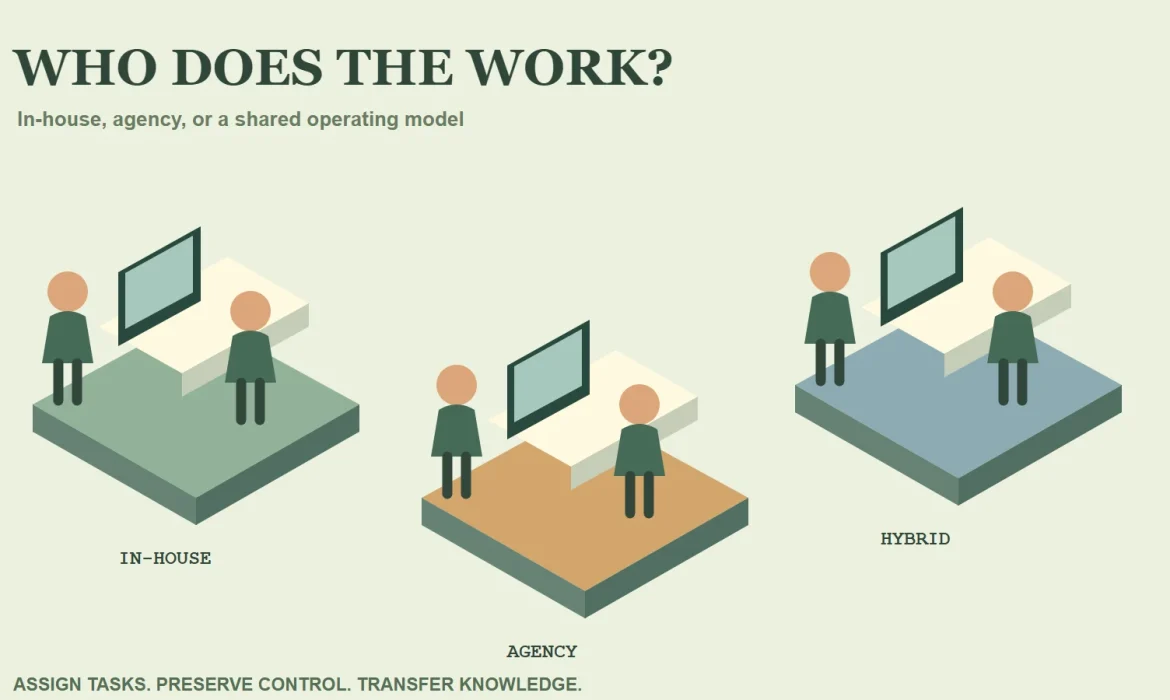
In-house vs outsourced overseas advertising management is a decision about who can reliably do the work. Compare the tasks, available skills, time, total cost, account control, and route for sales feedback. A hybrid model can be useful when execution capacity and internal knowledge need to grow together. Start with responsibilities, then choose the staffing arrangement that can meet them.
The operating-model decision
- The decision is about operating design, not a moral preference
- In-house vs outsourced overseas advertising management starts with task ownership
- Calculate the real cost of an internal team
- Compare agency costs on the same scope
- Separate the price of media from the cost of the operating model
- Identify the capability gap before buying help
- Choose in-house when the work is core and continuous
- Choose an agency when expertise or execution capacity is scarce
- Use a hybrid model to build capability without a risky handoff
- Protect account control and institutional knowledge
- A decision matrix for leadership
- Make the cost comparison using equivalent work
- A transition plan when the team changes models
- How to decide between in-house and outsourced overseas advertising
- Match the operating model to the company’s growth stage
- Questions for leadership before changing models
- Choose a model that leaves the business more capable
The decision is about operating design, not a moral preference
Some companies treat in-house marketing as inherently more trustworthy; others assume agencies are always more efficient. Neither belief is a useful staffing rule. An internal employee can lack the time or support to run a campaign well, while an agency can have a strong process and still be poorly matched to the company’s product or sales cycle. The question is which operating model lets the business make sound decisions, keep control of its assets, and consistently connect advertising with customer and sales feedback.
Overseas campaigns increase the number of responsibilities. A team may have to research a market, choose a language, create local creative, manage an account, maintain conversion tracking, coordinate a website, monitor policy changes, and route inquiries across time zones. Some tasks are strategic; others are recurring operations. A business that asks one “marketing person” to do all of them may be under-resourced even if it calls the model in-house.
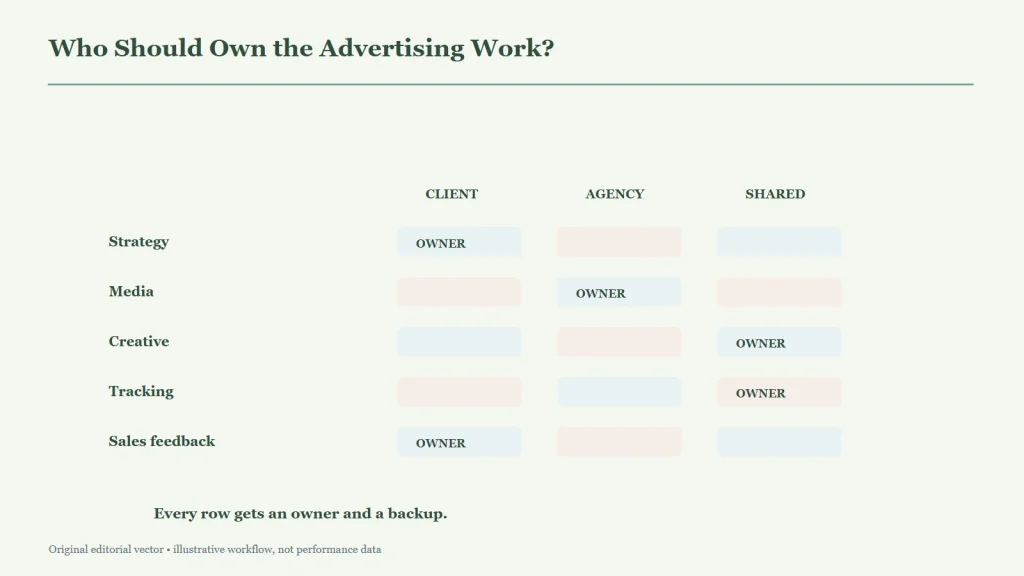
Begin with an inventory of work rather than a job title. List what must happen weekly, monthly, quarterly, and at launch. For each task, identify the decision owner, operator, reviewer, and backup. This reveals whether the gap is expertise, capacity, technology, language, or authority. Training can address a skills gap; an agency can address execution capacity; hiring can establish long-term ownership; a hybrid arrangement can distribute the work. The choice should match the actual gap.
In-house vs outsourced overseas advertising management starts with task ownership
The company should retain ownership of business goals, market priorities, product claims, pricing, sales definitions, and customer treatment. These decisions depend on knowledge the organization must protect and apply across channels. A provider can advise on them, but the company remains responsible for what it sells, which markets it serves, and what it promises. If those choices are delegated without a clear internal owner, advertising can drift away from inventory, margin, and sales capacity.
Execution can be divided in many ways. An internal team may control budget and approvals while an agency builds campaigns and provides reporting. An agency may manage day-to-day operations while a client analyst owns tracking and CRM. A coach may review the account with an in-house employee who performs changes. The labels “outsourced” and “internal” do not specify who does which task. A responsibility matrix makes the boundaries visible and prevents two teams from assuming the other owns a conversion problem.
Think of account access separately from account operation. A company can retain administrator ownership while an agency receives the permissions required for work. A business can also keep the Google, Meta, analytics, and CRM assets under its own control while buying specialist help. Confirm the current platform permission model and company security rules. Do not equate “we run it internally” with “we understand it,” or “the agency operates it” with “the client has lost control.” Governance determines the practical reality.
| Model | Strategic owner | Daily operator | Most useful when… |
|---|---|---|---|
| Fully in-house | Company | Company | Stable workload and skilled staff exist |
| Agency-led | Company for business goals | Agency | Execution capacity or specialist knowledge is missing |
| Coaching | Company | Company with external review | An operator exists and wants to build judgment |
| Hybrid | Shared by explicit role | Split by task | The team is transitioning or needs specialist components |
Calculate the real cost of an internal team
An internal employee’s cost includes more than salary. The business may pay payroll taxes, benefits, recruiting, onboarding, management time, analytics or creative tools, training, and the opportunity cost of work the employee cannot do while managing campaigns. If more than one person contributes—designer, web developer, analyst, sales operations—include the share of their time. The goal is not to make internal work look expensive. It is to compare the full resource requirement with an external proposal on equivalent scope.
Internal staffing also carries continuity risk. If one employee owns all campaign knowledge, a resignation or extended absence can interrupt the account. Documentation, cross-training, access controls, and a backup plan reduce this risk. A company should ask whether the role has enough volume to stay practiced. If campaigns run only occasionally, maintaining specialist proficiency may be difficult. Conversely, if the business runs paid media continuously across important markets, internal ownership may justify the investment in tools and training.
Model costs over a realistic period. A monthly view can obscure hiring and setup expenses, while an annual view may make variable agency work look fixed. Use a period that matches the business cycle and include both routine work and market launches. Track costs in the same currency and separate one-time build from recurring operations. If the team handles product content, CRM, and landing pages, decide whether those functions are part of the comparison or exist regardless of the advertising model.
Compare agency costs on the same scope
An agency fee can be fixed, tied to spend, project-based, or blended. The client should identify media spend, management, setup, creative, localization, web work, analytics, software, taxes, and minimum terms. A low retainer may exclude tasks the internal team must absorb. A larger proposal may include work the company does not currently need. Compare the cost of the responsibilities being transferred, not the agency’s package name.
Ask how scope changes as the business adds countries, languages, products, or platforms. Does a new market require research, translation, a local landing page, and sales coordination, or does the fee only cover account build? Who is accountable for technical fixes? How many meetings and creative iterations are included? Does the agency work with the CRM or only read platform reports? These questions reveal whether the quote addresses international operations or just media settings.
The external model also has coordination cost. Employees must prepare briefs, approve content, provide product information, check leads, and attend reviews. If those hours are substantial, include them in the comparison. The agency may still be worthwhile because it supplies expertise or execution speed, but the complete cost should be visible. A business should not compare an agency invoice with one employee’s base salary while ignoring the agency-management work that remains inside the company.
Separate the price of media from the cost of the operating model
Leadership sometimes attributes every rising marketing expense to the team structure. The auction can move even when the staffing model does not. In its full-year 2024 financial results, released January 29, 2025, Meta reported an 11% year-over-year increase in ad impressions and a 10% increase in average price per ad across its Family of Apps. Those global aggregates do not establish your account’s CPM or an agency’s value. They illustrate why media-price movement belongs in a different line of the comparison from labor and service fees.
Build the operating comparison using equivalent work. If an internal specialist spends six hours preparing creative briefs and an agency quote excludes that work, the two totals are not comparable until the missing hours are assigned. Apply the same logic to translation, analytics repair, sales-feedback meetings, leave coverage, and management time. Use your actual compensation and quotes rather than importing a generic salary benchmark.
The decision record should show which costs vary with spending, which recur regardless of spending, and which are one-time transition costs. A hybrid arrangement may cost more during transfer because two people are learning the same process; that overlap should have a purpose and an end condition.
Choose the model that supplies the required work at an acceptable total cost while preserving the company’s decision-making ability. That is a more durable test than comparing a retainer with one employee’s base salary.
Identify the capability gap before buying help
A team may need market research, campaign setup, daily operation, creative strategy, analytics, conversion development, landing-page design, localization, or CRM reporting. These capabilities do not have to come from the same source. The company might manage media internally but hire a specialist to audit tracking, produce video, or review a new market. It might outsource campaign operations while keeping strategy and sales data in-house. A task map allows the business to procure the missing capability without transferring unrelated decisions.
Assess whether the internal operator can explain the account. Can the person describe the primary conversion, the meaning of a qualified lead, the reason a country is targeted, the search-term process, and the next budget decision? Can they identify when a number is unverified? If the answer is no, the team may need coaching or supervision even if it has enough hands to make changes. Tool access alone does not create operating judgment.
Assess capacity separately. A skilled person may have no time for regular review, creative iteration, and sales feedback. A recurring agency engagement can provide that capacity, while a new hire can make sense if the workload is steady and strategically important. For occasional launches or a temporary diagnostic, a project may be more appropriate. The company should avoid hiring a generalist because it has named a broad need without estimating the task volume.
Choose in-house when the work is core and continuous
Internal management can make sense when advertising is a continuous business capability, the company has a stable portfolio of campaigns, and the necessary skills and support exist. An internal operator can hear product updates quickly, join sales reviews, and connect media decisions to inventory, pricing, or customer service. The knowledge remains close to the business and can inform other teams. That advantage is strongest when the organization has a process for documenting decisions and collaborating across functions.
In-house management also gives the company more direct control over pace and prioritization. A marketer can respond to a new product launch or sales insight without waiting for a vendor queue, provided the employee has authority and platform skills. The company can decide which information is shared externally and maintain its own reporting. This control is useful when campaigns touch sensitive markets, complex technical products, or a rapidly changing offer.
However, direct control has a price. Internal teams must keep skills current, cover absences, QA changes, coordinate creative, and ensure account security. One employee should not be expected to be strategist, media buyer, analyst, designer, developer, translator, and sales operations lead without support. A realistic internal model includes time for peer review and training. If work becomes a recurring late-night task for a founder, the business may technically own it but lack a sustainable operating system.
Choose an agency when expertise or execution capacity is scarce
An agency can help a company launch faster when it lacks specialized platform experience, needs a repeatable operating cadence, or is entering markets where it has limited media history. A provider may bring process, benchmarks from its own work, and the ability to coordinate campaign builds. Those benefits should be verified through references and a clear scope. No agency can transfer a result from one client to another without accounting for product, market, creative, budget, and sales differences.
External support can also reduce the training burden for a small team. A founder may not want to spend each week in an advertising interface when core work is product and sales. The agency can handle operations while the company remains involved in goals, approvals, and lead feedback. To keep the relationship useful, the client should appoint an internal owner who can answer questions and challenge recommendations. Outsourcing execution does not eliminate the need for business context.
Risks include dependence, weak account transparency, generic work, and misaligned incentives. An agency may optimize for platform events when the client needs accepted leads, or may report activity without explaining what changed. Contract terms can limit flexibility if accounts, assets, and data are not documented. These risks are manageable when the client retains ownership, reviews reports, sets clear definitions, and obtains a current handoff record. The business should evaluate the provider continuously rather than assuming a signed agreement guarantees quality.
Use a hybrid model to build capability without a risky handoff
Hybrid models are not a compromise for companies that cannot decide. They can be a deliberate design. The business may retain market strategy, budget, CRM, and final approvals while an agency manages campaign operations. An internal employee can implement changes after a coaching period. A specialist can handle a one-time tracking repair while the in-house marketer owns day-to-day performance. The division should reflect the company’s goals and the provider’s competence.
Specify one accountable owner for each activity. For instance, the agency may recommend budget changes, the client may approve them, and the finance lead may confirm the spending limit. Sales may define qualification while marketing tracks the result. Web development may implement a landing page, while the media team tests it. If multiple parties can edit the same account, use a change log and approval process so changes do not conflict or obscure their causes.
Hybrid work requires information to move. Share approved product facts, sales rejection reasons, market feedback, and creative learnings with the people who need them. Agree what data may be used, where it is stored, and who can access it. If privacy or legal issues apply, consult qualified reviewers. Keep the partner informed without sharing more personal or commercially sensitive data than necessary. A good hybrid arrangement turns external help into organizational learning rather than a parallel system.
Protect account control and institutional knowledge
Whether work is internal or external, the company should maintain an asset register. Include ad accounts, business managers, analytics properties, tags, domains, pixels or equivalent tools, CRM integrations, creative libraries, and billing. Record owner, administrator, users, access purpose, recovery method, and review date. This register is a lightweight governance tool. It helps the organization respond when a team member leaves, an agency changes, or an account needs to be audited.
Document the logic that matters. Preserve campaign naming rules, conversion definitions, audience and keyword exclusions, reporting formulas, test histories, creative permissions, and market-specific decisions. The point is not to record every click. It is to explain why the system is configured the way it is and what the next operator should verify. A monthly change log and a concise operating guide are often enough to reduce dependency.
Set an access review cadence. Remove users who no longer need access, confirm that billing contacts are current, and validate backups for critical roles. When a contract ends, revoke permissions in a planned sequence, export agreed data, and transfer assets. Do not wait until a dispute to discover that a key tag or report lives in an employee’s personal workspace. Ownership and knowledge transfer are part of the operating model, not housekeeping left for the end.
A decision matrix for leadership
Use the matrix below in a planning meeting. Rate the current state, then identify the gap. A “high” rating for business context with “low” time capacity may support an agency or contractor for execution. “High” strategic importance and “high” continuity needs may support an internal role, even if an outside specialist is needed during setup. The matrix should start a conversation; it does not calculate a universal answer.
| Business condition | In-house signal | Agency signal | Hybrid signal |
|---|---|---|---|
| Campaign workload | Regular and continuous | Variable or launch-heavy | Stable core plus specialist bursts |
| Internal skill | Experienced operator and backup | Major specialist gap | Operator exists but needs coaching |
| Time capacity | Protected weekly time | Internal schedule is full | Split operation and review |
| Market complexity | Deep internal market knowledge | Need external execution experience | Internal strategy, external media support |
| Knowledge priority | Build a long-term core skill | Need temporary speed | Transfer capability over time |
| Account governance | Strong internal control | Clear contract and permissions | Client owns assets, provider operates defined tasks |
Discuss the consequence of each choice. If the company hires, who supervises the role and where does creative or analytics support come from? If it outsources, who evaluates quality and provides sales feedback? If it chooses hybrid, which single person resolves disagreements and approves changes? The answers may reveal that the business needs to strengthen its governance before increasing spend.
Make the cost comparison using equivalent work
Build one spreadsheet with internal and external columns. For each task, include hours or fee, tools, production cost, review responsibility, and risk. Internal costs may include loaded compensation, training, recruiting, and backfill. External costs may include retainer, setup, media, creative, software, and internal coordination. Record one-time and recurring amounts separately. Use ranges when costs are not known rather than inventing a precise estimate.
Add quality and continuity factors. A purely financial comparison can miss the value of company knowledge, continuity, speed, or external specialist access. Describe these benefits in plain terms and decide how leadership will weigh them. For example, a company may accept a higher first-year cost to build internal capability, or pay an agency for a rapid launch while recruiting a permanent operator. The decision can change as the business grows.
Do not confuse platform budget with the cost of managing the platform. The media budget is spent through the advertising system; the operating model determines who plans, creates, measures, and learns. If the company changes its staffing but keeps the same media budget, that does not mean the total acquisition cost is unchanged. Finance should see all cost categories, while marketing and sales should see the quality and outcomes they need to improve.
A transition plan when the team changes models
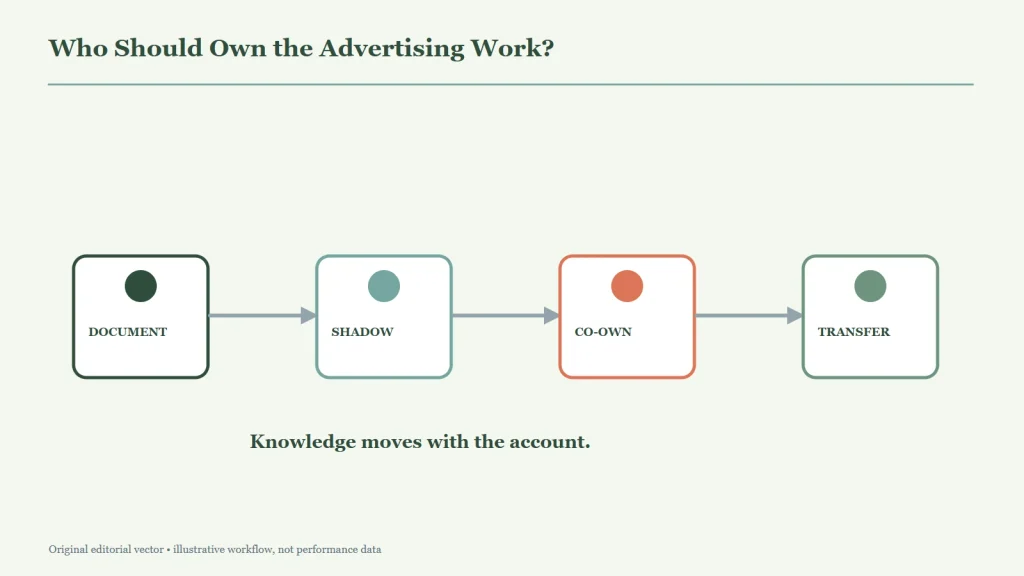
If the company moves from an agency to in-house management, do not simply turn off the contract and expect an employee to inherit an undocumented account. Request an asset inventory, conversion map, naming guide, current experiments, open issues, report history, and access transfer. Schedule working sessions for the incoming operator to understand why decisions were made. Run a short overlap if feasible, with one party as the final account editor to avoid conflicting changes.
If moving from internal management to an agency, prepare the business brief, account history, sales definitions, product facts, market constraints, page list, tracking documentation, and known data issues. Clarify which assets belong to the company and what permissions the agency needs. Maintain a client-side owner who can approve claims and explain outcomes. The agency should not have to guess about the product, but it should also demonstrate that it understands the context before scaling activity.
If building a hybrid model, define a learning milestone. For example, the provider might document launch settings and train an internal employee to complete a weekly review. Another milestone may be the employee independently producing the monthly reconciliation. The timeline should reflect the person’s starting skill and available time. A coaching arrangement is useful only if the company protects time for implementation and feedback.
How to decide between in-house and outsourced overseas advertising
Work inventory
- List every recurring and launch-related advertising task.
- Assign current and backup owners, required skills, and time estimates.
- Identify whether the gap is expertise, capacity, technology, or authority.
Cost and control
- Calculate internal and external total costs for equivalent work.
- Decide which strategy, data, assets, and approvals must stay with the company.
- Select in-house, agency, coaching, or hybrid ownership by task.
Transition decision
- Document permissions, reporting, decision rights, and exit or transfer steps.
- Review the model after a defined period using cost, quality, speed, and learning.
Match the operating model to the company’s growth stage
An early-stage company often needs help turning a founder’s market knowledge into an account structure, a landing page, and a trackable inquiry process. It may not yet have enough recurring work for a full-time specialist. A project or coaching arrangement can help establish the foundation while the founder retains decisions. As the company enters more markets, the recurring workload may justify a dedicated employee or a broader agency scope.
A mature company may already have a paid media team but need outside expertise for a new platform, a technical audit, or a temporary product launch. In that case, the agency can be a specialist resource rather than the permanent operating center. An internal owner can coordinate the help and ensure that methods and learning move back into the company. The business should review the arrangement when the project ends instead of automatically renewing a support model built for a different stage.
Growth stage is only one factor. A small manufacturer with one mission-critical market may need stronger governance than a larger company with a broad but low-risk test portfolio. A company with strict internal approval requirements may prefer in-house operation even when it costs more. Another may value rapid market coverage and accept external execution as long as account access and reporting remain transparent. The right model reflects the organization’s risk tolerance and strategic priorities, not only headcount.
Questions for leadership before changing models
Is in-house advertising cheaper than hiring an agency?
Not automatically. Compare loaded employee costs, tools, training, creative, analytics, coordination, and management time with the agency’s complete scope and internal client workload. Use the same tasks and time period for both models.
Will an agency own my advertising account?
The company should understand and document ownership of its core accounts and data. An agency may operate with granted permissions. Verify current platform controls and include access and handoff rules in the contract.
When should a small business hire an in-house media buyer?
Consider hiring when the work is continuous, strategically important, and large enough to support a dedicated role, with access to creative, web, analytics, and sales collaboration. Estimate workload and supervision before recruiting.
Is coaching a substitute for a full-service agency?
Coaching can help an internal operator build judgment and workflows, but it does not automatically provide daily execution capacity. Choose based on whether the main gap is skill or time.
Can I outsource only campaign execution?
Yes. A company can retain strategy, account ownership, approvals, and CRM while a provider handles defined execution tasks. Put each responsibility and reporting expectation in writing.
How do I prevent agency dependence?
Keep account ownership, require documentation and change logs, review reports, and schedule knowledge transfer. Ask for exportable data and a current asset inventory throughout the relationship.
How often should I reconsider the operating model?
Revisit it when markets, budget, platform count, sales complexity, or internal staffing changes. A quarterly or semiannual review can help, but the cadence should match the business’s pace.
Choose a model that leaves the business more capable
In-house, agency, coaching, and hybrid arrangements can all work when the responsibilities are explicit. The strongest model gives the company clear ownership of business decisions and assets while matching execution to available skill and time. Map the work, compare total cost, and decide what knowledge should remain in the organization. Revisit the arrangement as the business changes instead of treating the first staffing choice as permanent.
If your company needs external execution across markets, review Marketboo’s global paid media services. If you want an internal team to retain account ownership and improve its operating skills, explore hands-on advertising coaching.