Quick answer
Quick answer: Choose an overseas advertising agency by checking the work it will perform, who controls the accounts and data, how it defines a usable lead, and how results reach sales. Compare proposals on the same brief, separate media spend from service fees, inspect a sample report, speak with relevant references, and write down the exit process. A pilot can test the working relationship, but it should have a defined scope, owner, review date, and evidence standard. The right provider is the one whose process fits your markets, sales capacity, and internal gaps.
The question of how to choose an overseas advertising agency for a B2B exporter sounds like it belongs in a price comparison. It often starts somewhere less glamorous: who controls the account, what happens to the leads, and can the company take the work with it if the relationship ends? A tidy proposal will not answer those questions on its own. Read the scope, reporting, lead process, and exit terms before weighing the retainer.
The procurement file
- Quick answer
- How to choose an overseas advertising agency for a B2B exporter: set the brief
- Dossier one: prove that the relationship is portable
- Dossier two: turn service labels into work products
- Dossier three: test one lead definition with sales
- Dossier four: examine what the reporting system can prove
- Score the evidence, then apply the nonnegotiables
- Using a case study as a procurement test
- Ask the proposed delivery team, not only the salesperson
- Read the sample report as evidence of daily work
- The finance interview: ask about an ordinary budget rule
- Call references about the decisions that went wrong
- Pilot terms that make the shortlist testable
- Keep the vendor review alive after selection
- The approval record the owner should sign
- How to Evaluate an Overseas Advertising Agency
- Frequently asked questions
How to choose an overseas advertising agency for a B2B exporter: set the brief
Put a simple sentence at the top of the evaluation file: “We are buying a repeatable way to reach and qualify buyers in named markets.” That keeps the decision anchored to the business. A company exporting custom components has different needs from a consumer brand selling stocked products. The former may need product terminology, engineering pages, distributor exclusions, and a long sales record. The latter may need a larger creative pipeline and order-level economics. A logo slide does little to resolve either need.
Appoint three reviewers before the pitches begin. Sales evaluates whether the inquiry definition is usable. Finance evaluates fees, cash exposure, and billing controls. The person who administers the website and accounts evaluates access, tracking, and handoff. One person can hold more than one role in a small company, but each question still needs an owner. The marketing manager should not have to certify a CRM integration or a cancellation clause alone. Bring in the technical owner and whoever reviews the commercial terms.
Give every candidate the same product and market brief. Then request a written response rather than allowing each firm to define its own comparison. The packet need not be long: a scope table, access inventory, example reporting page, and pilot proposal can reveal more than a polished sixty-slide presentation. The point is comparability. If one candidate assumes the client supplies videos while another includes production, record the difference before looking at the final price.
This evaluation is a procurement decision, not a contest to find the most confident forecast. A provider may reasonably say that country-level demand or tracking quality needs investigation. That answer becomes useful when it includes a method, a cost, and a stopping point. Uncertainty that has an owner can be managed; uncertainty hidden inside a revenue promise cannot.
Dossier one: prove that the relationship is portable
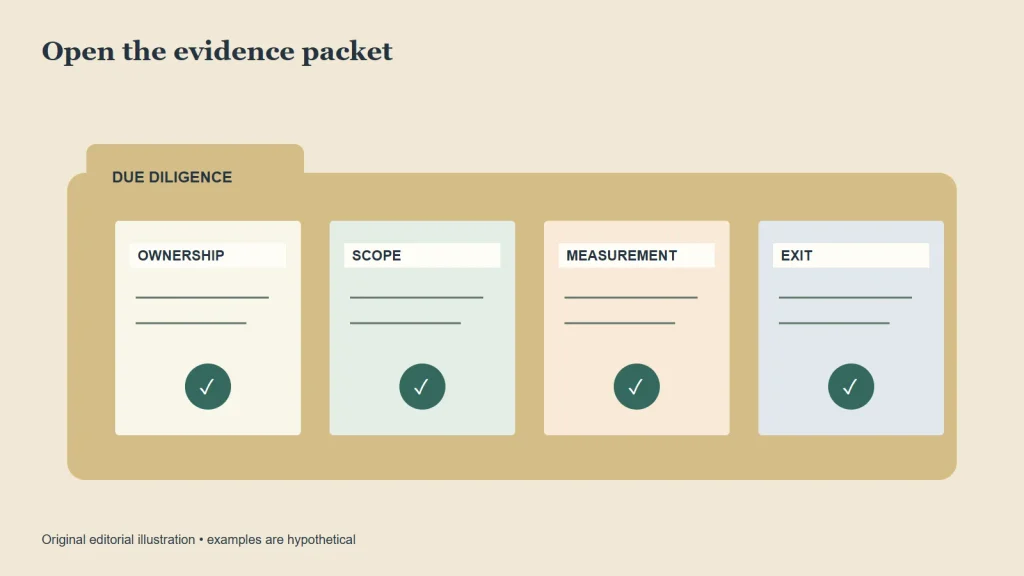
Ask the candidate to draw the intended ownership structure on a single page. List the advertising accounts, analytics property, tag container, domain, CRM, product catalog, and source creative. Beside each, identify the owning organization, current administrator, proposed agency permission, and export method. An agency dashboard can be helpful, but it should not become the only place where the client can see its own operating history.
Use an exit rehearsal to make this concrete. Suppose the company gives notice after a pilot. Which files arrive? Who removes the agency’s access? Can the next operator see the conversion definitions and campaign changes? What remains dependent on a paid third-party tool? A clear explanation reduces switching risk and often reveals implementation gaps before onboarding. It also protects the agency from being blamed for assets the client never commissioned.
Treat creative portability separately from data portability. A contract may permit running a video without transferring the editable project file. A creator agreement may limit territory, duration, or paid reuse. Record those limits at the asset level. “The creative is included” is too broad to settle usage rights, revisions, source files, and permissions after the engagement ends.
Dossier two: turn service labels into work products
Agency proposals often use similar labels for different amounts of work. “Campaign management” may include research, build, daily checks, search-term review, creative testing, landing-page recommendations, conversion setup, and a monthly meeting—or it may include only a subset. Ask for a deliverable map that names each activity, its frequency, the responsible person, and the artifact the client receives. The goal is not to prescribe a particular agency workflow. It is to make omissions visible before they become change orders.
Separate work that is usually bundled from work that requires another specialist. Advertising operations may be included while video production, translation, product photography, web development, CRM configuration, analytics implementation, and legal review are not. If the agency identifies a dependency outside its scope, ask who will own it and how the handoff is documented. “We can help with that” is not enough to price or schedule the work. A written boundary protects both sides from assumptions about unlimited revisions or emergency support.
The scope should also say how the agency will respond when the account has a problem. Who investigates a conversion drop, a disapproved ad, a broken form, a tracking outage, or a sudden change in lead quality? What is the expected acknowledgement time, and which issues require client approval before changes are made? These questions matter more when a business sells internationally because working hours and escalation routes can cross time zones. A modest, clear support model is more useful than a broad promise of constant optimization.
| Scope area | Ask the agency to specify | Evidence to request |
|---|---|---|
| Research | Markets, audiences, intent, and exclusions covered | Brief, query map, assumptions |
| Media operations | Build, monitoring, testing, and review cadence | Sample change log |
| Creative | Formats, concepts, production, revisions, rights | Asset list and usage terms |
| Website and tracking | What is implemented versus recommended | Event map and QA record |
| Lead management | CRM fields, routing, and feedback responsibilities | Lead-stage definitions |
| Reporting | Metrics, periods, owners, and meeting cadence | Redacted report sample |
Dossier three: test one lead definition with sales
Bring six anonymized examples to the interview: a relevant RFQ, a distributor inquiry, a consumer request, an unsupported country, a duplicate, and a contact whose project is unclear. Ask the candidate to classify them under the proposed reporting rules. Then ask sales to do the same. The disagreement is useful. It exposes where “qualified” is shorthand for different expectations.
Keep a pending category. An inquiry that has not been reviewed should not count as a rejected lead, and an unanswered message should not automatically count as invalid. Record the date a classification can change. This matters in export sales, where technical review and time zones can delay acceptance. A provider should be judged on what it controls while still making downstream gaps visible.
Define the unit of evaluation, too. Two contacts from the same buying organization might be duplicate records for one project or distinct opportunities for different facilities. Sales should decide the rule and maintain the project identifier. Otherwise an agency can appear to produce more opportunities simply because a CRM stores more people.
An example calculation clarifies the incentive. With $6,000 of media and 80 unique inquiries, inquiry CPL is $75. If 20 become sales-accepted projects, accepted-lead cost is $300. These are hypothetical figures. The scorecard should ask whether the agency can report both measures and preserve the definitions, rather than treating the smaller number as the entire result.
Dossier four: examine what the reporting system can prove
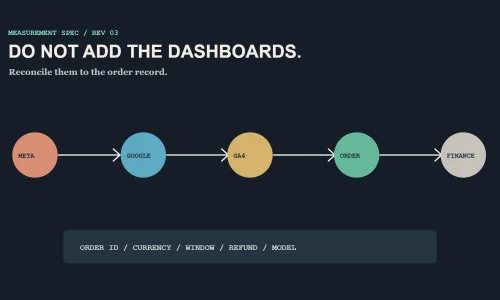
International B2B buying journeys can include search, trade events, referrals, social content, email, direct visits, and multiple people within one buying organization. A single last-click field cannot explain every influence. At the same time, an attribution report should not be so complicated that no one can tell what was measured. Ask the agency to distinguish platform reporting, analytics reporting, CRM source data, and any modeled or imported conversion information. Each system has a different purpose and may use a different lookback window or deduplication rule.
Use a consistent campaign naming convention and a written UTM standard for destinations where applicable. The agency should explain how it will handle redirects, language paths, consent choices, cross-domain journeys, and form submissions. Then have someone outside the agency test a sample journey and compare the records that appear in the analytics property and CRM. A test does not prove that every future visit will be attributed perfectly. It does confirm that the basic plumbing works and that the team understands how to investigate discrepancies.
Agree on how the report will speak about uncertainty. If a platform claims more conversions than the CRM contains, the report should show the difference and explain possible causes without inventing a reconciliation. If a lead returns later through a different channel, note the rule used to assign source credit. An agency that says “our dashboard is the source of truth” without explaining definitions is asking the client to outsource judgment as well as execution. A sound partner makes the data easier to inspect and helps the business decide which measure is appropriate for each decision.
Score the evidence, then apply the nonnegotiables
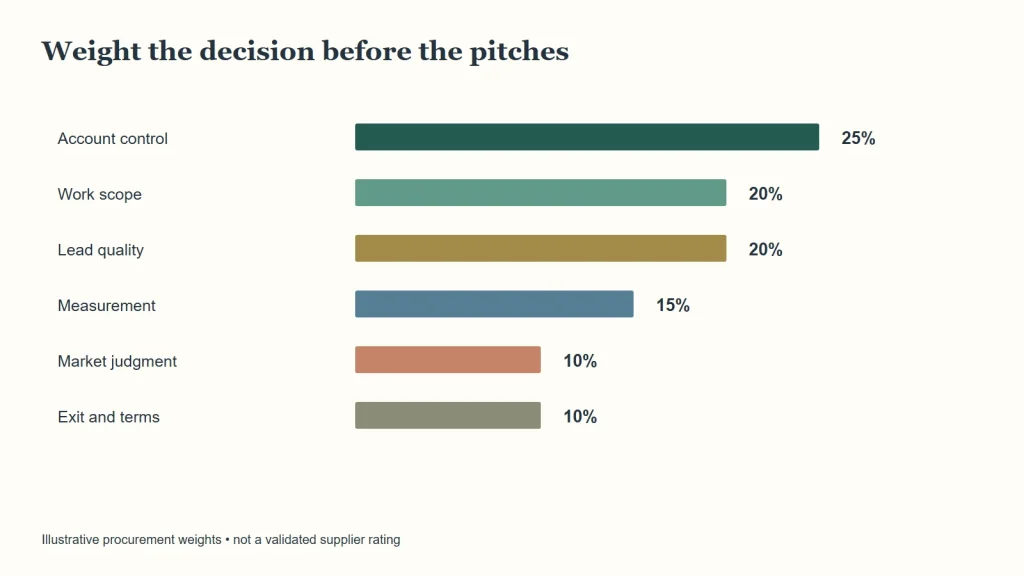
A weighted score is a decision aid, not a scientific measure of supplier quality. Set weights before reading the proposals. In the illustrative model below, a candidate earns zero for an unanswered item, one for an unsupported assertion, three for a usable document, and five for a relevant demonstration. Reviewers may use intermediate scores, but they should attach a reason and evidence link.
| Criterion | Illustrative weight | Proof that supports a high score |
|---|---|---|
| Account and asset control | 25% | Ownership map and permission walkthrough |
| Work scope and staffing | 20% | Named owners, cadence, and deliverable examples |
| Lead-quality process | 20% | Acceptance rules and a sample disposition record |
| Measurement and reporting | 15% | Traced event, stated limitations, change history |
| Market and product judgment | 10% | Relevant query or audience rationale |
| Commercial terms and exit | 10% | Comparable cost sheet and handoff schedule |
Calculate each weighted contribution as weight multiplied by score divided by five. A score of four on the 25% control item contributes twenty points. Have reviewers score independently before the group discussion; otherwise the strongest presenter can quietly set everyone’s view. Preserve the original scores and the reasons for any final change.
Now apply the nonnegotiables. A high total should not compensate for an ownership arrangement your company cannot accept, missing permission to use creative, or an unexplained billing dependency. Mark each mandatory condition as satisfied, unresolved with a deadline, or unacceptable. Some issues may be resolved during diligence. Others make the proposal unsuitable regardless of its total.
Avoid false precision. If two firms finish at 81 and 83 under your own subjective model, that gap is not proof that one is superior. Compare the underlying evidence, ask what remains uncertain, and decide whether a bounded pilot can settle the difference. A scorecard succeeds when it improves the conversation and preserves the reasoning.
Using a case study as a procurement test
An agency case study should survive a short reconciliation interview. Marketboo’s supplied case material includes a North American automotive-parts campaign with approximately $160,000 in Google Ads spend, 3,683 recorded conversions, $519,000 in conversion value, and a reported 3.24 ROAS from July 1 through September 28, 2026. The arithmetic is consistent: $519,000 divided by $160,000 is about 3.24. That establishes what the case slide reports; it does not establish gross margin, refunds, incremental sales, or profit.
The same case file reports a large- industrial-equipment campaign with about RMB 54,900 in spend, 33,900 clicks, 62.96 Ads conversions, and roughly RMB 872 per conversion in the same dashboard period. It separately says that, after roughly six months of operation, the project averaged 30+ effective inquiries a month and had sold three machines for more than RMB 2 million. The presentation does not join those six-month sales to the three-month Ads snapshot. A careful agency should point that out before a buyer asks.
Use these examples to test a vendor’s reporting habits, not to set your own target. Ask which account and market the figures cover, what a conversion meant, which dates apply to each line, what was included in conversion value, and how leads were checked. Ask for the record that connects a campaign event to a sales-accepted inquiry. If confidentiality prevents a screenshot, request a redacted data dictionary and a client reference with permission.
Then ask what the case cannot prove. The automotive result is ecommerce and Google Ads; it is not a benchmark for a B2B exporter or a Facebook campaign. The equipment result has a mismatch between reporting periods and later business outcomes. A trustworthy answer keeps those limitations visible and explains what additional record would resolve them. A provider who turns either figure into a guaranteed forecast is overselling the evidence.
For this shortlist, score the agency on whether it can distinguish platform metrics, CRM outcomes, and finance results. A compelling case is one another operator can inspect and reproduce—not simply one with the largest percentage on its cover.
Ask the proposed delivery team, not only the salesperson
Meet the person who will manage the account and the person responsible for measurement. Ask each to explain the first two weeks in their own words. The answers should connect: the campaign lead should know which page and event dependencies exist, and the measurement lead should know what the business considers an accepted inquiry. Perfectly matching language is unnecessary; shared understanding is the goal.
Check capacity without demanding private staffing data. Who covers holidays, who reviews a significant change, and what happens if the named operator leaves? Ask whether work is subcontracted and which responsibilities the contracting agency retains. A small specialist team can be excellent, but the client should understand the continuity plan it is purchasing.
Review the approval burden on your own company. If every ad requires three internal signatures and product information takes two weeks to obtain, the agency’s production schedule must account for that. Set a realistic review service level and nominate a backup approver. Supplier performance becomes difficult to evaluate when client delays are invisible in the work record.
The agreement should distinguish urgent corrective action from discretionary changes. An operator may need authority to pause an obviously broken destination, while expansion into a new market may require approval. Document the boundary and escalation contacts. This is more practical than requiring either unrestricted freedom or written permission for every routine action.
Read the sample report as evidence of daily work
Request a redacted example of the actual report the team uses, not a presentation deck designed only for a sales meeting. Check whether it shows spend, market, objective, conversion definition, lead quality, changes made, and decisions needed from the client. A useful report lets a sales or finance reader understand what happened without having to decode platform terminology. It should also make missing information visible. A report that contains many charts but no interpretation can still leave the client unable to decide what to do next.
Look for a change log. Each material optimization should include what changed, the reason, the date, and what signal will be reviewed afterward. This creates a basic audit trail and makes it possible to distinguish deliberate tests from random account edits. Ask whether the agency keeps a hypothesis register or test record, especially when multiple markets or products run at once. The format can be a spreadsheet or a platform log; the quality is in whether someone else can follow the sequence and the conclusion.
Finally, check that the report supports a conversation rather than hiding behind a score. The agency should be prepared to explain why it recommends increasing, holding, or reducing spend; which assumptions remain unresolved; and what the client must do. If a recommendation depends on new creative, a faster sales response, or a page change, the report should name the owner and date. Shared accountability is easier to manage when it is written down instead of buried in a monthly call.
The finance interview: ask about an ordinary budget rule
Use a question that can be checked against primary documentation: “With an unchanged $100 average daily budget, what exposure should finance understand?” Google’s standard guidance permits spending up to twice the average daily budget on a given day and describes the standard monthly spending limit as 30.4 times that budget. The corresponding figures are $200 and $3,040. These are spending-rule illustrations, not lead or revenue forecasts; campaign-specific rules and budget changes need separate review. Google’s overdelivery documentation supplies the reference.
The candidate’s next questions matter more than memorizing the multipliers. Who can change the setting? What approval is required? Does the report distinguish platform charges from agency fees? How are currency, credits, and taxes handled? Finance should be able to reconcile the payment record without relying on a screenshot chosen by the salesperson.
Request a three-column cost sheet: committed service fees, variable third-party costs, and client labor or prerequisites. Translate one-time setup into the chosen comparison period without pretending it repeats forever. If an agency offers performance pricing, define the credited outcome, refund treatment, attribution rule, and disputes process. An incentive is only aligned when both parties can calculate it from the same record.
Call references about the decisions that went wrong
Ask for references from businesses with a similar sales motion, product complexity, and international footprint. A company that sells low-priced consumer products may have little in common with a manufacturer that needs engineering review before a quote. Similarity is more useful than a famous logo. Where client confidentiality prevents a direct reference, ask for an anonymized case that still describes the market, period, budget range, conversion definition, lead-quality process, and the agency’s exact role.
A case study’s headline number makes a good first question, but it cannot forecast a different account. Ask what changed during the period, whether the client changed pricing or inventory, how long the campaign had been active, and whether the result includes media spend only or also service costs. A cost-per-lead improvement is meaningful only when the lead definition and comparison periods match. If the source material lacks those details, the agency should say so. A cautious, auditable case is more useful than a dramatic figure with no denominator.
References should also help you evaluate the working relationship. Ask how the agency handled a tracking issue, a disagreement about lead quality, a missed approval, or a market that did not perform as expected. The goal is to learn whether the team communicates clearly when results are mixed. Strong partners can describe a decision that did not work and what they changed afterward. A provider that offers only flawless stories may be presenting a sales narrative rather than a complete picture of its operating discipline.
Pilot terms that make the shortlist testable
Write the pilot around the largest uncertainty. If the company has never advertised the product in the proposed country, the test might assess relevant search demand and inquiry quality. If an account already has traffic but poor sales records, the initial deliverable may be a repaired event map and lead feedback process. A pilot should not promise to resolve every market, creative, and measurement question at once.
Give it a commercial boundary: named product family, countries, channels, service work, media authorization, and maximum additional charges without approval. Separately state the evidence required to continue. That could include a functioning inquiry path, a defensible search-term review, timely reporting, and a usable sample of sales-classified inquiries. Choose the review window based on actual demand and sales timing rather than a universal number of days.
Agree on the response to mixed evidence. Low inquiry volume with strong relevance is different from many irrelevant forms. A tracking outage makes some comparisons unusable. Delayed sales classification may require an operational fix before a media decision. The pilot report should identify these conditions explicitly and recommend extend, narrow, repair, pause, or continue, with a reason.
Do not turn a pilot into free consulting by requesting a complete production-ready strategy from every shortlisted firm. Ask for enough detail to evaluate judgment, and pay for a defined diagnostic when substantial account work is required. Procurement should be fair to suppliers as well as protective of the advertiser.
Keep the vendor review alive after selection
At the agreed review point, reopen the original evidence packet. Which promised artifacts arrived? Which assumptions changed? Did the business supply its pages, approvals, and sales classifications on time? Evaluate the working system against both parties’ commitments. A review that ignores client dependencies can blame the supplier for a problem the contract assigned elsewhere.
Update the risk register rather than starting a new scorecard from memory. Close resolved access and tracking items, preserve the evidence, and assign dates to remaining work. If the provider recommends a scope change, compare the new cost with the original decision question. Expansion should solve a documented need rather than quietly convert a bounded pilot into an indefinite program.
This ongoing record also improves the next procurement cycle. The exporter can describe its product, markets, and operating needs more accurately, with fewer assumptions. Even if the relationship ends, the business retains a clearer system for evaluating advertising work and protecting its commercial continuity.
The approval record the owner should sign
The final memo should fit on two pages with evidence attached. Name the chosen provider, scope, total modeled cost, unresolved risks, internal owners, pilot question, review date, and exit conditions. Include why the other finalist was not selected. Six months later, that record is more useful than a vague recollection that one presentation felt stronger.
If the decision is to delay hiring, record the prerequisites and assign them. Missing product pages, no one answering international inquiries, and unreliable account ownership are work items, not permanent reasons to avoid advertising. Once resolved, the company can return to the shortlist with a clearer brief and a more credible budget.
After the review, the shortlist should make three things obvious: who owns each task, which evidence the agency will return, and how the business keeps its assets if the relationship ends. Compare Marketboo’s overseas paid-media service overview with that record. If the company plans to keep execution in-house, hands-on advertising coaching is another option. Choose the model that fits the team’s actual gaps.That is the practical answer to how to choose an overseas advertising agency for a B2B exporter: compare evidence, account control, and exit terms before weighing presentation polish.
How to Evaluate an Overseas Advertising Agency
- Write a one-page brief. List the products, target markets, buyer types, current channels, and business action you want advertising to support. Define what your team considers a sales-ready inquiry.
- Map account and asset ownership. Inventory the advertising accounts, analytics properties, website, CRM, creative files, and domains. For each, record the owner, administrator, proposed agency access, and handover method.
- Request comparable proposals. Give each candidate the same brief. Ask them to separate agency fees, media spend, creative production, analytics work, and any third-party costs, and to identify excluded services.
- Inspect the reporting and lead process. Request a sample report and ask how campaign activity connects to inquiry records and sales feedback. Agree on the lead stages, definitions, reporting period, and data owner before comparing results.
- Check evidence and references. Ask candidates to explain the context, time period, measurement definitions, and limitations of relevant examples. With permission, speak to references about communication, handoffs, and how problems were handled.
- Score the same criteria. Set your evaluation criteria before reviewing proposals. Score scope, account access, measurement, communication, relevant experience, fees, and exit terms using evidence rather than presentation polish.
- Bound a pilot and record the decision. If a pilot makes sense, define its scope, responsibilities, approved spend, review date, data access, and exit process in writing. Record why the selected proposal fits the brief and what remains unverified.
FAQ
What should a B2B exporter check first when choosing an overseas advertising agency?
Start with the agency’s scope, account access, lead definitions, reporting process, and exit terms. These determine what the company can review and retain if the engagement changes.
Should the company or the agency own the advertising accounts?
Agree on ownership and administrator access before work begins, and document how access and data will be handed over. The right arrangement depends on the company’s systems and contract, so verify the details with the account owner.
How can exporters compare agency fees fairly?
Normalize proposals by separating service fees from ad spend, production, tracking work, and other costs. Compare the work included, revision limits, billing terms, and exclusions alongside the quoted amount.
Which metrics matter beyond clicks and impressions?
Use measures connected to the sales process, such as inquiries accepted by sales, cost per accepted inquiry, and progression to a defined opportunity stage. Document the definitions and reporting period so proposals are comparable.
Should an agency guarantee leads or sales?
A guarantee alone does not show whether the work is sound. Ask the agency to explain its assumptions, measurement method, responsibilities, and what it will change when results differ from the plan.
What should an exporter ask an agency reference?
Ask about the working team, reporting clarity, lead handoffs, issue resolution, and account access during the engagement and at exit. Request context for any performance figures and confirm that the reference is authorized to discuss them.
What belongs in an agency pilot?
A pilot should define the products or markets covered, tasks, owners, spend approval, measurement, review date, and handover conditions. Set learning objectives without treating a short test as a guaranteed forecast.