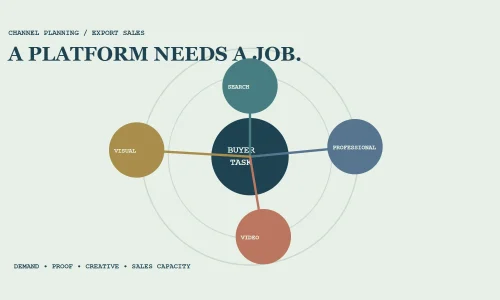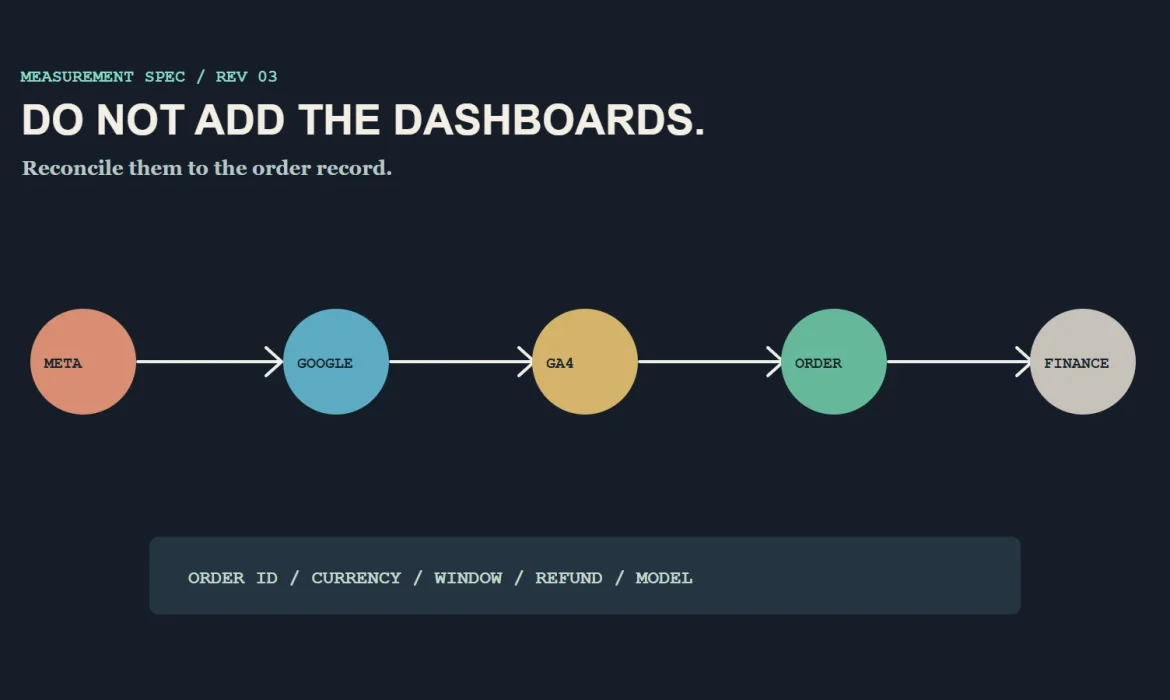
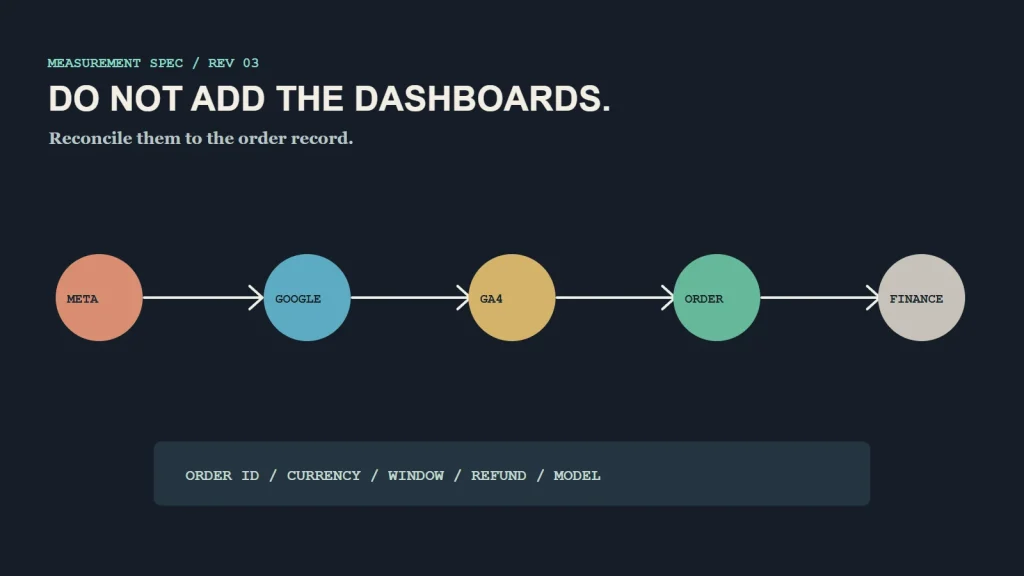
Meta and Google can both claim credit for an order. The store still has one order. Anyone working out how to track ROAS across Facebook and Google Ads needs to keep those views side by side: one records the transaction, the other explains a platform’s claim to credit. Adding dashboard revenue together is the quickest way to overstate the result.
Quick Answer
To track ROAS across Facebook and Google Ads without double-counting, keep a unique order or revenue ledger separate from each platform’s attribution report. Agree on revenue, spend, period, currency, refund treatment, and attribution model before comparing results. Use consistent campaign tags, test the purchase path, and document duplicate or missing events. Report Meta/Facebook, Google, analytics, and finance views side by side; do not add platform-claimed revenue as if each were a separate sale. ROAS describes credited revenue relative to ad spend under stated rules; it does not by itself establish profit or incremental impact.The measurement specification
- Quick Answer
- How to track ROAS across Facebook and Google Ads with one measurement contract
- Ledger design / Keep business totals separate from credit assignment
- Collection design / Make campaign tags survive the visit
- Event design / Verify one order before trusting a thousand
- Attribution design / Three GA4 models are three different questions
- A real Google Ads ratio—and the missing Meta side
- Regression testing / The store release that changes the report
- Attribution settings can restate the recent past
- Closing design / A weekly report can be provisional
- Worked close / One refunded order and three dates
- Exception design / Investigate differences in a fixed order
- B2B adaptation / Pipeline ROAS is not revenue ROAS
- Decision design / Use each view for the work it can support
- Access design / Keep the reporting system usable at handoff
- Reporting permissions / Make the close reproducible without exposing customers
- Implementation acceptance / What should be true before the next report?
- How to Reconcile ROAS Across Facebook and Google Ads
- Frequently Asked Questions
How to track ROAS across Facebook and Google Ads with one measurement contract
ROAS is attributed revenue divided by advertising spend. That definition leaves several decisions open: which revenue, which spend, which attribution rule, which date, and which currency? Write those decisions in a short measurement contract that marketing and finance can both inspect. A dashboard should implement the contract rather than silently choose its own definitions.
For an ecommerce store, an operational ROAS view may use purchase value reported to the platform. A finance view may use net sales after discounts and refunds, with tax and shipping handled according to the company’s chosen accounting policy. These values can differ legitimately. Label them so a buyer of the report does not mistake a platform value for settled cash or profit.
Media-only ROAS also excludes agency fees, production, software, and many business costs. Keep that metric if it helps campaign operation, then add a separately labeled fully loaded marketing return or contribution view. Do not quietly put management fees in one channel’s denominator while leaving them out of the other.
The contract should name the owner of every input and the review date. If finance changes refund treatment or marketing changes attribution settings, version the definition and mark the break. A changing measure can still be useful; an undocumented change creates misleading trends.
Ledger design / Keep business totals separate from credit assignment
Use the commerce or finance system to establish unique orders and realized amounts under the agreed revenue policy. Keep transaction ID, order date, currency, gross item value, discounts, tax, shipping, refunds, and net sales in the authorized ledger. Store customer information only where it belongs under the company’s data controls; a reporting spreadsheet does not need unrestricted personal details.
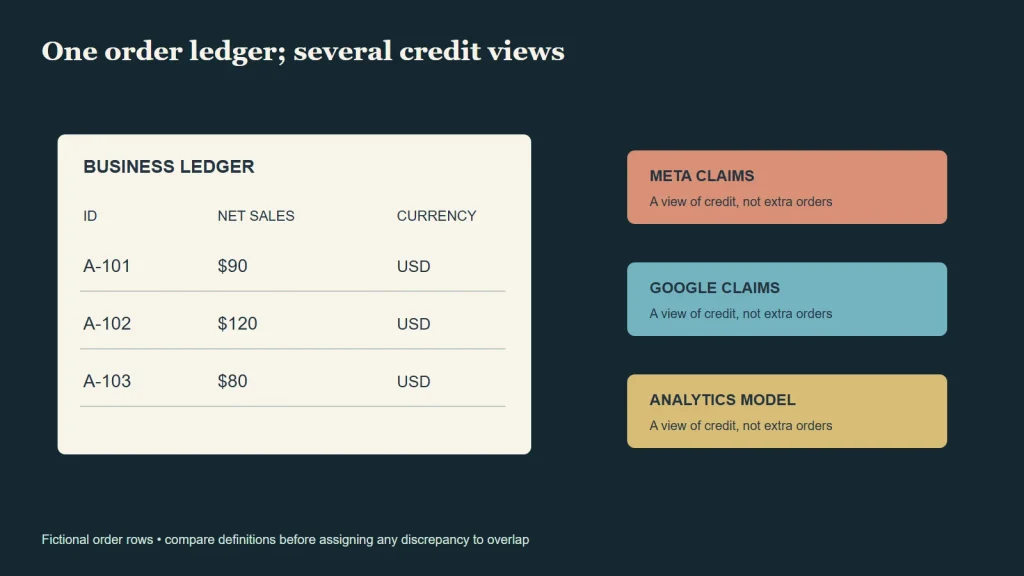
Maintain channel credit as another view, not as a second set of orders. One order can receive credit in Meta, Google Ads, and an analytics attribution report. Those records describe the systems’ allocation rules, not three different purchases. The reconciliation should link to a stable transaction identifier where the permitted integrations and available data allow it.
For B2B businesses, a CRM opportunity and invoice ledger may replace the ecommerce order table. Keep estimated pipeline separate from closed-won value and collected revenue. A $50,000 opportunity is not $50,000 of realized sales. Long buying cycles also require cohort reports so current advertising is not judged solely against invoices from much older projects.
Use a written deduplication key. A repeated event, a retried integration, and two installments of the same order need different handling. Email can change or belong to more than one order. Prefer the commerce system’s order ID when matching a purchase across reports. Test the business’s actual order and refund behavior with the systems owner before relying on the totals.
| Field | Purpose | Check before reporting |
|---|---|---|
| Transaction or opportunity ID | Links the business record | Stable and unique at the intended level |
| Event and order time | Explains timing differences | Time zones and date basis documented |
| Currency and value | Makes the numerator interpretable | Currency matches value; conversion policy stated |
| Discount and refund | Supports a net-sales view | Partial and late refunds accounted for |
| Source/campaign fields | Describes observed acquisition context | Controlled naming and no personal data in URLs |
| Attribution model/window | Explains assigned credit | Saved with the report version |
| Spend basis | Defines the denominator | Media, credits, taxes, and fees labeled |
Collection design / Make campaign tags survive the visit
Use a controlled vocabulary for source, medium, campaign, and content. A simple plan might use a consistent social source value for Meta website links, an agreed paid-social medium, and a campaign code that identifies market and offer. Google Ads linking and auto-tagging should be reviewed in the authorized account; manual tags should complement rather than accidentally conflict with the chosen integration.
Google’s URL-builder documentation explains campaign parameters and their role in acquisition reporting. Treat naming as a data specification. Capitalization, spaces, and inconsistent abbreviations can split what the team intended to be one campaign. Keep an approved list rather than letting every operator improvise tags.
Test the full route. Click a tagged destination in a controlled test, follow redirects and language selection, complete the relevant action, and inspect the records available to your authorized team. Check link shorteners, cross-domain checkout, and applications that rewrite destinations. A tag that exists in the ad editor may not survive the page path.
Do not use campaign URLs to carry names, emails, phone numbers, or other personal information. A useful reporting key is an opaque campaign or creative identifier, not a customer record. Coordinate any first-party matching or offline upload with the company’s responsible owners and current platform requirements.
Event design / Verify one order before trusting a thousand
List every path that can send a purchase event: the commerce integration, a tag manager, theme code, a server connection, and other apps. Multiple paths are not automatically wrong, but they need deliberate deduplication. A legacy tag left beside a native integration can create a convincing but inflated revenue report.
Shopify’s Meta-pixel documentation explicitly warns that adding a pixel through an agency or app can lead to duplicate or incorrect data, and it advises removing manually added theme pixel code when setting up the channel integration. Shopify’s help page is a first-party reference for that store-specific risk. Have an authorized implementer inspect the actual setup before changing production code.
For a test order, verify the intended event name, transaction ID, value, currency, timestamp, and destination systems. Refresh the confirmation page and repeat relevant navigation to check whether extra events appear. Where browser and server events are both used, inspect the documented deduplication mechanism for the active integration rather than assuming that similar timestamps are enough.
Test discounts, shipping, tax, multiple currencies, partial refunds, and cancellations as separate cases where applicable. A standard full-price order may pass while a discounted or international order reports the wrong value. Retain a test log with expected and observed results, but keep sensitive customer data out of shared review files.
Attribution design / Three GA4 models are three different questions
Google’s current attribution introduction lists three models in Analytics attribution reports: data-driven attribution, paid and organic last click, and Google paid channels last click. It also notes that first-click, linear, time-decay, and position-based models are no longer available as of November 2023. Google’s attribution documentation supplies these definitions. Several familiar GA4 attribution options were retired in November 2023. Check the current model list before writing a reporting specification around an old screenshot.
| GA4 attribution model | What the documented rule does | Interpretation limit |
|---|---|---|
| Data-driven | Distributes credit using data for the key event | Model-specific credit, not a ledger of causal sales |
| Paid and organic last click | Assigns credit to the last eligible non-direct interaction under its rules | Earlier influences can receive no credit |
| Google paid channels last click | Favors the last eligible Google Ads click, with documented fallback | Different question from an all-channel allocation |
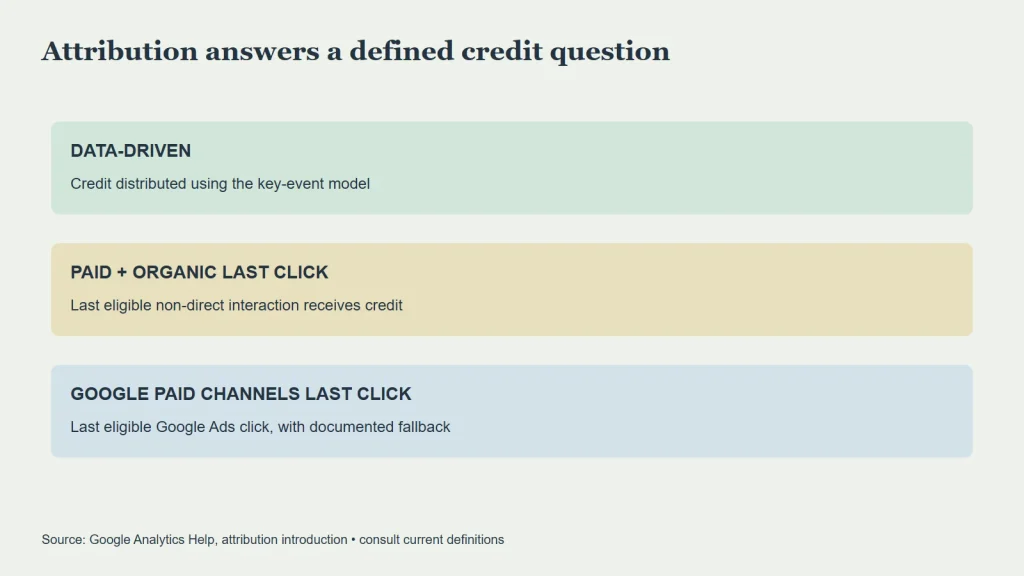
The graphic summarizes the documented model labels above; it does not show an experimental result or a measured share of revenue.
Select and record the model used for the comparison. A report from one model should not be placed beside a different model and labeled a channel performance change. The same customer path can allocate revenue differently without the customer buying anything additional.
For example, a buyer might encounter a Meta ad, later click a Google search ad, and complete a purchase after another visit. Each platform may apply its own eligible interactions and windows. GA4 may distribute credit under the selected model, while the commerce system records one order. The disagreement is an expected subject for reconciliation, not proof that one system fabricated the order.
Attribution is not incrementality. A credited sale might have occurred without the ad, and an uncredited interaction might still have influenced the buyer. A causal lift question requires an appropriate experiment and sufficient evidence. Keep observational credit reports useful without asking them to prove something their design cannot establish.
A real Google Ads ratio—and the missing Meta side
The supplied case pack contains two North American ecommerce Google Ads summaries from July 1–September 28, 2026. Automotive parts: about $160,000 spend, 3,683 conversions, approximately $519,000 conversion value, and reported ROAS 3.24. Outdoor power equipment: about $20,700 spend, 431.85 conversions, roughly $62,500 conversion value, and reported ROAS 3.02. Dividing the rounded values reproduces the reported ratios closely. These are platform-reported Google Ads figures, not reconciled net sales or profit.
The case pack contains no matched Facebook/Meta result for those stores. It has no order-level ledger that would let us identify a sale claimed by both Meta and Google, no shared attribution-window export, and no refunds or finance close. So there is no honest real-world “Facebook versus Google” reconciliation to publish from this evidence. Do not manufacture one by assigning part of the Google value to Meta.
For a live Shopify store, the comparison worksheet should leave Meta fields blank until the authorized Meta export and commerce ledger are available. Record unique order ID, order date, currency, gross value, discount, refund, net value under the agreed policy, Meta-reported credit, Google-reported credit, GA4 model, and each system’s reporting window. If one order appears in both platform reports, keep one business order and document both credit claims; do not add the credited values to the finance total.
Use the supplied Google figures as an arithmetic check only. The 3.24 ratio is approximately $3.24 of configured conversion value per dollar of recorded Google spend. It does not establish incremental lift or net contribution. The 3.02 figure has the same limitation. Product margin, fulfillment, returns, and repeat-purchase definitions are absent. Before making a channel allocation decision, obtain the missing Meta and finance data, align definitions, and label the resulting comparison with its actual attribution model.
Regression testing / The store release that changes the report
Measurement is not a one-time installation. A theme update, checkout change, new app, consent configuration, currency expansion, or order-management migration can alter the event path. Tie a compact regression test to changes that could affect collection. The release owner should know who validates events and what evidence is required before the report is considered comparable again.
Build a test matrix rather than relying on one familiar checkout. Include the main device path, a discounted order, a relevant nondefault currency, a confirmation refresh, and a partial refund where those behaviors apply. Do not create unnecessary live transactions just to complete a checklist; use appropriate supported test methods and authorized controlled orders where necessary. Label test records and coordinate with finance and fulfillment.
For each test, record expected value, observed value, identifier, currency, event count, and system receipt. A pass means the observed record matches the intended definition, not that a browser tool displays a green status. Keep open issues visible with an owner and affected reports. If a change breaks historical comparability, annotate the date rather than hiding it in the implementation notes.
Include campaign-link tests in the same release process. A new language selector may drop parameters; a redirect may change the destination; an app may insert an additional domain. Verify representative links after the change. A good UTM standard cannot preserve source information through a route that discards it.
Attribution settings can restate the recent past
Google’s current attribution documentation notes that data-driven conversions can be reattributed for up to seven days after conversion. That is a documented behavior of the specified model, not a promise that every business report is final after seven days. Refunds, late imports, sales classification, and accounting adjustments can have their own timing. Save the retrieval date when comparing exports.
A small change in yesterday’s channel allocation may therefore have a different explanation from a missing order in the commerce ledger. Check the model and recent reattribution window before treating the movement as a tracking defect. Then use the business close policy for the later net-sales view. This is another reason to label operational reports provisional rather than expecting all systems to freeze at midnight.
Closing design / A weekly report can be provisional
Use a close schedule suited to the business. An early operational report may show recently collected events and known import lag. A later close may incorporate refunds, classification, and corrected costs. Label both versions and preserve the date each was produced. Do not quietly overwrite last month’s result and leave leadership wondering why its saved report differs.
Choose how refunds are dated. An order-cohort view can restate the original order’s net value; a period cash or accounting view may recognize the refund when processed. Both can be useful under an explicit policy. The campaign comparison should use one consistent convention and show material late adjustments separately.
Align time zones before reconciling daily totals. An order near midnight can appear on different dates in the store, analytics property, and ad account. Currency conversion can introduce another gap. Compare a sufficiently broad period and a sample of transaction timestamps before treating a one-day mismatch as data loss.
Credits and billing adjustments belong in the spend policy. State whether the report uses served cost, billed cost, or another defined measure. Management and production can appear in a separate fully loaded view. The finance owner should be able to reconstruct the denominator from the invoices and exports used in the close.
Worked close / One refunded order and three dates
Suppose a fictional $120 order is placed on October 28 and partially refunded by $30 on November 6. Under an order-cohort net-sales policy, the October cohort may eventually show $90 for that order, with the restatement disclosed. Under a period transaction view, October may show $120 and November a $30 refund. Neither presentation should be silently substituted for the other in a channel comparison.
Now suppose the advertising interaction occurred on October 25. An operational platform export may organize credited value using its selected date basis and window. The store ledger uses order and adjustment dates. The report should preserve those definitions and explain the bridge rather than moving dates until the totals happen to match.
Use a bridge table with opening reported value, known order adjustments, known cost adjustments, definition differences, and unresolved differences. Only enter a numeric adjustment when the underlying record supports it. A line called “attribution adjustment” should not become a dumping ground for every unexplained gap.
At close, save the raw exports and a version of the policy used to transform them. Record extraction time, account time zone, currency, and filters. A colleague should be able to reproduce the reported total from the authorized data without relying on the memory of the analyst who built the spreadsheet.
Exception design / Investigate differences in a fixed order
First compare definitions: gross versus net value, date basis, window, currency, and eligible actions. Next test collection: missing IDs, duplicate events, incorrect values, failed imports, and broken redirects. Then inspect coverage: consent choices, device or browser limits, and journeys the available systems cannot fully observe. Finally review attribution allocation under each system’s rules.
This order prevents a tracking change from being used to solve a definition difference. If one system includes shipping and another excludes it, additional tags will not reconcile the values. If purchase events fire twice, an attribution-model switch will not repair the source data. Write the issue and probable owner before changing implementation.
Maintain an exception register with affected period, system, sample evidence, value at risk where known, owner, action, and status. Do not force an unknown difference to zero. An unresolved balance with a documented investigation is more trustworthy than an invented adjustment labeled “other.”
Privacy settings affect what may be collected and shared. Shopify, for example, exposes customer data-sharing levels and privacy controls in its documented workflows. Shopify’s customer privacy guidance is a platform reference, not a universal legal determination. Have the appropriate owner review the actual market and integration choices.
B2B adaptation / Pipeline ROAS is not revenue ROAS
For a long-cycle exporter, keep at least three value stages distinct: estimated opportunity value, closed-won contracted value, and realized revenue under the company’s chosen policy. Advertising may influence all of them, but a pipeline estimate should not be labeled revenue. A late loss or scope reduction can change the first stage without creating an accounting refund.
Preserve an opportunity ID that can link multiple contacts and marketing interactions. The CRM may contain an engineer’s guide request, a procurement inquiry, and a salesperson’s conversation about the same project. Deduplicating people alone does not deduplicate the commercial opportunity. Sales operations should define the project unit and own exceptions such as multiple facilities or separate purchase orders.
Report intake cohorts and maturity. A November campaign can be assessed for inquiry relevance and accepted projects before enough deals close to judge revenue return. Show the pipeline as provisional and revisit it later. Do not divide current-month spend by all current-month invoices and imply that this measures the return of the current campaign.
Use contribution where reliable cost evidence exists. Two contracts with equal revenue can have different product, freight, financing, and service costs. An acquisition decision should not automatically prefer the larger top-line project if it leaves less contribution. Keep the underlying margin assumptions available to the approved finance reviewers.
Decision design / Use each view for the work it can support
Campaign operators need platform detail to assess delivery, creative, queries, and the signals used for optimization. Marketing leadership needs a consistent cross-channel view with unique outcomes and stated attribution. Finance needs realized revenue and the full cost picture. Present those views together rather than declaring one dashboard the answer to every question.
Before moving money, ask whether the observed difference is large enough and mature enough to justify the action. A channel with higher reported ROAS may be harvesting existing demand, selling a different product mix, or benefiting from a different attribution window. Investigate those explanations before interpreting the ratio as a causal ranking of channels.
For B2B, review accepted projects, quote progression, and realized contribution alongside attributed revenue. A small number of large deals can make a monthly ratio volatile. Keep intake cohorts and sales lag visible so a recent campaign is not condemned before its projects have had time to progress.
Marketboo’s paid-media services can be evaluated by the clarity of their event map, reporting contract, and reconciliation process. Teams keeping analytics and campaign operation internally can use hands-on advertising coaching to resolve the definitions and checks their own staff will maintain.
Access design / Keep the reporting system usable at handoff
Store the measurement contract, naming dictionary, event map, test matrix, source exports, and transformation notes in a client-controlled location. Give each responsible person appropriate access and document which tool subscriptions are required. A dashboard that stops working when one agency account is removed is an operating dependency the merchant should understand before procurement.
When a provider leaves, transfer definitions and open exceptions as well as charts. The next analyst needs to know which values include shipping, which periods were restated, and which event path remains under investigation. Clear documentation reduces the chance that a handoff creates a new metric with the old label and an unexplained performance jump.
Reporting permissions / Make the close reproducible without exposing customers
The person reconciling totals may need transaction identifiers and monetary fields without needing full addresses, payment details, or every sales note. Use approved access controls and redacted review extracts. Keep sensitive source records in the authorized systems rather than copying them into an unrestricted shared drive for convenience.
Document the transformations applied to each extract. State how duplicates are identified, how currency is normalized, which refunds are included, and which records are excluded as tests. If the spreadsheet contains manual overrides, preserve the original value, reason, owner, and date. A corrected total is only useful if another approved reviewer can see how it was produced.
Separate extraction failures from true zero activity. A missing file or expired connector should be marked unavailable, not converted to $0 revenue or $0 spend. Add a completeness field to the close record so an apparently dramatic performance movement triggers a data check before a campaign change. This small control prevents an infrastructure issue from becoming a false channel conclusion.
When a report is shared outside the operating team, include the definition note and known limitations with the chart. A screenshot detached from its period, currency, attribution, and revenue policy is easy to misread. The aim is a number that stays interpretable when it leaves the analyst’s screen.
Implementation acceptance / What should be true before the next report?
- Marketing and finance have approved the revenue, spend, date, and currency definitions.
- Campaign names and URL parameters follow a controlled standard and survive tested redirects.
- Representative orders produce the intended events, values, currencies, and identifiers.
- Duplicate paths, refunds, and late imports have been tested or explicitly recorded as open issues.
- Platform, analytics, and business-ledger views are labeled separately.
- The report names its attribution model, window, close date, and remaining exceptions.
- Budget recommendations distinguish observed credit from claims about causal lift.
A useful ROAS report will not make Meta and Google agree on every order. It will let marketing and finance see the one business transaction, each platform’s credit claim, and the rule behind the difference. That is enough to make a sounder budget decision than adding two dashboards together. A clear answer to how to track ROAS across Facebook and Google Ads is to separate business revenue, media spend, and each platform’s attribution credit.
How to Reconcile ROAS Across Facebook and Google Ads
- Agree on definitions. Have marketing and finance define revenue, spend, date range, currency, refund treatment, cutoff, and attribution model.
- Standardize campaign tags. Set a naming and URL-parameter convention. Test that parameters survive redirects and appear in the intended reports.
- Test representative orders. Trace approved test transactions through the store and reporting tools; record values, currencies, duplicate signals, and missing fields.
- Create one business transaction view. Use store or finance records to identify transactions; document deduplication, cancellations, partial refunds, and late updates.
- Keep attribution reports separate. Show Meta, Google Ads, analytics, and business-ledger results as separate views; do not add platform-attributed revenue as unique sales.
- Compare with shared definitions. For each ROAS figure, show revenue source, spend source, attribution model, and reporting period.
- Add lead-stage reporting. For longer sales cycles, link inquiries to CRM stages where records support the connection; label immature cohorts.
- Save a reproducible close. Keep definitions, exports, transformations, exceptions, and close date with the report; assign owners to unresolved issues.
FAQ
How is ROAS calculated?
ROAS is attributed revenue divided by advertising spend for a defined reporting view. State the revenue source, spend source, period, currency, and model.
Why do Facebook and Google Ads report different ROAS?
The platforms may assign credit under different settings and attribution rules. Keep their views separate and compare them with a defined business-ledger view.
Can I add Facebook and Google Ads revenue together?
Not when both may claim credit for the same order. Reconcile unique transactions in store or finance records.
Is GA4 ROAS the same as platform ROAS?
Not necessarily. Data sources, attribution settings, and reporting rules can differ. Label each result by source and model.
Should refunds be included in a ROAS report?
Choose and document treatment that fits the reporting purpose. State whether revenue is before or after refunds and apply the rule consistently.
Does high ROAS prove that an ad caused a sale?
No. Attribution assigns credit under a model; it does not by itself establish incremental impact or profit.
What should a finance reconciliation include?
Include period, currency, spend and revenue sources, unique orders, refund treatment, attribution view, data cutoff, and known exceptions.