Quick answer
Quick answer: A practical Google Ads strategy for B2B manufacturing companies starts with one product, one serviceable market, and one buyer question. Map product, application, and specification queries to pages that answer those questions; write ads from claims the business can support; and connect the inquiry event to a sales record. Before launch, test the form, routing, analytics, and owner handoff. Set a bounded budget and review date, then compare search terms and sales dispositions together. This creates evidence for the next build without treating an early test as a universal forecast.
A Google Ads strategy for B2B manufacturing companies can break before anyone gets to bidding. The ad sends an engineer to a generic product page; the form asks for an annual volume they cannot estimate; the inquiry lands with a salesperson who has no technical context. Start with one product, one buyer question, and a route to a useful reply. The campaign has something real to optimize only after those pieces fit.
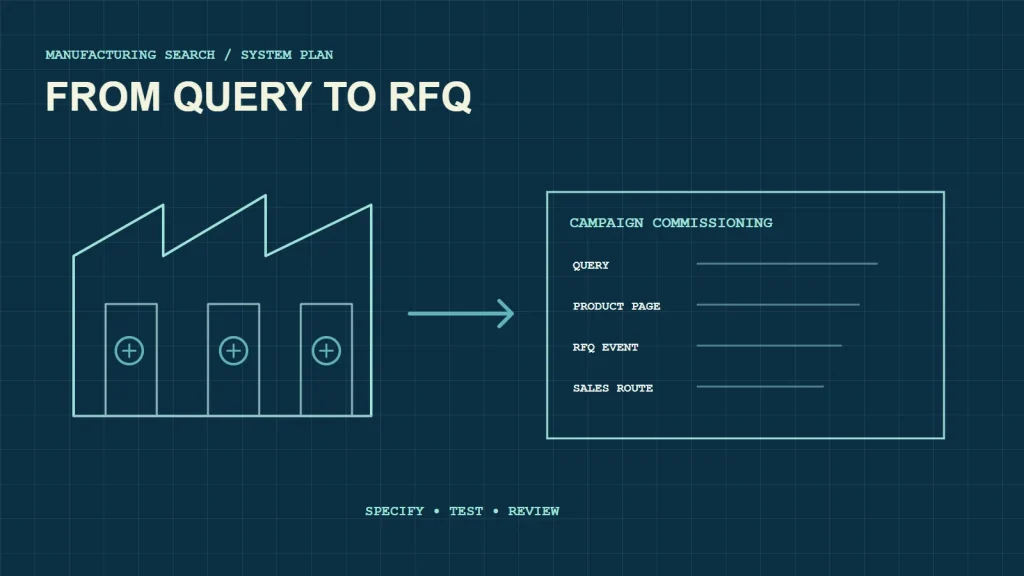
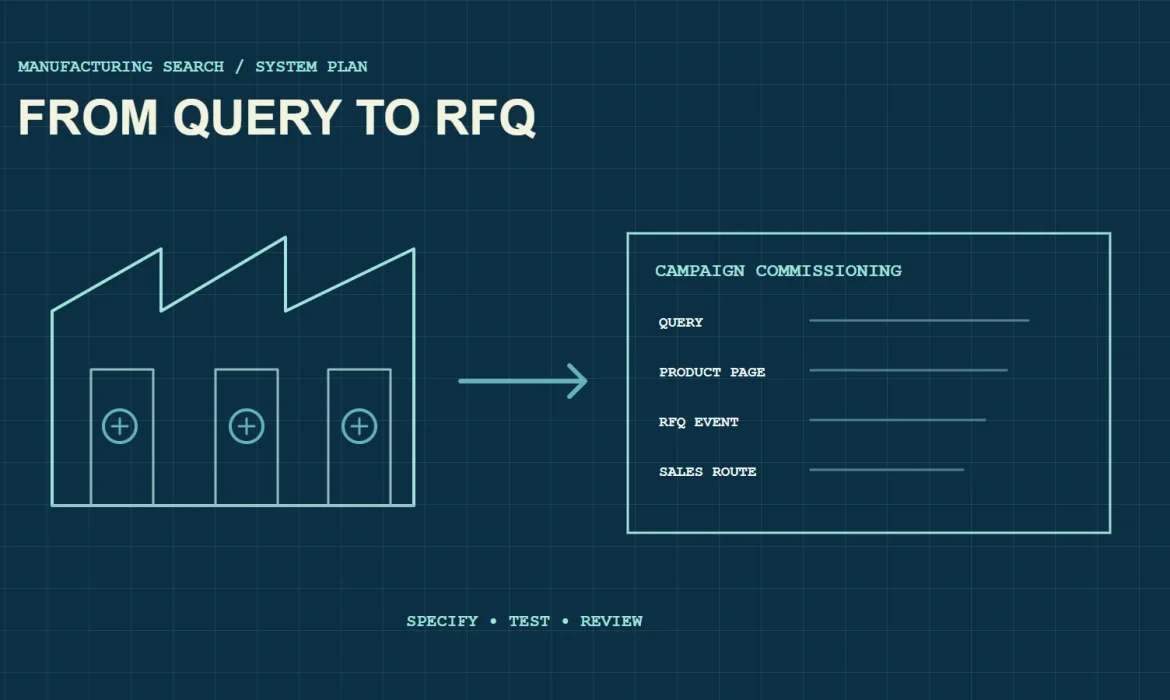
The commissioning sequence
- Quick answer
- Google Ads strategy for B2B manufacturing companies starts with the offer
- Station 2 / Measure the available search language
- Station 3 / Draw the account around operating differences
- Guardrail / Keep query exclusions explainable
- Station 4 / Match the page to the engineering question
- Inspection point / Make the ad promise supportable
- Station 5 / Wire the event to the RFQ record
- A commissioning sheet for one product-country pair
- Engineering exception / What if the buyer cannot submit a complete RFQ?
- Station 6 / Set the cash boundary and the learning boundary
- After commissioning / Review exceptions weekly and outcomes later
- Campaign evidence / What one automation case does and does not establish
- Release criteria for the person approving launch
- How to Build and Check a Manufacturing RFQ Campaign
- Frequently asked questions
Google Ads strategy for B2B manufacturing companies starts with the offer
Choose one product family for the initial build. “Industrial equipment” is a category, not a campaign specification. A useful starting sheet names the part or machine, application, dimensions or performance range, production constraints, supported markets, and buying organization. Have an engineer approve the technical description and a commercial owner approve the delivery promise. Advertising should inherit these facts rather than improvise them.
Separate manufacturing capability from stocked availability. A buyer searching for a replacement part needed tomorrow may be unsuitable for a custom-production line with a minimum order and an engineering review. Put lead times and customization limits where the visitor can find them. If sales accepts smaller development projects but production has a larger minimum, explain that path rather than using an unqualified “low MOQ” claim.
Map the first contact to the next commercial action. Does the buyer need a drawing review, a specification sheet, a sample discussion, a distributor introduction, or a formal quote? Each implies different questions and different staffing. For a custom component, a complete technical RFQ might be a later milestone; the first accepted inquiry may simply identify a serviceable project requiring engineering discussion.
Create an exclusion sheet at the same time. Record unsupported industries, countries, materials, certifications, consumer uses, and service requests. This becomes an input for query review, ad copy, landing pages, and sales disposition. When an exclusion is uncertain, name the person who can resolve it. A campaign operator should not make a regulatory or engineering promise because a search term looks attractive.
Station 2 / Measure the available search language
Manufacturing catalogs are often organized around internal names, part numbers, and engineering classifications. Buyers may search using a common category, a problem, a process, a material, an industry application, or a competitor’s product language. Build a map that puts these expressions beside the product hierarchy. Ask sales and technical staff for the wording they hear in RFQs, distributor conversations, service calls, and trade-show follow-up. That first-party vocabulary is usually more useful than starting with a broad list of generic terms.
Separate at least five kinds of search intent. Product-specific searches name a category, model, or specification. Application searches describe where the product is used. Problem searches describe a failure or performance need. Supplier searches show procurement intent, while educational searches may indicate early research or a student assignment. These groups are not universal labels; they are a practical way to decide what message and destination belong together. A query should be grouped according to the business task it signals, not merely because two phrases contain the same word.
Review each keyword candidate against operational reality. Can the company supply the item in the searcher’s country? Is there a local distributor, export restriction, lead-time limit, or minimum order? Does the sales team want small sample requests, large project opportunities, or both? A high-volume term can be a poor choice when the business cannot serve most of its searchers. Conversely, a narrow application phrase may be worth testing even if a standard keyword tool shows little volume, provided it maps to a genuine buying use case and the test budget is appropriate.
| Search group | Example query pattern | Likely next question | Useful page destination |
|---|---|---|---|
| Product category | “industrial pump manufacturer” | What types and capacities are available? | Product-family page |
| Specification | “316 stainless valve 2 inch” | Does the item meet the required spec? | Technical product page |
| Application | “valve for chemical processing” | Is it suitable for this environment? | Application page |
| Supplier intent | “custom gear manufacturer USA” | Can this supplier quote my project? | RFQ or capability page |
| Research | “how to select a gear ratio” | What factors should I compare? | Technical guide or calculator |
Build a query specification instead of a word collection
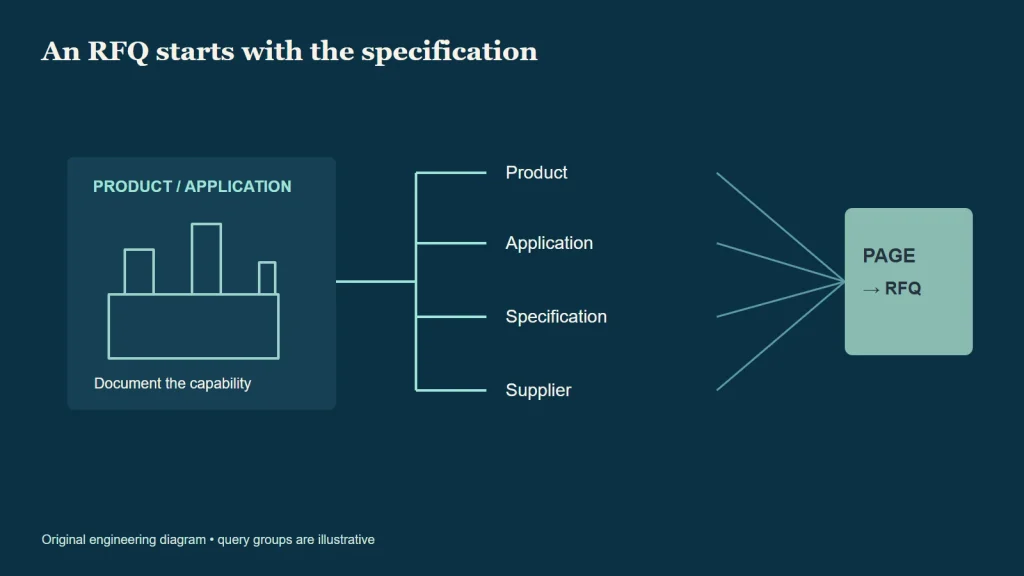
Use four query buckets: product, application, specification, and supplier. “Stainless mixing tank” names a product; “mixing viscous coatings” names a use; “jacketed tank 500 liter” supplies a requirement; “custom mixing tank manufacturer” expresses supplier interest. These are illustrative examples, not measured search-volume claims. A fluent reviewer should check which terms buyers use in the actual target market.
Beside each bucket, write the destination page and the commercial next step. A specification query may need dimensions and material compatibility before a form. A supplier query may need proof of production capability and a quote route. If all four buckets lead to the same generic homepage, the mapping has exposed a site dependency that should be addressed before launch.
Keyword Planner or another authorized account tool can help estimate demand, but a number without country, language, network, and period is incomplete. This article does not supply verified volume or CPC estimates. Record the settings with any export used in planning so the next reviewer can reproduce the analysis. Search availability is a constraint to investigate, not a number to invent for the budget meeting.
Station 3 / Draw the account around operating differences
Campaign structure should make a decision easier, not create the maximum number of folders. Separate countries when language, budget control, landing pages, or sales ownership require independent management. Separate product families when different teams own them or the economics and conversion path differ. Within a campaign, group keywords tightly enough that the ad can answer a coherent query set. Avoid splitting every phrase into a separate group if there is not enough data or a distinct message to justify the maintenance.
Choose naming rules before the first build. A practical convention may include market, product family, intent, language, and campaign objective. The naming standard should match how finance and sales want to review results. Keep product terms and applications visible in the names, but do not include personal data or information that should not appear in platform URLs. Consistent names help a team spot when a market or product has been added and make exports less dependent on the original operator.
The campaign settings deserve the same care as the keywords. Confirm the location option, language, network, schedule, devices, and budget with the current account and market plan. A campaign for a region should not accidentally spend in places the exporter cannot ship to or support. If a business wants to test several countries, make the country-level budget and lead-quality view visible from the beginning. A combined campaign can hide that one market consumes spend while another produces the qualified inquiries the sales team actually wants.
Guardrail / Keep query exclusions explainable
Search-term review is an operating habit, not a one-time setup task. A new account may receive variations that reveal a buyer’s vocabulary, but it can also receive irrelevant searches for consumer repairs, jobs, training, used items, or unrelated product meanings. Create a review process that identifies the reason a query is unhelpful and records the exclusion. The reason helps the team avoid repeatedly adding and removing the same terms without understanding the underlying intent.
Negative keywords need thoughtful handling because their behavior and scope are not identical to positive keyword matching. Use Google’s current documentation and the account’s live settings when deciding how a negative phrase should be applied. Review shared lists carefully, especially when one product line may serve a term that another line should exclude. A broad exclusion such as “cheap” can block a serious procurement search if the company sells cost-effective bulk supply. Classify the query in context before acting.
A low-volume keyword has not necessarily failed; in a narrow industrial market, it may still describe a valuable buying task. Check the query and its page before dropping it. Search volume estimates are directional and can vary by market, language, and tool. A narrow phrase can have value if it brings a relevant engineer or procurement contact, but its performance should be evaluated on a longer window and with the right business outcome. Conversely, a phrase with many clicks may be a poor fit if the searcher is looking for consumer retail or instructions rather than a supplier. Let search intent and downstream evidence guide decisions.
Station 4 / Match the page to the engineering question
A manufacturing landing page should help a technically literate visitor decide whether a conversation is worthwhile. Start with what is made, for whom, and under which practical limits. Place the most requested specification information near the relevant product image. If a capability requires review, say so. An unsupported badge is less useful than a precise explanation of what the factory can document.
Technical depth helps until the page starts reading like a filing cabinet. Put the details a buyer needs near the top and make supporting documents easy to find. Offer a concise specification table, application examples, the production or sourcing route, and a clear next step. Detailed drawings can sit behind a deliberate download or request process where appropriate, but essential compatibility information should not be so hidden that a buyer must submit a form to rule the product out.
An RFQ form should distinguish required information from information that can follow later. For example, product family, application, company contact, delivery country, and project description may be sufficient for initial review. A drawing upload, quantity range, material requirement, or project timing can be useful when the team can actually process them. Do not require an exact annual volume from an engineer who is only assessing feasibility.
Check the upload path. File size, accepted types, malware screening, permissions, and the internal recipient all affect whether a drawing reaches engineering. Provide an alternate contact route when an upload fails. A successful thank-you screen does not prove that the attachment arrived or that a human can open it.
The page should also explain the response process. If engineering reviews the inquiry before a quote, state that sequence without promising an unrealistic turnaround. Name a response-time commitment only when the business can staff it. The most persuasive page is often the one that removes uncertainty about the next practical step.
Inspection point / Make the ad promise supportable
Manufacturing ads should help the right buyer recognize fit. A message might identify a product category, application, design capability, standard, or quote path. Use only claims the company can substantiate. “Fast delivery,” “certified,” “custom,” and “made in the USA” can have specific meanings in a buyer’s decision; verify their use with the people responsible for operations and legal review. Avoid stacking generic superlatives that could belong to any supplier. The best ad is not necessarily the loudest one. It is the one that sets an accurate expectation for the page it opens.
Create message variations around different buyer questions rather than changing a word at a time. One version can emphasize specifications and material options; another can emphasize engineering support or a process capability; a third can focus on the quotation workflow. Keep the destination page consistent with each claim. If an ad mentions custom manufacturing, a generic homepage is not an adequate response. The page should show what can be customized, what information the buyer should provide, and how the next conversation works.
Review assets for market and language fit. A phrase that sounds natural to a U.S. procurement team may not be the term used by a distributor in another English-speaking market. Have a product specialist validate technical terminology and a fluent editor validate regional language. If a campaign runs in several languages, keep an approval record that maps translated ads to the correct page and market. A translation should not silently broaden a performance claim or add a delivery promise that the original team did not authorize.
Station 5 / Wire the event to the RFQ record
Define the events that matter before launch. A form start, form completion, phone click, file download, quote request, and sales-accepted inquiry are different actions. Select a primary event that represents the business step the campaign is meant to optimize, and keep softer engagement events separate for analysis. Google’s documentation describes conversion measurement as a way to understand actions after ad interaction; the business still has to define which action reflects meaningful progress for its own sales process.
Use a consistent UTM convention for campaign links where applicable, and document the required fields. Avoid free-form campaign names that change from one operator to another. In the CRM, preserve source, market, product, and sales status in fields the team can report. Use platform-specific conversion imports only after confirming data handling, identifiers, timing, and permission with the appropriate technical and privacy owners. The tracking design should be simple enough for a new analyst to understand from the documentation.
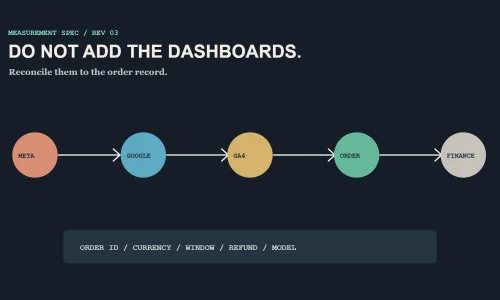
Reconcile platform and CRM totals regularly. Numbers may differ because of time zones, duplicate contacts, consent choices, cross-device behavior, attribution windows, offline imports, and system delays. A discrepancy is a prompt to investigate, not proof that one system is necessarily wrong. Compare records at the level the business can safely inspect, and report the known limits. If sales needs weeks to qualify a project, create a reporting view that distinguishes a current platform action from a later sales outcome.
| Metric | Example definition | Question it helps answer |
|---|---|---|
| Click-through rate | Clicks divided by impressions | Does the ad attract attention for the query? |
| Landing-page inquiry rate | Valid inquiry submissions divided by ad clicks | Does the page and offer support the next step? |
| Sales acceptance rate | Sales-accepted leads divided by submitted inquiries | Are inquiries commercially relevant? |
| Cost per accepted lead | Media cost divided by sales-accepted leads | What does qualified demand cost under this rule? |
| Quote rate | Quotes issued divided by sales-accepted leads | Does the handoff produce a sales action? |
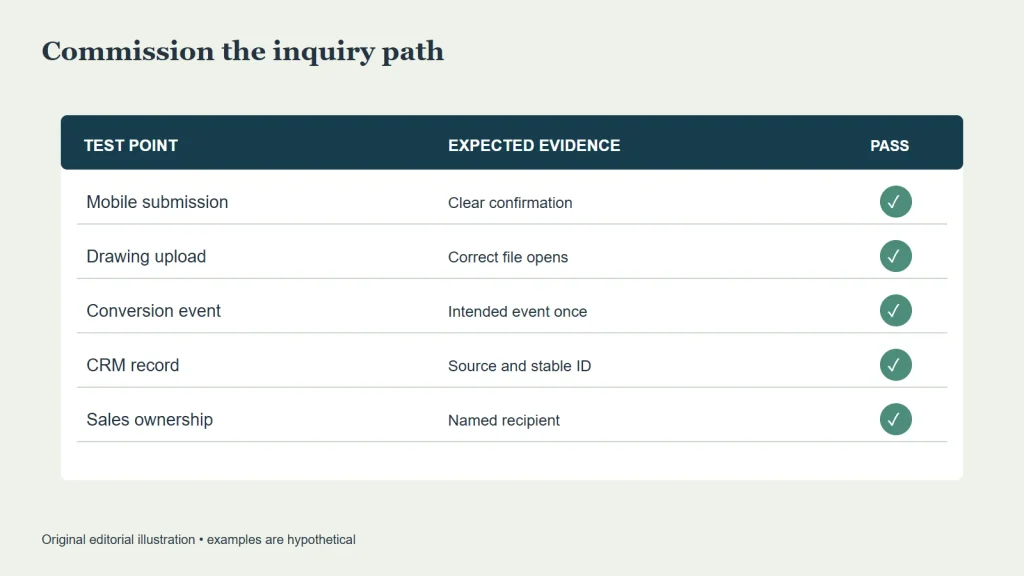
A commissioning sheet for one product-country pair
| Test point | Test action | Pass evidence | Owner |
|---|---|---|---|
| Query and destination | Open the mapped page for each intent bucket | Page answers that query’s main requirement | Campaign lead |
| Mobile form | Submit required fields on a phone | Clear validation and one confirmation | Web owner |
| Drawing upload | Send a permitted sample file | Authorized recipient opens correct file | Engineering ops |
| Analytics event | Submit once and refresh | Intended event appears without an extra purchase or lead count | Analytics owner |
| CRM route | Follow the test inquiry | Stable ID, source, country, and assigned owner | Sales ops |
| Feedback | Classify the test record | Agreed disposition available to campaign team | Sales lead |
Use dummy data clearly marked as a test. Where a live submission is necessary to validate an integration, notify the recipient and remove or label the test record according to the company’s recordkeeping process. Do not let commissioning traffic pollute the first performance report. Save timestamps so the operator can compare analytics, integration logs, and CRM receipt without guessing which event belongs to which test.
Include a failure route. An unavailable CRM, changed webhook credential, or missing sales user should trigger an owned exception rather than silently losing inquiries. Decide who reviews the queue and how a failed record is retried. A low-volume industrial campaign can lose a meaningful share of its opportunities through a handful of unnoticed routing failures.
Engineering exception / What if the buyer cannot submit a complete RFQ?
An incomplete inquiry is not always an irrelevant one. An engineer may know the application but not the final material or annual volume. A distributor may need a capability conversation before sharing a customer’s drawing. Give sales a clarification route that distinguishes missing information from a demonstrated mismatch.
Record the minimum information needed for the next technical decision. If engineering can assess feasibility from application, operating conditions, and approximate dimensions, ask for those first. If a safety-critical use needs formal review, make that requirement explicit and route it to the appropriate specialist. The campaign should not imply automatic suitability.
Use a separate disposition for “awaiting technical detail.” Keep its age and owner visible. When the record becomes accepted or rejected, update the original intake cohort so the campaign review reflects the eventual result. This avoids treating every slow engineering conversation as a failed lead while still exposing inquiries that have stalled without follow-up.
Station 6 / Set the cash boundary and the learning boundary
Google’s standard average-daily-budget guidance allows spending up to twice the average daily budget in one day and uses 30.4 times that setting for the standard monthly spending limit. An unchanged $100 setting therefore corresponds to $200 and $3,040 under those rules. Verify campaign-specific conditions, budget edits, and actual billed cost before using the calculation for cash control. This documented platform rule is not a prediction of RFQ volume. Read Google’s overdelivery guidance.
Separate that cash boundary from the evidence needed to learn. A niche product may generate too few relevant searches in one month to support a confident comparison. Conversely, a broken form is a reason to act immediately without waiting for a large sample. Agree in advance on the decisions that require mature inquiry data and the operational defects that require prompt repair.
Build a simple monthly model with relevant clicks, inquiry rate, and sales acceptance. If a hypothetical $3,000 test buys 300 clicks, 12 become inquiries, and four become accepted RFQs, click cost is $10, inquiry rate is 4%, and cost per accepted RFQ is $750. These assumptions explain the arithmetic; they are not manufacturing benchmarks. Change one assumption at a time to see which uncertainty dominates the plan.
The economics depend on more than the first quote. A manufacturer may win repeat orders, but expected lifetime value should not be used to excuse any acquisition cost without evidence about retention, margin, and collection. Start with conservative first-order contribution and show repeat-order value separately until the customer cohort matures.
After commissioning / Review exceptions weekly and outcomes later
A weekly check can catch broken pages, disapproved ads, unusual spend, irrelevant search terms, missing form records, and changes that require approval. It should not become a reason to make many simultaneous edits. A change log records the setting, date, reason, expected effect, and review point. This allows the team to see whether a later result followed a deliberate test or an accidental adjustment. Establish which settings an agency may change independently and which require the client’s sign-off.
The monthly or sales-cycle review should go beyond platform engagement. Compare countries, product families, query themes, accepted leads, quotes, and known opportunities. Ask sales to explain a sample of accepted and rejected records. If the company cannot obtain that feedback, treat lead quality as unknown and make it a workflow task. Do not report “qualified demand” merely because a form contains a company email address. Qualification should reflect the agreed fit criteria, not an assumption about the contact.
Each review should end with a small set of decisions: keep the current test, adjust a defined part, pause a market, repair measurement, or collect more evidence. A good operating rhythm also preserves useful negative findings. If a phrase consistently attracts the wrong buyer, the exclusion and reason become reusable knowledge. If a page is technically sound but has too little demand, do not ask the agency to rewrite it repeatedly without new evidence. The goal is a better decision, not a higher count of changes.
Campaign evidence / What one automation case does and does not establish
A supplied Marketboo case summary covers robotic arms and automation components marketed to buyers and systems integrators in Europe and North America. For the stated Google Ads reporting period, July 1–September 28, 2026, it lists approximately RMB 35,600 in spend, 5,092 clicks, 139.69 recorded conversions, and about RMB 255 per conversion. The campaign description says its search coverage included product models, applications, and procurement language such as “supplier” and “manufacturer.”
Those figures help a manufacturing team ask better commissioning questions. Which query families produced the clicks? Did model-number searches reach the relevant product detail? Did application searches reach an application page? What did the configured Ads conversion represent? The summary does not provide a query-level export, so it cannot tell us which product group performed best. A new manufacturer should not copy the campaign structure from a one-paragraph case description as though it were a complete build specification.
The case material separately reports 80+ effective inquiries per month after combining advertising with email and phone. It does not say how many of those inquiries came from the 139.69 platform conversions, and it does not define “effective.” That separation matters. Ads reported fractional conversions; the project summary reported a monthly, multi-channel inquiry count. They belong in adjacent columns until CRM records reconcile them.
For an RFQ commissioning plan, add the missing fields before launch: unique inquiry ID, product family, country, query or campaign source when available, first-response timestamp, sales disposition, and quote stage. Then test one real route from search click to submitted form to CRM assignment. If a manufacturer wants to use this case as proof, obtain the underlying report and permission rather than inferring a lead-quality rate from the two totals.
The public takeaway is deliberately narrower than a performance claim: product, application, and procurement language were all part of the described campaign; downstream inquiry reporting combined channels. The evidence supports a measurement design lesson. It does not reveal a universal winning keyword list, an audited conversion rate, or a guaranteed cost per RFQ. A sound Google Ads strategy for B2B manufacturing companies can pass these checks before spend is approved.
Release criteria for the person approving launch
- Product, market, and service exclusions have been approved by their owners.
- Query groups lead to pages that answer the corresponding buying question.
- Ads use claims the business can substantiate and fulfill.
- Forms, uploads, analytics, CRM routing, and feedback have passed a documented test.
- Finance understands the authorized spend and the applicable platform rules.
- The first review has a date, a decision question, and a sales participant.
If a criterion fails, name the specific repair. “The campaign is not ready” is less useful than “the drawing upload lacks an engineering recipient.” A defined defect can be scheduled, retested, and closed. That is what makes an advertising build repeatable across product families and markets.
A manufacturer does not need every product group live on day one. Start with one product-country pair and let the first search terms and RFQs show where the build needs work. Marketboo’s global paid-media services can cover campaign operation; an in-house operator can use hands-on advertising coaching to work through the query map and launch checks.That is a practical Google Ads strategy for B2B manufacturing companies: start with a supportable product-market pair, measure qualified inquiries, and expand only when the evidence justifies it.
How to Build and Check a Manufacturing RFQ Campaign
- Choose one product and market. Select a product-country pair the business can serve. Record product limits, service exclusions, buyer roles, and the commercial action the campaign should support.
- Map buyer questions to search themes. Group queries by product, application, specification, and buying problem. Review current search-term and keyword information, then document exclusions and the reason for each.
- Match each theme to a useful page. Send each group to a page that addresses the relevant engineering or procurement question. Check that specifications, claims, form fields, and follow-up expectations are consistent.
- Draft ads from verified product information. Use claims the company can support with current product documentation. Have the responsible technical or commercial owner review the ad and the destination page before launch.
- Define and test the conversion path. Write down what counts as an inquiry, RFQ, or other business action. Test the form, confirmation, analytics event, CRM record, ownership assignment, and sales notification with a sample submission.
- Approve a bounded test. Set a spending limit, campaign scope, responsible owner, and review date that fit the company’s budget and sales capacity. Check current platform guidance for budget settings before applying them.
- Review search and sales evidence together. At the scheduled review, compare search themes, page behavior, recorded inquiries, and sales dispositions. Note tracking gaps and decide whether to maintain, revise, or pause the test.
FAQ
How should a manufacturer choose keywords for a Google Ads campaign?
Begin with product, application, specification, and buyer-problem language that matches the company’s offer. Review actual query information and sales feedback before expanding the list.
How many campaigns or ad groups does a B2B manufacturer need?
There is no fixed count that fits every manufacturer. Separate themes when differences in product, market, landing page, budget control, or reporting justify separate management.
What should a manufacturing landing page include?
It should answer the buyer’s relevant product or application question, present supportable specifications, explain the next step, and provide a usable inquiry route. The exact information depends on the product and the buyer’s stage.
Which conversion should the campaign optimize around?
Choose an action that reflects a meaningful business step and can be recorded consistently. Track the path into the CRM where possible, and distinguish raw form submissions from inquiries that sales accepts.
How much should a manufacturer budget for a Google Ads test?
Set the limit from the company’s approved test budget, sales capacity, and the amount of evidence it needs to review. Do not treat a generic budget figure as a forecast of leads or sales.
Should campaigns be separated by country?
Separate markets when language, service coverage, offer, budget ownership, or measurement needs differ enough to warrant it. Keep the structure simple enough for the team to monitor and report consistently.
Should a manufacturer optimize for every form submission?
Not automatically. Reconcile submissions with sales dispositions and tracking quality before using them as the sole success measure; incomplete or irrelevant inquiries may not reflect the outcome the business wants.