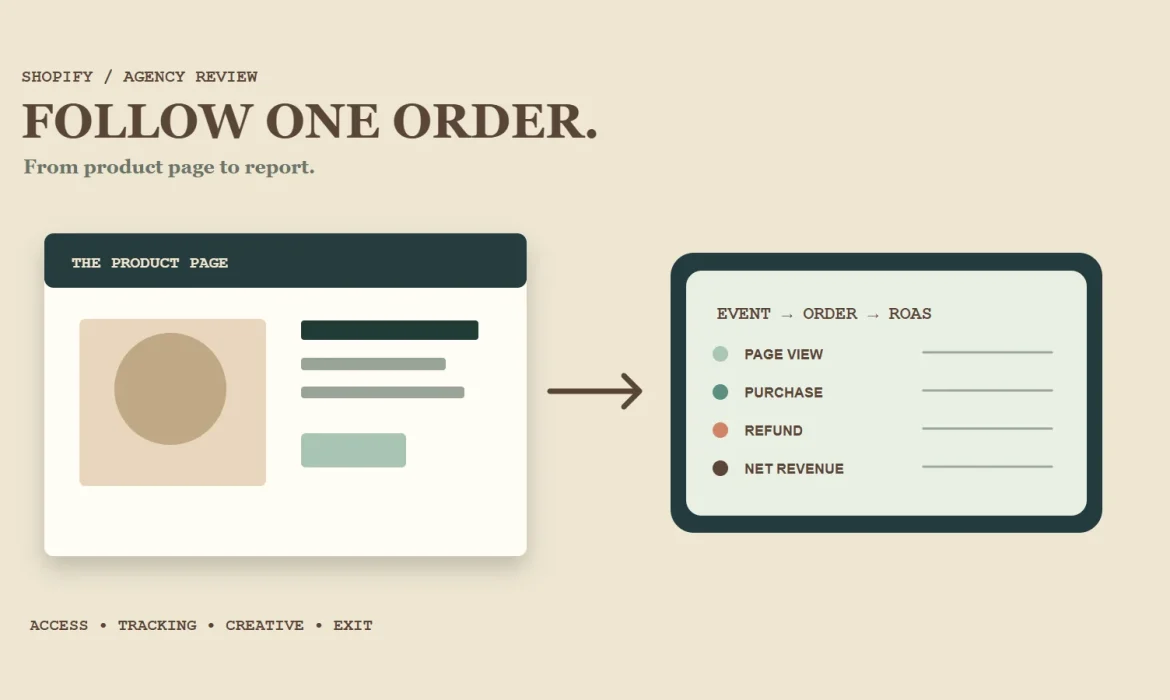
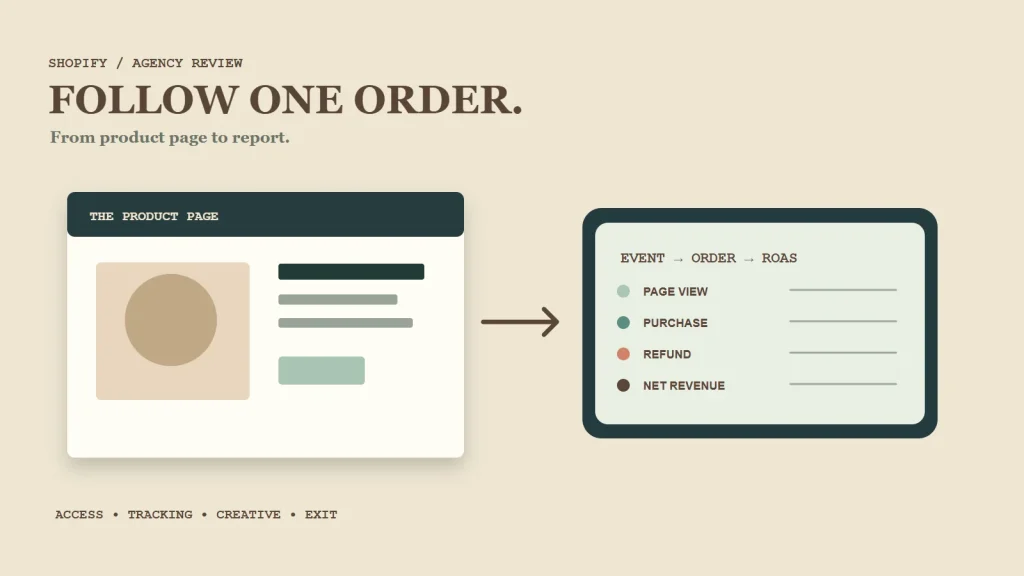
Leave the pitch deck closed for a few minutes. Pick one Shopify order and trace it from product page to checkout, purchase event, report, and refund if there is one. That walkthrough tells you more about a Facebook Ads agency for Shopify stores than a slide of audience labels. Start with access, measurement, and what the owner can verify.
Quick Answer
Choose a Facebook Ads agency for Shopify stores by testing whether you can verify the work, numbers, and handoff—not by relying on a promised outcome. Walk one order through the store and reporting path, confirm who owns the accounts and creative, and ask how the team will check purchase events and refunds. Compare fees and responsibilities under the same scope, including merchant-provided assets and exit terms. Use your store’s margin and fulfillment data to define a bounded pilot with functional checks and a review date. Treat case studies as context, not forecasts; define the evidence you will review instead of assuming a particular ROAS.Walk through the Shopify store
- Quick Answer
- How to evaluate a Facebook Ads agency for Shopify stores with a store walkthrough
- Stop 1 / Read the product page as an acquisition promise
- Stop 2 / Map the assets the merchant controls
- Make the account and data inventory visible
- Stop 3 / Trace the Meta integration before adding another tag
- Stop 4 / Place a controlled order and follow the record
- Stop 5 / Review creative as a working inventory
- Stop 6 / Ask what ROAS leaves out
- Stop 7 / Put the service agreement beside the walkthrough
- Price the dependencies you found during the store review
- Stop 8 / Ask for a case study you can actually compare
- Case-study cross-check / Do not let a Google result masquerade as a Shopify Meta case
- A store-specific agency scorecard
- Stop 9 / Buy a bounded first engagement
- The first review / Separate delivered work from sales maturity
- Handoff rehearsal / Could the store continue next Monday?
- Leave the meeting with an operating record
- How to Evaluate a Facebook Ads Agency for Shopify
- Frequently Asked Questions
How to evaluate a Facebook Ads agency for Shopify stores with a store walkthrough
Open the storefront, not the pitch deck. Choose a representative product and ask the candidate to explain what a new shopper needs to know before buying it. The answer should connect the advertised benefit to actual product evidence, variant availability, shipping, returns, and support. If the agency talks only about audiences and never asks what the customer receives, the evaluation has found a gap.
Use a realistic product-country pair. An item stocked domestically may have a different promise from an item shipped internationally. A bundle may have a different margin and return pattern from a single unit. The agency should not treat the store as one average product with one universal acquisition target.
Tell the candidate what it may inspect and which information is confidential. A discovery conversation can use an owner-led screen share or redacted exports. A sales demo should not require broad production access. Start with a read-only review or a sandbox, then grant only the permissions the approved work needs. When deeper technical work is needed, commission a bounded diagnostic with a scope and appropriate permissions.
The interview route below is designed for a store owner reviewing a provider, rather than a technical implementation manual. It names the questions an agency should answer and the evidence an authorized implementer should preserve. Current account options and platform requirements should be checked during the actual build.
Stop 1 / Read the product page as an acquisition promise
Ask the agency what it would advertise and what proof supports the claim. If the product saves space, where are the dimensions? If it performs a task faster, under what conditions was that demonstrated? If it is suitable for a particular material, who has approved that statement? A good creative concept should not outrun the evidence the store can provide.
Have the candidate identify likely objections: fit, durability, included accessories, delivery, returns, and total cost. Then ask which belong in the ad and which need a page answer. A short video cannot carry the entire sales conversation, but it should not create an expectation the page reverses. Keep the offer consistent across the route.
Examine the product mix. The easiest item to advertise is not always the most profitable to acquire a new customer with. Ask how the team will use approved margin bands, stock coverage, and variant availability. The agency may not need every supplier invoice, but it needs a way to avoid scaling a low-contribution or unavailable item.
Ask what happens when inventory changes. Who pauses or revises an ad promoting a variant that is no longer available? Who checks the catalog and page? How quickly are promotions updated? A media team and a merchant need a shared release process; neither can assume the other has noticed every storefront change.
Stop 2 / Map the assets the merchant controls
Make the account and data inventory visible
The advertiser should understand which organization owns the ad account, analytics property, tag manager, domain, pixel or equivalent event configuration, CRM data, and creative files. In most arrangements, the business should retain administrative ownership of its core assets while granting the agency the access needed to do its work. The precise setup depends on platform features and the company’s security rules, so have the account administrator confirm the current permission model before onboarding. Do not make account ownership a verbal assumption.
Ask the provider to show how access is granted, reviewed, and removed. The agency should identify named users or business entities, use the narrowest practical permissions, and have a process for staff turnover. The client should know where billing is charged, how invoices reconcile with platform spend, and how access changes are recorded. These are ordinary governance questions, not accusations. A professional supplier should be comfortable explaining them and documenting the answer in the kickoff pack.
Plan for the end of the relationship while setting it up. The agreement should require a current asset inventory, exportable campaign records, tracking documentation, creative source files where contracted, and timely transfer of access. Decide what happens to third-party tools, audiences, and reports after termination. If work is held in the agency’s proprietary system, identify which historical data can be exported and in what format. A relationship becomes safer when the client can continue operating, change suppliers, or pause spend without rebuilding its measurement foundation from memory.
For a Shopify and Meta engagement, include the store, Facebook Page, Instagram account where relevant, advertising account, catalog, pixel or dataset, domain configuration, analytics property, and creative library. The precise asset names and permissions can change; have the administrator confirm the active structure. Record the owning business and who can authorize changes rather than relying on the agency’s familiarity with the interface.
Keep billing explicit. Does the merchant pay Meta directly, or is there a documented arrangement for agency billing? How are credits, taxes, exchange rates, and media reconciled? A service invoice should not leave the owner unable to distinguish platform spend from management and production charges.
Stop 3 / Trace the Meta integration before adding another tag
Shopify’s first-party Meta-pixel help page warns that agencies and apps can cause duplicate or incorrect tracking data if the setup is not coordinated. It also says to remove manually added theme pixel code when configuring the channel integration so the store does not retain conflicting pixel implementations. Shopify’s documentation is the reference. The agency should inspect the current implementation before proposing an additional layer.
Ask for an event-path diagram. Which app or channel sends browser events? Is a server-side path active? How are intended duplicate copies deduplicated under the current integration? Where are purchase value, currency, and transaction identifiers set? The owner does not need to memorize every setting, but should receive documentation another qualified operator can understand.
A green pixel status only says that a connection exists. It does not prove the order value, currency, or event count is right. A connection can be active while a discounted order reports the wrong value or a confirmation-page refresh creates another event. Ask what representative cases were tested and which remain unverified. A useful agency knows the difference between a connected integration and a validated business event.
Privacy and data sharing need merchant approval. Shopify documents three Meta customer data-sharing levels: Standard, Enhanced, and Maximum. Its current help page describes Standard as sending customer behavior and the higher settings as sending additional customer information. These are platform settings, not a universal recommendation to choose the highest level. Review the actual configuration with the company’s responsible privacy owner.
| Merchant question | Evidence to request | Who should approve it |
|---|---|---|
| Which integrations send events? | App, channel, tag, and theme inventory | Store/analytics owner |
| What data is shared? | Current setting and field description | Merchant privacy owner |
| How is purchase value built? | Test order and expected value | Finance and analytics |
| How are duplicates controlled? | Active integration method and test | Qualified implementer |
| What changes in a migration? | Release and rollback plan | Authorized store owner |
Stop 4 / Place a controlled order and follow the record
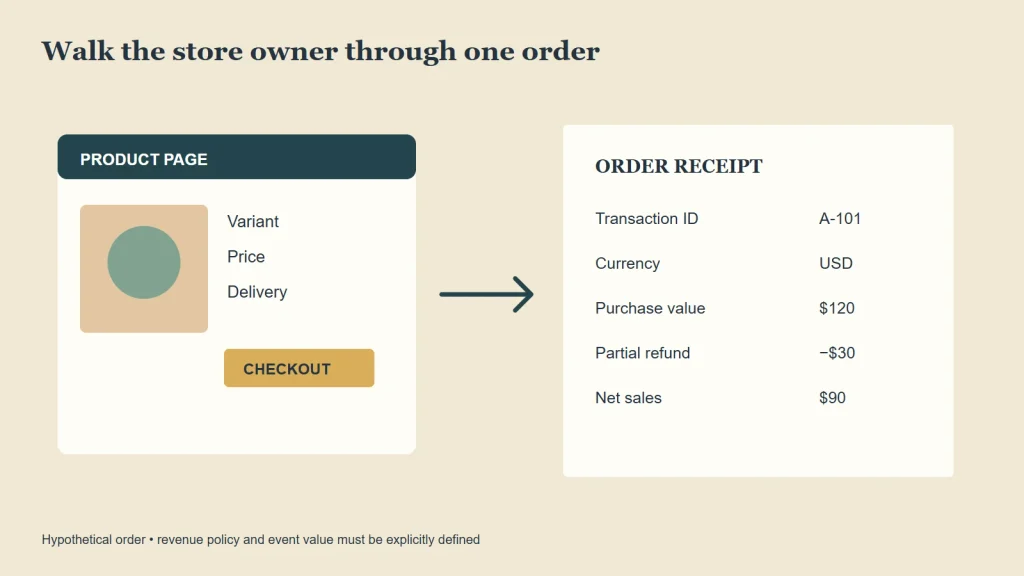
Use an agreed test method with an authorized implementer. Mark test records and coordinate with fulfillment so a QA order does not unintentionally ship. Verify the selected variant, discount, tax, shipping, currency, confirmation, event value, and order ID. Keep the test evidence free of unnecessary customer information.
Then test an edge case. A discount, partial refund, cancellation, alternative currency, or changed variant can reveal a problem a standard purchase misses. Ask which systems reflect the adjustment and when. A finance report may have a different refund-date convention from a platform report; the agency should explain the difference instead of promising that every dashboard will match exactly.
Inspect the mobile route. The first page should continue the creative’s promise, the selected product should remain clear, and unexpected costs should not appear without context. An agency can recommend improvements, but the contract must say whether it implements them or passes them to the merchant’s developer. Recommendations that nobody owns are not completed work.
Stop 5 / Review creative as a working inventory
Ask for a sample asset plan organized by buyer question: demonstration, comparison, fit, objection, delivery, or social proof that can be verified. Three crops of the same image are not three distinct concepts. The candidate should explain what the next production round would investigate and which product evidence it needs from the merchant.
Check rights at the asset level. Creator appearance, photography, music, stock elements, testimonials, and source files can have different usage terms. A content license may permit an organic post but not indefinite paid reuse. Record channels, territory, duration, edits, and renewal conditions. This protects the merchant from losing a successful ad unexpectedly and helps the agency price production honestly.
Ask who approves claims and who responds to comments. For products with technical, health, safety, or regulated claims, involve appropriate reviewers and current policy checks. A campaign operator should not be expected to certify the product’s underlying evidence. The workflow should show how a question returns to the person qualified to answer it.
The merchant should receive a useful production record: concept, source assets, approved claim, usage limit, launch date, and observed response. That is more valuable than a folder of unexplained final exports. It supports the next test and makes handoff possible if staff or agencies change.
Stop 6 / Ask what ROAS leaves out
Platform ROAS is attributed value divided by media spend under the platform’s rules. It is not automatically net sales, incremental sales, or profit. A store owner should ask how discounts, returns, tax, shipping, existing customers, and attribution windows affect the reported number. The exact definitions should be saved with the report.
Use a hypothetical order to test the explanation. At $100 net sales, $35 product cost, $12 fulfillment and shipping subsidy, $3 payment cost, and $10 expected return allowance, contribution before acquisition is $40. If media costs $25 and allocated creative plus management costs $8, $7 remains before fixed overhead and profit. Media ROAS is four, but the order’s remaining contribution is much smaller than the revenue number suggests.
These are illustrative costs, not Shopify or Meta benchmarks. Ask the agency how it would revise the acquisition allowance if the product mix or returns changed. An operator who requests margin context and reports uncertainty is more useful than one who promises a universal ROAS target without seeing the economics.
Keep a store ledger for unique orders and a labeled attribution view for each platform. If the same shopper clicks a Meta ad and later a Google ad, the business has one order even if both systems claim credit. The agency should reconcile those views and identify known coverage limits rather than adding claims into a larger sales total.
Stop 7 / Put the service agreement beside the walkthrough
Price the dependencies you found during the store review
Separate media spend from agency fees, creative production, translation, landing-page work, analytics implementation, third-party software, taxes, and any minimum commitment. Ask whether fees are fixed, tied to a percentage of spend, project-based, or blended. None is automatically fair or unfair. The important questions are how the fee changes when budget changes, what work it covers, and whether the agency has an incentive that could conflict with the client’s priorities. A proposal should show the total expected cost under at least two budget scenarios.
Review payment timing, renewal, cancellation notice, pause conditions, scope changes, intellectual-property rights, confidentiality, and responsibility for platform charges. For international campaigns, also confirm currencies and which party bears exchange-rate fees. Have qualified counsel review legal language that affects data, advertising claims, or liability. A marketing team can identify the operational questions, but a checklist is not a substitute for legal advice. If a vendor asks for a long lock-in, request the business reason and the work product that justifies it.
Consider the cost of switching before signing. A short agreement with no documentation can be harder to exit than a longer engagement with clean account ownership and monthly exports. Conversely, a long commitment may be reasonable when the scope includes substantial setup, research, and training. Compare the expected work, transferability, and risk—not just the number of contract months. Your scorecard should give points for a workable exit plan because continuity of data and assets is part of the service value.
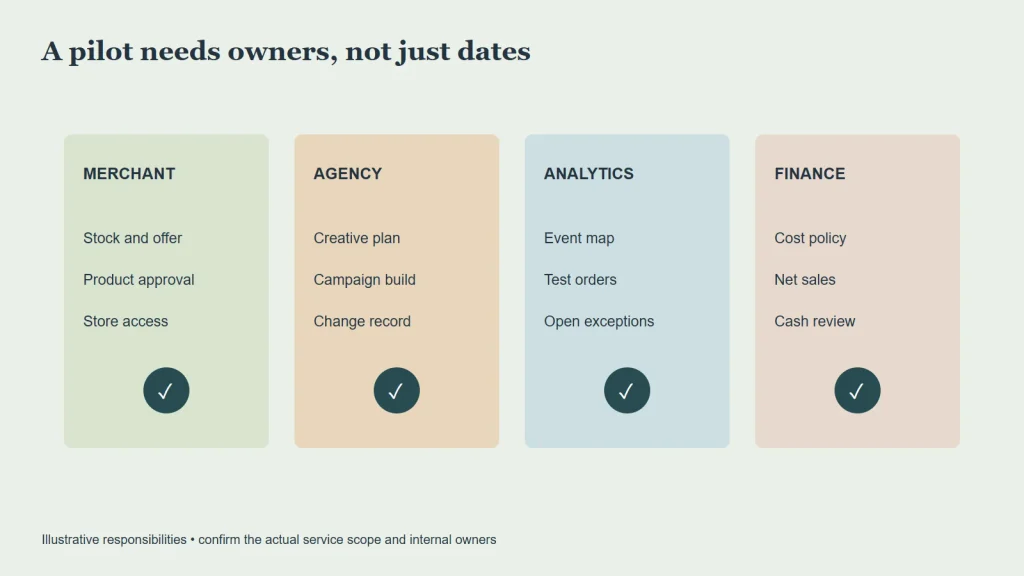
Add store-specific responsibilities: catalog changes, promotion calendar, creative supply, theme work, product-page implementation, analytics QA, customer-service escalation, and reporting. A provider can legitimately exclude some of these, but the merchant must then know who owns them. A “full-service” label should not substitute for a scope table.
Clarify what is included in a creative allowance. Does it cover new concepts, edits, filming, localization, or only resizing? How many revisions and which formats? Who pays for creator licensing or product shipping? A small agency fee can coexist with a large production bill; the owner needs the full cash plan.
Make a pause and exit scenario part of the quote. If stock runs out, what service continues and what fees remain payable? If the merchant changes providers, which files and records transfer, when is access removed, and which subscriptions stop? Portability should be designed while the relationship is healthy.
Stop 8 / Ask for a case study you can actually compare
Request a case with a similar commerce model, price range, geography, and operating constraints where confidentiality permits. Ask for the period, media scope, revenue definition, product changes, and the agency’s exact role. An impressive headline from a mature store with a large creative team may say little about a new merchant with one product and no content pipeline.
Look for the denominator behind the percentage. A claimed improvement may start from a short unstable baseline or coincide with pricing, stock, or promotion changes. Ask whether the comparison uses equal windows and whether returns and existing customers are included. A provider should be comfortable describing limits instead of presenting the result as a forecast.
Use references to learn about execution. How did the agency handle a broken integration, a delayed shoot, a stockout, or a disagreement over attribution? Did it preserve documentation and explain what the merchant needed to do? These answers illuminate the working relationship more directly than another polished screenshot.
Case-study cross-check / Do not let a Google result masquerade as a Shopify Meta case
The supplied case library includes a North American automotive-parts Google Ads campaign with about $160,000 in spend, 3,683 reported conversions, roughly $519,000 in conversion value, and 3.24 ROAS for July 1–September 28, 2026. The case description says Shopping, Performance Max, and Search were combined. It is relevant to an agency interview because automotive catalogs depend on feed accuracy, fitment, variant availability, and product-level margin.
But the source does not identify the store as Shopify, does not describe Meta advertising, and does not provide the product-feed error rate or a reconciled finance report. A candidate should not present this as a Shopify/Meta success story. Ask what additional evidence would be required: commerce platform and catalog export, named product groups, Meta account report, unique order IDs, refunds, customer-acquisition status, conversion-value rules, and permission to show the client’s results.
Use the example to rehearse the interview. If the agency claims that a 3.24 platform ROAS proves profitability, ask for gross margin by SKU, shipping subsidy, discount and return treatment, plus the exact conversion-value configuration. If it says its work caused all reported orders, ask for the comparison or experiment that supports incrementality. If a case combines three Google campaign types, ask how the provider separates their roles and what the case actually reports by campaign.
The answer may be that the available case evidence is not enough to make those claims. That is a sound reason to request a narrower statement, not a failure of the interview. For the Shopify engagement being considered, demand its own account permissions, pixel/event map, test-order record, creative license, product economics, and sales or order ledger. A case in another platform can inform questions; it cannot stand in for evidence from the merchant’s store.
A store-specific agency scorecard
| Review area | Strong evidence | Warning that needs clarification |
|---|---|---|
| Product and offer | Specific buyer objections and supportable claims | Generic creative promises without product questions |
| Commerce operations | Stock, shipping, returns, and margin dependencies | ROAS target offered before economics review |
| Account control | Merchant ownership and documented permissions | Core assets accessible only through the provider |
| Measurement | Event inventory, test record, and value definitions | A connected status offered as the entire QA result |
| Creative supply | Distinct concepts, rights, revisions, and owners | Unlimited language with no production scope |
| Reporting | Unique orders, labeled attribution, and open exceptions | Platform claims summed into business revenue |
| Exit | Portable files, documentation, and access removal | Undefined tool or source-file dependency |
Use this as a discussion record, not a badge system. Mark each area supported, unresolved with an owner, or unacceptable under the merchant’s requirements. A serious unresolved ownership or data-sharing issue should not disappear because the provider has strong creative examples. Resolve the condition before allowing it to become a production dependency.
Let candidates correct gaps during diligence. An agency may clarify that its standard proposal excludes theme development or that a particular source file requires a separate license. The revised written scope is what the merchant should evaluate. The objective is a clear operating agreement, not a surprise after the first invoice.
Stop 9 / Buy a bounded first engagement
The initial engagement should resolve a named uncertainty. It might validate events and product economics, establish a creative testing process, or assess one product-market offer. Define the included store, market, product range, service work, authorized media, reporting, and review date. Do not hide a full migration inside an informal “quick test.”
Set functional acceptance criteria alongside commercial observations. The purchase path should work, event values should be checked, asset ownership should be documented, and inquiries or orders should appear in the agreed reports. Commercial data may take longer to mature; functional defects should not wait for enough orders to form a trend.
If the pilot produces mixed evidence, the agency should recommend a specific next action. A creative route may earn attention but fail to explain product fit. A product page may work while shipping cost undermines conversion. A small sample may justify another bounded period or a decision to stop. The explanation should identify the evidence, owner, and expected learning.
Marketboo’s global paid-media service overview can be assessed with this store walkthrough. Merchants retaining daily execution can compare hands-on advertising coaching against the implementation and review work they need. Use the same evidence requirements for either model.
The first review / Separate delivered work from sales maturity
At the initial review, assess work that should already be verifiable: asset inventory, authorized access, approved offer, event tests, creative record, campaign build, and reporting definitions. If these deliverables are missing, do not let a small amount of early revenue substitute for completing them. A favorable short-term number can coexist with a fragile implementation.
Evaluate early commercial observations separately. Are visitors seeing the promised product? Are stock and shipping conditions stable? What questions do shoppers ask? Are test orders and refunds excluded or labeled correctly? Which campaigns have enough mature orders for a useful acquisition-cost discussion? State the sample size and period beside each ratio.
Give the merchant’s obligations the same visibility. Late product approvals, missing footage, unavailable developers, or delayed finance inputs can prevent the agency from completing scoped work. Name those dependencies and agree on the next date. A review is more productive when it assesses the system both parties operate rather than assigning every delay to one side.
If the agency proposes expansion, ask what constraint it expects the additional money to solve. More media cannot repair missing stock. More creative cannot by itself fix a broken purchase event. A broader catalog campaign may be reasonable when the current product group is understood and the next group has its own margin and page evidence. The recommendation should connect the spend to a specific commercial hypothesis.
Handoff rehearsal / Could the store continue next Monday?
Ask the agency to identify the files and permissions another qualified operator would need to continue authorized work. Include campaign structure, creative versions and rights, event definitions, test results, catalog notes, reporting calculations, and unresolved issues. The merchant should know where those records live and which are updated during the engagement.
Do the same for an internal staff change. If the merchant’s only approver is away, who can authorize a stock-related pause or answer a product question? If the agency’s account lead leaves, who covers the queue and how is context transferred? Continuity is a shared design problem, not simply an exit clause.
The walkthrough has succeeded when the owner can describe what the provider will do, what the merchant must supply, how the numbers are built, and how the work can continue through a change. That is a practical basis for choosing an agency and a clearer foundation for evaluating its work after launch.
Leave the meeting with an operating record
Collect the asset map, event inventory, test results, creative scope, economic assumptions, proposal, and open issues. Name the merchant owner for every dependency and the agency owner for every promised deliverable. A good meeting ends with fewer unexplained handoffs, not merely a longer feature list.
If the candidate cannot yet answer a technical question, request a follow-up from the person who will implement the work. Honest escalation is reasonable. Repeatedly replacing evidence with reassurance is a reason to pause the procurement decision until the gap is resolved.
The right Facebook Ads agency for a Shopify store should leave the owner able to trace what happened, question the numbers, and keep control of the assets. If the walkthrough cannot do that, the meeting has already produced a useful answer: the store needs clearer evidence before it buys the service. A Facebook Ads agency for Shopify stores is ready for a longer engagement when the merchant can verify the work, numbers, and handoff.
How to Evaluate a Facebook Ads Agency for Shopify
- Trace one store order. Follow a representative order from the product promise through checkout, recorded purchase value, and any cancellation or refund.
- Map account access and assets. List store, advertising, analytics, catalog, domain, and creative assets; record owners, needed permissions, and handoff files.
- Test the measurement path. Ask the implementer to demonstrate a test purchase in relevant reports. Note duplicate or missing events and privacy settings for review.
- Review store economics. Use merchant margin, fulfillment, discounts, returns, and inventory assumptions. Keep attributed revenue separate from contribution and profit.
- Define creative responsibilities. Write down formats, production, revisions, approvals, usage rights, source files, and merchant-supplied materials.
- Request comparable evidence. Where disclosure is permitted, ask for examples with similar constraints and check dates, scope, definitions, and agency role.
- Compare fees and exit terms. Separate media, setup, service, production, and optional costs; record minimum commitments, notice, and transfer arrangements.
- Set a bounded pilot. Agree on scope, owners, functional checks, review date, and decision evidence. Assess delivered work separately from early sales results.
FAQ
How should I choose a Facebook Ads agency for Shopify?
Check access, measurement, store economics, creative scope, reporting, fees, and handoff terms. Ask the people doing the work to explain a real store test.
What Shopify experience should an agency demonstrate?
Ask how the team would inspect your product page, purchase events, order values, refunds, and reporting handoff. Request an explanation, not just a label.
How much does a Facebook Ads agency charge for Shopify?
This package does not establish a verified market-price benchmark. Request itemized quotes for the same scope.
Who should control my store and ad accounts?
Document the account owner, each party’s access, included assets, and exit process. Confirm permissions in the actual account and contract.
How can I check whether purchase tracking works?
Use a documented test path and compare the store transaction with connected reports. Check for missing or duplicate events and record open issues.
What should I expect from an agency pilot?
A pilot can test defined operational and commercial assumptions, but outcomes depend on the store and market. Agree on checks without treating them as a results guarantee.
Should I judge the agency by ROAS alone?
No. Consider margin, fulfillment, discounts, returns, order quality, and the attribution model; ROAS alone does not establish profit or incremental impact.