Quick answer
Quick answer: Facebook lead generation ads for exporters work best when the offer, qualifying questions, and sales handoff are designed together. Start by listing the countries, products, languages, and hours your team can actually support. Ask only the form questions that change the next action, record the source and arrival time, and test the route from submission to an owned sales queue. Review accepted, pending, and rejected inquiries as a cohort rather than treating form volume as revenue. If the desk cannot respond usefully, fix that operating constraint before adding budget.
A Facebook lead form can fill while the sales inbox is already behind. That is the risk with Facebook lead generation ads for exporters: the handoff can be weaker than the targeting. Before adding budget, decide who checks the queue, what makes an inquiry serviceable, and how quickly someone can give the buyer a useful reply. Those decisions belong in the campaign plan, not just on a sales team’s cleanup list.
A day at the lead desk
- Quick answer
- 8:45 a.m. / Open the queue, not just Ads Manager
- The seven fields that keep a lead from disappearing
- 9:15 a.m. / Confirm the buying motion Facebook can support
- An audience fact, with its limits attached
- 10:00 a.m. / Admit only markets the desk can serve
- 10:30 a.m. / Make the offer useful enough to qualify
- Facebook lead generation ads for exporters need a usable follow-up path
- Noon / Rehearse the reply before editing the form
- The form edit / Ask only what changes the next action
- 1:30 p.m. / Trace the integration to an owned queue
- 3:00 p.m. / Read rejected records for a pattern
- The weekly arithmetic: volume, acceptance, and time
- What the supplied export campaigns teach about the lead desk
- Friday / Change one part of the desk at a time
- How to Connect Facebook Lead Ads to the Sales Desk
- Frequently asked questions
8:45 a.m. / Open the queue, not just Ads Manager
The first screen of the day should show which inquiries need attention. Look for unassigned records, failed imports, duplicates awaiting review, and contacts without a first attempt. The platform’s submission total remains useful, but it cannot tell a sales manager whether an overseas buyer is waiting in the wrong queue.
Define the business day for each market. A lead received after the team closes is different from one ignored during staffed hours. Keep actual elapsed time and staffed response time separate if both are reported. There is no useful one-size-fits-all five-minute rule. Agree on a reply window the team can meet, tell buyers what to expect, and review the misses against that promise.
A small exporter may rotate desk duty among salespeople rather than employ a dedicated coordinator. The process still needs one responsible person per shift, a backup, and a clear transfer at the end of the day. A shared inbox without an owner creates the illusion of coverage. The daily queue should make responsibility visible without requiring everyone to read every message.
Use role-based access where the CRM supports it. The campaign operator needs enough outcome information to diagnose targeting and offers, but not unrestricted access to every customer attachment or commercial negotiation. Agree on the minimum feedback fields and the authorized place to review examples. Useful feedback does not require distributing full customer records through chat.
The seven fields that keep a lead from disappearing
Start with a compact intake record: stable lead ID, received timestamp, campaign and form version, requested product, destination country, assigned owner, and disposition. Contact details belong in the approved CRM fields, with access governed by company policy. Add information only when someone uses it to make a decision or deliver the promised response.
Store the original source alongside later classification. If sales changes “unreviewed” to “accepted,” the source should not be overwritten. If an integration retries the same form record, it should update or flag the existing inquiry according to a documented key. A new row is not automatically a new buyer. Exporters with long projects may also need a separate opportunity identifier linking several people and conversations.
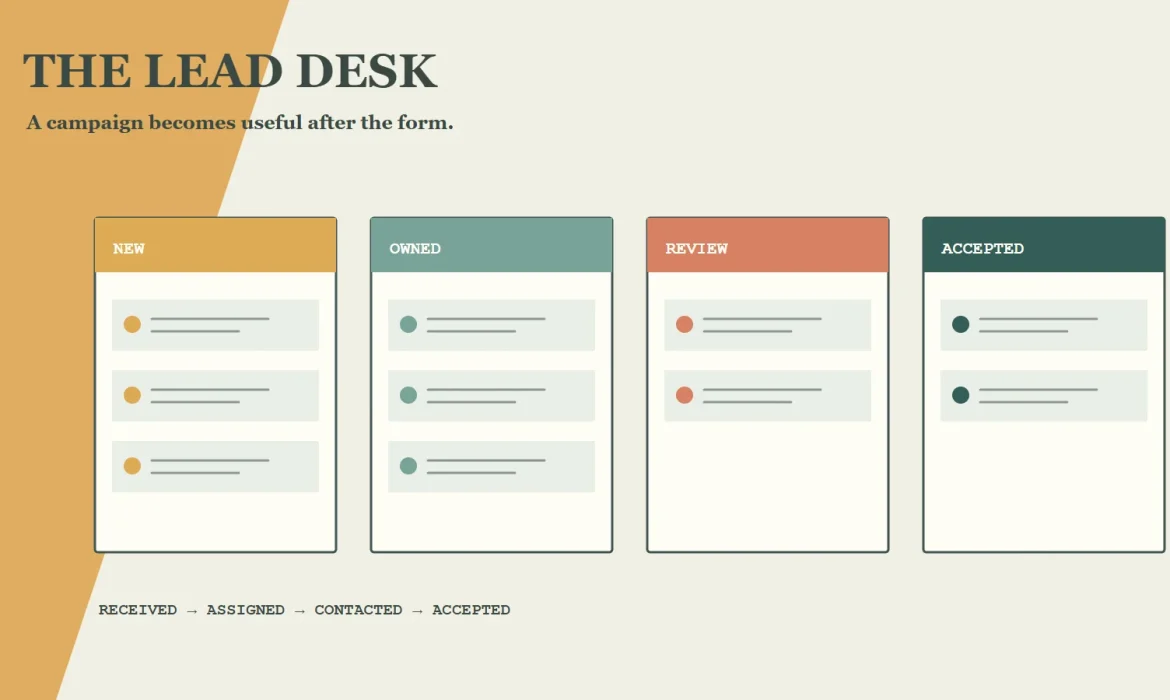
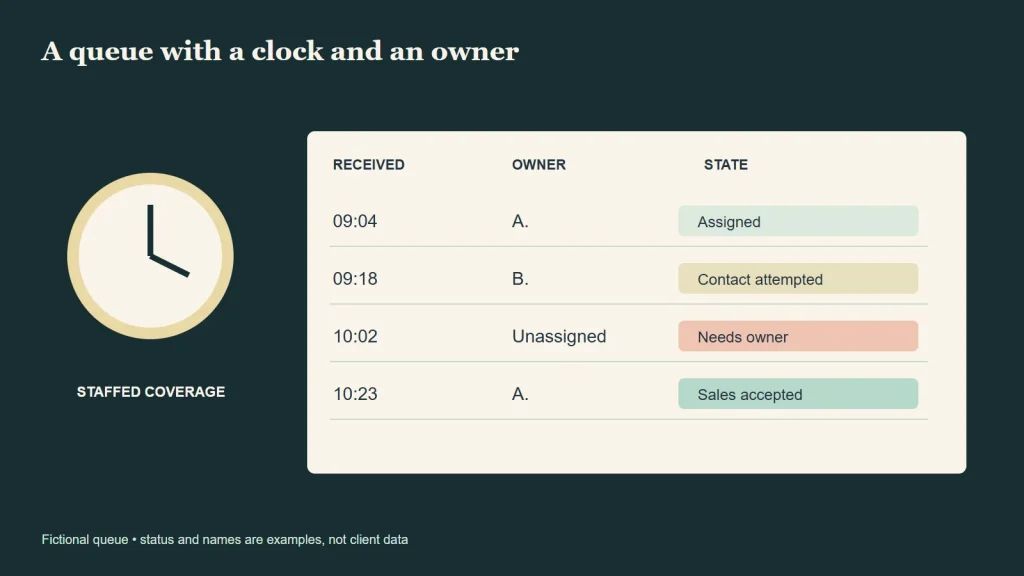
| Queue state | Meaning | Next owner action |
|---|---|---|
| Received | Form arrived; no review completed | Confirm route and assign |
| Assigned | Named salesperson owns the record | Check product and serviceability |
| Contact attempted | An attempt is recorded | Follow the approved sequence |
| Clarification needed | The buyer may fit but key context is missing | Ask a focused question |
| Sales accepted | Record meets the agreed project criteria | Move to quote or discovery |
| Rejected with reason | A defined mismatch was established | Return usable feedback |
| Pending review | Evidence is not yet sufficient | Keep it out of rejection totals |
These are example states, not a required software workflow. Keep the system simple enough that a busy salesperson will use it. If the taxonomy demands a dozen subjective judgments before a reply can be sent, the reporting design is obstructing the work it was meant to clarify.
9:15 a.m. / Confirm the buying motion Facebook can support
Facebook can put a product, use case, or business offer in front of people who may not be actively searching for a supplier at that moment. That can help when the product is visually demonstrable, when the audience can be described by market or business context, or when a useful resource can introduce a problem the buyer recognizes. It is not an automatic fit for every industrial product. If buyers only purchase through a small number of known procurement organizations and the sales team has no capacity to nurture early interest, another channel or a direct sales approach may be a better starting point.
Start by mapping the buyer journey. Does a procurement manager know the category already, or does an engineer first need to understand the application? Is there a distributor network? Can a potential customer make a meaningful inquiry without a detailed engineering call? These questions help decide whether the campaign should ask for an RFQ immediately, offer a specification guide, invite a product consultation, or direct people to a product page. The offer should match the buyer’s stage rather than forcing every visitor into one form.
Make serviceability explicit. List the countries where the exporter can sell, ship, provide support, and respond within a reasonable time. Include any distributors, exclusions, product restrictions, or local-language requirements. A campaign that collects inquiries from a market the business cannot serve is not a successful campaign, even if the platform reports many conversions. Have sales and operations approve the market list before launch and establish how the team will handle a request from outside it.
An audience fact, with its limits attached
Pew Research Center’s 2026 survey reports that 70% of U.S. adults use Facebook. The fieldwork ran January 30 through June 18, 2026. That figure establishes broad self-reported use in the United States; it does not measure importers, industrial procurement teams, advertising reach, or people ready to buy your product. Pew’s fact sheet gives the survey scope and methodology.
An exporter should therefore make two separate judgments. The first is whether the intended market plausibly uses the platform. The second is whether the offer and qualification process can distinguish a commercially relevant inquiry from casual interest. A broad audience statistic can support the first discussion, but only account-level testing and sales records can inform the second.
For markets outside the United States, retrieve local evidence rather than projecting the 70% figure globally. Record country, age base, date, and metric. A platform’s estimated advertising audience uses a different method from a public survey and should be labeled accordingly. Treat a large audience as room to investigate, not a quota the campaign is expected to convert.
10:00 a.m. / Admit only markets the desk can serve
A large audience estimate is a poor reason, by itself, to open a new country. Check service coverage, buyer fit, language, and the team’s ability to respond. Exporters also need to consider product eligibility, shipping cost, duty and tax questions, service coverage, language, sales representation, and payment or procurement practices. The marketing team should not make legal or customs determinations by itself. Where regulations or trade restrictions may apply, consult qualified specialists and official sources before the campaign makes an offer or collects sensitive details.
Score candidate countries against a practical set of factors: current customer evidence, product fit, ability to fulfill, sales coverage, language support, competitive environment, and measurement readiness. A country with existing distributor activity may be a better first test than a larger market with no sales owner. If the business has no history, treat the score as a prioritization tool, not proof that demand exists. Mark assumptions explicitly and define how the test will validate them.
Separate market observations in the account and CRM. Use a consistent country field, campaign naming rule, and lead source. If several countries share one campaign, the business may lose control over where spend goes or what response is needed. Separate budgets when financial control, sales ownership, language, or offer differences justify it. Avoid over-segmentation when the available budget cannot support meaningful learning. The design should balance local accountability with enough observations to review.
| Country factor | Question to resolve before launch | Internal owner |
|---|---|---|
| Product fit | Can the company sell and support this product there? | Product and sales |
| Fulfillment | Can orders ship under the stated terms? | Operations |
| Language | Who reviews ads, form copy, and follow-up? | Local market owner |
| Sales coverage | Who responds and in which time zone? | Sales leader |
| Measurement | Can country and campaign source reach the CRM? | Analytics or CRM owner |
| Policy or legal review | Are claims and data practices approved? | Qualified reviewer |
10:30 a.m. / Make the offer useful enough to qualify
An exporter should give a buyer a reason to share contact information. A spec sheet, catalog, application review, sample request, quote, or technical consultation may be useful depending on the product and the buyer’s stage. The offer must be real and deliverable. If the company advertises a consultation, it needs a person who can conduct it. If it offers a document, the document should be current, clear, and appropriate for the selected market.
Write the ad from the buyer’s problem rather than the company’s desire for more leads. A message might explain how a particular component is used, what information helps the supplier assess a request, or which product dimensions the buyer can compare. Use only claims that can be substantiated. The Federal Trade Commission’s current guidance should be checked for U.S.-targeted advertising claims, and other markets may have their own rules. Have a qualified reviewer assess claims that concern performance, certification, safety, or regulated products.
Creative should make the offer understandable before the form appears. For a B2B exporter, a useful visual may show the product in a credible application, a material detail, a manufacturing process, or a simple selection comparison. Avoid generic stock-style imagery that could represent any supplier. Do not place technical labels or performance promises in an image unless they have been approved and are legible on mobile. Keep the ad, form, and destination page consistent so the visitor does not feel that the offer changed after the click.
Facebook lead generation ads for exporters need a usable follow-up path
An instant form can reduce the steps between an ad and a submission. That may be convenient on a mobile device, but convenience does not guarantee intent or qualification. A website form can provide more product detail and context before someone submits, but it depends on the site’s speed, usability, and tracking. Neither path is universally better. Choose based on the information the buyer needs, the qualification requirements, the CRM integration, and the team’s ability to follow up.
For an instant form, review the intro text, questions, privacy notice, confirmation message, and destination action. Explain what happens after submission. If the business will call, email, or send a quotation, say which team handles the request and what information may be needed. Avoid asking for sensitive personal or business information that is not necessary. Have the company’s privacy owner review the form and data flow for the applicable markets; a platform form does not itself determine whether a particular collection practice is appropriate.
For a website form, inspect the full path on mobile and desktop. Confirm that the ad link opens the right language and product page, that required fields are understandable, and that the success message appears. Submit a test inquiry and make sure the record reaches the intended CRM queue. Check whether UTM parameters or campaign fields persist through redirects and embedded forms. A button click is not the same as a completed inquiry, and an event firing in analytics is not proof that sales received the information.
| Form path | Works well when | Risks to check |
|---|---|---|
| Instant form | A short inquiry is enough and mobile ease matters | Low-intent submissions, field limits, routing delays |
| Website form | Product context or technical detail is important | Slow page, broken tags, abandonment |
| Message conversation | A buyer needs clarification before sharing details | Unassigned inboxes, inconsistent qualification |
| Download offer | Early research and nurturing are appropriate | Content is outdated or follow-up is unclear |
Noon / Rehearse the reply before editing the form
Write a model first response for each offer. A request for a technical catalog should receive the correct catalog and a useful invitation to clarify the application. A quote request should acknowledge the product and ask only for missing information needed to price it. Sending every contact a generic company presentation can waste the relevance the ad created.
Keep the response consistent with the consent and expectations established at submission. A request for one document does not by itself settle every permitted future marketing use. Coordinate forms, notices, storage, retention, and follow-up with the company’s responsible privacy or legal owner and the current platform rules. An instant form is a collection mechanism, not an automatic compliance decision.
Use a first-message checklist rather than a rigid script: identify the company, refer to the requested item, confirm the serviceable market, give the promised next step, and offer a simple way to respond. For a technical product, a short relevant question is more credible than an aggressive sales sequence. Have a fluent reviewer check the actual language used with the buyer.
Record failed contact routes separately. An invalid email, an unanswered valid email, and a salesperson who has not tried to contact the buyer are different events. Combining them as “bad leads” hides the repair. The campaign might need a better form field, the desk might need a new route, or sales might need coverage; the label should preserve that distinction.
The form edit / Ask only what changes the next action
Form design is a trade-off. Every field can help sales, but every added question can make the request feel more work. Begin with a minimum set: business contact, country, product or application, and a field that signals the project or quantity when those details are needed. Then test whether sales can act on the submissions. If too many records remain ambiguous, add one field that answers the biggest gap rather than adding a long questionnaire all at once.
Use clear answer choices when they make it easier to compare needs. For example, a quantity range can be more useful than an open text field if the sales team uses ranges for routing. But do not force buyers into inaccurate choices. Include “not sure yet” when the buyer may be early in research. Avoid asking for information that the company already has or can obtain in a respectful follow-up. The form should help start a conversation, not replicate an internal procurement system.
Review form performance together with lead quality. If submissions fall after adding a field but the remaining records become more relevant, the change may be worthwhile. If the form becomes shorter but sales spends more time disqualifying contacts, it may not be. Track the number of submissions, reachable contacts, sales-accepted records, and time spent on follow-up. The best form is not the one with the most fields or the highest submission count; it is the one that supports the next business step efficiently.
1:30 p.m. / Trace the integration to an owned queue
The lead should reach a monitored destination with an assigned owner. That may be a CRM queue, an approved inbox, or a sales system. Avoid relying on a single employee’s personal email. Confirm who covers holidays, time zones, and staff changes. If the lead is routed by country or product, test that rule with sample records from every relevant branch. A technically successful integration can still route the wrong category to the wrong salesperson.
Preserve the context sales needs: campaign, country, product, offer, submission time, consent or notice information as required by the company’s policy, and the fields the person supplied. Do not add personal data to campaign names or URLs. Follow internal retention and access controls. If data is sent to an advertising platform for conversion reporting, have privacy and technical owners approve the fields, identifiers, and implementation. A campaign’s need for optimization does not override the business’s data responsibilities.
Make response status visible. A lead should not disappear when someone replies. Use a small set of statuses such as new, contacted, qualified, disqualified, quoted, and closed if that matches the sales process. Keep rejection reasons useful and concise. The marketing team can then tell whether the problem is geography, product fit, contact validity, timing, or sales capacity. Review the status definitions periodically; if different salespeople use the same label differently, the analysis will be unreliable.
3:00 p.m. / Read rejected records for a pattern
Review a small anonymized sample with marketing and sales. Group verified rejections into causes the team can act on: unsupported destination, wrong product family, consumer request, invalid contact, duplicate project, student or job seeker, and a genuine project outside the current commercial criteria. Leave unreviewed records out of this exercise until someone examines them.
Match the cause to the likely owner. Unsupported countries may point to targeting settings, form wording, or an offer being shared outside its intended audience. Wrong product requests may point to ambiguous creative or a generic catalog. Duplicate projects may require CRM logic. A platform setting is not the correct response to every disappointing contact.
Use examples to test a proposed fix. If ten inquiries request a consumer version of an industrial product, adding “industrial supply only” near the offer might be worth testing. Do not add a long list of discouraging questions to every form without checking whether it blocks the buyers you actually want. Run a bounded version change and retain the previous form for comparison.
Distinguish contact quality from readiness. A relevant distributor without an immediate order may be useful for a relationship objective but unsuitable for a campaign evaluated on near-term RFQs. State the objective before scoring that contact. An agency and sales team can disagree about quality simply because one is evaluating future fit while the other needs a quote this month.
The weekly arithmetic: volume, acceptance, and time
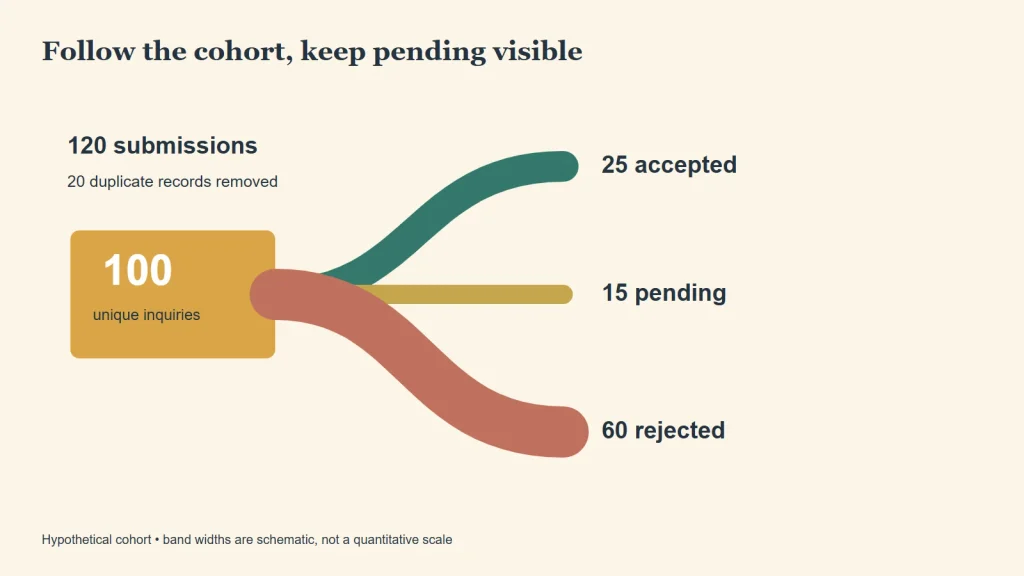
Consider a fictional campaign with $2,400 of media, 120 form submissions, 100 unique inquiries after deduplication, 25 sales-accepted records, 15 pending reviews, and 60 verified rejections. Platform submission CPL is $20. Unique-inquiry cost is $24. Observed accepted-lead cost is $96. These figures are illustrative and describe different denominators; none is a Facebook or exporter benchmark.
The observed acceptance rate across all unique inquiries is 25/100, or 25%. Among completed reviews it is 25/85, approximately 29.4%. Show which denominator is used and keep the fifteen pending records visible. A report that silently removes pending records can look better than the actual operating situation; one that treats them as rejections can look worse.
If five more records are accepted next week, the cohort changes. Update the outcome for that original intake period rather than mixing it into the next week’s submissions. This simple cohort practice helps long-cycle export teams compare campaigns fairly. It also prevents a delayed sales update from being mistaken for a sudden improvement in this week’s targeting.
| Measure | Fictional calculation | Decision it supports |
|---|---|---|
| Submission CPL | $2,400 / 120 = $20 | Form volume and media trend |
| Unique-inquiry cost | $2,400 / 100 = $24 | Deduplicated intake economics |
| Accepted-lead cost | $2,400 / 25 = $96 | Current commercial relevance |
| Pending share | 15 / 100 = 15% | Review backlog and report maturity |
| Reviewed acceptance | 25 / 85 ≈ 29.4% | Quality among classified records |
Finance may also want management, production, and integration costs included. Call that fully loaded acquisition cost and state its components. Do not replace the media-only metric without labeling the change. The value of the ledger is that each reader can see the numerator, denominator, period, and remaining uncertainty.
What the supplied export campaigns teach about the lead desk
The available case material contains useful export context, but it does not document a Facebook Lead Ads result. One Google Ads case covers electric-vehicle exports to Central Asia, the Middle East, and North Africa. Its supplied dashboard summary reports roughly RMB 32,800 in spend, about 189,000 clicks, 244 conversions, and an average CPC near RMB 0.17. The case notes also say that conversion rate was low and that subsequent inquiry screening was needed. The figures do not tell us how many inquiries sales accepted.
Another case concerns motorcycles and three-wheelers in Nigeria, where the project had a local factory and targeted wholesalers and dealers. The roughly half-month summary lists about RMB 5,528 in spend, 30,000 clicks, 155 Google Ads conversions, and an average cost around RMB 35.66 per recorded conversion. Separately, the project team reported 10+ inquiries per day and three orders covering roughly 50 motorcycles. Those daily inquiries and orders are project feedback; the presentation does not show that each was caused by Google Ads or reconcile them to individual conversion records.
That is exactly why an export lead desk needs separate states for received, contacted, sales-accepted, and closed. If a report collapses them into “leads,” a cheap conversion can conceal poor fit; if the desk leaves records unreviewed, marketing may mistake a follow-up delay for bad targeting. For a Facebook pilot, preserve the form ID and market, deduplicate repeated contacts, label unreviewed records as pending, and ask sales to record a short reason for rejection.
Do not transfer the Google Ads figures above to Facebook. They are useful as examples of the difference between a platform event and a business outcome, not evidence that Meta will produce the same cost or volume. A Facebook test needs its own account export, form definition, CRM mapping, and approved market. Before describing an inquiry as qualified, the exporter should be able to show the rule and the record that satisfied it.
Friday / Change one part of the desk at a time
Choose the highest-evidence problem. If records are being lost, repair routing before buying more traffic. If one country has no staffed response, narrow or fix coverage. If the offer attracts the wrong use case, change the message and document the version. A weekly meeting should finish with one owner and a review point for each approved action.
Keep a short change log: problem, example evidence, action, date, affected form or campaign, and expected indicator. An integration repair may be judged by receipt and assignment completeness. A qualification change should be judged by accepted inquiries as well as submission rate. Different interventions require different proof.
Do not call a quieter inbox a success until commercial output is examined. A stricter form may reduce irrelevant contacts and worthwhile buyers at the same time. Compare the same market and offer over a reasonable window, report the sample sizes, and keep conclusions modest when volume is small. The desk’s purpose is useful conversations, not simply fewer messages.
A lead desk does not need elaborate software to work. It needs an owner who checks the queue, a reply the buyer can use, and a record of what sales did next. Marketboo’s paid-media services can be assessed against those handoffs; advertising coaching suits teams that want to keep daily control themselves.For Facebook lead generation ads for exporters, the operating test is simple: can the team serve the market, route the inquiry, and learn from the outcome?
How to Connect Facebook Lead Ads to the Sales Desk
- Confirm the markets the team can serve. List target countries, supported languages, product availability, and sales coverage. Exclude markets where the business cannot provide a useful response or fulfill the offer.
- Choose a useful, specific offer. Select an offer that helps a buyer take a real next step, such as requesting relevant product information or discussing an application. Make sure the offer matches what the company can deliver.
- Define lead qualification with sales. Agree on what makes an inquiry serviceable and which fields would change the next action. Keep questions focused on that decision rather than collecting information without a clear use.
- Select and review the inquiry route. Choose the form or website route that fits the offer and follow-up process. Review the current configuration and make sure the form explains what the buyer is requesting.
- Build the handoff record. Specify the fields, timestamp, source, owner, and disposition the sales team needs. Confirm where the record will appear and who checks the queue.
- Test the full journey. Submit a test inquiry and trace it through the confirmation, CRM or sales queue, owner assignment, and response process. Correct missing fields or routing gaps before increasing activity.
- Review a defined lead cohort. At an agreed interval, compare total inquiries with accepted, pending, and rejected records. Ask sales to explain dispositions and use the findings to adjust the offer, fields, or handoff.
FAQ
Are Facebook lead generation ads suitable for every exporter?
No channel is automatically suitable for every exporter. Consider whether the audience, offer, supported markets, sales coverage, and lead-handling capacity fit the company’s buying process.
Should an exporter use an in-platform form or send people to its website?
Choose based on the information the buyer needs, the fields sales needs, the website experience, and the team’s ability to route and respond to inquiries. Test the complete handoff rather than choosing by form length alone.
How many questions should a lead form ask?
Ask only for information that changes qualification or follow-up. Review each field with sales and remove questions that add friction without helping the next action.
How can exporters reduce low-quality inquiries?
Clarify the offer, market coverage, and buyer expectations; use relevant qualification questions; and review sales dispositions regularly. These steps help diagnose quality but cannot guarantee a particular lead mix.
How quickly should sales follow up?
Set a response standard that the team can staff across the markets and working hours involved. Record when the inquiry arrived and when it was handled so the company can assess its own process.
What should the CRM record for each inquiry?
At minimum, define the source, campaign context, relevant form answers, arrival time, assigned owner, and sales disposition that the team will actually maintain. Confirm the fields and access against company policy.
How should an exporter judge whether the campaign is working?
Review a defined group of inquiries using consistent stages such as accepted, pending, or rejected, alongside spend and follow-up status. State the period and definitions, and avoid equating form volume with revenue.