
Quick answer
Quick answer: TikTok ads for ecommerce brands entering the US deserve a bounded test only when the product can be shown honestly, the store can deliver the promised experience, and the unit economics support learning. Check audience plausibility, product proof, creative capacity, U.S. fulfillment, customer support, and tracking before launch. Prepare distinct video hypotheses, define one commercial question, and set a spending limit that the business can absorb. Review recorded orders, costs, returns, and customer experience together. Platform use statistics can provide context, but they do not predict ad reach or sales for an individual brand.
A product that looks satisfying in a short video still has to survive the store visit. When brands consider TikTok ads for ecommerce brands entering the US, the first questions are practical: can the product be shown honestly, can the page deliver what the clip promises, and do the margins support a test? A trend can earn attention. It cannot fix a weak offer or late fulfillment.

The launch gates
- Quick answer
- TikTok ads for ecommerce brands entering the US need a product-fit review
- Gate A / Is the audience plausible for this product?
- Gate B / Does the item survive a practical product review?
- Gate C / Can three different videos prove the same value?
- The storyboard / One product, three honest treatments
- Gate D / Does the page continue the video honestly?
- The fulfillment gate that a creative review can miss
- Gate E / Can the order carry its acquisition cost?
- Gate F / Separate a good video from a good order
- The test card / Ask one commercial question at a time
- A Google ecommerce result is context, not a TikTok forecast
- The post-launch note / What did the test actually establish?
- Before the next production day
- How to Assess Readiness for a U.S. TikTok Ads Test
- Frequently asked questions
TikTok ads for ecommerce brands entering the US need a product-fit review
Imagine opening a product package with no brand presentation beside it. What would you show someone in fifteen seconds? A visible result, a satisfying mechanism, a comparison with a familiar alternative, or an answer to a frustrating daily problem can create a starting point. If the product needs a long explanation before the value becomes visible, the campaign may need a different educational route or more patient economics.
This is a commercial editing problem. The job is to remove the gap between what a video suggests and what a buyer receives. An attractive demonstration does not fix ambiguous dimensions, unexpected shipping charges, or a return policy that appears only after checkout. Each of those gaps becomes an expensive objection once the business pays for the visit.
Use a launch sheet with four columns: promise, proof, operational dependency, and owner. For “fits a small apartment,” proof might be actual dimensions and a demonstration in a measured space. For “ships from a U.S. warehouse,” the dependency is real stocked inventory and an accurate fulfillment route. One tempting edit is to turn ‘may help’ into ‘solves.’ Keep the claim tied to what the product can demonstrate under ordinary conditions.
The following gates are meant to be answered by product, finance, operations, and marketing together. A single marketer cannot approve material compatibility, invent delivery capacity, or decide privacy obligations alone. The launch is ready when those owners can support the same offer, even if the first campaign remains deliberately small.
Gate A / Is the audience plausible for this product?
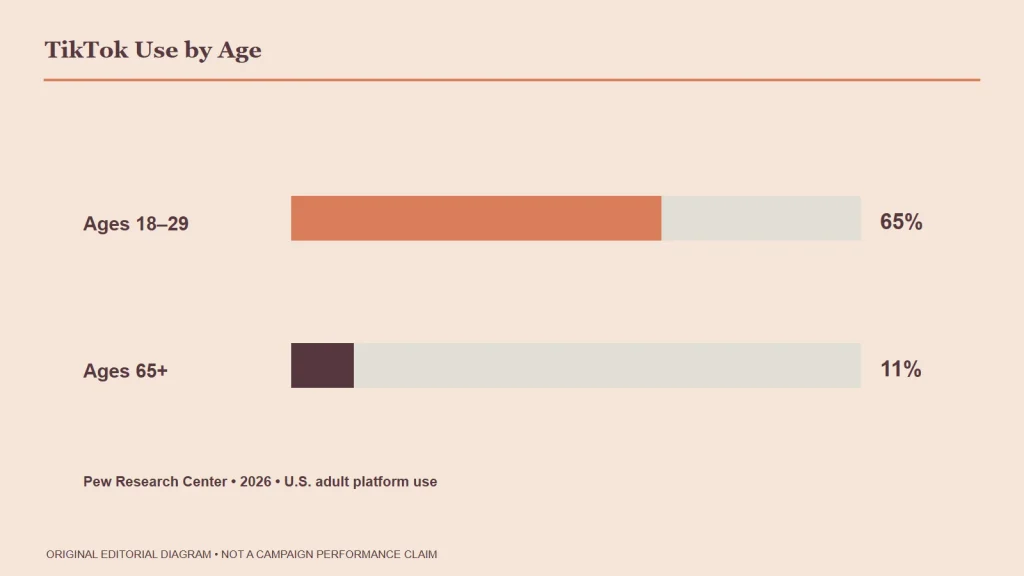
Pew Research Center’s 2026 survey reports TikTok use among 31% of U.S. adults, including 65% of adults ages 18–29 and 11% of adults ages 65 and older. Fieldwork ran January 30–June 18, 2026. These figures describe self-reported platform use, not paid reach, purchase intent, or ecommerce conversion. The survey tables and methodology are the source.
| U.S. adult group | Reports TikTok use | What the figure can inform |
|---|---|---|
| All adults | 31% | Broad platform context |
| Ages 18–29 | 65% | Age-related audience-fit discussion |
| Ages 65 and older | 11% | Caution about assuming equal use across ages |
An older intended customer does not automatically disqualify a product: the purchaser may be a younger family member, professional, or gift buyer. Conversely, a younger audience does not make every affordable product a fit. Write down who uses the item, who pays, and which person’s problem the video addresses. Those may be three different people.
Check actual campaign availability, audience estimates, category policy, and fulfillment destinations before committing production money. Public descriptions and account options can change. This guide does not supply a verified reachable-audience estimate or a legal eligibility assessment for a particular product. Keep those account and product checks in the launch record.
Gate B / Does the item survive a practical product review?
Visual demonstration is the first dimension. Can the product be shown being used, installed, compared, assembled, or applied? Is the relevant change visible and honest? Can the video communicate scale and context? Products that need a diagram or technical explanation may still be suitable, but the brand must create a clear explanation rather than relying on a vague reveal. Avoid editing that makes the item appear more powerful, durable, or effective than the evidence supports.
Contribution margin is the second dimension. Calculate what remains after product cost, fulfillment, discounts, payment fees, returns, and other variable costs. A campaign’s revenue divided by ad spend is not the same as profit. A low-price item may require repeat purchase or a bundle to support acquisition cost; a higher-price product may need more time and education before conversion. Use a range for uncertain costs and decide what the business can afford to learn before assuming that scale will lower the cost.
Creative capacity, market relevance, fulfillment, and measurement complete the scorecard. Can the team produce multiple genuine angles rather than many near-identical edits? Does the offer make sense for U.S. shoppers, including sizing, units, delivery expectations, and return information? Can inventory and customer support handle the response? Are purchase and checkout events recorded well enough to assess the test? A weak score in any one area may mean “fix first,” not “never advertise.”
| Dimension | Stronger test signal | Pause-and-fix signal |
|---|---|---|
| Demonstration | Product use is clear in a short scene | Value depends on an unsupported claim |
| Margin | Variable costs and allowable acquisition range are known | Revenue is used as a stand-in for profit |
| Creative | Several genuinely different stories are feasible | The plan depends on one clip or trend |
| Market fit | U.S. offer, language, size, and pricing are ready | Important terms are unclear or unlocalized |
| Fulfillment | Inventory, shipping, and returns are defined | Delivery promise cannot be supported |
| Measurement | Product and checkout events are testable | The team cannot confirm orders or revenue |
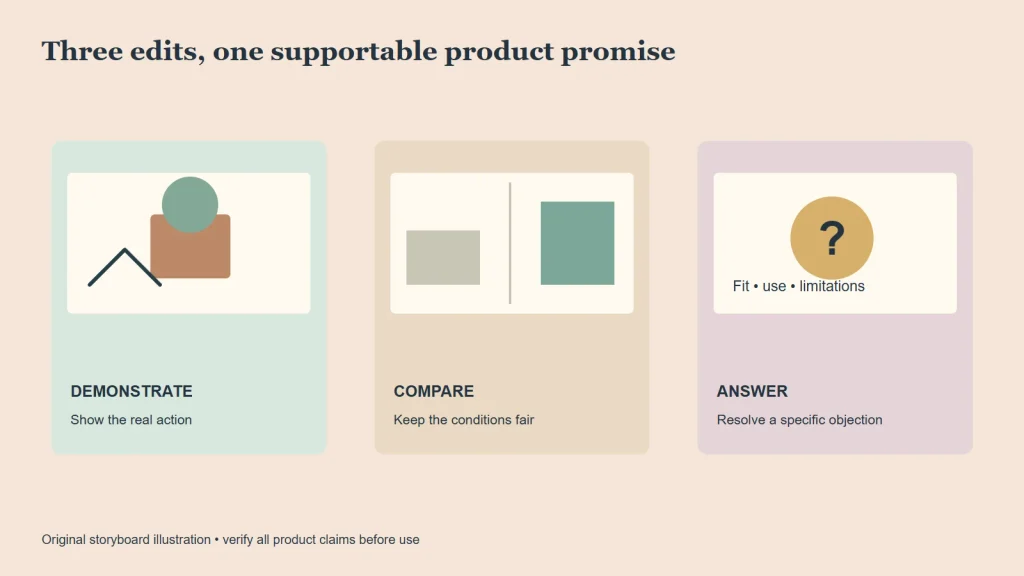
Gate C / Can three different videos prove the same value?
Develop a demonstration, a comparison, and an objection answer. These are three editorial routes, not three opening lines attached to the same footage. For a fictional compact kitchen organizer, the demonstration shows the actual setup, the comparison shows a measured space before and after, and the objection answer explains which shelf sizes will not fit. The last route can improve trust even when it rules out unsuitable buyers.
Write a shot list before recruiting a creator. Specify the visible action, the claim it supports, the exact product version, and the conditions needed to reproduce it. If the result depends on lighting, preparation, accessories, or a particular surface, disclose the relevant limitation. A video that looks easy but cannot be replicated creates a returns problem, not just a creative problem.
Keep claims proportionate. A demonstration of one use does not prove a universal health, safety, durability, or performance benefit. Route regulated or technical claims to qualified reviewers and current policy checks. When a comparison is used, define the alternative fairly and avoid implying an unsupported endorsement. Original product evidence is more durable than a borrowed viral claim.
Separate permission to post from permission to advertise. Creator contracts should address footage, edits, duration, territory, channels, paid reuse, and what happens when usage ends. If music is involved, confirm rights for the actual commercial use. A platform sound available in one setting should not be assumed cleared for every paid placement or off-platform edit.
Plan the next production round before the first one launches. Save clean product footage, close-ups, ambient sound where usable, and alternate demonstrations. The goal is an asset library organized by shopper question. That makes future creative decisions more specific than “find another trend.”
The storyboard / One product, three honest treatments
Take a fictional rechargeable task light. The demonstration route opens with the actual work surface, turns on the light, and shows where it is placed. The comparison route uses the same camera position and exposure conditions to illustrate the difference in a defined setting. The objection route shows controls, charging, and the limits of the mounting surface. None requires an invented customer testimonial.
For each treatment, write down what the viewer can verify from the footage and what still needs a specification. A video may show where the light attaches but not establish a universal battery-life claim. If runtime is advertised, the product team should supply the tested conditions and appropriate qualification. The editor’s job is to distinguish visible evidence from a broader inference.
End each route with a next step that matches the page. “Check the dimensions and mounting options” is different from “buy the complete workshop kit.” If the store sells the light separately from accessories, the frame and copy should make that clear. The correct expectation can reduce an avoidable support and returns burden.
The production brief should include the product version, supplied accessories, claim approval, file owner, and permitted use. Save a clean master without music or platform overlays where rights and workflow allow. That makes future edits possible without assuming that every element in the first export can be reused indefinitely.
Gate D / Does the page continue the video honestly?
A shopper who clicks should land on a product page that answers the questions raised by the video. The page should make the product, price, variant, availability, shipping estimate, return policy, and next action easy to find. If the ad shows a particular bundle, color, or use case, the destination should not make the shopper search through unrelated products. Mobile performance is important operationally because social traffic often arrives on phones, but inspect the actual store rather than assuming that a theme or app has made the experience fast.
Review copy for U.S. conventions and product specifics. Use clear units, sizing, price, shipping currency, and customer-support details. If the brand’s original market uses different terminology, ask a U.S. editor or product specialist to review it. Avoid implying domestic manufacturing, delivery speed, product certifications, or comparative superiority unless the company has evidence and legal approval for the statement. A polished video cannot make a misleading product page trustworthy.
Test the purchase path from the ad destination through confirmation. Check variant selection, inventory state, shipping calculation, taxes, payment, order confirmation, analytics events, and customer-support route. Use a test order or another approved QA method that does not introduce real customer data into a public report. If the store uses analytics or advertising pixels, confirm that the organization’s consent and data rules are met and that technical owners understand how purchase information is handled.
Test the promise with a first-time shopper
Ask someone unfamiliar with the brand to watch the video, open the page, and explain what arrives, what it costs, and what happens next. Let the shopper respond before explaining what the clip was meant to show; otherwise the test only confirms the editor’s own reading. If they expect a bundle but the page sells one piece, or expect next-day delivery where the store offers a longer window, the offer needs revision before a media test.
Check units, sizing, variants, and packaging. American shoppers may need inches alongside metric measurements or a clear size guide. Currency should be obvious. Product photos should distinguish included items from styling props. A customer should not discover the missing accessory by inspecting a tiny footnote after placing an order.
Review the mobile checkout with the actual shipping destination and a representative payment route. A store can look localized while still presenting unavailable shipping, confusing taxes, or an international support contact with no staffed response. Record the tested route and date, because store updates can change the experience after launch.
The fulfillment gate that a creative review can miss
Ask operations to test the promise from the order confirmation backward. Which warehouse fulfills the advertised variant? What stock is actually available after existing commitments? Which destinations create extra cost or delay? Does the shipping estimate shown at checkout match the language used in the video and product page?
Returns need the same specificity. A U.S. shopper should be able to understand the applicable conditions, contact process, and return destination before purchase. Customer service needs a route for damaged, missing, or unsuitable items. Marketing should use approved wording, not invent an attractive policy while writing a hook.
Build a stock interruption plan. If the promoted variant runs low, decide who informs the campaign owner, which assets may continue, and whether an alternative item genuinely fulfills the same promise. Automatically substituting a different size or bundle can make the ad misleading even when the product family is similar.
Include service load in the test envelope. A video that generates many repetitive fit questions may indicate missing page information, but someone still needs to answer those questions while the page is repaired. Record the topics and feed them back to the creative brief. Customer conversations can improve the next edit without being republished as testimonials without permission.
Gate E / Can the order carry its acquisition cost?
Use contribution margin to set boundaries. Suppose a fictional product sells for $80 and has $34 in product, pick-pack, and shipping costs, with an expected $6 allowance for discounts and returns. Before fixed overhead, the contribution available to cover acquisition and other costs is $40. That does not mean the business can spend $40 on an order and remain profitable; payment costs, customer support, and other expenses may still apply. It simply makes the assumptions visible.
Build low, central, and high scenarios for conversion and return behavior rather than choosing one optimistic value. For example, the team can model how many visits and orders it would need to observe to evaluate the offer, then approve a maximum learning budget. Do not call a scenario a forecast unless it is based on relevant data and a documented method. A small test may produce direction but not enough purchases to prove repeatable economics, particularly when new-market traffic is limited.
Set rules for pacing. The team may want to hold spend while it checks landing-page behavior, pause when the product is out of stock, or continue while an agreed cohort matures. Avoid making a decision from one expensive day or a single high-return order. Record the reason for each budget adjustment and preserve the prior period for comparison. The business should know in advance what level of uncertainty it is willing to accept before the test begins.
The margin test behind a plausible ROAS target
For a hypothetical item, start with $80 net selling revenue after discount. Subtract $24 product cost, $10 fulfillment and shipping subsidy, $3 payment cost, and a $5 expected allowance for returns or other variable losses. The remaining $38 is contribution before advertising and fixed costs. These are illustrative inputs, not typical TikTok economics.
At a $25 media acquisition cost, the modeled order leaves $13 before management, creative, overhead, and profit requirements. Media-only revenue ROAS is $80/$25, or 3.2. That same 3.2 does not mean the store is profitable after all costs. A higher return allowance or a larger shipping subsidy could consume the apparent margin quickly.
If the store wants $8 of contribution after advertising and allocated service costs total $6 per acquired order, the modeled media acquisition allowance is $38−$8−$6=$24. The implied revenue ROAS target is $80/$24, approximately 3.33. Show the assumptions beside the target so that a price change or shipping increase triggers a recalculation instead of an argument about the dashboard.
Repeat the model for the main variants. A campaign can shift the product mix toward an item with lower contribution even while aggregate revenue rises. If order volume is still small, report that uncertainty and avoid presenting a precise break-even point as a stable business fact.
Gate F / Separate a good video from a good order
Short-form video can produce a lot of visible activity that does not represent an order. Watch time or engagement can help assess creative, but the business also needs to see product-page visits, add-to-cart behavior, checkout starts, purchases, cancellations, refunds, and customer questions. Match every metric to the question it answers. An opening hook may be evaluated by viewing behavior; the offer and page need shopping outcomes; long-term product fit requires post-purchase signals.
Attribute results carefully. TikTok, other ad platforms, analytics, and the ecommerce platform may report conversions under different windows and rules. A shopper can see a social ad, later search the brand, then purchase through a different channel. Do not sum platform-reported revenue and call the total incremental sales. Use a consistent tagging approach where possible, compare with order records, and describe any gap. If the store is too small for a reliable lift test, say that the analysis is directional.
Quality includes customer experience after payment. Track cancellation, returns, support contacts, delivery complaints, and review themes alongside acquisition metrics. If ads attract buyers who misunderstand the item, the creative or page may need correction even when immediate sales look positive. A brand entering the U.S. should protect customer trust during its first market impression. A campaign is not healthy if it acquires orders by making an offer the operations team cannot fulfill.
The test card / Ask one commercial question at a time
Pick one main product, a defined audience or market hypothesis, and a small set of distinct creative concepts. The test should answer a question such as whether shoppers understand the value, which demonstration earns a product-page visit, or whether a specific offer reduces uncertainty. Do not ask one test to prove the product, price, creative, landing page, and repeat-purchase strategy all at once. If several variables change simultaneously, the team may see a result without knowing what produced it.
Define the success indicators and stop conditions before launch. A test might use an early creative signal, an ecommerce action, and a quality check. The thresholds should come from business economics and available traffic rather than an unsupported industry average. Record the observation window and minimum data needed to make a decision. If the sample is too small, classify the test as inconclusive and determine whether more data is worth the additional cost.
Review creative at regular intervals, but avoid reacting to noise. If a concept receives attention but little product interest, inspect the message and destination. If shoppers add to cart but abandon checkout, investigate price, shipping, payment, or checkout friction. If orders arrive but returns rise, check whether the ad created an inaccurate expectation. Each symptom suggests a different layer of the journey. Change one primary variable at a time where practical and keep a record of the revision.
A Google ecommerce result is context, not a TikTok forecast
The supplied case material includes a North American automotive-parts retailer using Google Ads. Its July 1–September 28, 2026 summary reports approximately $160,000 in spend, 3,683 recorded conversions, $519,000 in conversion value, and 3.24 reported ROAS. The campaign description mentions Shopping, Performance Max, and Search. This is a useful reminder that catalog quality, vehicle fitment, stock, product margin, and the page all matter when commerce advertising scales.
It is not evidence about TikTok. The source does not describe a TikTok account, short-form video, creator licensing, TikTok-attributed orders, or U.S. market-entry results from a TikTok test. Nor does 3.24 ROAS mean that the retailer kept $3.24 in profit for every dollar spent. Conversion value is an advertising-reporting measure; the material does not give product margin, discounts, returns, fulfillment cost, or incremental lift.
For a brand considering TikTok, use the case as a question list for its own store. Can the product catalog distinguish the promoted variant? Does the landing page confirm compatibility and stock? Can finance calculate contribution after returns and delivery? Will a video demonstrate a real product claim under conditions the buyer can understand? Can the event record be reconciled to unique orders? Those are transferable operating checks; the Google campaign’s outcome is not.
If the team wants a channel comparison, define a TikTok-specific test and keep its denominator consistent with the Google view. Save media spend, unique orders, net revenue policy, product mix, attribution window, and refund treatment. The source pack contains no TikTok measurement, so this article makes no claim about expected TikTok ROAS or about which creative would win. The launch gate should be passed by the store’s evidence, not by a number borrowed from a different platform.
The post-launch note / What did the test actually establish?
Write a short finding for each gate. The video may have demonstrated attention, the page may have revealed a sizing objection, and order data may still be too sparse to judge acquisition cost. Those can all be true at the same time. Resist compressing them into a single “works” or “does not work” label.
If a creative route is paused, retain the asset and reason. Was the claim inaccurate, the product unavailable, the audience irrelevant, or the evidence simply insufficient? Future editors should be able to tell which idea was tested and under what conditions. Otherwise a new production team may repeat the same unresolved problem with a new visual style.
End the review with the next bounded question. It might be whether clearer dimensions improve relevant shopping behavior, whether a different demonstration answers the main objection, or whether the economics justify continuing at all. A good test leaves a decision record even when it does not produce a profitable launch.
Before the next production day
Give the creative team a list of unresolved shopper questions and actual product evidence. Name the page section or support answer that will carry each promise after the video. Mark which claims need approval and which footage needs renewed usage rights. This brief is often more useful than asking for a generic number of new assets.
Allocate a portion of the authorized test envelope to the next iteration, but do not assume a fixed percentage fits every brand. An inexpensive-to-film object and a product requiring a location shoot have different production economics. List the cost, owner, and usable outputs rather than treating creative as an unlimited add-on to media.
If the offer is not ready, identify the exact gate that failed. “TikTok does not work for us” is a weak conclusion from a campaign that sent shoppers to unavailable stock. “We cannot currently deliver the advertised variant in the promised window” is an actionable finding. Repair it, revise the promise, or postpone the test.
If the store can make the product promise clearly, fulfill the order, and support the test with enough margin, it is ready to consider a measured launch. Marketboo’s global paid-media services are one way to connect the media plan to the store’s operating limits. Brands keeping their own operator can use hands-on ad coaching to review a specific launch plan.For TikTok ads for ecommerce brands entering the US, review the product promise, margin, fulfillment, and measurement together before committing to a broader launch.
How to Assess Readiness for a U.S. TikTok Ads Test
- Check the product and market fit. Describe the buyer, the problem the product solves, and the evidence a short video could show. Confirm that the company can serve the intended U.S. customers and support the product promise.
- Review the complete customer journey. Check the product page, checkout, delivery expectations, customer support, and return information. Make sure they align with the claims and experience shown in the proposed creative.
- Calculate a conservative contribution margin. List revenue assumptions and variable costs such as product cost, fulfillment, payment costs, discounts, and returns. Use a clearly defined margin measure to set a test boundary; do not assume a target ROAS guarantees profit.
- Plan distinct creative hypotheses. Write several different ways to demonstrate the same verified value, such as a practical demonstration, comparison, or answer to a common objection. Keep the product claim consistent and supportable.
- Set the test question and limits. Choose one primary question, the audience and offer to test, the approved spending cap, and the person who can pause the test. Use current platform documentation for account and campaign setup.
- Check tracking before launch. Test the product view, add-to-cart, checkout, and purchase records that the business relies on. Compare event and order records using a documented date range and attribution definition.
- Review orders and customer experience. At the planned review, examine spend, orders, cancellations or returns when available, margin assumptions, and customer-service issues. Record what the test supports and what needs another test.
Frequently asked questions
What makes a product a plausible candidate for TikTok ads in the U.S.?
A product may be worth testing when its value can be shown clearly, the offer and page are credible, the business can fulfill U.S. orders, and the economics allow a bounded experiment. Those conditions indicate readiness to test, not a prediction of performance.
Does a product that performs well in organic videos have to succeed in paid ads?
No. Organic response does not establish paid performance, order economics, or customer fit. Use it as one source of creative ideas and evaluate paid activity with separately defined measurements.
How much should an ecommerce brand spend on an initial test?
Set a limit the business can afford to lose while gathering the evidence it needs. The amount depends on its economics, test design, and operating capacity; no universal amount predicts sales.
How many video concepts should the team prepare?
Prepare enough distinct concepts to test different explanations of the product’s value, while keeping the offer and measurement understandable. The appropriate number depends on production capacity and the specific test question.
What should a brand test before increasing its ad budget?
Check that the creative promise matches the product page, checkout and tracking work, fulfillment is ready, and recorded orders can be reconciled with the company’s own records. Increase spend only if the evidence and business limits support that decision.
How should a brand calculate ROAS for the test?
Define which recorded revenue and ad spend are included, then divide the attributed revenue by that spend for the same stated period. Because attribution settings and business costs affect interpretation, ROAS alone does not establish profit.
Do U.S. audience statistics predict how many customers a TikTok campaign will reach?
No. Survey measures of platform use describe the surveyed population under the study’s definitions; they do not predict campaign delivery, ad reach, conversion, or sales for an individual brand.