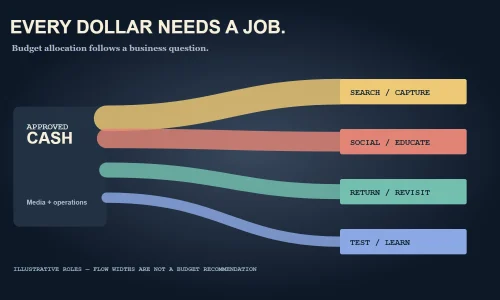
A useful TikTok Ads course should leave you able to explain why a campaign is structured a certain way, what evidence would justify changing it, and which person owns each account action. Look for guided practice in measurement, objective selection, audience and creative planning, budget control, and post-test analysis. The strongest format combines short lessons with a sandbox or supervised account exercise, a written campaign brief, and feedback on decisions. A course can teach a process; it cannot promise profitable results, because outcomes depend on the offer, market, creative, website, data quality, auction conditions, and the decisions made after launch.

What a TikTok Ads course should leave you able to do
Imagine two new media buyers opening the same ad account. One can name every button on the campaign screen but does not know whether to optimize for a lead, a purchase, or a video view. The other can state the business goal, identify the conversion event that represents progress, check whether that event is measured reliably, and explain what result would trigger a change. The second learner has a usable skill. The difference is not vocabulary. It is judgment applied in sequence.
A TikTok Ads course is structured instruction on planning, creating, measuring, and improving campaigns in TikTok Ads Manager. Training may be self-paced, instructor-led, or delivered as coaching with practice and feedback. A course generally organizes lessons for multiple learners; coaching usually adapts practice to a particular account, skill gap, or work context. Neither format should be sold as a shortcut to a fixed return. A campaign is a chain of assumptions, and a learner needs to see how each assumption can be checked.
Before comparing providers, write down the decisions a learner should handle independently after training. Those outcomes might include drafting a brief, checking that a conversion signal fires, selecting an objective that matches the business action, creating a controlled test, reading results without overreacting to a single day, and documenting what changed. “Understand TikTok Ads” is too broad to evaluate. “Explain why this campaign optimizes for a qualified lead and what data must be verified first” can be assessed.
The TikTok Academy is a first-party place to review TikTok’s own learning materials and education options. Treat platform education as a foundation for current terminology and product navigation. Then add a practical layer: a learner should produce work, receive critique, and repeat the decision in a different scenario. A course that only walks through a trainer’s polished campaign leaves beginners with few chances to make a mistake safely and understand it.
Match the course format to the learner’s starting point
Someone who has never worked in paid media needs a different sequence from an experienced Meta buyer learning TikTok. The beginner needs basic funnel language, conversion tracking, creative hypotheses, and budget limits before campaign optimization. The experienced buyer may already understand those concepts but still needs to learn how TikTok placements, creator content permissions, and video-first creative affect the workflow. A founder who expects to manage the account personally may need a shorter operational orientation and a clear account access policy rather than a specialist curriculum.
Ask a provider to separate prerequisites from learning outcomes. If the course assumes an existing pixel, verified domain, creative library, and completed business verification, those items should be listed before enrollment. A learner who does not yet have them can still study with diagrams, sample briefs, or synthetic data; the course should say exactly which exercises require a live account. This prevents a training day from turning into account recovery, asset chasing, or permission troubleshooting.
Build the learning account safely
Account practice can be useful without handing a new learner unrestricted control of a live business asset. Start by documenting who owns the TikTok Business Center, who can approve access, which ad account is used for practice, and what role is appropriate for each participant. Keep ownership with the business. Give the learner only the permissions needed for the exercise, and set a review point for removing access when the program ends.

Before an exercise uses a live pixel, product feed, audience list, lead form, or customer file, identify what information it contains and which internal policies govern access. For a general course, a mock event map or anonymized sample often teaches the same reasoning without exposing customer records. The training lead should explain how to pause campaigns, prevent accidental spend, and recognize when a learner is looking at production data. A safe learning environment is built through clear controls and supervision, not through a vague promise that an account is secure.
Ask the instructor to show the learner’s role from the beginning: who creates, who reviews, who publishes, and who can change payment or business settings. Keep practice work separate from campaign changes that affect customers. Use an approval gate before any learner action can publish or increase spend. That boundary lets a learner experiment with a naming convention or draft while preventing an accidental launch.
An account that is not ready for direct practice can still support serious instruction. Use a paper campaign map, a simulated event table, a creative review exercise, and a historical dataset with identifying details removed. The learner can still decide which objective fits, identify a missing measurement step, compare two creative angles, or propose a test. Instructors should label simulated data and never present it as client performance.
Choose an objective before choosing a button
The campaign objective is a statement about the action the business wants the advertising system to pursue. It is not a substitute for a business goal, and it does not tell you whether the business has the right offer. A learner should begin with the desired customer action: awareness, meaningful consideration, a lead, an order, or another result that the company can define and measure. Then the learner should confirm that the selected event is available, configured correctly, and useful enough to guide the campaign.
This is where many interface-only courses lose the plot. The lesson becomes “click this menu, choose that setting” before anyone asks whether the chosen event means anything. If a business selects a purchase event but the event is missing, duplicated, or firing on a page that is not a completed order, the interface may accept the setup while the underlying measurement stays weak. The learner’s first assignment should be to map the business action to the event and to list what would make that event unreliable.
A course can teach event reasoning without prescribing a universal objective. A retailer with reliable purchase data may test toward purchases. A service firm with a low-volume, high-value sales process may begin by reviewing how it defines and records qualified inquiries. A local event organizer may need to distinguish an event response from an actual ticket purchase. These are different measurement questions. The right class explains how to compare the action to the goal and where uncertainty remains.
A practical module map
| Module | Practice task | Learner deliverable | What the reviewer checks |
|---|---|---|---|
| Business and audience context | Describe the offer, customer problem, buying step, and exclusion assumptions | One-page campaign brief | Goal is specific; audience assumptions are marked as assumptions |
| Measurement readiness | Map the customer action to the event and note where it should fire | Event map and QA notes | Event represents the intended action; open questions are visible |
| Campaign architecture | Choose an objective and organize a test around one clear question | Campaign plan | Settings follow the question rather than habit |
| Creative hypothesis | Turn a customer insight into a hook, proof point, and call to action | Creative brief and variants | Variants test a meaningful difference, not cosmetic changes only |
| Budget and pacing | Set a capped test and define the decision window | Spend guardrail and review date | No unsupported volume or outcome promise; stop conditions are clear |
| Analysis and iteration | Interpret a small result set and choose a next check | Decision log | Learner separates observation from explanation |
| Governance | Assign creation, review, publishing, and access removal | Responsibility map | No shared passwords; approval owner is named |
The deliverable matters because it provides evidence of skill. A completion certificate may tell a manager that the employee attended a course. A reviewed brief, event map, test plan, and decision memo show how that employee thinks. Keep the two forms of evidence separate. A manager can respect a platform credential while still checking whether the new hire understands the company’s product, margins, privacy rules, and lead quality requirements.
Creative briefs and Spark permissions
TikTok creative work should not be framed as a hunt for a single universal style. The creative assignment is to make the product or service relevant, communicate a clear idea, and provide a next step that fits the audience and the landing page. A useful course teaches learners to write a concise brief before they open an editing tool: audience tension, core message, evidence, visual setting, opening moment, call to action, and required disclosures or approvals.
When a team wants to use a creator’s organic post in advertising, it needs to understand permission and authorization, not just how to select a format. TikTok’s official Spark Ads documentation describes the format’s use of authorized organic posts. Treat the current setup and authorization process as something to verify in the account and in TikTok’s latest help material before a launch. Training should include the rights owner, permission scope, duration if applicable, account identity, and what to do if the creator or brand withdraws authorization.
A responsible exercise can use an instructor-owned practice post or a mock creator brief. Learners should identify what needs to be approved before the post is promoted, who may authorize the use, and whether the creative contains a music, image, or claim that needs review. Do not present platform ad approval as a complete copyright, privacy, or endorsement review. A platform’s ability to run a post does not automatically settle the business’s obligations toward creators or customers.
Make the test about a hypothesis
Instead of asking for “three TikTok videos,” ask learners to identify a reason for each version. One may show the product in use; another may open with a customer problem; a third may answer a common objection. If every version changes the hook, offer, audience, landing page, and call to action at the same time, the team will have trouble explaining why the outcomes differed. A course does not have to make experiments academically perfect, but it should teach the value of isolating variables and recording what changed.
Use a simple creative brief with these fields: intended viewer, situation, first visual or spoken idea, claim and its evidence, product demonstration, call to action, destination page, format notes, usage permission, and review owner. Ask the learner to underline statements that need proof and circle assumptions that need a test. The reviewer can then give precise feedback: “This feature claim needs a source,” “the landing page does not match the promised offer,” or “these versions test different audiences as well as different openings.”
The TikTok Ads policy and format guide is a current reference for advertising rules and format-related considerations; the page was shown as updated in April 2026 in the research snapshot used for this draft. Because creative policies and delivery details can change, use that page as a pre-launch reference and confirm the relevant market, format, and account settings before publishing. A general course lesson should teach how to find the current requirement, not memorize a static screenshot.
Budget tests without result promises
Training should teach budget discipline as a decision framework. It should not say that a particular amount is enough to guarantee learning or that a fixed spend will produce a set number of conversions. The amount a business can responsibly test depends on its financial capacity, the value of the action, the sales cycle, operational readiness, and how much uncertainty it can tolerate. The course can show a learner how to set a cap, choose a check-in date, and specify what evidence will be used for the next decision.
For an exercise, label every number as a scenario input. Suppose a fictional store sets aside $900 for a three-week learning exercise. The point is not that $900 is a recommended TikTok budget. It is to ask: What is the maximum acceptable loss for this test? What conversion event is reliable enough to watch? Does the business have enough inventory and customer support? How will the team distinguish an early delivery fluctuation from a consistent problem? The instructor should require learners to answer those questions before discussing a bid or daily budget.
Use a staged review plan. At launch, the team verifies that delivery begins and the event appears as expected. At the first scheduled review, it checks spend, delivery, creative status, and measurement. At the later decision point, it compares results with the stated hypothesis and checks for competing explanations. A learner should not make multiple major edits every few hours because one number moved. The course needs to explain that frequent changes can make interpretation harder, while also identifying conditions that warrant an immediate pause, such as a broken destination or a material policy concern.
Budget planning exercise:
| Scenario input | Example only | Why it belongs in the exercise |
|---|---|---|
| Test ceiling | $900 | Makes the maximum exposure explicit; not a platform recommendation |
| Test window | 21 days | Gives the team a review schedule; not a promise of statistical certainty |
| Creative concepts | 3 | Allows comparison of different customer messages |
| Primary event | Completed purchase | Must be checked against the store’s actual checkout behavior |
| Stop condition | Broken tracking, unavailable offer, or unacceptable spend | Protects the business from continuing a test that cannot answer its question |
| Review owner | Named media lead | Ensures one person documents the decision and next action |
If the learner studies auction delivery, distinguish the planning principles from temporary interface details. TikTok’s Auction In-Feed Ads material was shown as updated in June 2026 in the source snapshot available for this draft. Its guidance notes that safe zones can vary with the ad’s dimensions, text, and add-on formats. That is why “memorize one crop margin” is a poor course outcome. The durable skill is to check the current specification for the format being produced and test the final asset in the correct preview.
Read signals and decide what to change
A learner needs practice separating an observation from an explanation. “Spend rose and purchases fell” is an observation; “the new audience is bad” is an interpretation. Other explanations may include a price change, product availability, tracking, a landing-page problem, a creative mismatch, or a different reporting window. A useful review lists plausible causes before anyone edits the campaign.
Every decision still happens with some uncertainty. The learner should record the evidence, reporting period, what remains unknown, and which result would change the recommendation. That habit prevents a dashboard screenshot from being treated as a complete account of the business. It also makes a small test useful: the team can state what it observed without claiming that the observation explains everything.
Observation, explanation, next check
| Observation | Possible explanation | Next check before editing |
|---|---|---|
| Video views are high but visits are limited | The opening may attract attention without giving a reason to click | Compare the promise, call to action, and landing-page first screen |
| Clicks appear but purchases are absent | The offer, checkout, or tracking may be incomplete | Test the purchase path and reconcile the same period in store analytics |
| One creative appears stronger | The window may be short or delivery may differ | Compare dates, spend, audience, event volume, and other changes |
| A campaign has few events | Volume may be low, setup may be wrong, or the action may be too narrow | Verify the event and page before changing several campaign controls |
| A creator post cannot be promoted | Authorization or account linkage may be missing | Check current Spark Ads guidance and the rights owner’s permission |
Teach the learner to trace the customer event from the page to the reporting view, name who can validate the implementation, and specify which business record will confirm the outcome. A platform report is one view of the journey, not the company’s entire measurement system.
Keep a decision log
Record the date range, objective, audience, creative version, spend, event, data source, observation, possible explanations, next check, owner, and review date. A short note such as “Version B generated more page visits; purchase tracking is still being tested; compare store orders before raising the cap” is useful even before a winner is clear. It tells the next reviewer what the evidence can and cannot support.
A four-stage practice sequence
The following practice run works well as a midpoint assignment in a TikTok Ads course because it moves from a business question to a recorded decision. It can be completed with a practice account, mock inputs, or a supervised account that has been approved for the exercise. Any simulated numbers should be labeled; any production account use should follow the business’s access process.
- Write the business question. State who the campaign is intended to reach, what problem or desire the message addresses, and what action would count as meaningful progress. Keep the question narrow enough to test. “Grow online sales” may be a business ambition, but the exercise needs a defined offer, audience assumption, and measurable action.
- Map the action to measurement. Identify the event that represents the desired action and where it should occur. Record who can validate the implementation. If the learner cannot confirm the event, mark the campaign plan as measurement-pending rather than pretending the setup is ready.
- Choose a format and create a brief. Confirm the placement and format that fit the plan. Draft one clear creative hypothesis, a visible opening idea, proof for each product claim, and a call to action that leads to a matching destination. If the creative uses a creator’s post, document who can authorize its use.
- Set guardrails and launch approval. Name the person who owns the account, the maximum test exposure approved by the business, the check-in schedule, and any immediate stop conditions. Ask the learner to explain what they will not change during the first review, so the test remains interpretable.
- Review the first signal. Check whether the campaign serves, whether the destination works, and whether the expected event is recorded. Distinguish an implementation problem from a performance observation. Escalate a broken link, unavailable product, or unclear permission before optimizing.
- Write the interpretation. Summarize what happened in the defined window, what could explain it, what other data is needed, and which parts of the result remain uncertain. Use actual values only when they come from the agreed source and reporting period.
- Choose one next action. The next step may be to continue, pause, repair tracking, revise the message, or run a better-defined comparison. Explain why that action fits the evidence and who has authority to approve it.
- Close the exercise. Store the brief, event map, decision log, and reviewer notes. Remove temporary access if the practice arrangement has ended. The final debrief should identify one skill the learner can now perform alone and one that still needs supervision.
This is a learning sequence, not a guaranteed campaign recipe. If the learner cannot explain why a change is being made, the instructor should pause the optimization conversation and revisit the question, event, or evidence. A program can move quickly without skipping those steps.
A worked campaign review
Consider a fictional cookware store testing a short video for a new pan. The business wants purchases, but the participant first learns that the purchase event still needs a test transaction. The right next step is to verify the event before using it to make a budget decision.
The video demonstrates the pan but opens with “the only pan you will ever need.” The learner flags the absolute claim because the brief provides no evidence. They propose a specific product demonstration, ask the owner to approve the wording, and check that the landing page features the same item and offer.
The trainer then supplies simulated figures: Version A has 1,200 visits and 18 recorded purchases; Version B has 900 visits and 20 recorded purchases. These are classroom data, not a client result. The learner notes that B has more recorded purchases in the example, but asks whether spend, dates, audience, event validity, and order records are comparable before calling it a winner. The useful recommendation is to validate measurement, reconcile the period, then decide whether a controlled follow-up is justified.
How to evaluate a TikTok Ads course before enrolling
Ask to see a sample lesson or redacted assignment, and request the expected learner outputs. Find out what happens when someone has no live account, which exercises require access, and how feedback is delivered. A program should state its prerequisites and explain how it updates interface-dependent material.
Separate durable reasoning from settings that can change. A course can teach how to frame a goal, define an event, create a test, and write a decision memo. It should also show learners how to verify current menu names, eligibility, and format details in official platform help rather than relying on an old screenshot.
For an internal team, use a before-and-after scenario. Have a manager review the learner’s brief, measurement map, test plan, and decision memo for clarity, evidence, access awareness, and next-step logic. Attendance and a certificate can support the assessment, but the work sample shows how the employee applies the concepts.
If your team would benefit from guided practice on a real campaign brief, review Marketboo’s hands-on advertising coaching and agree on the learning deliverables and account-access boundaries before training begins.
Where beginners get stuck
Beginners often choose interface settings before they understand the offer, business action, event definition, or creative hypothesis. The dashboard supplies fields, but it cannot supply business context. Start by asking what the customer should do and what evidence will confirm that action.
Learners can also confuse a campaign metric with business value. A low-cost video view does not establish purchase intent; a click does not establish lead quality. A platform certificate may show completion of a defined curriculum, but it does not prove that a person understands the company’s margin, CRM, or approval rules. Pair study with an internal scenario and a manager’s review.
When an early campaign misses an expectation, inspect the assumptions before blaming the platform or the learner. Check the offer, page, audience, event, and changes made during the review window. The purpose of a postmortem is to form a better next question, not to claim that every campaign can be rescued.
Questions learners ask before a TikTok Ads course
Do I need a live TikTok Ads account to take a course?
No. A learner can study campaign structure, creative briefs, measurement maps, and decision logs using mock inputs or a supervised practice environment. A live account may help with current interface familiarity, but the course should say exactly what account access is required and who controls it.
Is a TikTok Ads course the same as TikTok Ads coaching?
Not always. A course usually follows a planned curriculum for a group or individual; coaching adds personalized feedback and may adapt the exercises to a specific skill gap or business context. Ask the provider what the learner will produce and how feedback is handled.
Can a course guarantee profitable TikTok campaigns?
No responsible training provider can guarantee profit from instruction alone. Results depend on the business’s offer, market, creative, site, tracking, operations, auction conditions, and decisions. Training can improve a learner’s process; it cannot control all campaign outcomes.
Should beginners start with platform certification or hands-on practice?
They serve different purposes and can complement one another. Platform learning helps a beginner understand current terminology and concepts. Practice reveals whether the learner can apply them to a brief, measurement plan, and review. A manager should evaluate both knowledge and work samples.
What should a practical TikTok Ads course include?
Look for goal definition, event and tracking checks, account permissions, objective selection, creative briefing, budget guardrails, policy review, reporting context, and a documented next-step decision. Ask for examples of the assignments and reviewer feedback before enrolling.
Is Spark Ads training relevant if my team works with creators?
Yes, if the team may promote eligible organic posts. Training should cover the current authorization process, rights owner, account roles, and creative review. Verify current requirements in TikTok’s official Spark Ads material and with the account before use.
How can a manager tell whether the training worked?
Give the learner a new scenario and review a campaign brief, event map, test plan, and decision memo. Check whether the learner can explain the goal, identify missing measurement, set guardrails, separate observation from interpretation, and name the next check. Attendance alone does not demonstrate independent judgment.
Conclusion: Choose practice that builds independent judgment
A TikTok Ads course is worth considering when it teaches a repeatable way to move from a business goal to a measured experiment and a documented decision. Before enrolling, inspect the practice assignments, account-access rules, instructor feedback, source update process, and expected learner outputs. Make the learner prove understanding with a new scenario rather than relying on attendance or interface recall. The primary value of a TikTok Ads course is better judgment under uncertainty—not a promised campaign result. If you want guidance tailored to an existing team, ask about the practical scope of hands-on advertising coaching and agree on clear access and review boundaries before the work begins.