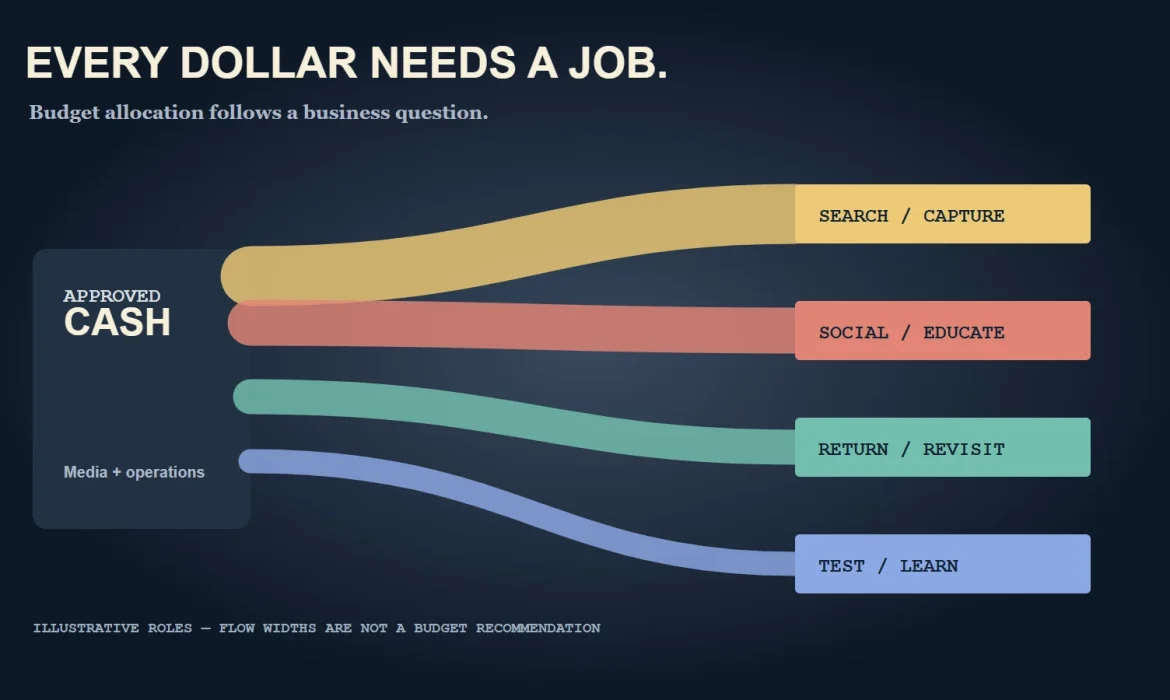
When deciding how to allocate an advertising budget across Google, Facebook, and TikTok, start with the business task each dollar must support. Separate demand capture, product education, return visits, and experiments. Account for creative and measurement before dividing media money, then set a review rule for every pool. The resulting split should follow margin, demand, sales timing, and operating capacity rather than a universal percentage.
The budget decision
- Why a fixed channel split is a weak starting point
- First set the total amount the business can afford to learn
- How to allocate an advertising budget across Google, Facebook, and TikTok by task
- Map Google, Facebook, and TikTok to those pools
- Use a scenario model rather than a universal percentage
- Reserve money for creative and measurement
- Budget for learning stages, not platform enthusiasm
- Do the cash arithmetic before the channel arithmetic
- Create budget movement rules before the first report
- Read ROAS and attribution without double counting
- A quarterly planning example with transparent assumptions
- Budget worksheet for the next planning meeting
- How to allocate a cross-platform ad budget
- Bring the sales cycle into the allocation plan
- Two decisions worth resolving early
- Questions for the budget approval meeting
- Allocate money to a question the business can answer
Why a fixed channel split is a weak starting point
A budget split such as “half for Google and one quarter each for Facebook and TikTok” looks decisive, but it hides the assumptions underneath. Does the business have enough search demand to spend that amount? Can it produce enough creative for two social platforms? Does the sales team know which leads each channel generated? Is the company entering a new market or defending an established one? A percentage does not answer these questions. It can be used as a temporary planning placeholder only if the team labels the assumptions and schedules a review.
Start with the work the business needs done. One campaign may capture existing product searches; another may explain a product to people who are not actively searching. A retargeting program may bring earlier visitors back to a product page. An experiment may answer whether a new country, offer, or creative concept deserves more investment. When each budget line has a job, a manager can shift funds based on evidence rather than platform preference or the loudest weekly report.
The roles are not rigid. Google also offers formats beyond search, while social advertising can capture people who are already familiar with a brand. A user might watch a video, later search the product, and ultimately convert through a different path. The budget plan should therefore describe the primary job for each campaign and the measurement limits. A platform is a delivery environment, not a complete description of customer intent.
First set the total amount the business can afford to learn
Work backward from cash, margin, inventory, and sales capacity. Decide the amount the company can spend without needing a guaranteed return inside the test window. If the offer is new, include creative production, landing-page work, and analytics setup in the total project cost. Media spend is only one part of a launch. A plan that allocates every dollar to platforms may leave no budget to make the ads or measure what happened.
For ecommerce, use contribution margin after variable product costs, fulfillment, discounts, payment fees, and returns. For B2B, estimate the value and timing of a qualified opportunity, but do not treat pipeline value as realized revenue. Model low, central, and high cases when the sales rate is uncertain. The business can then define a learning limit and a maximum exposure. The assumptions should be written down so finance can revisit them when actual order or CRM data becomes available.
Consider sales capacity as a budget constraint. If the team can only follow up with a limited number of inquiries each week, generating substantially more leads may create delay and poor customer experience. If inventory is constrained, an aggressive ecommerce campaign may sell through stock before replenishment. These constraints affect which platform tasks are useful and when money should move. Budget allocation is an operating decision involving marketing, finance, sales, and operations—not only a media buyer’s spreadsheet.
How to allocate an advertising budget across Google, Facebook, and TikTok by task
The first pool is demand capture. It targets people who already express a need through a search, product comparison, or other high-intent action. Google Search can play this role when the business has relevant query demand and a page that answers the query. Measure whether the traffic reaches a meaningful action, not just whether the ad receives a click.
The second pool is demand creation or education. Facebook and TikTok can deliver creative that demonstrates a product, communicates an offer, or introduces a use case. The budget depends partly on creative capacity and on how much explanation the buyer needs. A new product may require more educational content than a familiar replacement item. The third pool is return and conversion support: people who have already visited, watched, or engaged may be reached again under appropriate platform and privacy rules. The fourth is experimentation: a limited amount reserved to test a new message, market, landing page, or channel role.
These pools are a planning model, not a claim that platforms map perfectly to funnel stages. A Google campaign can reach exploratory searchers; a social ad can prompt an immediate purchase. The labels simply make the purpose of each budget visible. When a platform receives money, the team should know which question the spend is answering and what signal would justify continuing. If no such signal exists, the line is probably an unexamined allocation.
| Budget pool | Main question | Example signal | Common owner |
|---|---|---|---|
| Demand capture | Are active buyers finding the offer? | Relevant queries and accepted inquiries | Search lead |
| Demand creation | Does the creative make the offer understandable? | View behavior, qualified visits, response | Creative and paid social |
| Return support | Do prior visitors take a useful next step? | Returning visits and downstream action | Analytics and media |
| Experimentation | Which assumption should we test next? | Evidence against a stated hypothesis | Growth lead |
Map Google, Facebook, and TikTok to those pools
Google can receive a larger share when customers already search for the product or a clearly described solution and the business has pages that match those searches. Search traffic is constrained by query volume and auction conditions; adding budget cannot create unlimited qualified demand. The team should monitor search terms, country, language, conversion definitions, and the percentage of spend that reaches serviceable buyer intent.
Facebook may support prospecting, lead generation, product discovery, or re-engagement, depending on the offer and setup. The team needs a plan for creative variation, audience testing, follow-up, and lead quality. Platform reporting should be compared with the business’s own records. Current Meta features and policies should be verified in the relevant account and official help resources before building the plan, particularly when forms, custom audiences, or customer data are involved.
TikTok can be a place to test short-form demonstrations, creator-style stories, or educational creative. Its budget should include the cost and time required to make distinct content, not only ad delivery. Resources such as TikTok’s Creative Center can help generate ideas, but curated examples do not establish typical results for a particular business. If the product needs extensive specification review or the team cannot produce a credible demonstration, make that a test question rather than assuming the platform is mandatory.
Use a scenario model rather than a universal percentage
An illustrative early-stage plan might place 40% in search capture, 30% in social creative testing, 15% in retargeting, and 15% in a flexible test pool. Another company could reasonably place more in search if demand is established or more in creative if it is introducing a new category. These percentages are not recommendations or benchmarks. They are a way to show how a team can make roles explicit. Replace them with the company’s actual constraints, data, and test objectives.
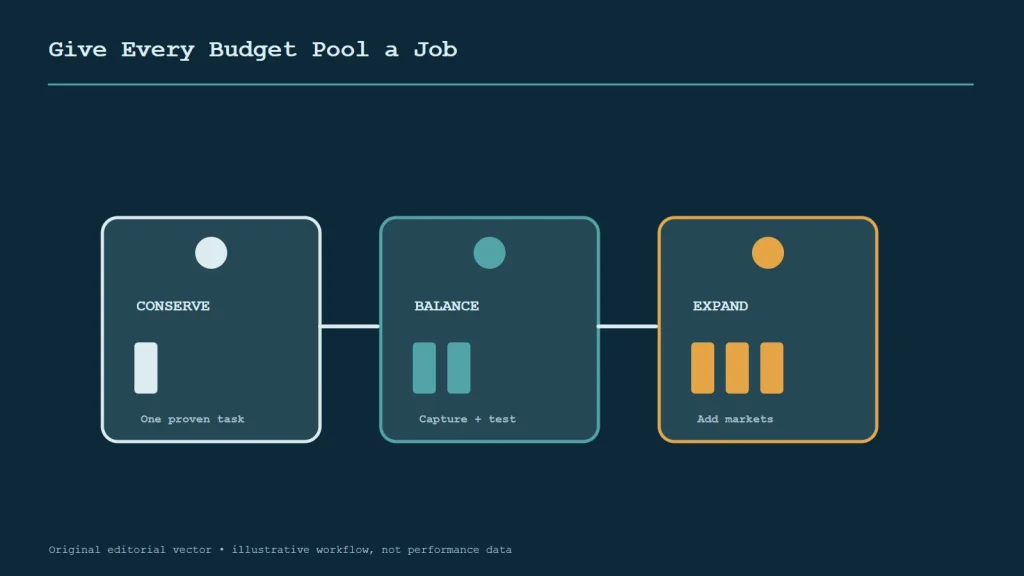
Create at least three scenarios. A conservative scenario funds only the highest-confidence task and basic measurement. A balanced scenario funds capture and one creative test. An expansion scenario includes additional markets or a second social platform after the initial test produces usable evidence. For each scenario, state total spend, duration, creative cost, expected lead or order capacity, and what would trigger a change. If the result depends on an unknown conversion rate, show the unknown instead of filling the model with a fabricated industry average.
Make the allocation resilient to small samples. A narrow B2B product might not produce enough accepted leads in a short window to compare all three platforms statistically. The business may need to test sequentially: capture demand first, then test a social offer, then run a limited combined period. Ecommerce with faster order feedback may support parallel creative tests, but it still has to account for returns and repeat purchases. The right design is the one that fits the available evidence and business economics.
Reserve money for creative and measurement
Creative is not a free input. A social budget without planned assets may produce little learning because the team repeats one concept until it fatigues. Estimate the cost of scripting, product samples, filming, editing, creator permissions, subtitles, and localization. A simple in-house video may cost less in cash but consume employee time. Record both. Review whether the creative budget supports distinct hypotheses rather than just more versions of the same idea.
Measurement has a cost too. The business may need analytics configuration, CRM fields, event QA, call tracking, landing-page work, or a reporting workflow. These costs can be one-time or recurring. If measurement is not ready, allocate some of the initial project budget to fix it before increasing media. A reliable count of inquiries and sales acceptance is more useful than a sophisticated dashboard that cannot be reconciled to the order or CRM system.
Keep these non-media costs visible in the finance plan. If the company’s approved budget is $20,000 for the quarter and creative plus analytics require $4,000, the media allocation is not $20,000. The remaining $16,000 must be divided according to the plan. This example is simple arithmetic, not a recommended spend level. A budget becomes more credible when finance can see the full cash requirement and the team can explain what is being purchased.
Budget for learning stages, not platform enthusiasm
An initial test should answer a limited question. Is a specific product query present in the market? Does a short video make the offer understandable? Does a lead form attract buyers the sales team can serve? Each question may require a different channel and observation period. Avoid allocating equal amounts to all platforms just to appear balanced. Equal spending is not automatically a fair test if one channel needs more creative, has a different purchase path, or cannot reach the same user intent.
The learning phase should have a clear budget ceiling and an observation date. A daily cap can control pacing, but the team must also understand platform billing behavior. Google Ads documentation describes how average daily budgets and overdelivery work, including a monthly spending limit under the published rules. Check the current document and account conditions before forecasting. The rule is a limit framework; it does not say how many leads or sales the budget will generate.
The next stage scales only the part that has earned more investment. That may be a search group, a market, a creative theme, or a landing-page path. Do not scale a platform merely because it has the highest attributed ROAS in its own interface. Review whether the reported results overlap with other channels and whether they reflect revenue, margin, or simply platform attribution. If no source of truth exists, treat reported ROAS as a platform view and report the limitation.
Do the cash arithmetic before the channel arithmetic
The first number in an allocation meeting should be the total approved cash requirement. The second should be the amount actually available for media after production, localization, management, measurement, and other agreed costs. Only then is a channel split meaningful.
For the Google portion, use the platform’s actual spending mechanics. Google’s documentation describes spending up to twice the average daily budget on a day and a standard monthly limit of 30.4 times that average. For an unchanged $100 setting, those figures are $200 and $3,040. Check budget edits and campaign exceptions before using the calculation in a cash forecast. It does not forecast clicks, orders, or opportunities.
Finance can then distinguish three different approvals: the project ceiling, each campaign’s operating setting, and the authority to move money between tasks. If those approvals are collapsed into “the marketing budget,” a routine optimization can create an unplanned cash commitment or leave an essential creative task unfunded.
End the meeting with a short decision record: the question each pool will answer, the owner, the observation window, the cash boundary, and the evidence needed for a change. A fixed platform ratio cannot supply that record. It is the reasoning behind the allocation that makes a later increase, pause, or reallocation defensible.
Create budget movement rules before the first report
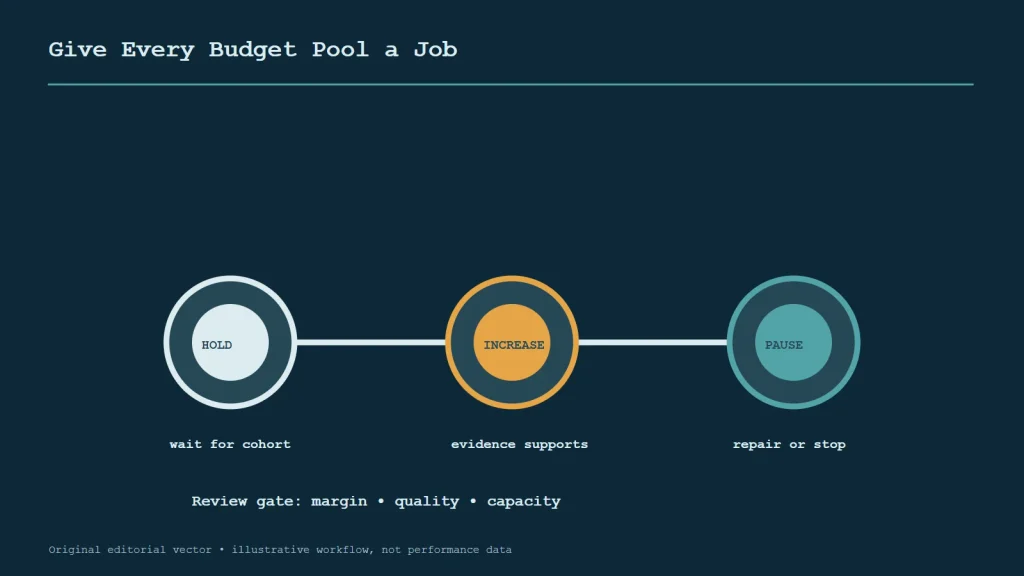
Write down what permits money to move. A budget increase might require stable tracking, acceptable sales-acceptance rate, inventory availability, and a result across more than one review period. A reduction might follow repeated irrelevant searches, broken follow-up, or a margin that cannot support the current acquisition cost. The exact criteria should be set by the company, not borrowed from an unrelated business. Each rule should name who approves the change and what records will be updated.
Set a maximum change per review if volatility is a concern. Moving half the budget from one platform to another after a single day can make the next period difficult to interpret. Conversely, preserving an underperforming allocation without review can waste funds. A documented rule gives the team a middle path: adjust when there is evidence, but change in measured increments that preserve learning.
Budget movement should be linked to the customer’s business stage. If a social campaign generates qualified awareness but few immediate purchases, the business may decide to develop a nurture or retargeting path rather than shut it down. If search campaigns capture all available high-intent demand, incremental budget may be better used to expand creative discovery. These are strategic hypotheses, not universal platform truths. Use the decision record to show why the budget changed and what outcome will be checked next.
Read ROAS and attribution without double counting
ROAS is commonly expressed as attributed revenue divided by ad spend. The formula is simple; the attribution rules behind the numerator can be different. Platforms may use their own windows and models, while analytics and ecommerce systems may assign credit differently. A customer can see a social video, search the brand on Google, click a retargeting ad, and later purchase directly. If each system claims the order, adding platform totals will overstate revenue.
Use a reconciliation view that distinguishes platform-reported conversions, analytics sessions, order records, and finance revenue. Keep dates, time zones, refunds, discounts, currency, and campaign identifiers consistent where possible. Explain which data source is used for optimization and which is used for business reporting. If the company cannot establish incrementality, do not call attributed revenue incremental. A holdout or other controlled design may help in some cases, but it requires sufficient volume and a suitable methodology.
For lead generation, compare platform cost with accepted leads and opportunities rather than pretending a lead has the same value in every country. For ecommerce, include margin and returns. A high ROAS can still be unattractive if the order has low contribution or heavy discounts. A lower attributed ROAS may be acceptable if the campaign contributes new customers or supports demand in a way the business can verify. State these conditions explicitly in the budget review.
A quarterly planning example with transparent assumptions
Imagine a fictional exporter entering two markets with a $30,000 quarterly project budget. It estimates $4,500 for creative and localization, $1,500 for measurement setup and QA, leaving $24,000 for media. The business has active product searches in one market, uncertain demand in the other, and a small internal video team. It may reserve more initial media for search in the established market and a bounded creative test in the new one. The precise split should follow the company’s research and service capacity, not a generic percentage.
The plan might divide the quarter into three decisions. First, validate conversion and country routing. Second, test search intent in the established market and several creative concepts in the new market. Third, review accepted inquiries and available ecommerce or CRM outcomes before shifting funds. A portion remains flexible so the business can address a verified issue or extend a test that is informative but under-sampled. The plan names a maximum spend and a review date for each stage.
At quarter-end, the company reports media cost, channel-level conversions under each platform’s definition, sales-accepted inquiries, creative production, and unresolved data gaps. It does not combine overlapping platform revenue into a single success number. It decides whether to keep the market test, improve localization, expand search, or stop. This fictional example shows the structure of a budget discussion; it is not a performance projection or an agency promise.
Budget worksheet for the next planning meeting
Use one row per task rather than one row per platform. This makes it easier to see why the money exists. The worksheet should include the business goal, owner, budget cap, creative or technical dependency, source of measurement, review date, and rule for continuation. If a platform has more than one role, give each role its own line. For example, a social platform may have a prospecting test and a separate retargeting budget with different audiences and outcomes.
| Plan item | Amount or share | Hypothesis | Review rule |
|---|---|---|---|
| Search demand capture | Relevant buyers are actively searching | Review query quality and accepted leads | |
| Social creative test | Demonstration makes the offer clearer | Review creative and downstream action | |
| Return support | Prior visitors need another touchpoint | Review overlap and incremental evidence | |
| Creative production | Distinct concepts are needed to learn | Review assets and usage rights | |
| Measurement and QA | Data path must connect to business outcomes | Test event and CRM reconciliation | |
| Flexible test reserve | An unresolved question deserves a bounded test | Release only with approval |
The blank spaces are deliberate. Fill them with the business’s own economics and actual evidence rather than copying example percentages. When the plan is approved, preserve the assumptions and the person who approved them. If the assumptions change because inventory, margins, or market coverage changes, update the budget plan and record why. A reliable plan is not a static spreadsheet; it is a shared decision record.
How to allocate a cross-platform ad budget
- Set the total cash limit, including creative, measurement, and media.
- Identify whether the current need is demand capture, demand creation, return, or experimentation.
- Map Google, Facebook, and TikTok to specific tasks the business can support.
- Calculate margin or acceptable opportunity cost using stated assumptions.
- Reserve resources for assets, localization, landing pages, and measurement.
- Set a budget cap, observation window, owner, and movement rule for each task.
- Reconcile platform reporting with analytics, CRM, ecommerce, and finance records.
- Move funds only when the evidence supports a specific next decision.
Bring the sales cycle into the allocation plan
An ecommerce purchase may be visible shortly after a click, while an export lead can take weeks to become a quote or opportunity. The budget review should match the time it takes for the outcome to mature. If the team moves money every few days based on unfinished lead records, it may favor the channel whose conversions appear fastest rather than the channel that creates useful opportunities. Mark new leads as pending until sales has had a reasonable chance to review them.
For B2B, set a distinct observation date for platform delivery and sales acceptance. The first review can identify technical issues and query relevance. A later review can assess lead fit and quote progression. If budget must be decided earlier, make the uncertainty explicit and use the best available leading indicators. Do not call those indicators booked revenue or qualified pipeline unless the CRM definition supports the label.
For ecommerce, include the post-purchase period in the review. An immediate purchase count may not reveal cancellations, returns, chargebacks, or customer-service load. The team can choose a shorter operational window for pacing and a longer financial window for evaluation. Both are useful if named. A budget decision should not wait indefinitely for perfect attribution, but it should distinguish the early signal from the mature business result.
Two decisions worth resolving early
Does a Google Ads daily budget limit mean the exact same amount is spent every day?
Google’s published average daily budget guidance describes variable daily delivery and an applicable monthly spending limit. Check the current documentation and account terms; the budget rule does not guarantee equal daily spend or a business result.
What should I do when there is too little data to choose a platform?
Keep the conclusion narrow, select the next test that resolves the most important uncertainty, and decide whether the expected learning justifies more spend. Do not invent a winner from an under-sized comparison.
Questions for the budget approval meeting
What percentage should go to Google, Facebook, and TikTok?
There is no universal split. Start with customer tasks, current demand, margin, creative capacity, sales coverage, and measurement. Label any initial percentages as assumptions and review them against business outcomes.
Should a new business advertise on all three platforms?
Not necessarily. A new business may learn more by testing one clear channel role at a time. The right number of platforms depends on budget, market demand, available creative, and the ability to measure each path.
How much should I reserve for creative production?
Estimate the actual cost of concepts, production, editing, localization, approvals, and rights. The amount should reflect how many distinct ideas the test needs, not an unsupported standard percentage.
Can I compare Google and Meta ROAS directly?
Not without accounting for attribution definitions, windows, deduplication, refunds, and the customer journey. Keep platform-reported figures separate from reconciled business revenue and be cautious about causal claims.
How often should I move budget between channels?
Set a cadence that matches spend and sales-cycle length. Review operational problems frequently, but avoid large changes based on a small or immature sample. Document every material shift and its reason.
Allocate money to a question the business can answer
Google, Facebook, and TikTok can play complementary roles, but the business should fund tasks rather than follow a fashionable split. Establish the total affordable investment, include the non-media work, and give every allocation a purpose, owner, and review rule. Use consistent business definitions and keep platform attribution separate from finance results. When the team can explain why money moved and what it learned, the next budget decision becomes more disciplined.
If you want help coordinating paid channels and market entry, review Marketboo’s global paid media services. If your team wants to build internal skill around budget decisions and campaign reviews, explore hands-on advertising coaching.