
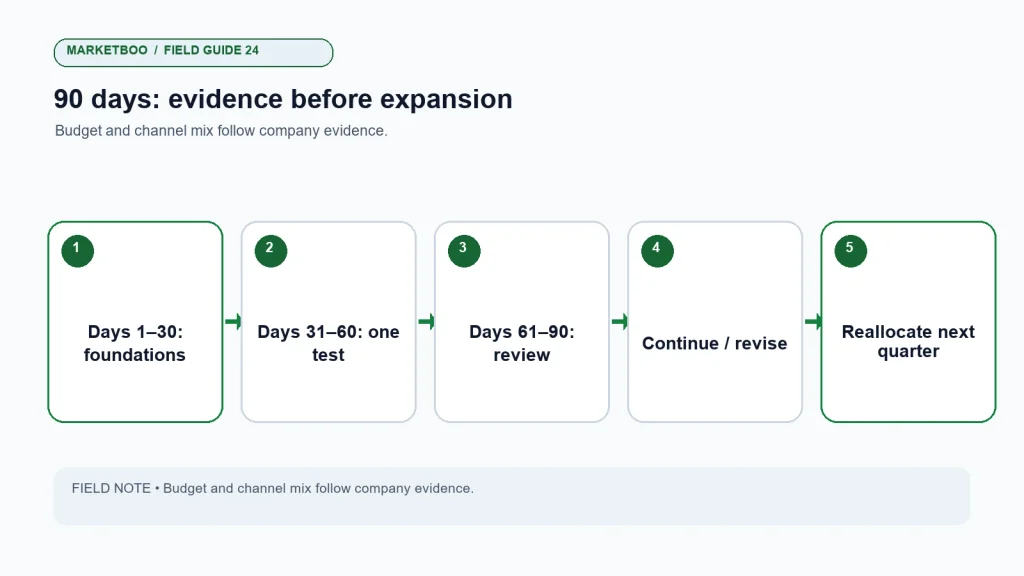
The short answer: A digital marketing strategy for startups should begin with one customer, one business objective, and a measurable path—not a long list of channels. In the first month, clarify the offer, instrument the conversion path, and fix the website basics. In the second, run a bounded test on the channel most likely to reach the intended buyer, while building a small foundation for durable discovery. In the third, review actual lead or order quality, keep what has evidence, and stop what cannot justify further attention. Budget amounts and channel choices should come from the company’s cash constraints and customer data; there is no responsible universal percentage or guarantee for a startup.
Start a digital marketing strategy for startups with evidence
The usual startup marketing problem is not a shortage of possible tactics. It is the lack of time, data, or clarity to choose among them. A team can open a social account, buy search ads, post on LinkedIn, publish articles, create video, and redesign a website in the same month. If those activities do not share a customer hypothesis or reporting path, the company may end the quarter with more work and little learning.
This 90-day plan uses three periods: establish the evidence, test a focused path, then decide what to continue. It is a planning structure, not a promise that a startup will reach product-market fit or profitability in three months. Some businesses need more time to collect sales evidence, particularly with long B2B buying cycles. The plan aims to improve decision quality under limited resources.
Before day one: define the constraint
Write one sentence describing the current business constraint. Examples include: “Qualified prospects do not understand the difference between our product and a workaround,” “We have inquiries but cannot identify which are in our target market,” or “Customers find the product page but abandon before the next step.” Treat each as a hypothesis until the data supports it.
Then agree on one business outcome for the quarter. It could be qualified conversations, trial starts, purchases, partner applications, or a customer-retention action. Do not select a vanity metric as the final goal unless it is clearly tied to the stage the business is in. Reach and engagement may be useful diagnostic signals, but they do not prove that the company has a viable acquisition path.
| Starting question | What to write down | Why it matters |
|---|---|---|
| Who is the buyer? | Role, company or situation, geography, current alternative | Prevents channel choices from targeting everyone |
| What problem is urgent? | Customer language and evidence source | Connects content with actual needs |
| What is the offer? | Product, price or next step, limitations | Keeps claims accurate and actions clear |
| What is the goal? | One observable business outcome | Focuses reporting and trade-offs |
| What is the constraint? | Cash, time, skills, supply, sales capacity, or data | Makes the plan operationally realistic |
| What is unknown? | Assumptions and evidence needed | Stops guesswork from becoming a forecast |
If the company cannot answer these questions, the first marketing task may be customer research and message clarification rather than paid acquisition. “We need more traffic” is not enough to establish that traffic is the bottleneck.
Days 1–30: repair the path before adding more traffic
Week 1: turn customer evidence into a message
Review sales conversations, support questions, product feedback, search terms, existing analytics, and customer interviews the company is authorized to use. Note exact questions and objections. Separate direct customer statements from team interpretations. Choose one audience segment and one problem to address first.
Write a short message: who the product is for, the problem it addresses, what the customer can do, and what the product does not claim to do. Have product and sales owners verify it. For B2B, identify the person who uses the product, who approves it, and what evidence each needs. For ecommerce, clarify the product, price, availability, delivery, and return information.
Week 2: make the website path understandable
Review the main landing page or product page on a phone and a desktop. Can a visitor tell what the product does, who it helps, what happens next, and where to get accurate details? Check that key forms and buttons work, page links are current, and customer contact routes are monitored. Fix the problems that block a relevant visitor before paying for more clicks.
Do not turn the website review into a full redesign unless evidence supports that scope. A clearer headline, stronger product proof, more useful FAQs, or a shorter form may be enough to test a specific hypothesis. If the site needs a broader rebuild, define a separate project with its own owner, baseline, budget, and acceptance criteria.
Week 3: define measurement and ownership
List what the company wants to measure and where each value comes from. Choose conversion events, CRM stages, UTM naming rules, currency, attribution definitions, and the responsible owner. Run test actions and confirm that the form or order reaches the right system. Document what cannot be measured rather than adding unnecessary tracking code.
| Metric layer | Examples | Decision it can support | Limitation |
|---|---|---|---|
| Awareness | Reach, impressions, relevant page visits | Did the message reach the intended audience? | Does not show buying intent by itself |
| Engagement | Content interaction, video completion, resource use | Did the content earn attention? | Does not equal qualified demand |
| Conversion path | Form starts, trial starts, checkout, demo request | Where do visitors take or abandon an action? | Requires reliable event definitions |
| Qualification | Target-fit inquiries, sales accepted, product fit | Are responses relevant to the business? | Depends on consistent CRM feedback |
| Revenue and retention | Paid orders, pipeline, expansion, renewal | Does marketing align with business outcomes? | Attribution and timing remain complex |
Week 4: set a budget boundary
The marketing budget should reflect cash runway, contribution margin, sales capacity, and the cost of learning. Separate paid media spend from contractor fees, creative production, software, and development. State who can approve an increase and what condition would trigger a pause. A budget is a maximum the company chooses to risk, not a forecast that a channel will return a particular amount.
Use a low, expected, and high scenario only when the inputs are explicit. For example, a startup can estimate the amount it is comfortable spending on a test, define the outcome it hopes to observe, and record the conversion assumptions. If no relevant data exists, label the scenario exploratory. Avoid borrowing a competitor’s advertised result as a forecast for your own offer.
Days 31–60: test one focused acquisition path
Choose the channel based on intent, audience access, available creative, and time to feedback. Search advertising may reach people expressing an active need; social advertising may test a message with a defined audience; organic search may build useful pages that can be discovered over time; social publishing may support credibility or conversations; partner outreach may be more appropriate for a narrow B2B market. These are possibilities, not universal rules. Select one primary test and a small supporting activity the team can maintain.
Write a test card with the audience, offer, creative or content, destination, budget cap, dates, primary outcome, diagnostic measures, and stop/continue criteria. Change one major variable at a time if the goal is to learn what drove a difference. If the test compares full concepts, interpret the result as a concept comparison.
For paid tests, confirm that the destination works, product or service claims are accurate, events are recorded, and sales can respond. For content tests, ensure the page answers a real buyer question and has a clear next step. For social publishing, assign someone to review responses and route customer questions. A channel that generates attention but no follow-up capacity may not be the immediate priority.
During this phase, keep an experiment log rather than changing the plan whenever a daily number moves. Record the date, change, reason, result, and caveat. If the sample is too small or the sales cycle has not matured, mark it inconclusive. One weak week should not automatically end a sound plan; one strong week should not justify unlimited spend.
Channel choice matrix
| Constraint | Candidate channel or work | Good first question | What must be ready |
|---|---|---|---|
| Customers are actively searching | Paid search or useful organic pages | Which queries signal fit and intent? | Relevant landing page and conversion tracking |
| Buyer needs category education | Social, video, or educational content | Which question should the content answer? | Accurate product context and a distribution plan |
| Sales needs target accounts | B2B paid social or direct sales support | Which accounts and roles matter? | Account definition and lead handoff |
| Visitors do not convert | Website or offer improvement | Where does the journey break? | Analytics evidence and user testing |
| Market is narrow and known | Partnerships, email, or account outreach | Who already serves the audience? | Permission, relevance, and owner capacity |
Days 61–90: decide what earns another quarter
Review the test against the original goal and budget cap. Compare platform reporting with store, CRM, or sales outcomes using the same period and definitions. Separate outcomes that are observed from outcomes attributed by a platform. Check if the campaign attracted the intended customer and whether the business could fulfill the promise.
The decision can be continue, revise, repeat, or stop. Continue if evidence supports the path and the company has capacity to expand carefully. Revise if the message, offer, or page clearly needs work. Repeat if a known measurement or delivery issue contaminated the test. Stop if the risk limit was reached or the evidence suggests the approach is not worth more resources now.
Do not spread the next-quarter budget evenly across channels to avoid a difficult choice. Use the strongest evidence, the remaining uncertainty, and the company’s constraint. A startup may decide to invest in a better landing page before expanding paid media. Another may continue a small paid test while building a long-term content base. The plan should explain why.
Build a lean operating rhythm
Startups rarely have a dedicated analyst for every channel. Use a weekly review for delivery and customer feedback, and a monthly review for business outcomes and resource allocation. Keep the weekly agenda narrow: what changed, what broke, what new customer signal appeared, what decision is due, and who owns the next step. The monthly review should compare the outcome with the original objective and update assumptions.
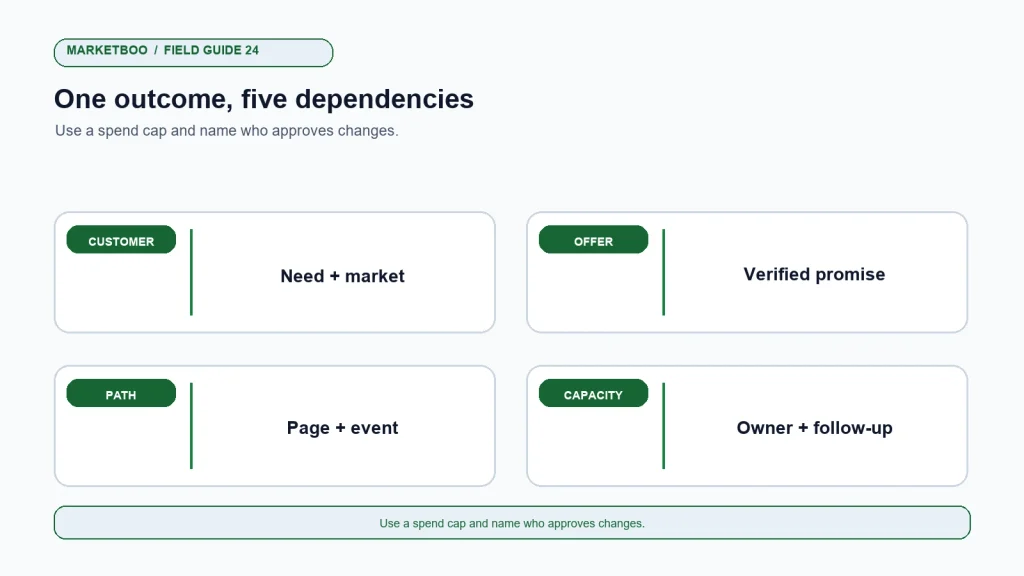
Name one accountable marketing owner even if execution is shared. Product should confirm product truth; sales should define qualified conversation; finance should advise on cash constraints; a founder or executive should approve priorities and budget. Outside partners can contribute, but unclear internal ownership will slow the work and weaken learning.
Use a small content and experiment repository with date, audience, asset, destination, owner, result, and next step. This helps a startup avoid repeating failed tests or losing customer insights when a contractor changes. Store only the data the team needs and follow company privacy and security policy.
Adjust the plan when the evidence changes
A 90-day plan is a commitment to review, not a promise to keep every channel running for exactly three months. If the team discovers that the form sends inquiries to an inactive inbox, fix the route before buying more traffic. If product information changes, update the page and pause ads that make an outdated promise. If the target audience does not recognize the problem, return to customer learning instead of increasing post volume.
Set a change rule before the first test. For instance: “We will pause if the approved spend cap is reached; we will rework the landing page if qualified visitors cannot complete the request; we will keep an inconclusive result open until the sales cycle has had time to progress.” Those are operational conditions rather than performance forecasts. The owners should agree on the exact thresholds using their business context.
Keep a decision journal at the end of each month. Write what the team believed before the work, what new evidence appeared, what remains unknown, and what changed in the next plan. This is especially useful when founders, marketers, or agencies rotate. Without a record, the team can mistake a repeated hypothesis for a new discovery.
Example monthly review note
| Review field | Example prompt |
|---|---|
| Original constraint | What customer or business problem did we intend to address? |
| Work completed | Which pages, campaigns, or content actually shipped? |
| Evidence | Which analytics, sales, and customer signals can be verified? |
| Limits | Was the sample small, tracking incomplete, or the cohort immature? |
| Decision | Continue, revise, repeat, stop, or gather more evidence? |
| Owner and date | Who will do the next task and when will it be reviewed? |
This review should stay short enough to repeat. The value comes from consistency, not from adding a complicated dashboard to a team that has no time to use it.
A 90-day calendar
| Period | Focus | Output | Decision gate |
|---|---|---|---|
| Days 1–10 | Customer and offer clarity | Audience note, customer questions, verified message | Is the target and promise specific enough? |
| Days 11–20 | Website and conversion path | Page fixes, tested forms, event map | Can the intended action be completed and recorded? |
| Days 21–30 | Budget and test design | Budget boundary, test card, named owners | Can the company run the test safely? |
| Days 31–45 | First focused channel test | Campaign/content and dated log | Is the signal relevant and the measurement intact? |
| Days 46–60 | Adjust one element | Revised test or focused iteration | Did the change answer a specific question? |
| Days 61–75 | Review customer and sales quality | CRM dispositions, customer feedback, limitations | Are responses relevant to the business? |
| Days 76–90 | Decide next-quarter allocation | Continue/revise/repeat/stop memo | What evidence supports more investment? |
This schedule is illustrative. If the sales cycle is longer, the last gate may assess qualified conversations or opportunity progression rather than closed revenue. If the company has no customer evidence, the first month may require additional discovery. Change the cadence to fit the business, and record why.
Match the workload to the team’s available hours
A lean plan can still be too large if nobody has time to execute it. Estimate the weekly hours needed for customer interviews, content, page changes, ad review, sales follow-up, and reporting. Compare those needs with actual staff capacity and other commitments. If an activity depends on the founder filming every week, include that time rather than treating it as free. If an agency is engaged, identify the internal person who will answer questions and approve work.
| Work type | Internal owner | Estimated weekly time | Dependency or approval |
|---|---|---|---|
| Customer and sales learning | Interview access and notes | ||
| Product/claim review | Product owner availability | ||
| Website and analytics changes | Developer or platform access | ||
| Content or creative production | Assets and review window | ||
| Lead follow-up | Sales capacity and CRM routing | ||
| Budget and results review | Finance and data definitions |
Use estimates as ranges if the work is new. A founder may discover that two short customer conversations are easy to schedule while a weekly video series is not. The plan can then prioritize the lower-friction activity that still advances the learning goal. This is more realistic than committing to every channel and apologizing when the team cannot maintain them.
If no one owns a task, either assign it, remove it from the plan, or bring in scoped help. Unowned work should not remain as an invisible dependency. A small plan that can be executed consistently is more useful than a comprehensive calendar that depends on spare hours that do not exist.
Common mistakes in startup marketing plans
Starting with channel preference. A founder may prefer video or SEO, but the plan should first answer who the buyer is and what evidence the team needs. Use the preferred channel only if it fits the problem and available capacity.
Treating marketing spend as a fixed percentage. Startup cash needs and margins vary. A rule-of-thumb percentage can ignore runway, inventory, sales cycle, and product maturity. Build a decision from the company’s finances and testing plan.
Changing the website, audience, offer, and creative at the same time. The team may see movement but cannot interpret it. Sequence changes or mark the work as a bundled concept test.
Calling every inquiry a lead. Define target fit and sales acceptance in the CRM. Review why inquiries do or do not qualify.
Using early metrics as revenue proof. Reach and clicks can diagnose attention. They do not guarantee pipeline or profit. Keep a clear boundary between leading indicators and business outcomes.
Expanding before the team can follow up. Confirm that product, sales, and support can respond. More inquiries are not useful if the customer waits or receives an inaccurate answer.
How to build a startup digital marketing plan
- Choose one business outcome. State what the quarter should help the company decide or improve.
- Describe one customer segment. Identify need, role, market, alternative, and evidence source.
- Write and verify the offer. Confirm the product promise and limitations with the product owner.
- Fix the customer path. Test the landing page, form, checkout, or demo request on a phone and desktop.
- Define data and ownership. Map events, CRM stages, attribution rules, and review responsibilities.
- Set the budget boundary. Separate media, service, creative, and development costs; assign an approver and cap.
- Select one primary channel test. Match channel to intent, audience, evidence, and team capacity.
- Write the experiment card. Record hypothesis, creative, destination, metrics, dates, and stop/continue criteria.
- Run and document the test. Monitor technical issues and customer feedback without overreacting to early noise.
- Review and allocate the next quarter. Compare evidence with the original constraint and decide continue, revise, repeat, or stop.
Where outside support fits
An outside team can add execution capacity, specialist skill, or a structured review. It should not take over decisions that require product knowledge or cash approval. Ask a partner to define deliverables, client inputs, data access, reporting, and the actions that remain internal.
Marketboo provides SEO/GEO services, global paid media, social media management, and website development. If a startup is choosing among these needs, contact Marketboo with the current constraint, evidence, and budget boundary. Ask for a scoped recommendation with assumptions and exclusions; do not treat a channel proposal as a guaranteed outcome.
Frequently asked questions
What is a good digital marketing strategy for a startup?
A useful strategy starts with a defined customer, business objective, offer, conversion path, budget boundary, and measurement plan. It selects a small number of channels based on customer behavior and team capacity, then uses evidence to decide what to continue. There is no universal channel mix for every startup.
How much should a startup spend on digital marketing?
There is no verified universal percentage or monthly amount. Set a budget based on cash runway, margin, sales capacity, the cost of a test, and the risk the company can accept. Separate advertising spend from agency fees, creative, tools, and development.
Which channel should a startup use first?
Choose based on how customers discover and evaluate the product, what the company needs to learn, and how quickly results can be reviewed. Active search, social distribution, content, partnerships, and direct sales each serve different situations. Validate the choice with the target audience and current evidence.
Can a startup create a 90-day marketing plan without product-market fit?
Yes, if the plan is framed as learning and validation rather than guaranteed scale. Focus on customer evidence, message clarity, a working conversion path, and small tests. Avoid treating early engagement as proof that the product has achieved product-market fit.
Should startups invest in SEO or paid ads first?
It depends on urgency, search demand, sales cycle, internal resources, and the need for immediate feedback. Paid ads can test a message under controlled spend; SEO can build discoverable resources over time. Many companies combine them, but the plan should define the role and evidence for each.
What marketing metrics should a startup track?
Track a small set across awareness, engagement, conversion, qualification, and revenue. Select metrics that answer the business question and define the source, time period, and attribution method. Keep early signals separate from closed business outcomes.
When should a startup hire a marketing agency?
Consider an agency when the company has a defined problem and an internal owner who can provide accurate product information, approve work, and evaluate outcomes. If key foundations are missing, begin with a scoped diagnostic, training, or customer research task rather than a broad retainer.
Let the evidence choose the next channel
A digital marketing strategy for startups does not need to cover every platform. It needs to make a deliberate choice about the company’s customer, the problem, the offer, and the next piece of evidence. Use the first month to repair clarity and tracking, the second to run a bounded test, and the third to decide what deserves another quarter.
The plan is successful when it helps the team stop low-value work and concentrate on a path it can explain. If the test is inconclusive, preserve the learning and adjust the question. If the evidence supports expansion, increase scope carefully and keep the same definitions. A lean budget works best when each dollar and hour has a purpose the company can review.