
The short answer: A digital marketing agency for SaaS companies should fit the company’s current growth constraint, not sell a fixed bundle of channels. Before hiring, identify what is known about the customer, which part of the funnel is weak, what evidence exists, and who inside the company can own product truth, sales feedback, and budget decisions. Early teams may need positioning and measurement before more campaigns. Growing teams may need channel execution or content capacity. Larger teams may need specialist support and cross-functional coordination. Choose an agency with a scope that can be reviewed against business outcomes, and retain strategic decisions that depend on product, customer, pricing, and revenue knowledge.
Choose a digital marketing agency for SaaS companies by bottleneck
A SaaS company may come to an agency saying, “We need SEO, paid ads, social, and a redesign.” That request names activities but does not explain the constraint. Perhaps sales conversations are not converting because the product page is unclear. Perhaps qualified accounts exist but do not find the product in search. Perhaps demand is healthy but the team cannot produce campaign assets. Or the company may lack reliable event definitions, making it impossible to tell whether any channel is working.
An agency can execute well and still be the wrong hire if the company has not identified the bottleneck. A channel plan should follow the customer, buying cycle, product maturity, and internal capacity. The provider should ask what the company has learned, what is still a hypothesis, and which internal team owns the next decision.
Match support to stage without pretending every company follows a ladder
Validation: clarify the audience and the offer
At an early stage, the company may still be learning which customer problem is urgent, who makes the purchase decision, and which product claims resonate. Heavy campaign volume can amplify an unclear message. The agency role may be limited to research support, a focused content test, landing-page review, or measurement setup. The company should retain product positioning and customer learning decisions because those require direct knowledge of the product and users.
Early growth: build a repeatable acquisition path
Once there is evidence of demand, the company may need a dependable cadence for organic search, paid media, social content, or website updates. The useful agency scope is usually tied to one or two explicit growth constraints: qualified demand, pipeline creation, conversion-path clarity, or content capacity. The company should give the partner access to product and sales insight and agree how leads or opportunities will be measured.
Scaling: expand execution with governance
As the company adds products, markets, and internal stakeholders, the work becomes more coordinated. Several channels may share a content source, brand claim, landing page, and analytics layer. A partner can add specialized execution, but the business still needs owners for budget, product facts, CRM definitions, legal review, and roadmap priorities.
Enterprise or multi-market operations: coordinate complexity
Large SaaS companies may have multiple brands, regions, product lines, CMS teams, and analytics owners. The agency may support a defined workstream, technical SEO backlog, paid campaign structure, content operation, or training. Governance, approvals, data definitions, and platform access must be clear before execution. A broad retainer does not automatically resolve cross-team ownership.
| Company condition | Possible agency contribution | Internal work to retain | Evidence to request |
|---|---|---|---|
| Offer still being validated | Research synthesis, message experiments, page review | Product decisions, customer interviews, claim approval | Clear assumptions and test plan |
| Early repeatable demand | Channel execution, content production, tracking review | Sales feedback, ICP definition, budget priorities | Reporting tied to qualified outcomes |
| Multi-channel growth | Campaign coordination, SEO/content, creative operations | Product truth, attribution definitions, sales ownership | Cross-channel work plan and responsibility map |
| Multiple markets/products | Specialist execution, governance support, audits | Market decisions, regional facts, technical approvers | Named team, workflow, access and QA procedures |
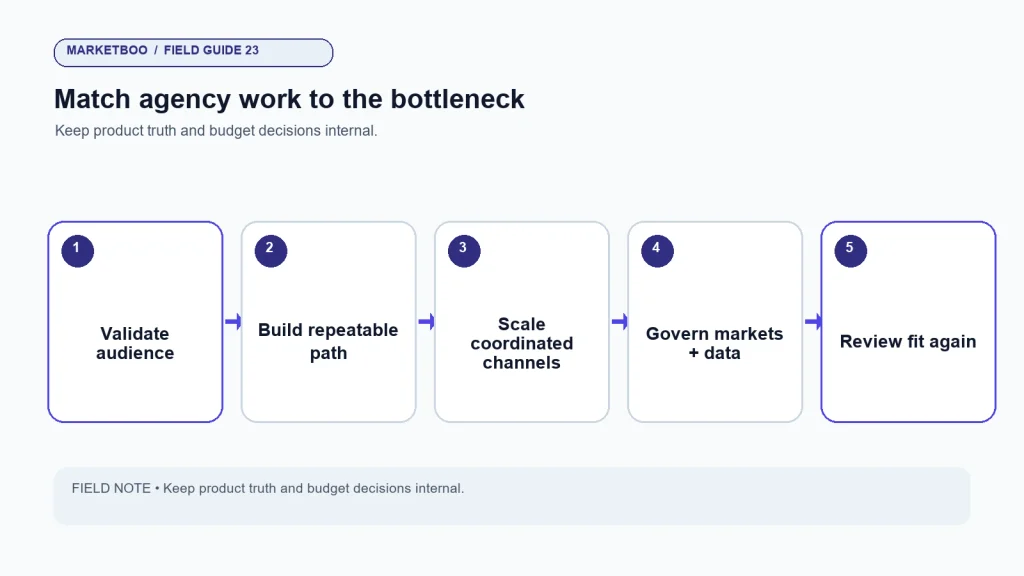
These are working conditions, not labels determined by funding, employee count, or ARR. A small company can have a mature acquisition path; a large company can still be validating a new product. Describe the actual work state.
Diagnose the marketing constraint before choosing a provider
Use a short diagnostic note: customer, buying committee, current offer, channel evidence, funnel stage, conversion path, reporting source, internal owner, and open questions. Separate a known problem from a hypothesis. “We have a large number of demo requests but few qualified accounts” is a measurable observation if CRM definitions are stable. “Our ads are bad” is an interpretation that needs evidence.
Then ask what the company can already do. Does marketing have a documented audience profile? Can sales return lead disposition? Are website events and CRM stages trustworthy? Does product marketing have source material for claims? Can the team approve content within a reasonable window? If several foundations are missing, a campaign execution retainer may be premature. A scoped assessment or training engagement may be a better first step.
Map channel work to the buying path
SaaS buyers may research a category, compare alternatives, read documentation, consult colleagues, attend a demo, test a product, and seek approval. Search, paid ads, social, content, and website pages support different moments. An agency should explain which customer question each channel helps answer and how the company will recognize useful progress.
| Customer question | Potential marketing work | Measurement consideration |
|---|---|---|
| “Is this problem relevant to us?” | Category education, social content, non-branded search content | Reach or engagement is early evidence, not pipeline |
| “Can this product handle our use case?” | Product pages, technical content, demos, paid search or social | Track qualified page actions and sales context |
| “How does it compare with our alternatives?” | Comparison content, pricing detail, solution pages | Maintain accurate claims and current product facts |
| “Can we trust the vendor?” | Documentation, security or implementation information, customer evidence | Require permission and precise scope for customer claims |
| “What is the next step?” | Demo, trial, consultation, contact, or self-serve path | Define qualification and conversion events clearly |
The website often connects the channels. If a paid ad and an organic search result lead to the same unclear page, increasing channel volume may not fix the problem. Consider whether page architecture, messaging, load, or the next step is the actual constraint. The relevant work may sit across marketing and product, not with one channel vendor alone.
Choose an agency model by capability and accountability
A specialist agency may provide deeper expertise in one area. A full-service provider may coordinate several disciplines under one relationship. A freelancer can offer direct work on a defined deliverable. An in-house hire develops context and continuity. These labels are not quality guarantees; compare the people, scope, and responsibility.
Ask who will perform the work, who approves it, how the agency gets information from product and sales, what data it needs, and what the company receives each month. Ask how a change in product strategy or campaign budget affects the plan. If the partner uses subcontractors, clarify who reviews the work and who owns delivery.
| Model | Useful when | Internal requirement | Question to ask |
|---|---|---|---|
| Specialist agency | One channel or technical problem needs depth | Internal coordination across adjacent teams | What does the specialist exclude? |
| Multi-service agency | Several channels need coordination | One accountable company-side owner | Who leads and how are handoffs managed? |
| Freelancer | Defined work and close collaboration | Internal strategy and review capacity | What backup and continuity exist? |
| In-house role | Product context and ongoing work are central | Hiring, management, tools, and coverage | Which skills and authority are needed? |
| Hybrid team | Company owns strategy with specialist execution | Clear work division and documentation | Where can responsibilities overlap? |
Keep product, revenue, and data decisions visible
The company should retain decisions that depend on internal facts: target customer definition, product roadmap, positioning, commercial pricing, discounts, sales qualification, budget caps, customer remedies, and the meaning of revenue data. An agency can recommend a change, produce evidence, or implement an approved plan, but should not invent product capabilities or redefine a qualified lead to make a report look better.
Data access should be scoped to the task. Define account permissions, analytics roles, CRM access, data retention, export rules, and who can approve changes. Do not share credentials in a proposal or onboarding email. Use approved account roles and documented access procedures. If an agency needs customer-level data, ask why and involve privacy and security owners.
Set a reporting agreement before work begins. Define organic-sourced pipeline, paid-attributed leads, influenced opportunities, conversion events, time period, currency, and CRM stage. The names may vary by company. The point is to preserve the definitions so a report can be interpreted without confusing channel attribution with causation.
Evaluate the proposal with a work sample, not a promise
Give each candidate a short, common brief. Ask for a sample six-week plan, a reporting outline, and the assumptions they need to validate. You are not buying free strategy; keep the exercise narrow and use it to assess how candidates think. A credible response should name missing information, distinguish facts from hypotheses, and propose a scope that fits internal capacity.
| Proposal element | What to inspect | Questions for the agency |
|---|---|---|
| Business diagnosis | Does the plan address an observed bottleneck? | Which evidence would change your recommendation? |
| Scope | Are channels, deliverables, frequency, and revisions defined? | What is specifically excluded? |
| Team | Are day-to-day owners named? | Who handles strategy, execution, and backup? |
| Measurement | Are source, influence, and outcome definitions clear? | How will you report uncertainty and low volume? |
| Collaboration | Are product, sales, and technical dependencies named? | What input and approval time do you need from us? |
| Access and data | Are permissions proportional and documented? | Who owns accounts, assets, and reports if we stop? |
| Commercial terms | Are fees, term, and change process clear? | What triggers additional cost or schedule change? |
Treat a guarantee of a specific number of leads, pipeline, or revenue with caution. Outcomes depend on product fit, audience, competition, sales response, pricing, and other factors outside the agency’s control. Ask the provider to distinguish its deliverables from expected business outcomes and show any case evidence with context, permission, and time period.
Structure a pilot to answer one question
A pilot should test whether the agency’s people and process fit the business, and whether the agreed work can produce evidence useful to the team. Choose one scope, one review date, and one main decision. Include a baseline, dependencies, budget cap, source of truth, and a route for changing scope. Avoid a broad pilot that attempts to prove every channel in a few weeks.
At the review, assess the agency relationship as well as performance: Was the work delivered? Were claims accurate? Did reporting align with definitions? Did sales provide feedback? Did the internal team have enough time to review? Did the provider flag risks early? Did the work change a business decision? The pilot may be valuable even when it confirms that the current message or page needs attention rather than more campaign volume.
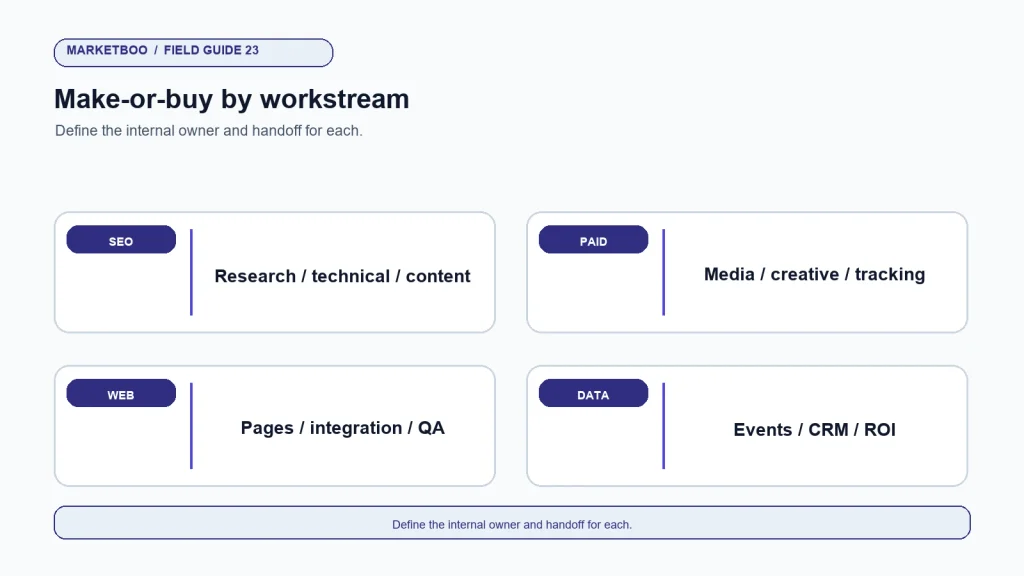
A make-or-buy map for common SaaS marketing work
The company does not have to outsource an entire channel. It can retain strategy and customer insight while buying production, technical implementation, or campaign operation. The split should reflect which decisions require company context and which tasks benefit from outside capacity or specialist tools.
| Workstream | Keep internal when | Consider outside support when | Handoff evidence |
|---|---|---|---|
| Positioning and ICP | Product learning is active and sales feedback is central | Team needs research facilitation or message testing | Approved audience note and assumption list |
| SEO strategy | Internal owner knows product roadmap and technical constraints | Site structure, technical review, or content capacity is limited | Prioritized plan, URLs, owners, and measurement definitions |
| Paid acquisition | Budget and product economics change frequently | Campaign operations or creative testing need specialist capacity | Account access rules, budget cap, naming, conversion map |
| Social/content | Subject experts can contribute distinct knowledge | Production cadence and channel adaptation exceed team capacity | Editorial calendar, source files, approvals, rights |
| Website and conversion | Changes are small and owned by the product team | Redesign, migration, or integrations require coordinated delivery | Requirements, test plan, release notes, code/account handoff |
| Analytics | CRM definitions and revenue reporting need company stewardship | Implementation and diagnosis need technical support | Data dictionary, event map, query/report, limitations |
Use the table during planning conversations. A provider may recommend that the company retain a capability even when it could be sold as a service. That can be a sign of good scope discipline. Conversely, a provider that seeks ownership of every workstream may create unnecessary dependency.
Determine whether the agency’s working style fits the team
An agency relationship has a rhythm: brief, review, implementation, report, decision. A startup should compare that rhythm with its own ability to provide feedback. Ask how often meetings occur, who joins, how urgent requests are handled, where decisions are recorded, and what happens when the company is unavailable. A weekly meeting can help a fast-moving team; it can also become overhead if there is no decision agenda.
Check how the provider communicates uncertainty. Does it distinguish a known technical issue from a hypothesis? Does it explain when the sample is too small? Does it ask product or sales to verify claims? Does it show which work was completed and which is waiting on the company? These habits matter because SaaS campaigns often combine platform, website, and CRM data that do not perfectly agree.
Ask for an example of a report with sensitive data removed. Look for definitions, date range, channel scope, next action, and limitations. A dashboard full of graphs is not automatically useful. The report should help the internal owner make one or more decisions: continue, revise, investigate, stop, or allocate more capacity.
Reassess when the company changes stage
A relationship that fit an early test may not fit a larger product portfolio. The company may need a technical SEO process, multi-market localization, enterprise account alignment, or a new CRM attribution model. Review agency fit when the company changes pricing, launches a product, enters a market, restructures sales, changes its CMS, or hires internal specialists.
Reassessment does not require ending the relationship. It can mean revising scope, adding a specialist, moving repeatable tasks in-house, or changing the reporting cadence. The key is to prevent an old retainer from continuing by habit after its original problem has changed. Document the new constraint and ask whether the current partner has the relevant people and capacity.
SaaS-specific questions that should be part of discovery
A SaaS marketing plan depends on the product’s buying and usage model. Does the buyer purchase through sales, self-serve, a channel partner, or a combination? Is the product evaluated by an individual user, a technical team, or an executive sponsor? Does a free trial provide useful evidence, or does activation require onboarding? Does expansion depend on seats, usage, integrations, or another factor? These questions shape the content, page, campaign, and measurement plan.
Ask the agency how it will learn the product without overreaching into customer data. A demo account or public documentation may be sufficient for creative familiarization. If real usage data or customer lists are proposed, involve privacy and security owners and limit access to the necessary fields. The agency should not need credentials for every system just because it manages a campaign.
Clarify the relationship between marketing events and product events. A trial signup, activated account, qualified demo, opportunity, and paid subscription represent different stages. Define who owns each event and what system provides it. If product analytics and CRM are not connected, report their outcomes separately until a reliable join is available.
| SaaS motion question | Marketing implication | Owner to consult |
|---|---|---|
| Self-serve or sales-assisted? | CTA, landing page, and qualification path | Product growth and sales |
| Individual or buying committee? | Content depth and stakeholder coverage | Product marketing and account teams |
| How is activation defined? | Trial or onboarding measurement | Product analytics |
| What makes an account fit? | Campaign targeting and CRM qualification | Sales and RevOps |
| Which use cases are supported? | Claims and solution-page scope | Product and customer success |
| What data can a partner access? | Agency onboarding and measurement | Privacy and security |
These answers help an agency avoid applying a generic lead-generation template to a product with a distinct activation or buying path. They also let the SaaS company keep strategic decisions where the relevant expertise sits.
Ask for evidence that matches the proposed work
If a candidate presents a case study, ask whether the problem, audience, market, and sales motion resemble your own. A consumer subscription result may not predict performance for enterprise software with procurement and implementation stages. A ranking improvement for a broad information query may not show that the agency can support qualified demand. Context is more informative than a large headline number.
Request the starting condition, time period, scope, client-side contribution, and metric definition. Clarify whether the outcome is attributed or causally tested, whether the client approved public use, and whether the work included product changes outside marketing. If the provider cannot share details for confidentiality reasons, it can still explain the method without disclosing customer identity. Do not insist that a screenshot prove a result it cannot establish.
The best work sample may be a redacted planning artifact: a brief, a measurement dictionary, a page map, or a post-campaign review. These can reveal how a team handles assumptions and trade-offs. Evaluate the reasoning and documentation alongside the visual or platform execution.
How to select a digital marketing agency for a SaaS company
- Describe the current growth constraint. State the observed problem and separate it from assumptions.
- Identify the customer and buying path. Document audience, roles, stage, objections, and next action.
- Audit the evidence. Check website, analytics, CRM, sales feedback, content, and product facts that support the diagnosis.
- Decide what must remain internal. Name owners for product truth, positioning, pricing, budget, sales qualification, and data definitions.
- Choose a bounded scope. Select the channel or capability that addresses the constraint and fits team capacity.
- Request comparable proposals. Give candidates the same brief and require deliverables, assumptions, exclusions, staffing, and fees.
- Review the operating model. Confirm account access, approvals, reporting, rights, data handling, and change control.
- Ask for a practical work sample. Evaluate reasoning, caveats, and questions rather than polished promises alone.
- Set pilot criteria. Define baseline, budget cap, dates, dependencies, measurement, and decision conditions.
- Review and adjust. Continue, change scope, bring work in-house, or end the relationship based on evidence and operational fit.
When Marketboo may be a fit
Marketboo’s service pages describe global paid media, SEO/GEO, social media management, and website development and design. A SaaS company should confirm current scope, relevant team experience, language and market coverage, deliverables, and measurement responsibilities directly. This article does not claim a specific SaaS case result.
If you are evaluating an agency, contact Marketboo with the growth constraint, the current evidence, internal owners, and what you expect a partner to own. Ask for a scoped response that separates recommendations, implementation, reporting, and client-side dependencies. Compare the proposal against the same criteria you use for other providers.
FAQ
What should a SaaS company look for in a digital marketing agency?
Look for evidence that the provider understands the company’s buyer, product, growth constraint, measurement, and internal dependencies. Ask for named team members, clear deliverables, reporting definitions, access boundaries, exclusions, and relevant evidence. Do not select on channel count or unsupported revenue guarantees alone.
When should a SaaS startup hire a marketing agency?
Consider hiring when the company has a defined business problem, an internal owner who can provide product and customer knowledge, and a scope that an outside team can execute. If audience, offer, or conversion tracking remains unknown, start with a bounded diagnostic or research task rather than a large retainer.
Should a SaaS company use a full-service agency or specialists?
Choose based on the number of capabilities required and the company’s coordination capacity. Specialists may add depth in one area; a broader provider may coordinate several workstreams. Verify the actual people, accountability, and interfaces with internal teams instead of relying on the label.
What marketing work should a SaaS company keep in-house?
Retain ownership of product facts, positioning, pricing, roadmap, customer remedies, sales qualification, budget approval, and revenue definitions. Agencies can research, advise, produce, and execute agreed work, but the company remains responsible for decisions that depend on internal business knowledge.
How do I measure a SaaS marketing agency?
Evaluate agreed deliverables and leading indicators alongside qualified pipeline or revenue measures where available. Define source, attribution, stage, period, and currency before work begins. Consider operational quality and learning, and do not treat platform attribution as proof that marketing caused an outcome.
What should a SaaS agency proposal include?
Ask for diagnosis, scope, deliverables, schedule assumptions, named team, client dependencies, fees, measurement, account and data access, exclusions, change process, and exit handoff. A proposal should identify unknowns and avoid treating expected outcomes as guaranteed results.
How long should an agency pilot last?
Use a period suited to the work, sales cycle, delivery volume, and decision the pilot should inform. Define review criteria and a budget cap rather than using a universal duration. A pilot may test operating fit and learning even when a long-cycle revenue outcome cannot mature within it.
Hire for the constraint, not the slide deck
A digital marketing agency for SaaS companies should fit the business stage and solve a defined operating problem. The company should know what it is asking the agency to do, what evidence will matter, and what decisions remain internal. This keeps channel work connected to product, customer, and sales reality.
Use a common brief to compare partners. Favor clear questions and honest limits over a confident promise of immediate growth. Start with scope the internal team can support, agree on definitions, and review both commercial evidence and collaboration quality. That gives the company a practical basis to scale the relationship, change it, or end it.