

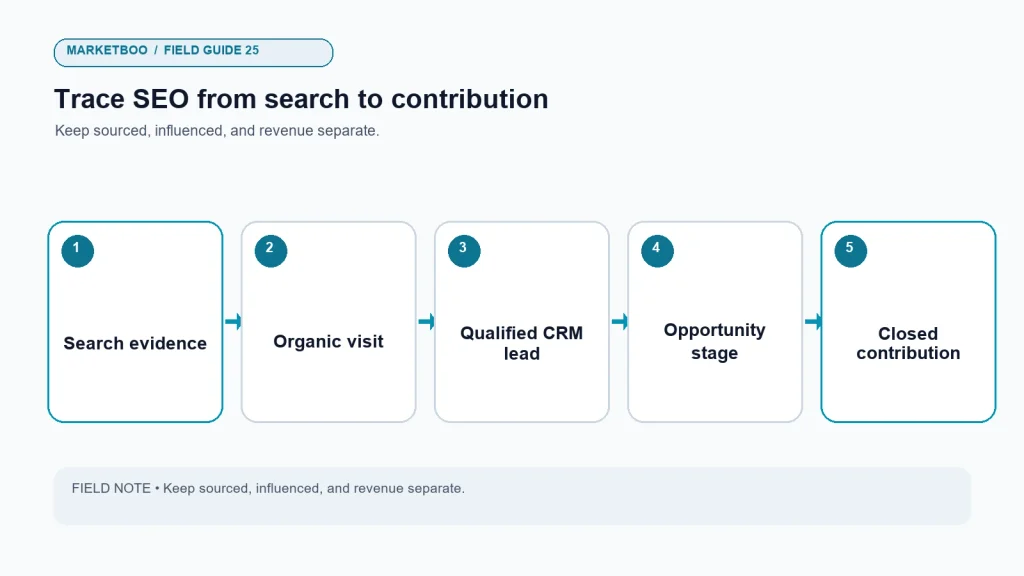
The short answer: To measure SEO ROI for B2B, define which costs belong to the program, connect organic search visits to qualified CRM outcomes, and report sourced revenue separately from pipeline that SEO influenced. A practical formula is (SEO-attributed contribution − SEO investment) ÷ SEO investment, but the numerator depends on the company’s attribution rules and margin data. Track leading signals such as qualified organic sessions and inquiries while opportunities mature, then update the analysis with closed-won contribution. Do not treat a ranking, click, form fill, or influenced pipeline value as revenue. State the period, CRM stages, attribution window, currency, cost assumptions, and limitations beside the result.
How to measure SEO ROI for B2B
When a B2B leader asks, “What did SEO return?”, the first response should define what “return” means. Does the company mean revenue from contacts whose first recorded touch was organic search? Pipeline from opportunities that engaged with an organic page? Revenue influenced by search among several marketing and sales touches? Or the profit contribution after delivery costs? Each can be useful, but they are not interchangeable.
Long B2B sales cycles make the distinction important. A buyer may discover a category article, return through a paid campaign, attend an event, speak with sales, and later convert through a direct visit. The CRM may have incomplete campaign data. A contact may be one of several people in an account. If the team compresses all of this into a single SEO ROI figure, leadership may believe the number is more precise than the underlying records support.
This guide starts with definitions, then gives a transparent fictional calculation and a process for improving evidence. It does not promise that a particular SEO investment will return a certain amount. The examples use hypothetical figures for arithmetic only.
Define the three layers of SEO value
Sourced: organic search is the first known acquisition source
“SEO-sourced” can mean that organic search was the first tracked session, first known touch, first inquiry source, or another defined event. The team must say which. A first recorded source may not be the person’s true first exposure; tracking may begin late or miss a device switch. Sourced reporting is useful for acquisition analysis when CRM and analytics rules are consistent.
Influenced: search was one documented interaction
“SEO-influenced” may include an opportunity where a contact engaged with an organic search landing page during a specified period. The label does not prove that SEO caused the opportunity. It helps the team see that organic content was part of a broader journey. Report the rule: what counts as an organic interaction, which pages are included, what window is used, and whether multiple people in one account are counted.
Contribution: the business value after defined costs
ROI is more meaningful when the numerator is contribution or gross profit, not only top-line revenue. A dollar of contract revenue is not a dollar of profit. Account for discounts, delivery costs, payment or partner fees, support costs, implementation, and other relevant variable expenses according to the company’s accounting policy. Finance should confirm which margin measure is appropriate.
| Label | What it answers | What it does not prove |
|---|---|---|
| Organic clicks | Did search results send visits? | That visitors were qualified or caused revenue |
| Organic inquiries | Did visitors complete a tracked inquiry? | That every inquiry fit the target customer |
| SEO-sourced pipeline | What pipeline is associated with a defined source rule? | Incremental pipeline caused only by SEO |
| SEO-influenced pipeline | Which opportunities had a defined organic interaction? | That SEO deserves full credit for the opportunity |
| Closed-won revenue | What contract value closed under a stated rule? | Profitability without cost and margin context |
| Contribution ROI | What value remains after defined expenses? | A causal result unless the attribution design supports it |
Formula: choose the numerator your company can defend
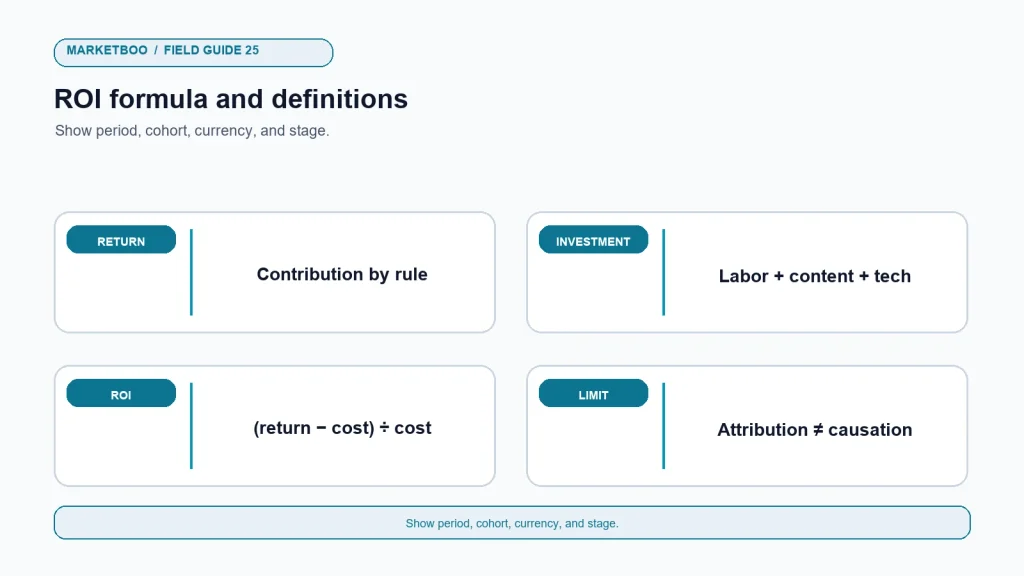
The standard arithmetic expression is:
ROI = (return − investment) ÷ investment × 100%
For SEO, replace “return” with a specific business value, such as attributable contribution, and define investment as the complete cost within the reporting period. One practical version is:
SEO contribution ROI = (organic-attributed contribution − SEO program cost) ÷ SEO program cost × 100%.
The formula is simple. The hard work is classification. What counts as an organic-attributed customer? Is the value first-year contract revenue or lifetime value? Are renewals included? Are internal salaries and technical costs included? How are multi-year deals treated? Do refunds, churn, implementation, or partner fees reduce contribution? Finance and RevOps should help set the policy, especially when SEO performance is used for budget or compensation decisions.
If the numerator is pipeline, do not call the result ROI. You can report a pipeline-to-cost ratio, such as sourced pipeline divided by SEO cost, but pipeline is not closed revenue. Name the metric accurately and show the stage, probability method, period, and open versus closed status.
A fictional B2B worked example
Assume a fictional software company records $36,000 in SEO program costs for one cohort period. Those costs include a content contractor, internal editorial time, technical work assigned to the program, and relevant tools. The company’s finance team confirms that three closed-won contracts can be associated with an agreed organic-first-touch rule. Their combined first-year contract revenue is $75,000. Finance calculates $60,000 in contribution after the agreed variable costs for this example.
Using contribution as the return:
- SEO-attributed contribution: $60,000
- SEO program cost: $36,000
- Net contribution after SEO cost: $60,000 − $36,000 = $24,000
- ROI: $24,000 ÷ $36,000 × 100% = 66.7%
This is a fictional arithmetic example, not a benchmark, client result, or expected outcome. It also does not prove that SEO caused all three contracts. The source rule associates the contracts with organic-first-touch records. Sales calls, product fit, brand exposure, paid campaigns, referrals, and other interactions may have contributed.
Suppose the same cohort also has $180,000 in open pipeline where one or more contacts visited an organic landing page. That can be reported as influenced pipeline under the company’s defined rule. It should not be added to the $60,000 contribution as if it were realized revenue. The opportunity may be lost, delayed, reduced, or won. Keep the figures in separate rows.
| Measure | Fictional value | Interpretation |
|---|---|---|
| SEO program cost | $36,000 | Includes the defined internal, agency, technical, and tool costs |
| Organic-first-touch closed revenue | $75,000 | Revenue associated with a stated source rule |
| Contribution from those contracts | $60,000 | Finance-defined after specified variable costs |
| Contribution after SEO cost | $24,000 | Contribution minus program cost |
| Contribution ROI | 66.7% | (60,000 − 36,000) ÷ 36,000 |
| Open SEO-influenced pipeline | $180,000 | Separate, not realized return or ROI numerator |
If the company used revenue instead of contribution, the arithmetic would be (75,000 − 36,000) ÷ 36,000 = 108.3%. That number answers a different question and can overstate economic return if costs to deliver the contracts are material. Present the chosen numerator prominently and show the alternate only when it helps clarify the definition.
Decide what belongs in SEO investment
A narrow cost view may include only the agency invoice. A broader program view may include internal time, technical development, content production, research, analytics, tools, and migration work. Neither is automatically wrong, but inconsistent cost definitions make period-to-period comparisons unreliable.
Choose a costing rule with finance. If staff split time across SEO and other duties, decide whether to allocate time by hours, role percentage, project, or another method. Avoid spending more effort on false precision than the result can support. Record whether one-time platform changes are expensed in the period they occur or amortized under the company’s financial approach. Keep unusual migration costs visible rather than hiding them in a baseline.
| Cost category | Examples | Costing decision |
|---|---|---|
| Labor | SEO lead, content editor, technical writer, developer | Include relevant hours or document exclusion |
| External services | Agency, consultant, research, translation | Use invoiced amounts and service periods |
| Content production | Writing, design, photography, video, review | Assign based on scope and rights period |
| Technical work | Templates, schema, performance, migration, analytics | Identify SEO-related portion and one-time work |
| Tools | Crawling, rank, analytics, content, reporting tools | Allocate consistently if shared across teams |
| Operations | Legal review, product review, sales enablement | Include if part of the program’s required delivery |
Connect Search Console, analytics, and CRM carefully
Google Search Console reports how a site appears in Google Search, including queries, impressions, clicks, and average position under its definitions. Google Analytics reports site and app activity under its own event and attribution configuration. A CRM records contacts, accounts, stages, and outcomes according to company process. These are complementary data sources, not one database with a perfect shared identity.
Google’s Search Console performance report documentation and GA4 traffic acquisition report guidance explain their respective reporting contexts. Review the current versions and definitions before building a dashboard. Do not expect query-level data to connect every search term with an individual CRM contact. Privacy controls, aggregation, consent, and platform design can limit what can be joined.
Use a consistent URL tagging convention for owned campaigns and preserve landing-page URLs in CRM where appropriate. Keep form source fields and campaign details. Deduplicate contacts using the company’s approved rules. For account-level reporting, define how a contact maps to an account and identify possible misattribution from shared domains, subsidiaries, or consultants.
Before relying on the report, run a test path: click a tracked link or organic landing page, complete a test form, verify analytics events, and confirm the record in the CRM. Use a test record that does not expose a real prospect’s personal data. Check the date, time zone, channel grouping, self-referrals, cross-domain settings, and consent configuration with the analytics owner.
Set a cohort window that matches the sales cycle
An SEO program produces work at different speeds. Technical fixes may affect crawl or rendering before an opportunity matures. A new page may receive impressions before it attracts a qualified visit. A B2B opportunity may remain open beyond the reporting quarter. Choose cohorts based on the company’s sales process and the question being asked.
Separate leading indicators from outcomes:
- Early technical evidence: pages can be crawled, indexed, rendered, and measured under expected conditions.
- Search visibility evidence: impressions and clicks for relevant queries or pages under Search Console definitions.
- Engagement evidence: visits that reach useful product, service, or conversion content.
- Lead evidence: inquiries that meet documented qualification criteria.
- Pipeline evidence: opportunities at defined CRM stages, separated by source and influence rules.
- Financial evidence: closed revenue and contribution after the finance-approved cost definition.
Do not change the cohort window to make a result look better. If a contract closes after the initial reporting period, keep the original source and update the cohort at a pre-agreed point. If attribution records are changed, document the change and recalculate comparable periods only when the data supports it.
Measure SEO’s contribution when last-click is incomplete
Last-click reporting is easy to explain but can miss earlier research. Multi-touch models can distribute credit, but a model’s allocation is still not a randomized causal estimate. A CRM field may say “organic source” because that was the first known touch, even if a referral introduced the company. A buyer may read content on one device and later submit a form on another.
Use several views with clear labels: first known source, last tracked non-direct source, campaign interactions, landing-page engagement, and account-level opportunity history. Keep the source field and influence data separate. Do not add several attribution views together; one opportunity can appear in multiple reports.
For larger programs, a company may evaluate an incrementality or holdout design, but these methods require careful setup and sufficient data. SEO changes can affect broad pages or markets, making simple control groups difficult. If the organization cannot support an appropriate design, report attribution and association honestly rather than calling the result incremental revenue.
Explain pipeline maturity
An open opportunity has a probability and timing profile that may change. When SEO reporting includes pipeline, label whether the value is raw opportunity amount, weighted amount, sourced pipeline, or influenced pipeline. Name the CRM stage and the date it entered the stage. If a deal changes scope, closes, or is lost, update the cohort according to the reporting policy rather than leaving the original value unchanged.
For long cycles, compare cohorts at similar ages. A group of leads from last month has had less time to become an opportunity than a group from the previous year. Showing both in one chart without cohort age can make newer SEO work appear weaker or older work appear stronger. Use a maturity note: “Open pipeline is still developing; closed contribution is not yet available for this cohort.” That statement prevents a leading signal from being presented as a final return.
Also distinguish opportunity creation from contract close. An opportunity may be influenced by several people in an account, while the CRM stores one account record. Decide whether the analysis counts one opportunity once, each contact, or a specific account event. Do not add individual contact values to an account-level pipeline total.
Keep an ROI change log
When the formula or cost definition changes, retain both versions and annotate the date. For example, adding internal developer time to investment can lower measured ROI without any change in search or sales performance. That may improve the economics view, but leadership should understand why the metric shifted. Likewise, changing from first-touch to multi-touch attribution can reassign value among channels. Treat the method change as a reporting event, not an organic performance gain or decline.
Dashboard layout for a B2B SEO review
A useful report should help leadership make a decision. Start with a compact headline: what changed, what evidence supports the interpretation, and what the team recommends. Then show a table separating leading signals, qualified leads, pipeline, closed value, and investment. Include data coverage and caveats. Avoid a large chart wall with no explanation of what should happen next.
| Section | Suggested fields | Decision supported |
|---|---|---|
| Coverage | Period, market, pages, channels, data completeness | Is the comparison valid? |
| Search | Impressions, clicks, queries/pages under Search Console definitions | Where is visibility changing? |
| Site behavior | Organic sessions, landing pages, conversions under analytics definitions | Which paths engage or convert? |
| Qualification | Leads, sales-accepted, disqualification reasons | Is organic demand relevant? |
| Pipeline | Opportunities by stage, source and influence rule | Is commercial progress emerging? |
| Financials | Closed revenue, contribution, cost, ROI formula | What economic value is observed? |
| Next action | Keep, revise, investigate, pause | What decision follows? |
For each metric, state the source and definition in a tooltip or note. If the report combines analytics and CRM, specify the join key and matching rule. If records cannot be matched reliably, show them as separate totals.
Review the report with finance and sales before it becomes an executive scorecard. Finance can confirm whether contribution includes implementation and support. Sales can verify whether the chosen CRM stage represents a qualified opportunity. Analytics can validate the source logic and time zone. These conversations keep the metric tied to how the business actually operates. When definitions change, version the report and preserve prior results instead of silently rewriting history.
Show sensitivity when a small number of contracts changes the result
B2B revenue is often concentrated in a small number of contracts. One additional closed deal can materially change a cohort’s calculated ROI. Present the deal count beside the percentage and consider a sensitivity view: how would the figure look if an open opportunity were lost, delayed, or reduced? Do not treat a scenario as the observed result. It simply shows how dependent the conclusion is on a small sample.
For a mature program, compare multiple cohorts and page groups, while preserving differences in sales-cycle age and investment. A single quarter may include a platform migration or a large technical project that does not recur. Explain the unusual work rather than hiding it. The decision can still be useful even when the result is not a stable annual average.
How to calculate and report B2B SEO ROI
- Choose the ROI question. Decide whether leadership needs organic-sourced contribution, SEO-influenced pipeline, or another clearly named measure.
- Set the source rule. Define first touch, last touch, influenced interaction, account matching, attribution window, currency, and CRM stages.
- Agree on the financial numerator. Ask finance whether to use revenue, gross profit, contribution, or another value and how contracts are treated.
- Define investment. List labor, content, technical work, agencies, tools, and one-time migration costs; state exclusions.
- Create a baseline and cohort. Record dates, page groups, market, sales-cycle context, and data coverage.
- Validate the data path. Test landing pages, analytics events, form fields, CRM routing, deduplication, and source preservation.
- Separate leading indicators from outcomes. Report search visibility, qualified visits, leads, pipeline, closed revenue, and contribution in distinct rows.
- Calculate transparently. Apply the stated ROI formula and retain the arithmetic and source figures.
- Explain attribution limits. Identify missing data, multi-touch paths, open opportunities, and any model assumptions.
- Recommend a decision. Continue, revise, investigate, or stop, and specify what evidence would change the next review.
Frequent reporting errors
Calling open pipeline revenue. Pipeline is a sales stage value, not a closed result. Label stage and probability method, and keep open opportunities separate from closed revenue.
Using lead count without fit. A hundred unqualified requests may be less useful than a smaller number of target accounts. Define qualification and report disqualification reasons.
Excluding internal cost. An agency invoice alone can understate investment if staff and development hours are material. Agree on a repeatable costing method.
Mixing sourced and influenced numbers. One opportunity can be counted in both views. Do not add these totals together as if they were unique revenue.
Changing the time window after seeing results. Predefine the cohort and update it consistently. A long sales cycle is a reason to report maturity, not to move the goalposts.
Reporting rankings as return. A higher position may be an intermediate signal. It does not by itself establish traffic quality, qualified pipeline, or profit.
Promising a ranking or ROI. Search outcomes depend on many factors. A service provider can commit to work and reporting, but should not guarantee a business outcome it does not control.
What an agency can and cannot own
An SEO agency can research, plan, create or improve pages, identify technical issues, support implementation, measure search and website outcomes, and recommend priorities within its scope. The company owns product truth, pricing, service delivery, sales qualification, CRM integrity, and the financial definition of contribution. Both teams should agree on data access and reporting responsibilities.
Marketboo describes SEO/GEO services for businesses that need organic search support. A B2B company should ask for the scope, measurement method, internal dependencies, and how the provider handles long sales cycles and attribution limits. If the program needs a review, contact Marketboo with the CRM stages, current data sources, and financial definition you use. Validate service details and fees directly.
Frequently asked questions
What is the formula for SEO ROI in B2B?
A transparent formula is (SEO-attributed contribution − SEO investment) ÷ SEO investment × 100%. Define the attribution rule, contribution calculation, cost period, and cohort before using it. If the numerator is open pipeline, call the result a pipeline-to-cost ratio rather than ROI.
How long does it take to see SEO ROI in B2B?
There is no universal time frame. Technical work, search visibility, qualified inquiries, and closed contracts mature at different speeds, and B2B sales cycles vary. Set cohort windows around the company’s actual sales process and report leading indicators separately from closed financial outcomes.
Should I measure SEO ROI by leads or revenue?
Track both, but name each stage. Leads show inquiry volume; qualified leads show fit; pipeline shows sales opportunities; closed revenue shows contracts; contribution accounts for defined costs. A single stage cannot substitute for the full financial picture.
Does Search Console show which keywords produced a customer?
Search Console reports search performance under its own definitions, but it does not provide a complete person-level link from every query to a CRM customer. Use it for query and page visibility analysis, and combine it cautiously with analytics and CRM data.
What counts as an SEO cost?
Potential costs include agency or consultant fees, internal labor, content production, technical development, research, localization, and tools. Choose a costing rule with finance and apply it consistently. Explain which costs are included or excluded in the reported period.
How should I report SEO-influenced pipeline?
Define what organic interaction qualifies, which time window and page groups apply, how contacts map to accounts, and whether multiple opportunities can be included. Show open pipeline separately from closed revenue and explain that influence is not causal proof.
Can an SEO agency guarantee B2B ROI?
No agency can responsibly guarantee a specific ROI for conditions it does not control, including product fit, sales follow-up, market demand, and competitor behavior. Evaluate the scope, implementation quality, evidence, reporting definitions, and decision process instead.
Make the number honest enough to act on
How to measure SEO ROI for B2B comes down to a few disciplines: define the financial value, preserve the source rule, include relevant costs, connect search evidence to CRM outcomes where possible, and show what attribution cannot prove. The resulting number may be a range, a cohort estimate, or a contribution ratio. A carefully qualified metric is more useful than a precise-looking result built from inconsistent fields.
Start with a defensible source and cost definition, then improve the data path over time. Report search visibility and qualified demand while contracts mature. When a cohort closes, calculate contribution and explain the attribution model. Leadership can then decide where to invest, which pages to improve, and what measurement gap deserves attention next.