
The short answer: Social media management pricing for small business depends on the work included, not just the number of platforms in a package. A quote changes with the volume and format of content, original design or video, filming, revisions, publishing, community response, approvals, reporting, and the amount of strategy or coordination required. Compare proposals by the same monthly deliverables, service levels, rights, and exclusions. Keep advertising spend separate from management fees, and ask whether account setup, paid campaign management, photography, creator fees, and extra requests are included. If a provider cannot describe the workload and boundaries in writing, the monthly number alone is not a useful comparison.
What drives social media management pricing for small business
Suppose a small company receives two proposals called “monthly social media management.” One includes four posts a week across three channels, original graphics, caption writing, scheduling, monthly reporting, and limited comment monitoring. Another includes three posts a week on one channel, content repurposing, no filming, no direct-message response, and one approval round. Even if the fee were identical, the service would not be comparable. The title on the quote does not define its scope.
This article focuses on the factors that drive cost and how to compare proposals. It does not provide a made-up market price. A real quote depends on the provider’s labor, region, capacity, channel mix, production needs, and contract terms. Marketboo’s public service page describes full social media management; use the current proposal to confirm deliverables, currency, billing period, and exclusions before making a decision.
Define the job before requesting a number
Start by writing down what the business wants social media to accomplish. A local professional service may need a consistent presence and timely answers to common questions. A B2B supplier may need clear product education and sales-team coordination. An ecommerce brand may need regular product storytelling, seasonal launches, and creator content. The deliverables should follow the job; a high post count does not prove strategic fit.
List the channels that matter and why. “We need all platforms” is not a reason. Ask where customers, prospects, employees, or partners actually interact with the business. Each platform has its own dimensions, editing requirements, moderation expectations, and audience behavior. Repurposing an asset can reduce work, but it is not the same as adapting the story to each channel.
Then specify the operating conditions: who supplies photos and product facts; who approves content; how quickly a reviewer can respond; who answers comments and direct messages; whether the provider can access brand assets; and how urgent issues are escalated. A provider may charge more when the client has complex approvals or late changes because those conditions require additional coordination.
The main cost drivers
Number of platforms and amount of adaptation
A platform count can indicate complexity, but it is an incomplete measure. One master video may need several crops, captions, subtitles, hooks, and versions. A simple image post may need different copy or a different call to action by channel. A provider should specify whether it is cross-posting the same asset, lightly adapting it, or creating separate channel-native versions.
Ask for an example of one asset across the proposed channels. Which parts are shared? What will be rewritten or redesigned? Are platform-specific formats, captions, or accessibility checks included? This reveals whether the monthly scope funds thoughtful adaptation or only distribution.
Content volume and format
Clarify the unit. “Posts per month” could mean feed posts only, short-form video, stories, carousels, community updates, or a mix. It could count each channel placement separately or count one master asset. A package with a few original video concepts may involve more work than a higher number of simple text posts. Ask how the proposal defines a deliverable and whether revisions count as a new deliverable.
Original design, video, and filming
Content created from client-supplied photos differs from creative that requires concept development, location work, filming, lighting, editing, motion, subtitles, voiceover, or talent. State who provides the raw material and who owns or licenses it. If filming is included, ask about shoot length, location, travel, equipment, number of edited outputs, usage rights, and rescheduling.
For a small business, content capture can be a hidden dependency. The provider may prepare the calendar but rely on the owner to film products or record expertise. That can keep costs lower, but only if the business has time and a person willing to participate. A quote should say who is responsible and what happens if the material is late.
Strategy, calendar, and research
Some scopes include a channel strategy, audience research, competitive review, monthly calendar, campaign planning, or content pillars. Others begin with a client-provided plan. The amount of strategic work affects both setup and monthly coordination. Ask whether strategy is a one-time project, included in an ongoing fee, or revisited after a defined period. Clarify the decisions the strategy is expected to support.
Publishing and community management
Scheduling a post is different from monitoring comments and responding to people. If community management is included, define operating hours, channels, response categories, escalation, and whether direct messages are handled. A provider may be able to acknowledge common questions but should route account-specific, safety, billing, legal, or sensitive issues to the business.
Do not assume that “engagement” means 24-hour monitoring. Ask which messages the provider can answer, what requires client approval, and how quickly the client must respond. If the business needs rapid customer support, it may need a dedicated support process rather than a content-management package.
Approval rounds and coordination
The number of reviewers, turnaround time, and revision policy can affect delivery. A small team with one owner may approve content quickly. A business with a founder, legal reviewer, product manager, and regional lead may need more coordination. Ask how many revisions are included, how feedback is consolidated, and whether an approval delay changes the publishing schedule.
Analytics and reporting
Clarify which data is included, how often it is reviewed, and whether the report contains a recommendation or only a metric export. Useful reporting connects the selected goal with reach, engagement, traffic, inquiries, or another agreed outcome. It should also explain the limits of platform attribution. If analytics setup or conversion tracking is outside the monthly scope, name that dependency.
Paid media and advertising budget
Organic content management and paid advertising can be separate services. A monthly social management fee may not include campaign setup, media buying, pixel or event work, ad creative, or the budget paid to a platform. Ask for those items as separate lines. If a provider manages both organic and paid activity, check which deliverables are shared and which require additional work.
Normalize proposals before comparing them
The simplest way to compare is to give every provider the same one-page scope and ask each to respond to it. Include channel list, content quantity and formats, original production, community coverage, calendar and strategy, approval process, reporting, revisions, rights, and client responsibilities. If a provider recommends a different scope, ask it to explain the trade-off.
| Proposal line | Provider A | Provider B | What to verify |
|---|---|---|---|
| Channels | Names of channels | Names of channels | Are they adapted or cross-posted? |
| Monthly output | Deliverables by format | Deliverables by format | Does one asset count once or per platform? |
| Production | Design, filming, editing | Design, filming, editing | Who supplies raw footage, talent, and locations? |
| Publishing | Scheduling and posting | Scheduling and posting | Are captions, tags, and accessibility checks included? |
| Community | Comments, DMs, escalation | Comments, DMs, escalation | Hours, response time, and restricted topics? |
| Revisions | Rounds and turnaround | Rounds and turnaround | What counts as a new brief or rush request? |
| Reporting | Metrics and frequency | Metrics and frequency | Does it include analysis, access, and recommendations? |
| Rights and files | Usage, term, source files | Usage, term, source files | Can the business reuse content after the contract? |
| Fee and term | Currency, billing, notice | Currency, billing, notice | Are setup, taxes, travel, or third-party costs separate? |
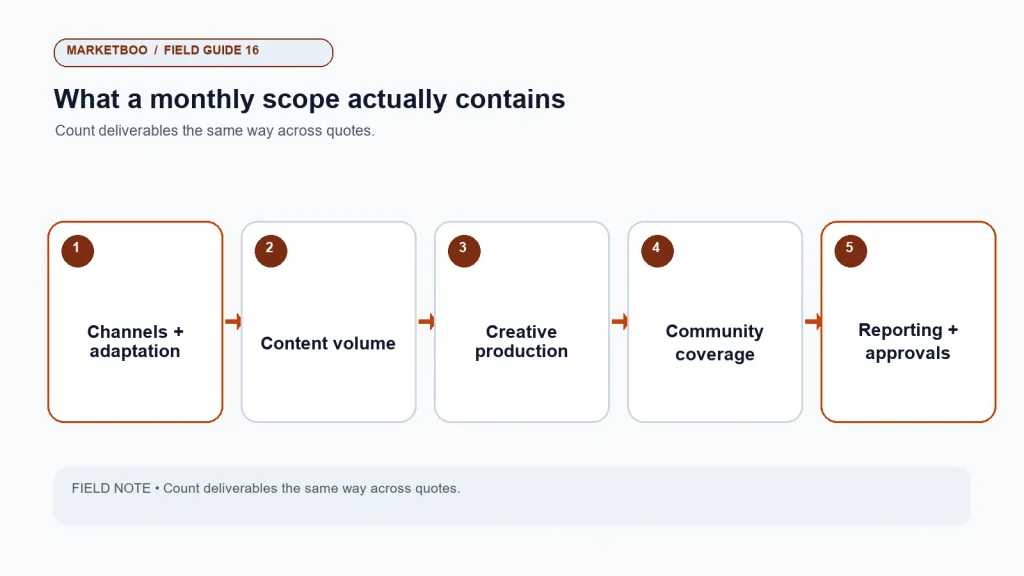
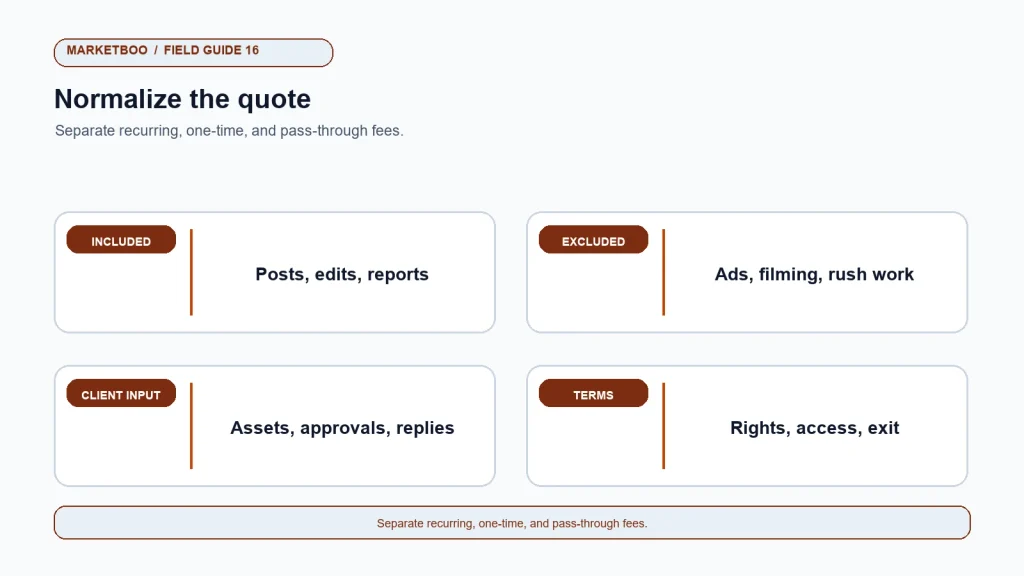
Do not compare a proposal total until the line items are clear. One quote may include setup and a planning workshop in the first month. Another may bill those separately. A package may include a set number of posts but not the content capture required to make them. A retainer may include account management but exclude urgent requests. Keep one-time fees, recurring fees, ad spend, and pass-through costs in separate columns.
Compare scope by operating level instead of package name
Providers often use labels such as “starter,” “growth,” or “premium.” Those names do not standardize the work. Ask for a description of the operating level and the business input required. A smaller scope may include a content calendar, a defined number of adapted posts, scheduling, and a monthly review. A more involved scope may add original video, community response, campaign coordination, or deeper analysis. Neither is automatically right for every company.
Consider the small business’s own operating capacity. If a package expects the owner to submit product footage every week, answer draft questions within a day, and approve posts within a fixed window, the business must have someone who can do that work. If the owner can only review content monthly, the provider should design a workflow for batch planning and clear exceptions. The fee should be compared with the total operating model, including staff time and content production.
Ask how the provider handles a normal month and an unusual one. What happens during a product launch, crisis, holiday schedule, staff absence, or urgent correction? Is the team charged for a separate shoot, rush delivery, or extra revision? Can unused deliverables roll forward? Does a platform outage change the commitment? Put the answer in writing. A contract that only describes an average month may not answer what the business needs when timing matters.
A practical service-level comparison
| Operating level | Possible scope emphasis | Client input required | Best comparison question |
|---|---|---|---|
| Consistency | Calendar, copy, design from supplied assets, publishing | Timely facts and approvals | How many original concepts and adaptations are produced? |
| Production support | Photography or video, editing, creative variations | Product access, people, locations, releases | How many shoot hours and final versions are included? |
| Community support | Defined comment and message monitoring | Escalation owner and response decisions | Which hours, response categories, and service levels apply? |
| Performance coordination | Content insights, paid coordination, conversion-path review | Analytics access and CRM feedback | Which reports and actions are included beyond metric export? |
Use this table as a discussion guide, not a universal package structure. A proposal may combine elements differently. The buyer’s job is to understand whether the combination reflects the business need and whether the client inputs are realistic.
Build a simple quote worksheet
For each provider, capture the scope and your estimate of the client time required. The second point matters: a low fee can still create a high internal workload if the business must supply frequent videos, answer comments, or rewrite every caption. Calculate the total cost of the operating model, including staff time where the business can estimate it. Avoid false precision; a range is acceptable when the time is uncertain.
| Cost or obligation | Monthly / one-time | Included? | Owner | Notes / cap |
|---|---|---|---|---|
| Social strategy and calendar | ||||
| Copy and design | ||||
| Photo/video production | ||||
| Publishing and channel adaptation | ||||
| Comment and message coverage | ||||
| Reporting and meeting time | ||||
| Paid media management | ||||
| Platform advertising spend | ||||
| Client asset capture and approvals | ||||
| Extra revisions, travel, rush, or tools |
Ask whether the provider’s quote assumes a minimum term, a setup period, or a particular approval speed. If the business changes channels or doubles content volume, ask how the fee changes. If the contract ends, ask how the team receives final files, account access, content calendar, and reporting data.
Match the service level to the business calendar
Social media workload is rarely identical every month. A retailer may have seasonal launches. A consultant may have a quiet period around service delivery. A manufacturer may attend a few major trade events. Ask whether the scope can shift within an agreed monthly total or whether each extra deliverable requires a separate charge. Flexibility should be defined: which work can be moved, what notice is needed, and what happens to unused production time.
Some businesses benefit from a quarterly content capture day followed by monthly editing and publishing. Others need frequent product updates and fast responses. The preferred model affects price and client workload. A batch-production model can reduce coordination but needs advance planning and stable information. A reactive model can handle current events but may require more time and faster approvals. The provider should explain which model its fee assumes.
Ask what happens when the business cancels or delays a planned shoot. Are travel or location costs recoverable? Can the unused time be rescheduled? If an event date changes, which outputs can be repurposed? Clear terms help avoid paying for activity that no longer serves the customer.
Account for the business’s share of the work
An agency fee is only one part of the operating cost. The business may need to gather product facts, provide raw photos, film short clips, answer comments, review copy, approve claims, coordinate promotions, and respond to escalated messages. Ask the provider to estimate the client-side workload in a typical month and during a launch. If the time is unknown, request a range and name the roles involved.
This matters for a small team because the owner’s time competes with sales, service delivery, inventory, and finance. A scope that looks inexpensive can become difficult if it assumes frequent internal contributions. Conversely, supplying a dependable asset library and a single approver may reduce coordination. Discuss which inputs would make the work more efficient and whether the provider can adapt the process to limited capacity.
Create a responsibility calendar that shows when the provider needs a product update, approval, footage, or escalation decision. Include a backup when the primary contact is unavailable. The calendar should distinguish routine work from a rush request. This helps the small business decide whether it needs a broader service scope or simply a more predictable internal review routine.
In-house, freelancer, or agency: compare the operating model
Hiring internally gives the business more direct day-to-day ownership but requires recruitment, management, tools, and coverage. A freelancer can be a good fit for a defined skill or predictable cadence, but capacity and backup vary. An agency can coordinate several disciplines, but the business should understand who actually performs the work and how many accounts or projects the team manages. These are models, not guarantees; quality depends on the people and process.
| Model | Potential advantage | Questions to ask | Often a poor fit when |
|---|---|---|---|
| Internal owner | Deep access to products and fast coordination | Does the role have time, skills, and backup? | Social media is only one of many unowned duties |
| Freelancer | Flexible specialist work and direct communication | What happens during absence or scope growth? | The work needs several simultaneous disciplines |
| Agency | Coordinated strategy, production, and channel support | Who is the day-to-day team and what is included? | The business expects broad output without supplying approvals or assets |
| Hybrid | Internal expertise paired with outside capacity | Who owns calendar, review, community, and reporting? | Responsibilities are ambiguous or duplicated |
A small business does not have to buy the largest scope. It can begin with a clear pilot: a strategy baseline, one channel, a defined content cadence, limited community support, and a review at an agreed point. The pilot should answer whether the workflow fits the business, not promise that a particular number of posts will create sales.
Contract details that affect real value
Read the statement of work for deliverables, dates, response expectations, ownership, term, cancellation, confidentiality, and what requires additional fees. Ask who owns the social accounts, who keeps administrator access, how credentials are managed, and how the business can retrieve its materials. Do not transfer account ownership just because a provider needs permission to schedule content.
Clarify music, stock, creator, and photography rights. Ask whether content may be used in paid ads, on the website, in email, or after the contract ends. A permission for organic posting may not include every future use. Keep any model or talent release, usage window, territory, and paid-media rights in the project record. The business should also define who reviews claims and how sensitive messages are escalated.
If the monthly fee depends on content volume, define the counting method. Is an Instagram Reel and a TikTok adaptation one master asset or two deliverables? Is a story sequence counted as one placement or several frames? Are copy changes considered a revision? Clear definitions protect both sides from disputes and make a renewal decision easier.
Also ask how the provider reports work that could not be completed because the client supplied information late. A transparent workflow should distinguish provider delay, client dependency, and an approved scope change. The same is true when a platform alters its publishing options or removes a feature. Define who will update the plan and how the team will preserve a record of the decision.
A procurement checklist for requesting a quote
- Write the business objective. Choose the audience and desired action; avoid generic goals such as “more engagement” without a reason.
- Select channels deliberately. Name the platforms and explain the role each should play for the business.
- Describe monthly output. Specify volume by format, whether assets are original or repurposed, and how adaptation is counted.
- List production needs. Identify design, photography, filming, editing, creator content, and who supplies each input.
- Define community coverage. State whether comments and messages are included, during which hours, and which topics require escalation.
- Set approval rules. Name reviewers, response times, revision rounds, and what happens when input arrives late.
- Clarify measurement. Request the data sources, reporting cadence, access, analysis, and limits of attribution.
- Separate fees. Itemize setup, recurring management, paid media management, ad spend, travel, tools, and third-party costs.
- Check rights and account control. Confirm source files, usage term, access, ownership, and exit handoff.
- Compare the same scope. Normalize proposals, list client workload, and ask providers to explain any recommended difference.
When to ask Marketboo for a scope discussion
If the business needs a team to plan and operate multiple social channels, review Marketboo’s full social media management service. Before requesting a quote, prepare the channels, current content cadence, asset availability, approval owner, community needs, language and market requirements, and the intended business outcome. The provider should use that information to propose a clear scope and exclusions.
For a more specific conversation about scope, contact Marketboo with the same worksheet you use to compare other providers. Ask for a written description of the work, price currency and billing period, one-time fees, ad spend exclusions, and cancellation terms. A clear quote should help you understand what the team will do each month and what remains your responsibility.
Frequently asked questions
How much does social media management cost for a small business?
There is no single fee that fits every small business, and this article does not invent a market range. Cost depends on channels, content volume, formats, original production, community coverage, approvals, reporting, and provider scope. Ask for an itemized quote based on the same deliverables and identify fees that are billed separately.
What is usually included in social media management?
Some providers may include planning, copy, design, scheduling, publishing, reporting, or community support, but the word “management” does not guarantee any particular item. Request an explicit list of deliverables, quantities, response expectations, revision rounds, and exclusions before comparing proposals.
Is paid advertising included in a social media management fee?
Not necessarily. Organic content management, paid campaign management, and advertising spend can be separate. Ask the provider to itemize each one, specify who pays the platform, and clarify whether ad creative, tracking, and landing-page work are included.
How many platforms should a small business outsource?
Choose based on where the intended audience is active and what the business can support with useful content and follow-up. More channels add adaptation and approval work. A focused scope on one or two well-supported channels can be more manageable than thin activity everywhere.
Can I compare agencies by price per post?
Only when the post definition and surrounding work are comparable. A post may involve strategy, design, filming, editing, copy, channel adaptation, approvals, rights, scheduling, and reporting—or only distribution of a client-supplied file. Compare total scope and client workload, not the unit label alone.
Should a small business hire in-house or outsource social media?
Compare the skills, capacity, management time, cost, and need for product context. In-house ownership can support fast coordination but requires time and backup. Outsourcing can add capacity or specialization, but the company still needs an approver and a person to provide accurate business information.
What should I check before signing a social media retainer?
Confirm channels, deliverables, revisions, community hours, reporting, fees, billing period, term, cancellation, ownership, source files, content rights, account permissions, and client responsibilities. Ask how scope changes affect price and what the handoff looks like if the contract ends.
Compare the work, then compare the fee
Social media management pricing for small business is easier to evaluate when every provider describes the same job. Define the channels, output, production, community work, approvals, reporting, rights, and client responsibilities first. Then compare recurring fees, one-time work, advertising spend, and the internal time your team must contribute.
A clear scope is useful even if the business decides not to outsource. It shows which tasks need an owner and which can wait. If you do hire, begin with the work the business needs now, set a review point, and change scope only when the evidence or operating needs justify it. The best comparison is not a spreadsheet of totals; it is a decision the business can explain six months later.