The short answer: A social media marketing agency for startups should fit the company’s current stage, business model, decision speed, and internal ownership. Before comparing providers, decide what social media is supposed to help the company learn or achieve, who inside the startup will supply product knowledge and approve claims, and which work the agency will own. Ask candidates to show a clear process, sample deliverables, reporting definitions, account-control practices, and the limits of their promises. A startup needs a partner that can operate within its budget and uncertainty while keeping strategic decisions visible. “We’ll make you go viral” is not a selection criterion; a specific scope and an honest review process are.
How to choose a social media marketing agency for startups
The question is not whether a startup should “be on social.” It is whether an outside agency can improve the company’s ability to communicate with a market it is still learning about. A pre-launch team may need to explain a product category and gather qualified feedback. An early commercial team may need a dependable editorial rhythm. A company with evidence of product-market fit may want to scale a campaign across channels and markets. These situations call for different expectations and different partner responsibilities.
This article is about agency selection and working boundaries, not a generic checklist of which individual tasks to outsource. The right provider depends on what the startup already knows, where its bottleneck sits, and how quickly leadership can make decisions. Social content can support discovery and trust, but it cannot substitute for a product that meets a real need or a sales process that follows up on interest.
Match the agency model to the startup stage
Pre-launch: explain the problem before amplifying a claim
At this stage, the company may have a prototype, initial research, or a new offer but limited customer evidence. The agency should help communicate the problem, demonstrate the concept, and create a disciplined way to learn from audience response. The startup must retain responsibility for product truth, privacy, technical accuracy, and the decision to change positioning. Avoid a long contract built around an untested promise or a channel count that the company cannot maintain.
Early revenue: turn what is working into a repeatable process
Once a company has customers or sales conversations, an agency can help make communication more consistent, adapt useful material into social formats, and coordinate publishing. The founder or product expert still needs to provide timely facts, examples, and approvals. Reporting should connect content to the business question—such as qualified conversations, product education, or audience feedback—without claiming that every response caused revenue.
Growth stage: add capacity without losing the company’s point of view
A startup with a proven offer may need more production capacity, channel adaptation, community coverage, or paid support. The provider should work with the internal marketing, sales, customer-success, or product teams. The challenge is governance: who can publish, who approves claims, who handles customer issues, and who controls a budget change? Growth often adds stakeholders, so the workflow must remain clear.
Expansion: coordinate markets, products, and channel decisions
When a startup enters new regions or launches additional products, local language, cultural context, product eligibility, and customer support capacity become relevant. Do not assume a provider can represent every market because it can translate copy. Ask who reviews regional claims, who speaks with customers, and how the agency will handle differences in business hours, platform usage, and available products.
| Startup context | What the agency may help with | What the startup should retain | Useful evidence of fit |
|---|---|---|---|
| Pre-launch | Clear explanations, content experiments, publishing workflow | Product claims, research interpretation, roadmap decisions | Brief exercise that separates assumption from validated fact |
| Early revenue | Editorial consistency, channel adaptation, campaign coordination | Customer insight, sales definitions, product positioning | A sample calendar linked to a real business question |
| Growth | Production capacity, channel operations, reporting cadence | Budget approval, risk decisions, customer escalation | Named team, workflow, reporting example, scope boundaries |
| New-market expansion | Local content operations, platform planning, coordination | Regional product availability and legal/claim review | Defined market owners and local review process |
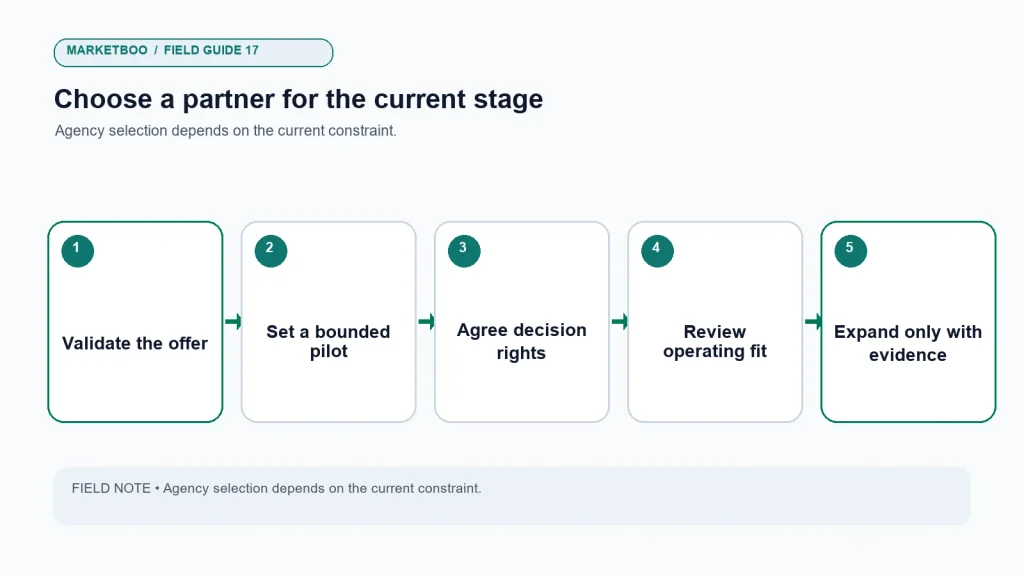
These stages are not a rigid ladder. A company may have strong revenue and a small marketing team, or a large audience but an unproven offer. Use the table to describe present constraints rather than assign status by funding round or headcount.
Write the brief that lets agencies show their judgment
Before taking sales calls, create a one-page brief. Name the customer, product, market, current channels, available assets, business goal, operating constraints, budget boundary, and approval owner. Include what is unknown. If the company has not confirmed a specific claim or audience, say so. A good agency conversation should help clarify what the work can responsibly address.
Ask candidates to respond to the same scenario. For example: “We have a product used by two customer segments. We have limited internal content capacity and need to learn which questions prevent a sales conversation. Propose a six-week pilot with one channel and a reporting approach.” The point is not to get unpaid strategy for free. It is to see whether the candidate asks about customer evidence, product truth, resources, and decision rights before promising results.
A startup can compare how providers define the outcome, scope, risks, and assumptions. Some may recommend a smaller pilot; others may identify that the company needs better source material or landing pages before increasing content. Consider the reasoning and clarity, not just the confidence of the presentation.
The agency-selection scorecard
Rate each area with evidence from the conversation, proposal, and sample work. The scorecard is a decision aid, not a scientific ranking. A high number should not compensate for a disqualifying issue such as unclear account ownership or unsupported performance claims.
| Area | What to inspect | Strong evidence | Concern |
|---|---|---|---|
| Stage fit | Does the provider understand startup uncertainty and constraints? | Asks what is proven and what remains a hypothesis | Recommends scale before understanding the offer |
| Business thinking | Does it connect content to a business decision? | Defines objective, audience, and review signal | Focuses only on impressions, followers, or viral reach |
| Relevant craft | Can it produce the formats and channels needed? | Shows work with context and explains the role of each asset | Portfolio is attractive but disconnected from the brief |
| Team and access | Who will do the work and communicate with the founder? | Named day-to-day owner, backup, response path | Senior sales lead disappears after signing |
| Measurement | Does it distinguish engagement, inquiries, and revenue? | States data sources and attribution limits | Guarantees follower, lead, or revenue results |
| Scope | Are deliverables, revision rounds, and exclusions clear? | Itemized output and client responsibilities | “Full service” with no definitions |
| Control | Does the startup retain account and asset control? | Clear permissions, ownership, and exit handoff | Requests broad ownership or password sharing |
| Learning loop | Can the provider adapt without hiding uncertainty? | Regular decisions, documented tests, and rationale | Changes many variables and reports unsupported causality |
When helpful, give more weight to stage fit, scope clarity, account control, and measurement than to a polished pitch deck. A startup is buying a working relationship as well as content. The person approving a contract should know who can publish, who can speak for the brand, and who remains accountable for customer-facing decisions.
Define the boundary between agency work and founder work
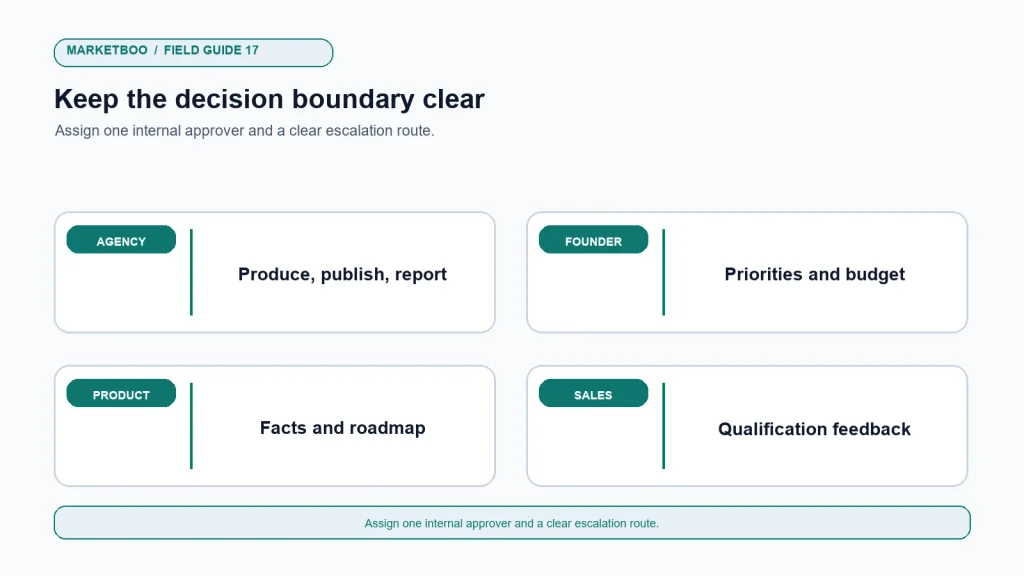
An agency can research the audience, propose concepts, draft content, design assets, schedule posts, moderate defined interactions, and prepare a report if those tasks are in scope. It cannot invent accurate product details the company has not supplied. It should not make roadmap, legal, pricing, refund, or customer-support decisions on behalf of the startup unless specific authority and process are documented.
The startup should name an internal decision owner even when the founder has limited time. That owner can gather input from product, sales, support, and leadership and return consolidated feedback. If three people send conflicting comments directly to the agency, the team will lose time and the content may become incoherent. One approval route is an operating control, not bureaucracy.
| Work area | Agency can own when scoped | Startup retains / approves |
|---|---|---|
| Strategy | Channel plan, editorial approach, content hypotheses | Business priorities, target customer, product positioning |
| Creative | Concepts, copy, design, editing, adaptation | Product accuracy, approved claims, final brand risk |
| Publishing | Calendar, scheduling, posting within permissions | Account ownership, escalation authority, sensitive decisions |
| Community | Defined response categories and moderation hours | Customer remedies, account-specific issues, high-risk complaints |
| Measurement | Reporting and analysis under agreed definitions | Source data access, business interpretation, budget decisions |
| Paid promotion | Campaign operation if explicitly included | Spend cap, billing access, final approval for budget changes |
| Rights | Asset tracking and usage coordination | Licenses, releases, claims, and approval of reuse beyond scope |
Document a decision matrix in the contract or kickoff notes. List who proposes, reviews, approves, publishes, and escalates. For time-sensitive content, include a fallback when the approver is unavailable. Do not let an agency infer that silence equals approval unless the company has expressly agreed to that rule and the subject is suitable for it.
What a startup pilot should prove
A pilot is a way to test fit and workflow, not a disguised performance guarantee. The company should select a manageable period, one primary channel or defined channel set, an agreed output, and a clear review date. It should also state the starting conditions: existing audience, available assets, current posting, response capacity, analytics access, and any product or market limitations.
At the end, evaluate several dimensions: Was communication clear? Did the provider meet the process? Did the internal team supply feedback on time? Were assets accurate and rights cleared? Did the content reach the intended audience? Did it generate useful questions or inquiries? What did the company learn about its message? A pilot can be operationally successful even if it reveals that the current message needs work. It can also create activity without being a good fit if the provider requires more founder time than the startup can spare.
Avoid changing the full plan midway through a pilot without resetting expectations. If a product launch, price change, or audience shift occurs, record the new conditions and decide whether the test should continue or be re-scoped. This keeps the final review honest and avoids blaming the provider for a business decision it did not control.
Contract points that deserve a direct conversation
Ask what the monthly fee covers, how one-time setup is billed, what requires an additional fee, and how the price changes when volume or channels change. Identify the contract term, cancellation notice, response expectations, and the process for urgent edits. Clarify whether paid media is included and keep advertising spend separate from management fees.
The startup should own its social accounts and retain appropriate administrator access. The contract should explain what happens to source files, content calendars, reporting, and access after termination. Ask about the use of freelancers or subcontractors, where assets are stored, and who can view data. Do not provide unnecessary customer lists or account permissions for a content-only task.
Clarify image, music, creator, and employee content rights. Ask whether materials can be used in paid advertising, on the website, in email, or after the relationship ends. Check territories, duration, formats, editing rights, and attribution requirements. A startup’s content library can become an important operating asset; define how it is retained.
Plan the transition before onboarding. Identify the person who will provide product access and facts, the approval calendar, existing assets, social account roles, brand rules, and any content that should not be reused. Ask the agency to produce a kickoff record with confirmed objectives, assumptions, and unresolved items. If the relationship ends, define how the company retrieves access, source files, published content, reports, and open decisions, and how credentials or client data are removed under the agreed process.
Red flags and questions that reveal them
Guaranteed virality or sales. Ask what assumptions support the promise and what part of the outcome the agency controls. No provider can control every market, product, audience, and sales factor.
A follower count as the only objective. Ask what business question the growth is meant to support, how follower quality is assessed, and what happens if engagement does not lead to useful behavior.
A generic package presented before discovery. Ask how the scope changes based on product complexity, internal capacity, customer questions, and current evidence.
No named operator. Ask who writes, designs, schedules, reviews, reports, and serves as backup. A clear team is more useful than a logo on a proposal.
Unclear ownership. Ask who controls ad accounts, social pages, creative source files, analytics, and passwords. Be cautious if the provider cannot explain an orderly exit.
Unverifiable case claims. Ask what the starting point, time period, scope, and contribution were. A screenshot without context does not prove a result or predict yours.
The agency proposes speaking for product or support teams. Ask how it will get accurate product information and when a customer issue goes back to the company.
Run the interview as a working session
Keep an agency interview focused on a business decision. Share one customer question, a representative product page, and the internal constraints. Ask the candidate to explain what it would need to know before proposing a calendar. You are listening for thoughtful questions: Who uses the product? What evidence supports the claim? Which market is in scope? Who can approve? What happens when a customer asks for support? The candidate does not need to solve the whole business in a meeting; it should show how it separates known facts from assumptions.
Ask the team to walk through a real deliverable from brief to approval. Who writes the first draft? How is product information checked? Which versions are prepared for each channel? How does the agency track revisions? Where are source files stored? Who publishes? What is the route for a correction after a post is live? This reveals whether the operation can work with a startup’s pace and decision structure.
Request relevant work samples with enough context to understand the role the agency played. A screenshot can show visual execution but not strategy, rights, sales impact, or the provider’s contribution. Ask whether the material is publicly viewable and whether the candidate has permission to share it. A provider that protects its clients’ confidential material should be able to explain the work without exposing private information.
| Prompt for the agency | What the answer can reveal |
|---|---|
| What would you need from us before recommending channels? | Whether the provider learns the business before prescribing activity |
| How do you handle a claim the product team cannot verify? | Whether accuracy outranks publishing speed |
| Who reviews customer questions after hours? | Whether community coverage has real boundaries |
| What would make you recommend a smaller pilot? | Whether scope fits uncertainty and capacity |
| How can we leave with accounts and source files intact? | Whether exit and ownership are planned |
| How do you report an inconclusive result? | Whether uncertainty is handled honestly |
Make the first month operationally realistic
Startup onboarding can stall when the agency waits for a product brief, the founder waits for a draft, and the product lead assumes the agency already has the latest facts. At kickoff, establish a single workspace for approved information, current offers, brand assets, customer questions, and open decisions. Name the person who can confirm facts and the person who can approve publishing. If the founder is both, agree on a review window that fits their calendar.
The first month should also produce a shared baseline: current account access, audience, publishing pattern, available analytics, relevant customer path, and known limitations. The provider should note what cannot yet be measured. This gives the startup an honest starting point and prevents later reports from implying that activity began from a blank slate when it did not.
Keep the kickoff proportional. A startup may not need a complicated campaign dashboard before it has a reliable audience definition. It does need enough shared records to avoid conflicting messages and accidental publishing. A content calendar, source-of-truth folder, approval log, and monthly decision note may be enough for the initial pilot. Add more process only when the work creates a real coordination need.
How to select and onboard a startup social media agency
- Describe the current stage. State what is validated, what is still uncertain, and what business constraint makes outside help relevant.
- Set one primary objective. Choose a decision or outcome the social program can reasonably support over the initial scope.
- Name the customer and market. Describe target users, regions, channels, and customer questions using available evidence.
- Map internal owners. Assign one approver and identify product, sales, support, legal, or technical reviewers who must contribute.
- Request comparable proposals. Give candidates the same brief and ask for deliverables, cadence, exclusions, fees, access, and assumptions.
- Review a working example. Ask the candidate to walk through how it would turn one customer question into a post, destination, and review signal.
- Check boundaries and control. Confirm account ownership, source files, rights, approvals, response hours, data access, and exit handoff.
- Agree on a pilot. Define scope, start conditions, budget cap, feedback deadlines, review date, and how the team will decide to continue.
- Set the operating rhythm. Use a content calendar, consolidated feedback, escalation route, and report with named definitions.
- Review fit, not just output. Decide whether the relationship improved clarity, learning, consistency, and execution within the startup’s constraints.
When Marketboo may fit
Marketboo offers social media management and broader global paid media support. A startup considering a conversation should share its current stage, target customer, channels, available internal owner, budget boundaries, and what it needs the partner to own. This lets both sides determine whether the scope is a match before discussing a longer commitment.
If a founder wants help planning the boundaries and channel roles before selecting execution support, contact Marketboo with the one-page brief. Ask for a scope that identifies deliverables, exclusions, reporting definitions, approvals, and account control. The company should be able to compare that scope with alternatives and keep ownership of its product decisions.
Frequently asked questions
What should a startup look for in a social media agency?
Look for a provider that understands the company’s stage, asks what is proven, defines a clear scope, names the people doing the work, explains reporting limits, and respects account control. Request evidence for relevant experience and a practical example of how the agency would approach your actual audience question.
When should a startup hire a social media marketing agency?
Consider outside support when the company has a business reason for social activity, someone internally can supply product knowledge and approve work, and the current bottleneck is within the proposed scope. If the product or target customer is still unclear, start with research and message definition rather than assuming more posting will resolve it.
How much does a social media agency cost for a startup?
There is no verified universal fee in the workbook, and cost depends on channel count, content volume, original production, community management, reporting, market, and contract terms. Ask for a written scope and itemized quote. Keep ad spend, creator costs, production, setup, and monthly management separate.
Should a startup choose a niche agency or a full-service agency?
Choose according to the capabilities and coordination the company actually needs. A specialist may have depth in one channel or format; a broader agency may coordinate several disciplines. Verify who performs the work and whether the proposed team covers the company’s product, market, and operational needs.
What should remain under the startup’s control?
The startup should retain product truth, strategy priorities, budget approval, customer remedies, account ownership, and final responsibility for claims. It can delegate defined research, creative, publishing, community, and reporting tasks, but decision rights and escalation rules should be written down.
How do I know whether an agency pilot worked?
Review scope delivery, workflow fit, internal time required, asset quality, audience relevance, customer questions, inquiries, and the learning produced. Compare results with the pilot’s starting conditions and avoid treating short-term engagement as proof of revenue impact.
What is the difference between an agency and a freelancer for a startup?
The labels do not guarantee a specific level of service. Compare named people, skills, availability, backup, coordination, production capacity, fees, and accountability. A freelancer may fit a defined task; an agency may provide a coordinated team. The right choice depends on the work and operating risk.
Choose a partner the company can work with
A social media marketing agency for startups should make the company’s work clearer, more consistent, and easier to evaluate. The selection decision is strongest when the founder understands the provider’s role, the startup’s own responsibilities, and how both sides will handle uncertainty. A defined pilot can reveal whether the communication style, working cadence, and scope match the company’s reality.
Use the brief and scorecard before the pitch. Ask direct questions about people, process, rights, data, fees, account control, and claims. Set one review point at which the startup can decide to continue, change scope, or stop. This protects the company’s budget and leaves it with a reusable understanding of what it expects from a partner.