
The short answer: Meta Ads cost for ecommerce is not a single platform price. The business chooses a media budget, while auction delivery and campaign results vary with audience, placement, creative, season, competition, and the offer. The useful starting point is your store’s economics: contribution available per order, the share you can allocate to acquisition, and a realistic range for conversion. Add agency, creative, tracking, and testing costs separately from media spend. Then model a low, base, and high case using your own data. Treat every example below as a planning calculation, not an industry benchmark or promise of what an account will achieve.
What Meta Ads cost for ecommerce includes
When an ecommerce owner asks what Meta Ads will cost, three different questions often get mixed together:
- What will Meta charge to deliver ads? This is media spend, controlled through campaign budgets and subject to auction delivery.
- What will it cost the business to operate the program? This can include campaign management, creative production, feed work, tracking support, landing-page changes, and reporting.
- What can the store afford to pay for an acquired order or customer? This is an economics question based on margin, repeat purchase, refunds, and the business’s cash position.
An answer that gives one monthly number without separating these items is hard to evaluate. A $3,000 media budget is not the same as a $3,000 all-in budget if management, photography, design, or a development sprint are billed separately. A low media cost per order can still be too expensive if the order’s contribution is small. Conversely, a first purchase that appears marginal may be acceptable for a business with reliable repeat purchase economics, but only when repeat behavior is supported by its own cohort data rather than assumed.
Meta explains its ad delivery and auction approach in its business help center. Those materials describe campaign tools, not a guaranteed CPM, cost per click, or customer-acquisition cost for a specific store. For budgeting, the store’s own transaction and cost data should take precedence over a general online average that may use another country, season, product category, attribution window, or conversion definition.
Start with the maximum acquisition cost your margin can carry
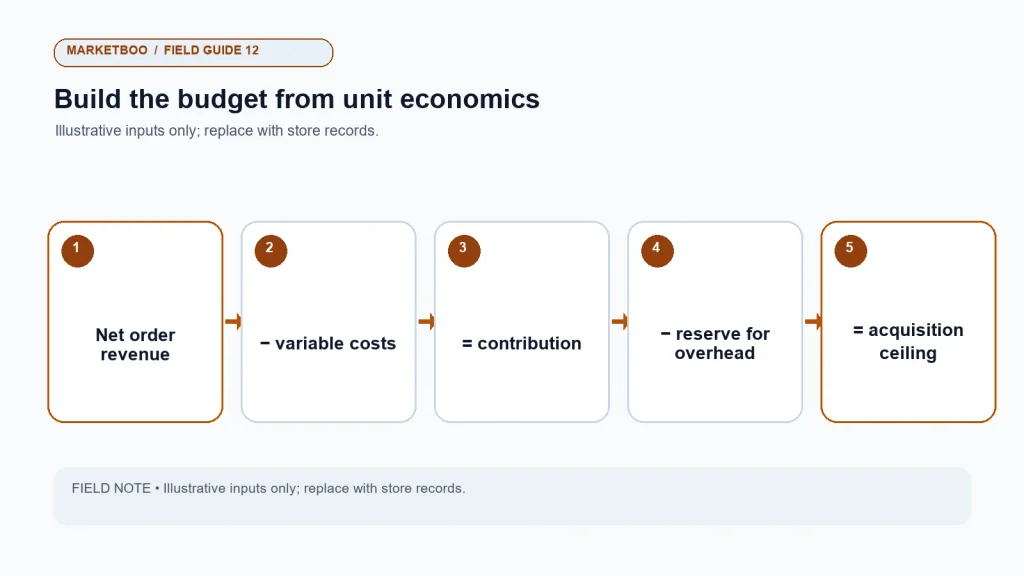
Build the model from the order backward. For a simplified first-order calculation:
Contribution before advertising = net collected revenue − product cost − variable fulfillment and payment costs − discounts − expected returns or refunds.
The word “expected” matters. A store with a meaningful return rate should not budget against the assumption that every placed order remains a sale. Use observed rates for the relevant product group and state the period. If the return window has not closed, flag the cohort as immature.
Then decide how much of that contribution can go to acquiring the order. The business may want to reserve some contribution for fixed overhead, inventory, customer service, and cash flow. The maximum allowable acquisition cost is therefore a management choice, not a platform number.
Illustrative example—not a market average: A product sells for $120 after a discount. Product cost is $42, variable shipping and payment cost is $14, and the store’s estimated refund/return cost allowance is $8. The contribution before advertising is $56. If the owner decides that $30 can be allocated to acquiring a new order while $26 remains for overhead and other needs, the planning ceiling for acquisition cost is $30. That $30 is not an expected result; it is the economic constraint used to judge a test.
| Input | Illustrative value | What to replace with actual store data |
|---|---|---|
| Net selling price after discount | $120 | Paid item revenue, excluding taxes if that is the chosen accounting convention |
| Product cost | $42 | Landed product cost for the order or product group |
| Variable fulfillment and payment | $14 | Pick/pack, shipping subsidy, processing, and other variable charges |
| Expected refund/return allowance | $8 | Observed cost per order for a mature cohort, or an explicitly stated estimate |
| Contribution before advertising | $56 | Net revenue minus the variable costs listed above |
| Contribution reserved for other needs | $26 | Owner’s allocation for overhead, cash needs, service, and profit |
| Planning acquisition ceiling | $30 | Amount available for acquisition in this scenario |
The point is not that $30 is the right target. Another store selling the same product could have different sourcing costs, shipping, discounting, repeat behavior, or business priorities. The point is that a budget question has to connect the ad to an order that the store can afford to acquire.
Translate an acquisition ceiling into a test budget
Once the store sets an acquisition ceiling, it can model traffic and order volume. A simple planning chain is:
Media spend → clicks or landing-page visits → orders → contribution after variable costs.
For a click-based planning model, expected orders equal spend divided by assumed cost per click, multiplied by the assumed store conversion rate. The model can help expose assumptions, but it cannot predict auction performance. Replace every assumption with a dated value from the store’s account or a deliberately wide test range.
Example: Assume a $1,500 test budget, a $1.50 planning cost per click, and a 2% visit-to-order rate. The model yields 1,000 visits and 20 orders. The implied media cost per order is $75. If the allowable acquisition ceiling is $30, the test would not be viable under those assumptions. A different cost per click or conversion rate changes the outcome, but the calculation does not establish that either improvement is available.
This is why budgets should be scenario-based. The base case can use the closest relevant store data. The low and high cases should show how sensitive the decision is to plausible changes in conversion and click cost. Avoid filling an empty data gap with an exact industry average. If the store has little relevant history, say so and treat the first campaign as a learning budget with a defined stop-loss and review date.
| Scenario | Spend | Assumed cost per click | Assumed visit-to-order rate | Modeled orders | Modeled media cost per order |
|---|---|---|---|---|---|
| Conservative | $1,500 | $2.00 | 1.0% | 7.5 | $200.00 |
| Planning case | $1,500 | $1.50 | 2.0% | 20 | $75.00 |
| Upside sensitivity | $1,500 | $1.00 | 3.0% | 45 | $33.33 |
These numbers are intentionally hypothetical. The decimals in modeled orders are expected values from a formula, not fractional customers. Actual results will be whole orders and may differ sharply, especially in a small test. The table shows why the owner should check whether the acquisition ceiling can tolerate the plausible range. It does not forecast a result or represent average ecommerce performance.
Separate media spend from service and production costs
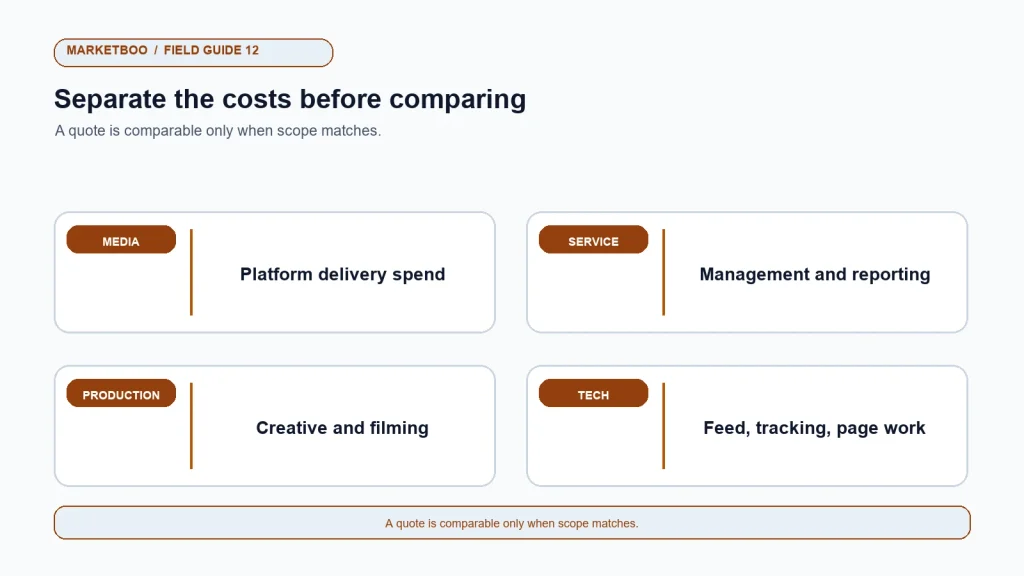
The word “cost” should appear beside a defined scope. Media spend is the amount allocated to ad delivery. Management fees pay for agreed work such as setup, optimization, coordination, and reporting. Production costs may include original photography, video editing, design, copywriting, creator fees, or usage rights. Technical costs may include catalog cleanup, event diagnostics, landing-page work, and store changes. These may be one-time, recurring, or shared with other channels.
When comparing a provider quote, ask whether the fee is fixed, hourly, or based on spend, and how it changes if the scope changes. Ask who pays for creative production, whether revisions are included, who owns source files, and how many campaigns or product groups the fee covers. Ask whether ad spend is billed directly by Meta to the business or handled through another arrangement. Confirm ownership and access to the ad account before work begins.
| Cost bucket | Common scope questions | How to budget it |
|---|---|---|
| Media spend | What campaigns, markets, and dates does the amount cover? | Set a capped test amount and an approval process for increases. |
| Campaign management | What setup, monitoring, optimization, and reporting are included? | Record fee basis, service period, and exclusions separately. |
| Creative production | Are concepts, filming, editing, versions, and rights included? | Price per agreed deliverable or production cycle, with rights clarified. |
| Catalog and feed work | Who corrects product data and how are exceptions reviewed? | Treat major cleanup as a defined project if it is outside routine care. |
| Analytics and tracking | Which events, systems, and tests are covered? | Scope the audit and implementation separately when custom work is required. |
| Storefront changes | Who updates the landing page, offer, or theme? | Assign the task to an owner and estimate it as development work. |
| Discounts and returns | Who approves offers and how are reversals reported? | Model their impact in store contribution, not only in ad spend. |
If the scope is unclear, ask the provider to price a short diagnostic with specific deliverables: data to inspect, questions to answer, changes that require approval, and a written recommendation. That can be easier to compare than a broad retainer whose boundaries are unclear. A plan to manage global paid media should identify channels, markets, and accountability, while any work on the shop itself should be scoped alongside website development and design.
Decide how much to spend before the result is known
A test budget is not simply the amount the team hopes to spend. It is the amount the business can afford to use to answer a question at a defined level of risk. The test should have an owner, duration or review condition, success and failure criteria, and an explanation of what will happen if the data is inconclusive.
For a new product or new market, the team may not have a reliable visit-to-purchase rate. In that case, separate the learning question from the scale decision. The first test could evaluate whether a specific audience responds to a specific product proof. It should not be described as a guaranteed path to a target cost per acquisition. If the purchase volume is too low for a stable estimate, report a range and preserve uncertainty.
A practical test charter contains:
- Decision: What decision will the test inform?
- Hypothesis: Which change is expected to influence the decision and why?
- Budget cap: What amount can be spent before review or stop?
- Time boundary: How long will the team observe before calling the test immature, failed, or ready for another step?
- Economic limit: What acquisition cost or contribution threshold applies?
- Measurement check: Which platform and store records will be compared?
- Next action: What will the team do if results are above, below, or between the thresholds?
If actual results are below the plan, do not automatically increase spend to force a larger sample. Check whether the product page is usable on mobile, the offer is accurate, the feed is current, the conversion event is reliable, and the creative reaches the intended customer. If those checks pass, compare the real cost and contribution with the ceiling. Pause when the budget has answered the question or when continuing would exceed the risk limit.
What can change costs from week to week
Several variables influence delivery and the store’s cost per order. Some are within the business’s control; some are contextual. A new product message can change response. A stockout can make previously useful creative irrelevant. A seasonal period can alter competition and intent. A slow or confusing page can reduce the share of visits that become orders. A discount may lift conversion while reducing contribution. A change in attribution settings can alter reported results without changing the underlying number of store orders.
For that reason, track the stages separately. If spend is stable but link clicks fall, examine delivery and creative response. If clicks remain steady while landing-page sessions fall, inspect links, redirects, and page load. If sessions are stable and checkout starts fall, inspect product relevance, price, shipping, and page clarity. If paid orders are stable but contribution falls, investigate discounts, product mix, costs, returns, and cancellations.
This diagnostic sequence keeps the team from treating every problem as a bidding problem. It also helps distinguish an advertising cost from an ecommerce conversion problem. The cost of a click may be within the account’s observed range while the store loses orders because the chosen variant is unavailable. Increasing budget in that scenario pays for more visits to a broken path.
Use auction controls as operating choices, not cost guarantees
The person setting a campaign may be able to choose a budget, schedule, audience approach, placement settings, optimization event, or bid strategy depending on the campaign type and account. These are controls over how the campaign participates in delivery; they are not a promise that the same spend will produce the same number of people or purchases. Before changing a control, write down the problem it is meant to solve. If cost per result increased because the product page stopped converting, a bid adjustment may change delivery without fixing the store problem.
Keep an event log for material changes. Record the setting, date, person responsible, reason, expected effect, and the metric that should respond. This is particularly useful when several people have access to the ad account. If a result moves at the same time as a new promotion, product price, landing page, or measurement change, the log helps explain the context. Without it, a team can mistake timing for cause.
There is also a distinction between a daily budget and the amount the business is willing to spend across the test. The account may pace delivery according to its own current rules. The business should still set a total financial cap and a human review condition. Check the current Meta billing and budget documentation for the relevant campaign type, because platform delivery behavior can change. Do not assume that a daily setting alone equals the maximum amount approved for the whole test.
If a campaign uses an automatic or campaign-level budget, the team should understand how spend may move among ad sets or product groupings. A combined budget can be convenient, but it can obscure whether each strategic segment received a meaningful chance to run. A more segmented setup can provide clearer control but may divide limited data and attention. Choose the least complicated structure that can answer the business question, then check spend allocation in the account.
The budget conversation should therefore include two guardrails: an account-level configuration that reflects the intended test and a business-level rule for pausing or reviewing if spend or risk reaches a threshold. The first is an implementation detail. The second is management responsibility. Confusing them can leave a small team with an active campaign that continues beyond the amount it intended to learn from.
A one-page budget worksheet
Use the same period, currency, and order definition in every line. Where a figure is unknown, mark it unknown rather than substituting a market average.
| Worksheet line | Formula or source | Example field to enter |
|---|---|---|
| Net revenue per order | Store order data after discount and agreed exclusions | Actual currency and period |
| Variable cost per order | Product + fulfillment + processing + expected reversals | Cost source and cohort maturity |
| Contribution before ads | Net revenue − variable costs | Calculated amount |
| Acquisition allocation | Owner’s decision based on margin and cash needs | Stated ceiling per new order |
| Visit-to-order assumption | Relevant store sessions and orders | Range, period, and segment |
| Click or visit cost assumption | Account history or explicit test assumption | Range and date observed |
| Modeled spend | Target orders × modeled cost per order | Cap, not a promised result |
| Non-media work | Management + production + technical support | Fee, scope, and billing period |
| Review rule | Budget cap + date + stop/continue conditions | Named approver |
The worksheet is useful because it keeps decision-makers from debating one number without understanding its inputs. If a vendor provides a forecast, ask which values are based on the store’s actual account, which are assumptions, and what evidence would change the recommendation. If a quote appears unusually precise despite missing conversion and margin data, precision is not evidence.
How to estimate an ecommerce Meta Ads test budget
- Choose the business outcome. Define whether the test is for first orders, repeat orders, qualified inquiries, or another goal. Do not mix goals in one numerator.
- Calculate contribution. Use actual product cost, discounts, shipping, payment charges, and mature refund or return data where available.
- Set an acquisition ceiling. Decide how much contribution may be used to acquire an order or customer, and who approves the limit.
- Gather store-specific assumptions. Pull a relevant conversion range, cost-per-click or session cost range, product mix, and reporting period from the account. If there is no history, say that the model is exploratory.
- Build conservative, planning, and upside cases. Change one or two assumptions at a time so the sensitivity is visible. Label every figure as actual, estimated, or hypothetical.
- Separate media from operating costs. Add agency management, creative, tracking, catalog cleanup, and web changes in distinct lines.
- Set a cap and review point. Record the maximum spend, the date or condition for review, and what counts as an inconclusive test.
- Check the purchase path before launch. Verify products, variants, destination pages, offer terms, and the event used to report a completed order.
- Reconcile platform and store results. Compare matching dates and currency; identify attributed results separately from recorded orders, refunds, and net sales.
- Update the model with observed evidence. Replace assumptions only when a test produces relevant data. Keep the old version so the team can see which assumptions changed.
Questions to take into a budget review
When an owner asks, “How much should we spend?”, the most useful response may be a decision conversation rather than a fixed recommendation. Does the store have margin data by product? Are there enough units to support a test? Can the page fulfill the promise in the ad? Is there room to spend for learning without making payroll, inventory, or operating needs uncertain? Does the team have a way to distinguish a weak ad from a weak landing page?
Those questions are not obstacles to advertising. They are the information required to set a budget that can be defended. A low-risk initial test is only useful if it can answer something. A large spend is only defensible if the store can monitor it and act on the result. Budget size should follow the company’s readiness and economics, not an online rule that every ecommerce brand should spend a fixed amount each month.
Frequently asked questions
Is there a fixed Meta Ads price for ecommerce?
No single fixed price applies to every store. The business chooses a budget for delivery, and auction costs and outcomes vary by campaign, market, product, timing, and creative. Any management or production fee is a separate commercial agreement. Ask for media spend and services to be itemized.
What is a reasonable starting budget for Meta Ads?
Choose a test amount the business can afford to spend while answering a defined question. Base the amount on contribution margin, inventory, the buying cycle, and the confidence of the measurement setup. When account history is limited, set a conservative cap and report the result as exploratory rather than promising a cost per order.
Should agency fees be included in ROAS?
Traditional media ROAS generally compares attributed revenue with media spend, so it may exclude agency and production fees. For business decisions, calculate an all-in view as well, with management, creative, technical, and other acquisition costs stated. Give each metric a clear name so the reader knows which cost base it uses.
How do I calculate the maximum cost per purchase I can afford?
Estimate net order revenue, subtract variable product and fulfillment costs, account for expected discounts and refunds, then decide how much remaining contribution the business can allocate to acquisition. The result is a management ceiling for that scenario, not a guaranteed target or a universal formula for every customer cohort.
Is a low cost per click proof that the campaign is working?
No. A low click cost can still bring visits that do not match the product or complete a purchase. Compare clicks with landing-page sessions, orders, net sales, and contribution. Use the click metric to diagnose response, not as a substitute for the business outcome.
Why does Ads Manager show a different cost per purchase than my store data?
The systems may use different attribution logic, time zones, event signals, and order status. The ad platform reports outcomes attributed to ads under its settings; the store records transactions and later changes such as cancellations or refunds. Compare matching periods and definitions, then explain the remaining difference instead of forcing the numbers to match.
Can a campaign with a high first-order acquisition cost still make sense?
Possibly, but only if repeat behavior, customer value, contribution, and payback timing are supported by the store’s own cohort data and cash position. A hoped-for repeat order is not the same as an observed one. Show the first-order result separately from any model based on future purchases.
A budget is a set of assumptions the team can revise
Meta Ads cost for ecommerce becomes clearer when a business separates the amount paid for delivery from the cost of operating campaigns and from the cost the store can economically tolerate to acquire a customer. Start with real unit economics, make uncertainty visible, and set a cap for learning. As evidence accumulates, revise the model rather than defending assumptions that no longer fit the store.
If the team needs help turning store economics into a media plan, discuss a paid media scope with Marketboo. If the limiting factor is the product page or checkout experience, review store design and development support before using more media to send traffic into the same friction.
The useful question is not “What do ecommerce brands usually pay?” It is “What can our store learn and afford under the evidence we have today?” Answer that with a dated worksheet, a clear decision owner, and assumptions that can be replaced by actual results.