
Google Ads coaching is structured guidance that helps an account owner understand evidence, make approved changes, and repeat the work after coaching ends. A four-week plan can be a useful schedule, but it is a proposed service format—not a Google standard or a guarantee of better results. Set a dated baseline, define the client’s goal and access boundaries, and attach an artifact to each session. Compare like-for-like periods where possible, record concurrent changes, and treat outcomes as observations unless the evidence supports a stronger conclusion.

Decide whether Google Ads coaching fits the account
Google Ads coaching makes sense when someone on your team has time to inspect evidence, practise account work, and explain the decision afterwards. If nobody can complete the homework or authorize a change, coaching will produce notes rather than capability. Discuss that constraint before booking a program.
A useful screening conversation starts with one problem: perhaps the account reports enquiries that sales cannot identify, or campaign changes happen without a record of why. Bring an anonymized example. Ask the proposed coach to describe how they would investigate it, what access they need, and what would remain outside their responsibility. Verify the trainer’s relevant experience and credentials directly; this guide does not claim a particular trainer is certified.
Week one: establish a baseline that can be reproduced

Start with an account map, not a list of optimizations. Record the campaign purpose, budget owner, landing page, conversion definition, sales follow-up, reporting period, and recent changes. Save the original report with its filters and time zone. A later comparison is useful only if the owner can reproduce the starting point.
Choose one decision the program should improve. “Understand why reported leads differ from accepted enquiries” is more testable than “get better at PPC.” Write down the evidence needed and the decision owner. If the data is incomplete, the first deliverable is an issue register and a repair plan; do not manufacture a clean baseline.
Week two: trace one action from ad to business record
Have the learner describe what should happen when a prospective customer completes the selected action. Then inspect a permitted test or redacted record: landing experience, confirmation, recorded event, duplicate handling, CRM entry, and assigned owner. Follow the organization’s consent and testing procedures rather than submitting personal data simply to populate a report.
Keep a vocabulary sheet beside the trace. A platform conversion, a unique enquiry, and an accepted lead may describe different sets of records. Google’s official conversion-measurement overview distinguishes website tagging from offline conversion imports that connect CRM actions back to ads. That distinction is useful in coaching: inspect how the business outcome becomes a recorded event, and which stages remain outside the report. The overview is undated; verify current implementation details and permissions for your account before making changes.
Week three: make one bounded change and preserve the reasoning

Select a change that addresses the evidence, with a named approver and a review window. For example, a query review might reveal that an offer intended for commercial buyers attracts students researching the subject. Inspect the available search-term evidence and landing promise before deciding whether targeting, exclusions, copy, or the offer needs attention. The official search-terms-report guide is the place to check current report coverage and limitations.
Record the hypothesis, affected campaigns, release time, expected mechanism, concurrent changes, and rollback condition. If several things change together, describe the result as an observation with competing explanations. A before-and-after screenshot alone does not establish that the coaching caused the difference.
Week four: ask the learner to run the review
The final session should reveal what the owner can repeat. Ask the learner to retrieve the baseline, check measurement, explain the latest change, identify an unresolved issue, and propose the next review. The coach can challenge the reasoning, but should not answer every question first.
Hand over a short operating playbook: weekly checks, report definitions, access owner, change log, escalation route, and outstanding questions. Separate work completed from work recommended. A four-week calendar is the sample format in this article; neither Google nor this guide guarantees that a particular account can be repaired or a skill mastered within that period.Apply for Google Ads coaching
Put an artifact and a decision beside each session
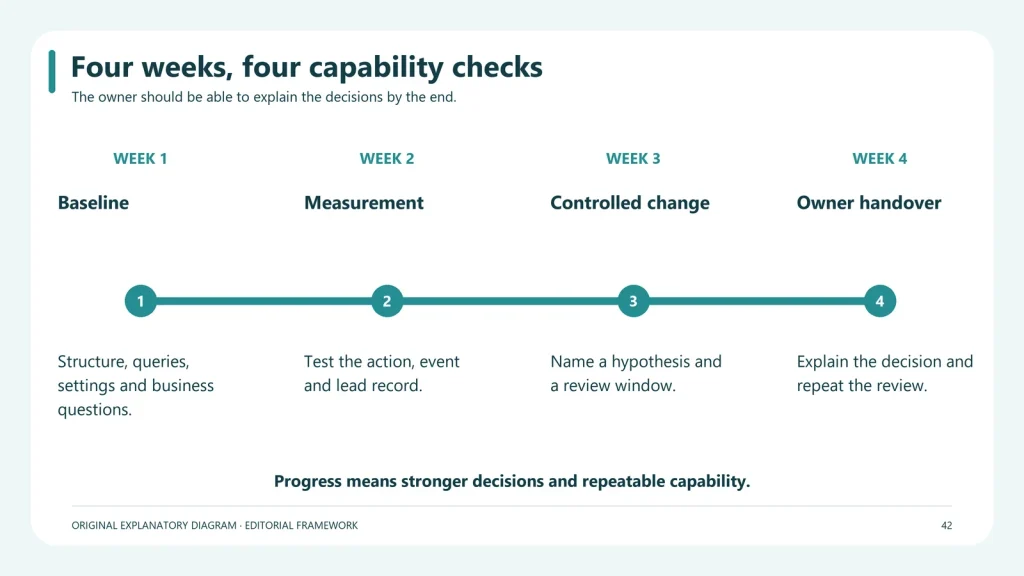
| Session | Evidence to bring | Useful output | Decision |
|---|---|---|---|
| Baseline | Dated reports and change history | Account map and issue register | Which problem comes first? |
| Measurement | Permitted test or redacted trace | Event and CRM reconciliation | Can the selected outcome be trusted? |
| Controlled change | Relevant queries, ads, or landing evidence | Approved hypothesis and change record | Release, revise, or defer? |
| Handover | Learner-led account review | Playbook and unresolved-work list | What can the owner maintain? |
Homework should be small enough to complete before the next review and specific enough to assess. “Reconcile five permitted example records and list mismatches” is clearer than “improve tracking.” Five is an illustrative exercise size, not a statistical sample or a platform requirement.
Keep media results separate from learning progress
Use two scorecards. One records the business evidence available in the agreed period; the other records what the learner can now do independently. A quiet account may not generate enough new sales evidence during the program, while the team can still learn to diagnose event duplication, explain a report, and maintain a change log.
For illustration, $600 divided by 30 recorded actions equals $20 per recorded action. If sales accepts only six of those records, the media cost per accepted lead is $100. These are invented inputs for an arithmetic exercise, not industry benchmarks or a Marketboo result. The lesson is to name the denominator before deciding whether a cost improved.
Agree access, approval, and exit responsibilities
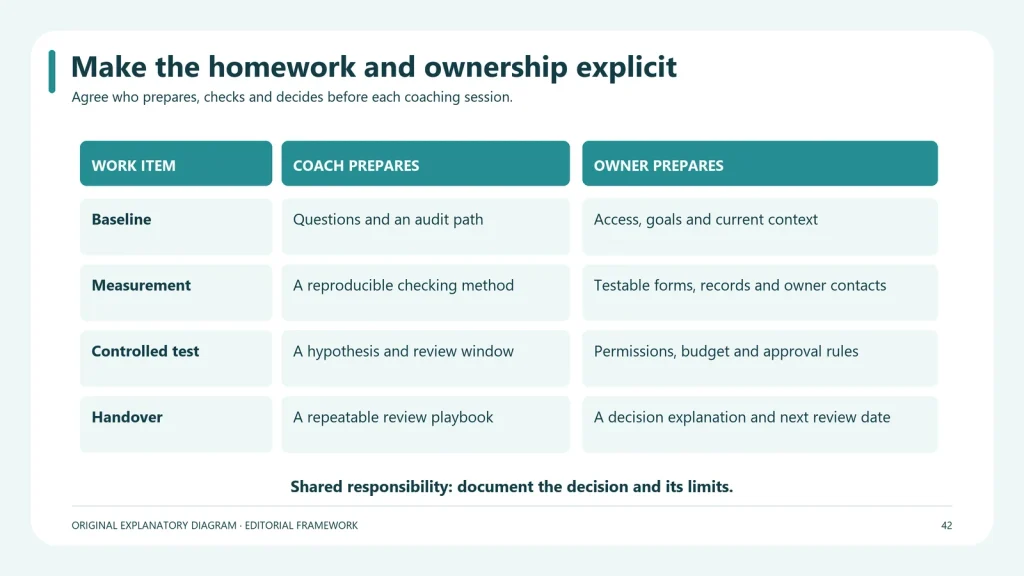
| Work | Coach’s proposed role | Client’s retained responsibility |
|---|---|---|
| Diagnosis | Frame questions and review evidence | Supply accurate business context |
| Account change | Explain or supervise the agreed task | Authorize release and rollback |
| Data handling | Use the agreed redacted materials | Approve access, retention, and testing policy |
| Learning | Set exercises and give feedback | Complete practice and maintain records |
| Exit | Deliver the agreed playbook | Review access and assign ongoing ownership |
Confirm confidentiality, access level, storage of session materials, and removal of access in the written scope. These are questions for the engagement, not claims about an existing provider’s security controls. Ask Marketboo whether the proposed cadence, supervised work, and handover fit your team, then confirm the actual service terms before committing.
How to turn four coaching weeks into an owner playbook
Use these steps as a working sequence; agree responsibilities and verification before implementation.
- Confirm the account objective, team capability, access, baseline period, data boundaries, and four-week decision.
- Inventory campaigns, queries, ads, budgets, conversions, landing paths, owners, and recent changes.
- Write the measurement dictionary and QA the chosen events, forms, CRM states, and reporting windows.
- Choose one controlled account improvement with an expected mechanism, owner, review window, and rollback note.
- Complete homework and review evidence in a weekly session; record what changed and what remains uncertain.
- Build a handover playbook with checks, decisions, permissions, escalation, and a maintenance calendar.
- Review capability, evidence quality, and the next priority with the account owner and stakeholders.
- Decide whether to continue coaching, pause, or move to a new scoped improvement cycle.
FAQ
What is Google Ads coaching?
It is guided account review and capability transfer in which a coach helps a team understand decisions, complete work, and retain account ownership.
What happens in the first week?
The coach and client establish the objective, baseline, account map, measurement context, access, priorities, and evidence gaps.
Does coaching include making account changes?
It can include walkthroughs or supported changes when the scope and access allow it. The production owner must approve changes.
What should clients prepare?
Bring account access, business goals, conversion definitions, sales context, landing paths, change history, and a named person for homework.
How is coaching different from full management?
Coaching emphasizes understanding and internal capability. Management may include delegated execution; the contract should state the boundary.
Can coaching guarantee lower costs or more leads?
No. Account decisions operate within offer, demand, competition, data, budget, and market conditions.
How does Marketboo structure coaching?
Ask Marketboo to confirm the available cadence, account-review work, homework, measurement checks, and handover. The four-week schedule in this guide is a proposed format, not a verified fixed package.
Conclusion
Google Ads coaching is worth considering when it improves the owner’s ability to inspect evidence and make repeatable decisions. Choose the coach by their explanation, relevant experience, teaching method, and agreed boundaries. Leave with a defensible next step and a usable playbook, rather than treating four weeks as a promise of lower costs.Review a four-week coaching agenda with Marketboo