An Instagram marketing agency for ecommerce should connect content and creator work to buyer questions and a measurable product path. Start with the profile promise, product details, stock and service information, then plan content that helps shoppers discover, evaluate, and act. Give creators clear deliverables, rights, approvals, and market-specific disclosure review. Measure product-page visits, cart activity, purchases, and returns with the agreed analytics setup; engagement alone does not show sales impact. Feature availability and attribution depend on the account, market, and measurement configuration.

A commerce review for your Instagram marketing agency
The useful question in an agency pitch is what a shopper will understand after seeing the work. A beautiful feed can still leave the buyer unsure about fit, materials, delivery, or returns. Ask the agency to identify the three doubts that most often delay a purchase and show the proposed asset for each. This creates a commercial reason for the content before anyone debates formats or posting frequency.
Start with customer-service questions, product-page search terms, return reasons, and conversations the brand is permitted to review. These are inputs to an editorial decision, not a representative survey. Keep the source and date beside each observation. A question heard twice can justify a low-cost explanation; it cannot establish what every customer wants.
| Shopper uncertainty | Useful content | Check before release |
|---|---|---|
| Will it fit my situation? | A demonstration with dimensions, conditions, or a stated use case | The example matches the actual product specification |
| What makes the difference? | A close-up comparison using consistent criteria | Comparable variants and substantiated wording |
| What happens after I buy? | Delivery, setup, care, or returns explanation | Current policy and service availability |
| Can I trust this recommendation? | A clearly identified creator account of their experience | Permission, relationship disclosure, and no unsupported typical-results claim |
Inspect the profile as a product-information desk
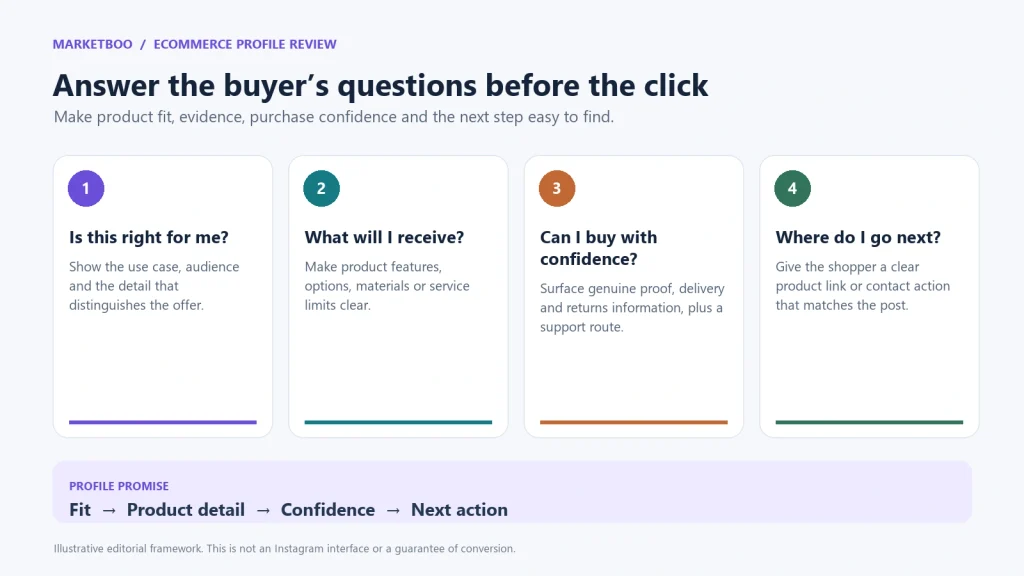
Open the profile as a first-time mobile visitor. Can you identify the product, intended customer, next step, and support route without deciphering slogans? A bio has little space, so move detailed questions into pinned content, highlights, and the destination page. Give each layer a distinct job. Repeating the same brand promise in every layer consumes space that could answer a purchase question.
Choose one priority route and follow it through to completion. Check product variant, price, availability, delivery region, and contact options. If an advertised colour is sold out, agree whether to pause its promotion, offer a clearly described alternative, or link to a waitlist. This is a merchandising decision that the content team needs before publishing.
Keep a short profile change log: information changed, approving owner, affected link or highlight, and date checked. Use it after a launch or policy change. A recurring customer question is a reason to improve the information path, even when the profile looks visually consistent.
Give the content portfolio different jobs
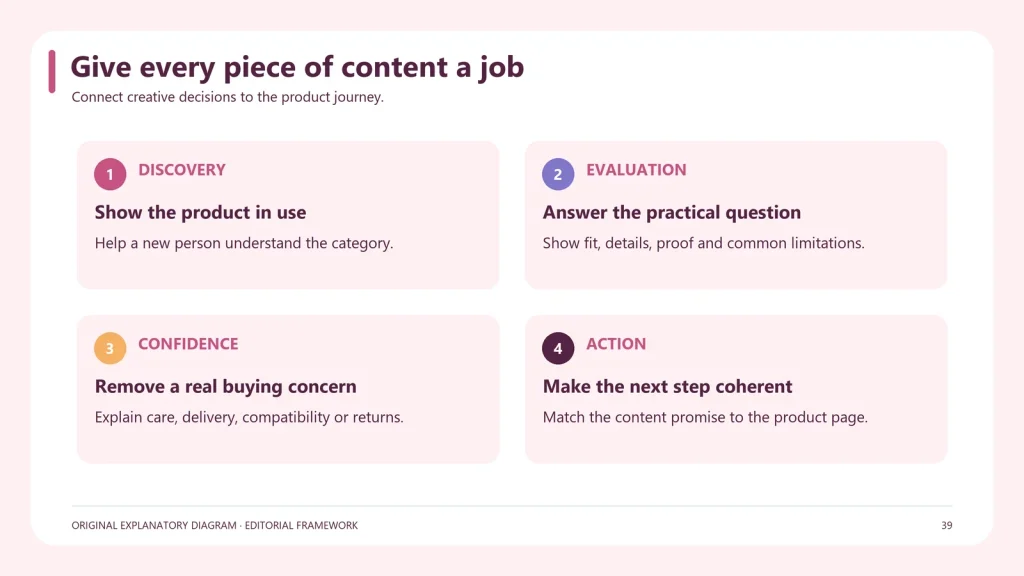
A demonstration should show how a product behaves under stated conditions. A comparison should explain a choice. A care guide should reduce avoidable confusion after purchase. A launch announcement should make availability and the next action clear. Judge each against its job instead of imposing the same sales metric on every post.
Consider a hypothetical bag brand. One asset can show what fits inside, another can compare strap adjustments, and a third can explain how to clean the material. Each answers a different uncertainty. Three near-identical lifestyle photographs would give the editor fewer reasons to publish and the shopper fewer reasons to continue.
Plan evidence before filming: the product version, approved measurements, demonstration conditions, and source for any comparative statement. Where personal experience is used, preserve the creator’s meaning. Avoid editing a qualified opinion into a universal product promise. A content library is more useful when assets are labeled by the question they answer as well as by format.
How to audit an Instagram commerce content system
Assign a named owner and review point for each step.
- Write the product, audience, buying friction, destination, inventory or service constraint, and success definition.
- Audit the profile, links, highlights, product data, accessibility, customer questions, and support path.
- Create a content map with education, demonstration, proof, community, offer, and product jobs.
- Brief creators with selection criteria, usage rights, disclosure, review, deadlines, and replacement plans.
- Connect product discovery, landing pages, events, checkout or enquiry records, and consent-aware measurement.
- Choose organic assets for paid amplification using a stated hypothesis rather than engagement alone.
- Review content, creator, paid, product, and sales evidence in one operating meeting.
- Retain the next test, owner, approval, and measurement baseline before expanding output.
Creator agreements need a rights map and a disclosure review
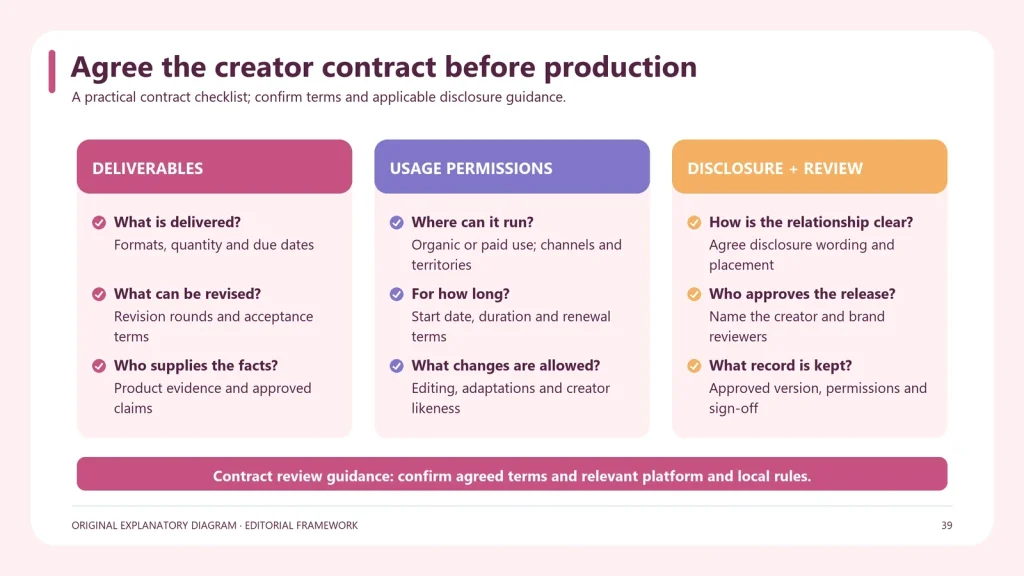
The FTC’s revised U.S. Endorsement Guides were published and became effective on July 26, 2023, at 88 FR 48092. Section 255.5 addresses connections that could materially affect an endorsement’s weight or credibility and that the audience would not reasonably expect. The published examples include payment and free or discounted products. Read the dated Federal Register text. This is U.S. guidance; campaign facts and other jurisdictions still need appropriate review.
Turn that reference into questions for the approval meeting: What did the creator receive? What relationship will the audience understand? Where does the disclosure appear in the actual asset? Does it remain clear when the content is clipped, translated, or used in an advertisement? A contract checklist should trigger these questions rather than promise that one standard label resolves every campaign.
Rights are a separate decision. Record the asset, channel, territory, permitted edits, duration, paid use, and renewal route. If the agreement allows organic posting only, keep that asset out of paid production until the relevant permission is agreed. Assign someone to act before the rights period ends; an expiry reminder without an owner will not remove an advertisement.
| Item | Decision to capture | Owner |
|---|---|---|
| Deliverable | Product version, format, dates, and required explanation | Content lead |
| Claims | Approved wording and supporting product evidence | Brand subject-matter owner |
| Relationship | Compensation and disclosure review for the target market | Brand reviewer or adviser |
| Reuse | Channels, paid permission, edits, territory, and term | Contract owner |
| Correction | Who updates, withdraws, or replaces an affected asset | Publishing owner |
Follow the product path before reading the sales report
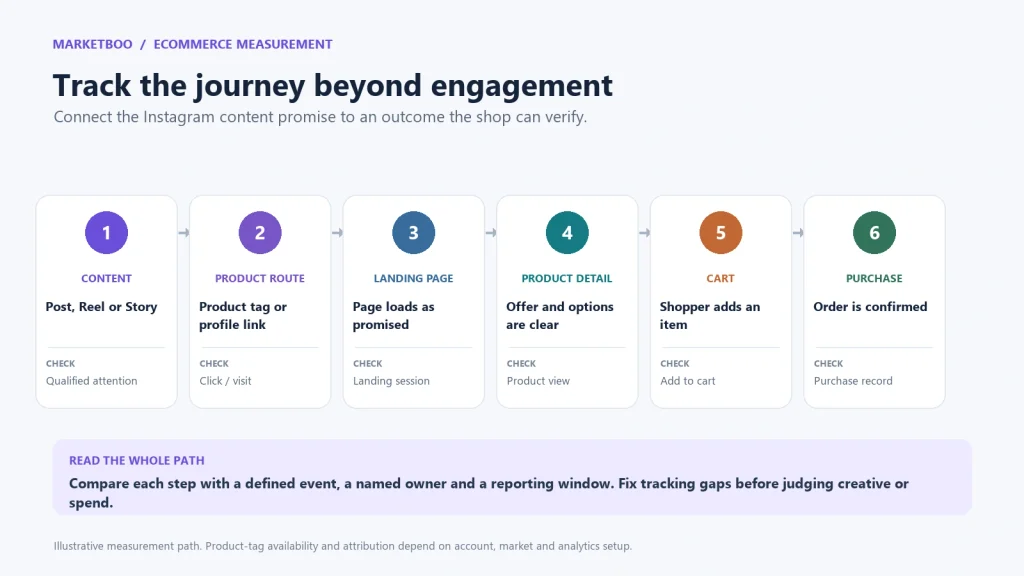
Use a tagged destination or another agreed identifier where the account and analytics configuration allow it. Test the link on a mobile device without administrator privileges. Then check the events that the business actually records: product view, cart action, checkout, purchase, or enquiry. A working link is the beginning of the test; the destination must also represent the product accurately.
Keep consent settings, attribution window, paid activity, time zone, and returns treatment beside the report. Platform attribution and store records may answer different questions. Reconcile them where possible and identify the unmatched portion rather than silently treating the larger number as correct.
Hypothetical calculation: 48 recorded orders divided by 1,200 tagged product-page sessions equals a 4% session-to-order rate for that example. It is not a benchmark, a Marketboo result, or proof of incremental sales. The same buyer can create more than one session; other channels can influence the order; cancellations and returns may change its value. Define the denominator before discussing improvement.
Amplify a test the business can support
An organic winner can be a candidate for paid use after rights, stock, claims, and destination checks. State the paid question: will a particular demonstration earn relevant visits from a defined audience? Specify the review window and evidence needed for the next budget decision. High engagement alone does not settle whether the offer or product path is sound.
Give the campaign a stop rule. Pause when the featured item becomes unavailable, a material product statement changes, usage rights expire, or checkout fails. Commercial operations should be able to flag these conditions without waiting for the next monthly report.
For an agency comparison, ask each provider to describe the first handoff it would improve and the evidence it would inspect. A proposal that names the dependency, decision owner, and measurable next action is easier to assess than a promised number of posts.Plan an Instagram growth system
FAQ
What does an Instagram marketing agency do for ecommerce?
It can coordinate profile strategy, organic content, creators, product discovery, paid amplification, community, and measurement. The scope should identify who owns each path.
How much should an ecommerce brand post?
Use a sustainable cadence tied to content jobs, inventory, launches, customer questions, and production capacity. A universal posting number is not a strategy.
Do creators guarantee sales?
No. Creator fit, audience trust, offer, rights, content, product experience, and measurement affect outcomes.
What should an Instagram profile include?
The profile should explain the offer, audience, proof, next action, support path, and relevant destinations in language the buyer understands.
How do product tags and links fit the funnel?
They can shorten discovery when the catalog, destination, tracking, and product information are current. Test the full path rather than assuming a tag equals a purchase.
Should every organic post be boosted?
No. Choose amplification when the asset, audience, objective, rights, and next action form a sensible paid hypothesis.
How can Marketboo support Instagram growth?
Marketboo publishes social strategy, content development, account coordination, community management, and reporting services. Ask which Instagram deliverables, creator tasks, paid permissions, and measurement work are included in the written scope.
Conclusion
Choose an Instagram marketing agency that can explain the buying doubt behind each asset and connect it to an accurate product path. Resolve claims, rights, disclosures, and stock dependencies before increasing output. Then judge the work using defined commerce evidence and its limits, rather than the appearance of a busy feed.Coordinate content and creator operations with Marketboo