A Facebook Ads course for business owners should teach people to connect campaign objectives, audience, creative, conversion measurement, reporting, and account ownership to business decisions. The goal is not to memorize every interface label; it is to ask what an event means, where its count came from, how the reporting window and attribution setting were selected, and what action follows. Use a mock report or an approved account export, clearly marked as such. Platform-attributed conversions do not automatically establish incremental sales or return on ad spend.

Choose a Facebook Ads course by the decisions you need to make
A Facebook Ads course for business owners should make a vendor conversation easier to judge. The most valuable outcome is not remembering every button: it is being able to explain the business goal, approve a sensible test, and question a report that does not answer the goal.
Before choosing a course, list three decisions you find difficult. You might need to decide whether an enquiry is valuable, whether a creative test has answered its question, or whether the agency’s proposed budget fits sales capacity. Ask the trainer to show an exercise for each. Check their relevant experience and teaching examples directly; a credential or persuasive sales page is not evidence of results in your business.
Start with a report-reading glossary

| Term | Plain-language distinction | Owner’s question |
|---|---|---|
| Impression | An exposure count rather than a unique buyer | Which audience and period are included? |
| Click | An interaction; it does not establish an enquiry | What kind of click, and where did it lead? |
| Recorded conversion | An action counted under the report’s definition | Which event, window, and counting rule? |
| Accepted lead | A record meeting your documented sales rule | Who reviewed it and why was it accepted? |
| Attributed revenue | Revenue assigned under a stated method | Is this an attribution result or a causal claim? |
| Creative test | A comparison designed around a question | What changed and what would change our decision? |
Use the glossary as a discussion tool, not a substitute for the platform’s current metric definitions. A trainer should open a relevant report, show the exact labels, and explain what the interface can and cannot establish. Keep a screenshot or export with its date, filters, and currency.
How to test what an advertising course has taught you
Use these steps as a working sequence; agree responsibilities and verification before implementation.
- Write the business goal, customer action, budget window, owner, capacity, and decision date.
- Learn the core terms for objective, audience, creative, placement, event, attribution, and qualified lead.
- Trace a real path from ad to landing or form, event, CRM record, follow-up, and business outcome.
- Review a sample report and ask for definitions, date range, comparison, insight, action, and owner.
- Confirm account, billing, page, pixel, catalog, creative, audience, and data ownership before hiring.
- Write an agency brief with scope, access, approvals, reporting, tests, exclusions, and handover.
- Use training to identify what the team can own and where specialist implementation is needed.
- Recheck the learning against the next campaign decision and update the questions list.
Translate a business goal into an agency brief
Write the commercial problem before the campaign setting. “Generate enquiries our service team can assess in one business day” identifies a real constraint; “get engagement” leaves the agency guessing. Add the offer, audience, location, exclusions, landing path, approved spend ceiling, sales response owner, and review date.
The course should help you distinguish the business outcome from the action chosen for campaign delivery. Ask the trainer to verify current campaign terminology in official Meta resources rather than relying on a recorded screen that may have changed. This guide proposes a briefing method; it does not prescribe a universally correct campaign objective.
Learn to test an offer before arguing about an audience
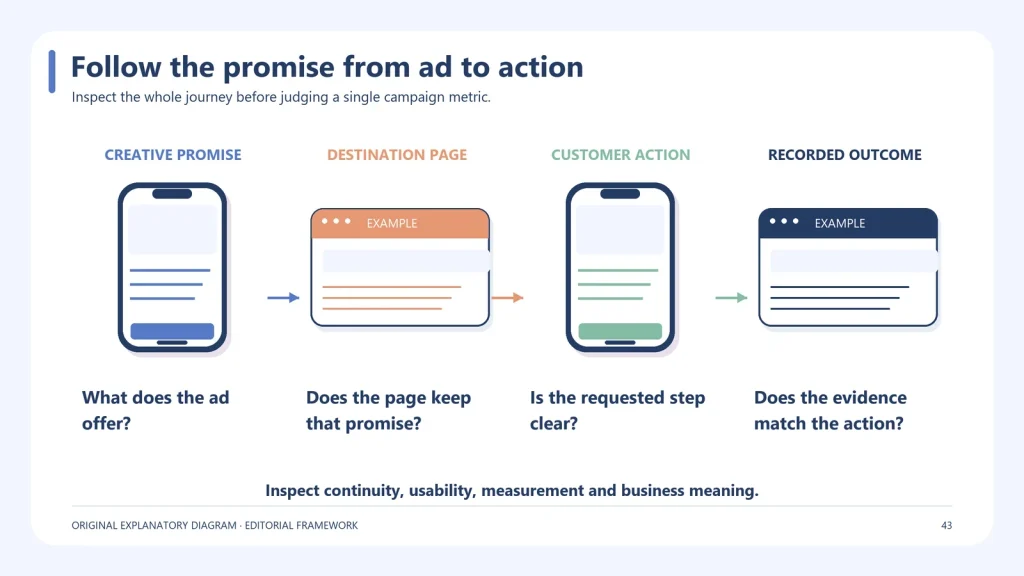
An audience can be relevant while the offer is unconvincing. In an illustrative home-services example, a generic “contact us” message and a page explaining the estimate process create different levels of uncertainty for the same household. Compare the promise, proof, eligibility, next step, and response capacity before attributing weak results to targeting alone.
Ask for an exercise in writing a hypothesis: “A clearer description of what happens after an enquiry may reduce uncertainty.” Then identify the evidence that would support or weaken it. Keep changes manageable and document concurrent edits. Do not promise that one creative format, audience setting, or course technique will always outperform another.
Follow the enquiry beyond the advertising report
A useful lesson follows a permitted test record through the whole path: ad promise, landing experience, completed action, record creation, duplicate handling, response, and qualification. The owner should understand where a record can be lost or counted twice, even when a specialist performs the implementation.
Use hypothetical arithmetic to practise reading denominators. If media spend is $900 and the report counts 45 enquiries, the media cost per reported enquiry is $20. If sales accepts 15 unique records, the media cost per accepted lead is $60. The inputs are invented teaching examples, not a platform benchmark or a Marketboo case study. Ask which count the vendor uses and whether fees, production, and taxes are included.Prepare for your Meta Ads program
Audit the report before renewing the budget
| Report item | Evidence to request | Warning sign |
|---|---|---|
| Spend | Period, currency, media source, inclusions | Fees and media combined without explanation |
| Outcome | Event definition and counted records | Clicks presented as customers |
| Lead quality | Accepted, rejected, duplicate and pending records | A single blended total hides review status |
| Changes | Dated log and test hypothesis | Results attributed to an undocumented change |
| Next decision | Pause, revise, continue, with owner and reason | More spend recommended without a clear question |
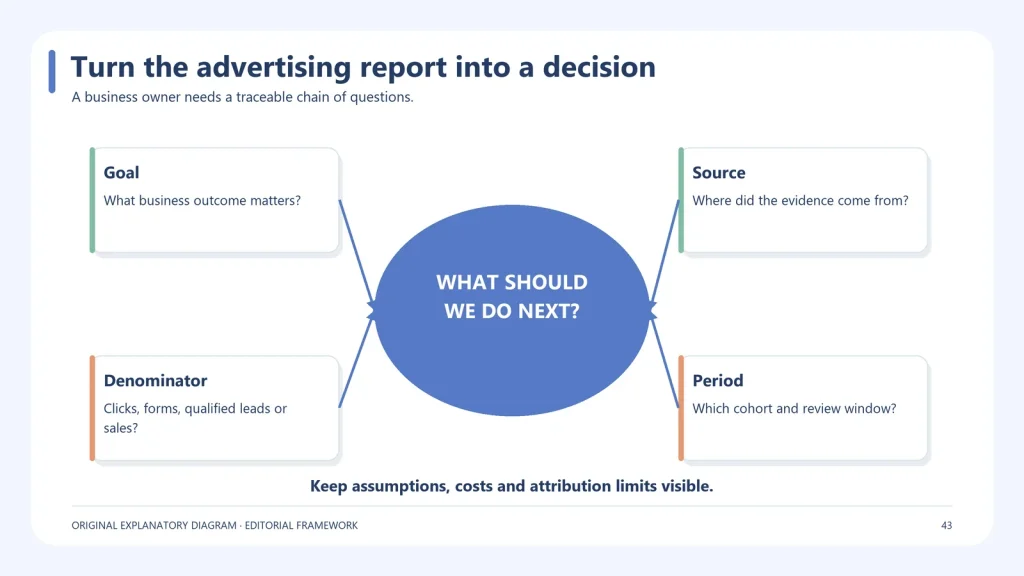
Bring one real, redacted report to the course and ask what it leaves unanswered. A good explanation should survive a follow-up question. If an attribution window or a counting rule is unclear, record the uncertainty rather than treating the total as settled business evidence.
Agree ownership and the education-to-execution boundary
List the business assets and the people who administer them. Ask how access is granted, which permissions are necessary, who approves changes, and what happens when the engagement ends. The appropriate arrangement depends on the account and business setup; confirm current permissions and terms rather than treating a course slide as an ownership guarantee.
Separate education from delivery in the scope. A workshop might teach report interpretation and produce an agency brief without including campaign management, creative production, or tracking implementation. Ask Marketboo what training and practical support are available for your situation, and request written inclusions and exclusions. The proposed readiness exercises here are not a confirmed packaged course or certification.
Use a final exercise to decide what help to hire
At the end of the course, explain your brief without the trainer’s prompts. Define the selected outcome, challenge one metric, identify a measurement gap, and state the next spend decision. If you can do that but lack implementation time, delegated management may be appropriate. If you cannot explain the evidence yet, another guided review may be more useful than buying a larger execution package.
Choose an agency using the same questions. Ask for a sample decision log, a redacted report, an explanation of rejected leads, and an example of a test that did not support the original idea. These requests reveal how the team reasons; none requires the provider to promise a particular cost or revenue outcome.
FAQ
What is a Facebook Ads course for business owners?
It teaches enough platform vocabulary and decision discipline for an owner to set goals, judge reports, protect access, and manage an agency relationship.
Do owners need to learn every Ads Manager setting?
No. Learn the settings that affect goals, audience, creative, measurement, budget, access, and decisions. Specialists can handle deeper implementation with approval.
What is the difference between a click and a lead?
A click is an interaction with an ad; a lead is a defined submitted or recorded action. Quality and qualification require additional evidence.
What should an agency report include?
It should state the objective, date range, metrics, definitions, comparison, interpretation, action, owner, and limitations.
Who should own a business ad account?
The business should establish ownership and continuity, with role-based access for partners. Exact permissions should be reviewed before access is granted.
Can a course replace an agency?
Education can reduce avoidable confusion, but it does not guarantee the time, experience, creative, analytics, or operational capacity needed to execute.
How can Marketboo teach business owners?
Ask Marketboo whether an owner workshop or coaching engagement can address your brief, reports, and agency decisions. Confirm curriculum, trainer experience, delivery, and execution boundaries directly.
Conclusion
A Facebook Ads course for business owners earns its place when it helps you brief an agency and judge its decisions. Learn the vocabulary, practise with a real report, and agree who owns each part of the work. You can delegate execution while retaining a clear definition of success and a reason for the next budget decision.Ask Marketboo about owner-side training