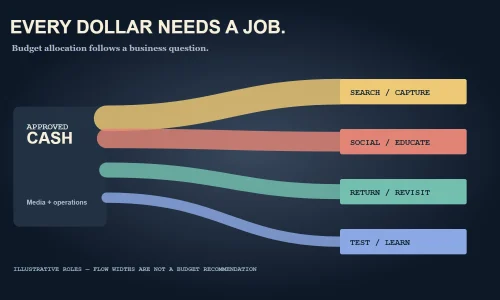
TikTok ads for ecommerce brands entering the US need a product that can be understood on video and a business that can deliver the promise. Before buying attention, check the demonstration, margin, creative supply, U.S. product page, fulfillment, and measurement. A launch should answer a specific product or shopper question. Views alone cannot tell you whether the offer deserves a larger investment.
The product-fit workshop
- TikTok ads for ecommerce brands entering the US: assess product fit first
- Score the product across six practical dimensions
- The U.S. audience is not one age group
- Build creative around shopper questions, not trend imitation
- Plan the U.S. product page before sending traffic
- Make the unit economics visible before choosing a test budget
- Separate attention, shopping intent, and order quality
- Choose a test design that can answer one question
- A fictional U.S. launch scenario
- Match the creative operation to the product lifecycle
- Practical product-fit worksheet
- How to evaluate TikTok fit before entering the U.S.
- A closer look at the product economics behind a video test
- A creative inventory that does not depend on one trend
- Before the first U.S. product shoot
- Enter the market with a test the business can support
TikTok ads for ecommerce brands entering the US: assess product fit first
When a brand enters the U.S. market, the first advertising decision is not which campaign button to press. It is whether a U.S. shopper can understand the product, trust the offer, and receive the item under the promise the ad makes. Short-form video can demonstrate motion, scale, transformation, texture, or a use case. It cannot repair weak product-market fit, unclear pricing, slow delivery, unsupported claims, or a checkout that does not work. Assess the whole offer before paying for attention.
“TikTok product” is not a meaningful category. Some products are naturally demonstrable, while others require explanation, comparison, or a longer research path. A product can still work in video if the creative teaches a task, answers a common objection, or shows a credible customer situation. The question is whether the team can create a useful story without exaggerating the result or confusing the buyer. The product should remain understandable when the video is watched without sound or when a viewer sees only the opening seconds.
Create a product-fit memo before opening the ad account. Describe the primary audience, the problem or desire, the main differentiator, the price and margin constraints, the shipping promise, and the evidence supporting any performance claim. Include who approves creative and who handles U.S. customer questions. This short document prevents the campaign team from making claims that operations or product cannot support and helps separate a genuine market-entry test from a loose experiment in trend-following.
Score the product across six practical dimensions
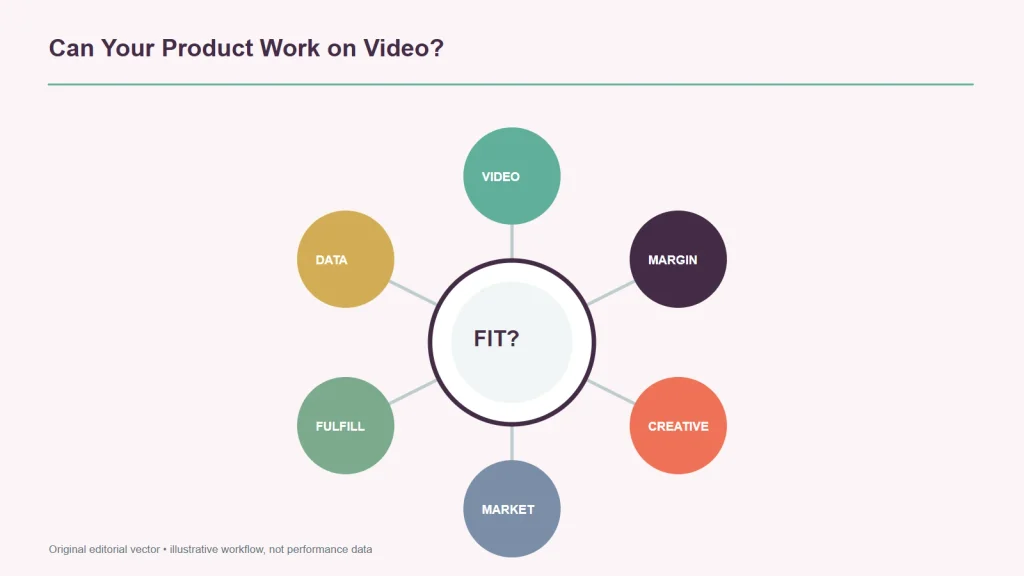
Visual demonstration is the first dimension. Can the product be shown being used, installed, compared, assembled, or applied? Is the relevant change visible and honest? Can the video communicate scale and context? Products that need a diagram or technical explanation may still be suitable, but the brand must create a clear explanation rather than relying on a vague reveal. Avoid editing that makes the item appear more powerful, durable, or effective than the evidence supports.
Contribution margin is the second dimension. Calculate what remains after product cost, fulfillment, discounts, payment fees, returns, and other variable costs. A campaign’s revenue divided by ad spend is not the same as profit. A low-price item may require repeat purchase or a bundle to support acquisition cost; a higher-price product may need more time and education before conversion. Use a range for uncertain costs and decide what the business can afford to learn before assuming that scale will lower the cost.
Creative capacity, market relevance, fulfillment, and measurement complete the scorecard. Can the team produce multiple genuine angles rather than many near-identical edits? Does the offer make sense for U.S. shoppers, including sizing, units, delivery expectations, and return information? Can inventory and customer support handle the response? Are purchase and checkout events recorded well enough to assess the test? A weak score in any one area may mean “fix first,” not “never advertise.”
| Dimension | Stronger test signal | Pause-and-fix signal |
|---|---|---|
| Demonstration | Product use is clear in a short scene | Value depends on an unsupported claim |
| Margin | Variable costs and allowable acquisition range are known | Revenue is used as a stand-in for profit |
| Creative | Several genuinely different stories are feasible | The plan depends on one clip or trend |
| Market fit | U.S. offer, language, size, and pricing are ready | Important terms are unclear or unlocalized |
| Fulfillment | Inventory, shipping, and returns are defined | Delivery promise cannot be supported |
| Measurement | Product and checkout events are testable | The team cannot confirm orders or revenue |
The U.S. audience is not one age group
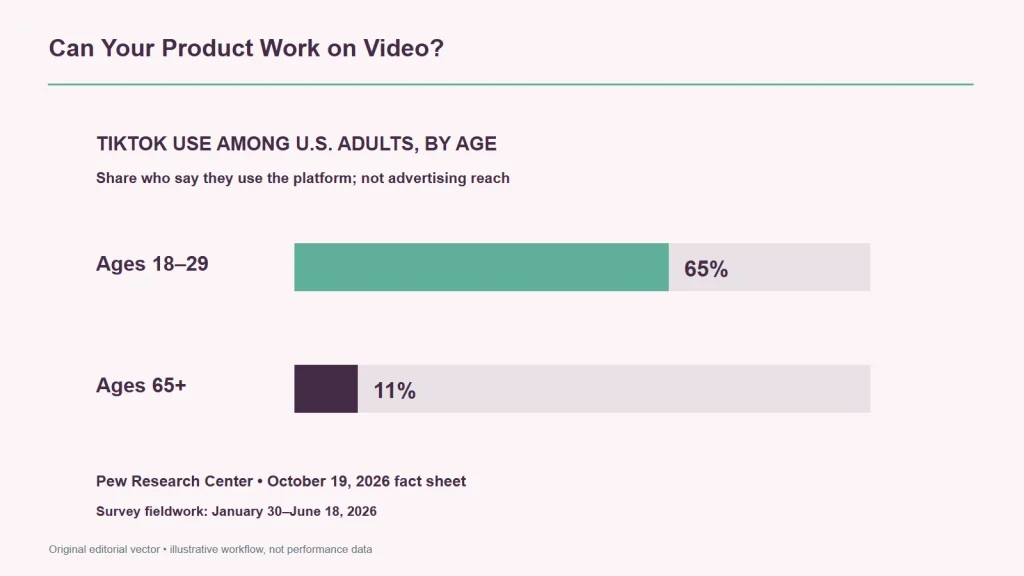
A product-fit decision needs a more specific customer than “people on TikTok.” Pew Research Center’s October 2026 fact sheet reports TikTok use among 65% of U.S. adults ages 18–29, compared with 11% of adults ages 65 and older. The fieldwork ran January 30–June 18, 2026. These are self-reported platform-use measures, not advertising reach, purchase rates, or a forecast for a brand.
That gap matters when a team sketches the first video. A travel accessory for a younger shopper and a specialist product bought mainly by older customers do not start with the same audience assumptions. Age alone does not settle product fit, but it changes which assumptions deserve early testing. Validate the actual buyer, including whether the purchaser and the end user are different people.
For the creative producer, the next question is concrete: what must a viewer see to understand the product without a salesperson beside them? Film that moment first. A fastening mechanism, a storage transformation, or a side-by-side size comparison may explain more than a long claim. Show the use accurately, including limits that matter to the purchase.
Keep the audience evidence beside the product economics. Broad adoption can support exploration; a weak margin or an unreliable delivery promise can still make the test a poor use of cash. The production brief and the financial worksheet should describe the same customer and offer.
Build creative around shopper questions, not trend imitation
Use customer questions, product reviews, support tickets, and sales conversations to identify useful creative themes. A video can show what arrives in the box, how an item is set up, which material or feature matters, what a common limitation is, or how a person chooses between models. These are editorial angles, not fabricated testimonials. If a real customer or creator appears, obtain appropriate permission and review the claims and usage terms before using the asset in advertising.
TikTok’s Creative Center and Top Ads resources can help a team observe creative patterns and discover examples. Treat those examples as prompts for hypotheses rather than as representative performance data. A selected collection of ads is not a controlled study of every product, audience, budget, or account. Do not copy another advertiser’s intellectual property, script, recognizable brand elements, or claims. Note which idea you are testing—opening hook, demonstration, creator perspective, or offer—and make an original version appropriate to your product.
Make variants meaningfully different. Changing the music or subtitle color on the same clip may not test a new idea. Try different openings, contexts, demonstrations, speakers, or objections. Keep a creative record with the asset name, date, market, promise, format, and destination page. Add an approval step for price, discounts, product results, shipping claims, and testimonials. The creative system should make it possible to learn why a viewer responded, not just which file name got more clicks.
Plan the U.S. product page before sending traffic
A shopper who clicks should land on a product page that answers the questions raised by the video. The page should make the product, price, variant, availability, shipping estimate, return policy, and next action easy to find. If the ad shows a particular bundle, color, or use case, the destination should not make the shopper search through unrelated products. Mobile performance is important operationally because social traffic often arrives on phones, but inspect the actual store rather than assuming that a theme or app has made the experience fast.
Review copy for U.S. conventions and product specifics. Use clear units, sizing, price, shipping currency, and customer-support details. If the brand’s original market uses different terminology, ask a U.S. editor or product specialist to review it. Avoid implying domestic manufacturing, delivery speed, product certifications, or comparative superiority unless the company has evidence and legal approval for the statement. A polished video cannot make a misleading product page trustworthy.
Test the purchase path from the ad destination through confirmation. Check variant selection, inventory state, shipping calculation, taxes, payment, order confirmation, analytics events, and customer-support route. Use a test order or another approved QA method that does not introduce real customer data into a public report. If the store uses analytics or advertising pixels, confirm that the organization’s consent and data rules are met and that technical owners understand how purchase information is handled.
Make the unit economics visible before choosing a test budget
Use contribution margin to set boundaries. Suppose a fictional product sells for $80 and has $34 in product, pick-pack, and shipping costs, with an expected $6 allowance for discounts and returns. Before fixed overhead, the contribution available to cover acquisition and other costs is $40. That does not mean the business can spend $40 on an order and remain profitable; payment costs, customer support, and other expenses may still apply. It simply makes the assumptions visible.
Build low, central, and high scenarios for conversion and return behavior rather than choosing one optimistic value. For example, the team can model how many visits and orders it would need to observe to evaluate the offer, then approve a maximum learning budget. Do not call a scenario a forecast unless it is based on relevant data and a documented method. A small test may produce direction but not enough purchases to prove repeatable economics, particularly when new-market traffic is limited.
Set rules for pacing. The team may want to hold spend while it checks landing-page behavior, pause when the product is out of stock, or continue while an agreed cohort matures. Avoid making a decision from one expensive day or a single high-return order. Record the reason for each budget adjustment and preserve the prior period for comparison. The business should know in advance what level of uncertainty it is willing to accept before the test begins.
Separate attention, shopping intent, and order quality
Short-form video can produce a lot of visible activity that does not represent an order. Watch time or engagement can help assess creative, but the business also needs to see product-page visits, add-to-cart behavior, checkout starts, purchases, cancellations, refunds, and customer questions. Match every metric to the question it answers. An opening hook may be evaluated by viewing behavior; the offer and page need shopping outcomes; long-term product fit requires post-purchase signals.
Attribute results carefully. TikTok, other ad platforms, analytics, and the ecommerce platform may report conversions under different windows and rules. A shopper can see a social ad, later search the brand, then purchase through a different channel. Do not sum platform-reported revenue and call the total incremental sales. Use a consistent tagging approach where possible, compare with order records, and describe any gap. If the store is too small for a reliable lift test, say that the analysis is directional.
Quality includes customer experience after payment. Track cancellation, returns, support contacts, delivery complaints, and review themes alongside acquisition metrics. If ads attract buyers who misunderstand the item, the creative or page may need correction even when immediate sales look positive. A brand entering the U.S. should protect customer trust during its first market impression. A campaign is not healthy if it acquires orders by making an offer the operations team cannot fulfill.
Choose a test design that can answer one question
Pick one main product, a defined audience or market hypothesis, and a small set of distinct creative concepts. The test should answer a question such as whether shoppers understand the value, which demonstration earns a product-page visit, or whether a specific offer reduces uncertainty. Do not ask one test to prove the product, price, creative, landing page, and repeat-purchase strategy all at once. If several variables change simultaneously, the team may see a result without knowing what produced it.
Define the success indicators and stop conditions before launch. A test might use an early creative signal, an ecommerce action, and a quality check. The thresholds should come from business economics and available traffic rather than an unsupported industry average. Record the observation window and minimum data needed to make a decision. If the sample is too small, classify the test as inconclusive and determine whether more data is worth the additional cost.
Review creative at regular intervals, but avoid reacting to noise. If a concept receives attention but little product interest, inspect the message and destination. If shoppers add to cart but abandon checkout, investigate price, shipping, payment, or checkout friction. If orders arrive but returns rise, check whether the ad created an inaccurate expectation. Each symptom suggests a different layer of the journey. Change one primary variable at a time where practical and keep a record of the revision.
A fictional U.S. launch scenario
Imagine a brand that sells a compact home-organization product in another country and plans to enter the U.S. It has U.S. inventory in a warehouse, but its packaging uses metric measurements and the return policy was written for its original market. The product is easy to demonstrate in a short video, so the marketing team is tempted to begin immediately. The product-fit review identifies two readiness gaps: a U.S.-clear product page and customer-service coverage for shipping questions.
The team updates the page and creates three original creative concepts: one shows setup, one compares product sizes, and one explains how the product fits a specific room. The team avoids a “life-changing” claim and includes the actual dimensions and limitations. It tests the order flow, shipping estimate, purchase event, and support route. The initial budget is set as a learning limit, not as a promise that the campaign will reach a particular cost per order.
During review, the setup video produces more product-page visits while the size comparison produces fewer clicks but more add-to-cart activity. The team does not declare the second asset a winner until it checks purchases and any early cancellations. If visitors misunderstand the dimensions, it revises the page or video before increasing spend. This is a fictional illustration of decision logic; it is not a customer case study or a performance prediction.
Match the creative operation to the product lifecycle
Some products have many use cases and can support a steady stream of videos. Others have one main demonstration and require deeper education. Plan the creative workload honestly. A small team might create a manageable batch of concepts, record customer questions, and film simple product demonstrations. A larger team can coordinate creators, editors, localization, and a review calendar. The right cadence depends on the product and available resources; a generic promise to publish a certain number of videos does not prove that the content will be useful.
Create a brief that protects both clarity and flexibility. It should include the audience, product facts, approved claims, prohibited claims, required visual details, the intended question, the landing page, and the action requested. Allow the creator or editor to speak naturally while preserving factual boundaries. Provide a way to submit a draft for review before the content is used in a paid campaign. Store the permission, version, and usage term alongside the final asset.
Do not let a creative winner become a reason to stop listening to customers. Comments and messages can reveal confusion about sizing, materials, compatibility, delivery, or product support. Route product questions to the right person and update the FAQ or page when a recurring issue appears. Avoid automating answers that promise a fact the support team has not verified. The content system should feed product and service learning back to the business.
Practical product-fit worksheet
Score each dimension from one to five for internal discussion. A low score does not mean the product can never use TikTok. It indicates a question the team must answer before scale. Weighting should reflect the product’s economics. A regulated item, a fragile product, or a product with complex installation may need more review of claims, fulfillment, or customer support. The worksheet is a planning aid, not a platform score or a guarantee of success.
| Dimension | Team score | Evidence to attach | Owner |
|---|---|---|---|
| Can the value be shown clearly? | Video concept or product demonstration | Marketing and product | |
| Is margin understood after variable costs? | Contribution model and assumptions | Finance | |
| Can the team make distinct creative? | Concept list and production capacity | Creative lead | |
| Is the U.S. offer localized? | Page, units, shipping, and returns review | Ecommerce | |
| Can operations fulfill the promise? | Inventory and customer-support plan | Operations | |
| Can the team measure order quality? | Event test and order reconciliation | Analytics |
Use the blank worksheet to make disagreement explicit. If marketing scores creative capacity high but product believes there is only one defensible angle, plan a small ideation session. If finance and marketing disagree on the acquisition limit, document the margin assumptions and resolve them before launch. The worksheet can also be revisited after a test. Update the evidence, not just the number, so the next decision reflects what the team actually learned.
How to evaluate TikTok fit before entering the U.S.
Product proof
- Write the product’s U.S. audience, use case, price, and differentiator.
- Check whether a short video can demonstrate the value accurately.
Commerce readiness
- Model contribution margin after fulfillment, discounts, fees, and returns.
- Draft several distinct creative concepts from real shopper questions.
- Localize product pages, units, delivery details, returns, and support.
A bounded test
- Verify inventory, order flow, analytics events, and data approvals.
- Set a learning budget, review window, and stop conditions.
- Evaluate attention, shopping actions, orders, returns, and customer feedback together.
A closer look at the product economics behind a video test
An ad can make an item look easy to buy, but the business needs to understand the cost of serving the resulting order. Map the path from product cost to warehouse handling, shipping, discount, payment processing, taxes where relevant, return allowance, and support. The exact accounting treatment should match the company’s finance process. Do not mix fixed overhead with variable costs unless the model clearly explains why. The goal is to know what contribution remains before advertising, not to create a perfect profit forecast from incomplete data.
Separate first-order economics from customer lifetime assumptions. A repeat-purchase product may generate future revenue, but the team should not use an assumed lifetime value to justify a first campaign unless it has a retention model supported by actual cohort data. A new brand entering a new country may not have that evidence yet. Use a conservative planning case and state which future behaviors—repeat purchase, subscription, accessory purchase—are assumptions rather than observed facts.
Returns deserve special attention when an ad demonstrates size, fit, performance, or compatibility. A video can increase orders and still create a poor customer experience if shoppers misunderstand the product. Track returns and customer-service reasons by product and creative where feasible. If a particular video drives questions that reveal a misconception, update the asset or page. The business may choose a lower immediate conversion rate in exchange for clearer expectations and fewer avoidable returns.
A creative inventory that does not depend on one trend
Before launch, list the stories the product can support. One might show setup, another compare variants, another address a common objection, and another demonstrate a use case. Each concept should have a distinct reason to exist. This makes it possible to learn whether the product’s appeal comes from convenience, appearance, function, or price. A set of near-identical cuts may vary the opening frame without testing a meaningful message.
Create an inventory table with concept, footage required, speaker or creator, product facts, claim review, landing page, and usage permissions. Add a status for draft, approved, live, and retired. If creators are involved, save the agreement and permitted uses alongside the asset. Clarify whether an ad may run only on one account or also through the creator’s identity, if that feature is used and allowed. Confirm current platform rules before relying on a specific permission workflow.
Plan for learning reuse. If a concept produces useful questions but not sales, the team may turn those questions into a product-page section, an email answer, or a longer demonstration. Do not assume that every successful organic post will perform as a paid advertisement, or that a paid result proves organic interest. The creative log should show what was observed and in which context. This prevents the team from converting an isolated platform result into a universal product claim.
Before the first U.S. product shoot
What kinds of ecommerce products work well with TikTok Ads?
Products that are easy to demonstrate, have a clear use case, can support creative testing, and can be fulfilled as advertised may be promising candidates. No category is guaranteed to work; economics and market response still need testing.
Does TikTok Ads work for high-priced products?
It can be tested, but higher-priced products may need more education, proof, and consideration time. Evaluate the full customer journey rather than expecting every video click to convert immediately.
How many videos do I need before launching?
There is no universal number. Prepare enough genuinely different concepts to test the product’s main messages, and make sure the team can review, produce, and learn from each asset.
Should I use the TikTok Creative Center as a benchmark?
Use it to observe creative examples and develop hypotheses. A curated collection does not establish typical performance for your product, audience, account, or budget.
What should I measure besides return on ad spend?
Review product-page actions, checkout progression, orders, cancellations, returns, support contacts, and contribution margin. Platform ROAS may not reflect all costs or incremental revenue.
Can I launch before the U.S. return policy is ready?
The offer and store should clearly communicate the business’s current terms before paid traffic begins. Have qualified reviewers confirm applicable obligations; do not use an ad to create demand for an unclear customer experience.
What if a video gets views but no orders?
Inspect the transition from creative to page to cart and checkout. The video may attract attention without purchase intent, or the product page, price, shipping, or payment path may be the barrier.
Enter the market with a test the business can support
TikTok should be treated as a product-and-operations test as much as a media test. A compelling video is only one part of a U.S. launch. The offer, margin, page, inventory, customer service, and measurement must support the expectations the creative creates. Use the product-fit worksheet to identify gaps, start with a bounded question, and expand only when the evidence and fulfillment process justify it.
If you are comparing TikTok with Google and Meta for a U.S. launch, review Marketboo’s global paid media services. If your team wants to build its own creative testing and measurement process, explore hands-on advertising coaching.