The short answer: LinkedIn employee advocacy for B2B works best as a voluntary way for employees to share useful professional ideas—not as a requirement to repeat corporate copy. Set a clear purpose, invite participation without pressure, provide accurate source material, and let people use their own judgment and voice. Explain what they may disclose, how to handle confidential information and customer questions, and where to seek review. Measure program health through participation quality, useful conversations, and relevant business signals rather than only reach. Employment, advertising disclosure, privacy, and industry rules depend on the organization and jurisdiction, so have qualified legal, HR, privacy, and compliance owners review the program before launch.
How LinkedIn employee advocacy for B2B earns trust
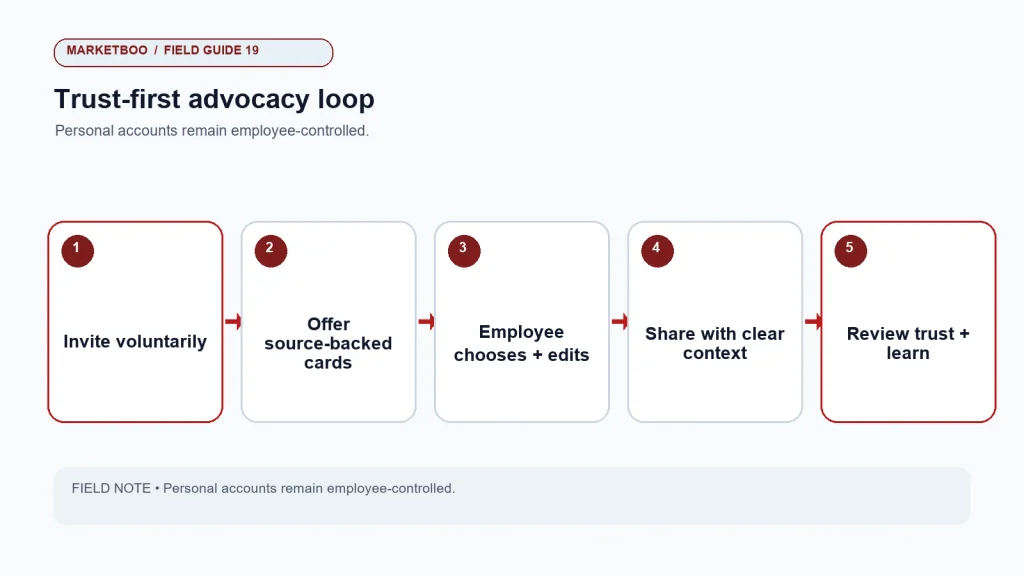
Employee advocacy can be misunderstood as a distribution tactic: give staff a library of posts and ask everyone to publish. That approach may create activity, but it can also make colleagues feel that personal profiles belong to the company. A more durable program begins with a boundary: participation is an invitation, employees keep control of their accounts, and no one is asked to present an opinion they do not hold.
In a B2B environment, employees often know more about customer questions, product trade-offs, implementation, or industry practice than a brand page can communicate alone. Their insight can be valuable when shared accurately and with appropriate care. But the employee’s professional voice is personal. The company should not disguise advertising, pressure workers to endorse products, or imply that every employee independently reached the same conclusion.
“Employee advocacy” here means an optional program that makes it easier for employees to share approved company or industry information from their own professional accounts. It does not mean that employees are required to post, that company accounts can control a personal profile, or that a program can guarantee reach or pipeline. Those distinctions should appear in the charter and in manager training.
The FTC’s 2023 Endorsement Guides, which revise 16 CFR Part 255, provide U.S. guidance on endorsements and material connections. They do not replace counsel for a specific employer or jurisdiction. Employee participation can also intersect with labor, privacy, securities, confidentiality, and industry-specific requirements. The National Labor Relations Board’s employee rights resources should be reviewed by qualified counsel where U.S. labor law may apply. The sources are starting points for review, not a legal determination about a particular program.
Write a charter that employees can actually accept
A program charter answers why the organization is creating the program, who can join, what participation means, what support is available, and how an employee may pause or leave. Use plain language. If joining has no impact on performance review, say so only if that is truly the company’s policy and managers follow it. If employees are compensated, receive incentives, or are asked to speak in an official capacity, obtain legal and HR review of the terms and disclosures.
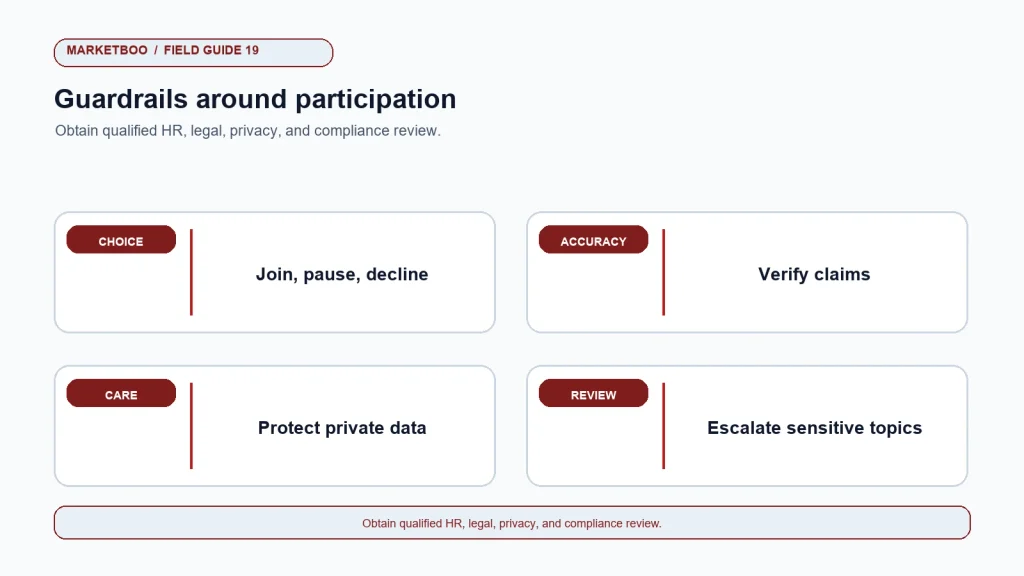
An effective charter states that employees choose whether to participate, decide which content to share, and may edit language to reflect their actual views, subject to accurate company facts and applicable policies. It explains that an employee should not share confidential, personal, customer, security, or unreleased product information. It names a contact for questions and a way to report mistakes. It identifies which topics require prior review and which are free for employees to discuss in their own professional judgment.
| Charter element | A clear program statement should explain | Owner to consult |
|---|---|---|
| Participation | Whether joining and posting are optional; how employees can pause | HR and program lead |
| Account control | Employees retain control of personal LinkedIn accounts and credentials | Security and HR |
| Content choice | Employees select relevant content and may use their own voice | Communications and legal |
| Disclosure | How relationships, incentives, or official roles are disclosed where applicable | Legal/compliance |
| Confidentiality | What company, customer, security, or personal information must stay private | Legal, privacy, security |
| Questions and errors | Where to ask, correct, or report an issue | Communications and product |
| Accessibility | How employees can request accessible content or alternate formats | HR and accessibility owner |
| Exit or pause | How to stop participating without pressure | HR and program administrator |
Use the language employees will see, not only a policy written for administrators. A separate FAQ can answer practical questions: “Do I have to post every week?” “Can I skip a topic?” “May I disagree with a company post?” “What if I notice an inaccurate product claim?” If the honest answer is unclear, pause recruitment until leadership resolves it.
Invite participation without turning it into a performance quota
Managers have influence over people’s workload and career opportunities. A request to share a company post can therefore feel compulsory even if the program document says “voluntary.” Train managers to invite, not monitor or penalize. Avoid publishing leaderboards that expose non-participation, setting posting quotas, or tying incentives to an individual’s reach unless counsel has reviewed the approach and employees can make an informed choice.
Offer practical support instead: a clear content library, context, source links, editable copy, image alt text, and a contact who can answer questions. Let employees choose an item that fits their role. A technical employee may prefer a product documentation link; a recruiter may prefer an open-role announcement; a customer-facing team member may share a general industry resource. Not every person needs to publish every campaign.
Do not ask employees to use private accounts for business access or provide passwords to the company. If an official company account needs multiple administrators, use the platform’s approved role management tools and internal security process. Employee advocacy should not give the employer control of a personal profile.
Give people information, not scripts to impersonate enthusiasm
The content library should include the source, context, intended audience, and any claim boundaries. A short note can help an employee understand why an item matters. Copy should be optional language, not a mandatory quotation. Employees should not be asked to claim a product solved a problem they have not personally experienced, or to make a technical statement outside their knowledge.
Build a review route for subjects that need careful handling: product safety, performance claims, customer outcomes, pricing, financial information, hiring, public company statements, regulatory topics, security incidents, or comparisons with a named competitor. Provide a contact and response expectation. If the review team is unavailable, employees should know whether to wait, skip, or share only an already approved source.
The program can also include original employee insight, not just corporate announcements. For example, a staff member might share a general lesson from a public technical standard or explain how to evaluate a process. The employee should not reveal client details or imply a company endorsement beyond what the employer has approved. If a post reflects personal opinion, it should remain honest and distinguish personal views from official company statements where needed.
A content card employees can review before posting
| Card field | Why it is useful |
|---|---|
| Topic and audience | Helps an employee decide whether the post fits their professional network |
| Original source link | Lets the employee check the underlying document or announcement |
| Verified facts | Identifies what the company has confirmed and who owns the claim |
| Optional framing | Offers a starting point without requiring an identical script |
| Disclosure note | Flags any relationship or incentive that needs disclosure review |
| Confidentiality boundary | Names details that must not be added or inferred |
| Contact for questions | Gives employees a route to clarify, edit, or skip the content |
| Review/expiry date | Prevents stale claims, prices, or offers from circulating indefinitely |
Keep the content card short enough to use. An employee should not need to read a long policy before sharing a routine company resource. The program owner can maintain detailed guidance separately and flag high-risk posts for review.
Make disclosure and accuracy part of the workflow
When an employee shares company content or discusses company products, the nature of the relationship may matter to readers. U.S. FTC guidance addresses material connections and clear disclosures in endorsements. Exactly what is required depends on the facts, wording, platform, industry, and applicable law. The program should route examples to qualified counsel rather than relying on a single boilerplate hashtag for every situation.
Disclosures should be understandable in context and visible to the audience. A buried note or an ambiguous abbreviation can leave readers unsure whether the person is speaking as an employee. If employees receive compensation, gifts, contest entries, or another benefit for participation, the company should not leave disclosure decisions to individual guesswork. Have legal and compliance staff approve the language and instructions for the specific arrangement.
Accuracy needs a similar process. Employees should link to the original source when sharing a technical or policy statement, avoid extrapolating beyond approved evidence, and correct an error promptly. If a post contains incorrect information, the program owner should explain how to edit or remove it and who documents the correction. Do not discourage employees from raising good-faith concerns internally.
Protect customers, colleagues, and company information
Set examples of information that should not appear in a public post: customer names or project details without authorization, screenshots with personal data, unreleased product plans, security details, private messages, employee records, or confidential pricing. A reminder should explain how to recognize the boundary, not simply say “be careful.” Employees should have a clear way to ask whether a detail can be shared.
Do not use engagement programs to collect or repurpose private information from employees’ connections. Avoid exporting personal contact lists or scraping profile data. If the organization plans to use an advocacy platform, check its data flows, access controls, retention, and terms with privacy and security owners. The fact that employees have public professional profiles does not mean every data use is acceptable.
Keep a reasonable separation between employee advocacy and customer support. Employees can refer a public question to an approved help channel, but they should not promise refunds, delivery dates, security outcomes, or customized service in a post unless they have authority and verified information. The company should monitor for emerging issues without demanding access to personal accounts.
Measure program health without ranking employees
Measure whether the program is useful and safe, not whether every employee posts. Possible indicators include voluntary participation, content relevance, asset reuse, questions employees raise, correction frequency, time needed to review content, referral visits under an approved aggregate method, or qualified conversations that marketing can responsibly connect to the program. Each measure has limitations. A click may not equal influence; a person’s post may be one of many touchpoints; an internal participation count can create pressure if used as a quota.
Avoid public leaderboards, required posting streaks, or manager scorecards built around reach unless the organization has carefully reviewed them. Such systems can incentivize low-quality content or create coercion. A private program review can ask whether people had useful choices, whether the content library was current, whether approvals were timely, and whether employees understood the rules.
| Program question | Possible evidence | Limitation to state |
|---|---|---|
| Are employees choosing to participate? | Voluntary opt-in and participation trend | Do not use as an individual performance rating |
| Is the content useful? | Employee feedback, saves or thoughtful discussion where visible | Engagement does not prove business impact |
| Does the process work? | Review time, error reports, asset expiry, support requests | Fast approval must not replace necessary review |
| Is there a relevant business signal? | Aggregate referral or opportunity data under approved tracking | Attribution cannot prove that a post caused a sale |
| Is the program trusted? | Anonymous feedback, opt-out reasons, manager check-ins | Protect employee privacy and avoid coercive surveys |
Agree on a reporting period and definitions before collecting metrics. If the program is new, begin with process and trust measures. Do not promise a specific revenue contribution. If later analysis links an account interaction to an opportunity, describe how the link was made and what other influences may be involved.
Rehearse the moments that create pressure or risk
Training should not ask employees to memorize a long set of legal terms. It should give them a few practical scenarios and show where to get help. For instance, an employee sees a post with a product claim they believe is out of date. The right action should be to flag the source and ask for a correction, not to repost because the campaign is scheduled. Another employee receives a question about a customer’s account. They should know how to route the person to an approved support path without requesting private details in the comments.
Managers need a separate conversation about voluntariness. A manager can explain why the program exists and invite participation, but should not ask who declined or describe a lack of posts as poor teamwork. If the company chooses incentives, it should define them in advance, review whether employees can freely decline, and have HR and counsel assess wage, tax, disclosure, and employment implications as applicable. Do not assume a small gift or contest is legally irrelevant.
| Scenario | Employee action | Program-owner response |
|---|---|---|
| Product fact looks outdated | Pause and ask for the source owner | Verify, correct library, notify affected participants |
| Customer posts private details publicly | Avoid repeating the details; route to approved support | Move case to the proper channel and follow policy |
| Manager asks everyone to post | Ask program owner or HR for clarification | Reinforce that choice is genuine and address pressure |
| Employee disagrees with a draft | Skip, edit, or raise concern without penalty | Do not require a false personal endorsement |
| An incentive or benefit is offered | Ask what disclosure and tax rules apply | Obtain HR/legal/compliance approval before launch |
| Post is wrong after publication | Notify the owner and correct promptly | Document correction and update source material |
This rehearsal makes the program easier to use in the moment. It should also include a way to report pressure confidentially. A program that only offers a public help channel may not be sufficient if the concern is a manager’s request.
Let employees shape the library
Employees know which company updates are useful to their professional communities and which feel like generic promotion. Invite feedback on the content cards and ask participants whether they need more context, a technical source, accessible visuals, or permission to adapt a caption. People should be able to decline a post because it does not fit their expertise without having to justify that choice.
Review the content library for role range. A company can offer product announcements, educational resources, hiring information, event updates, public research, or practical industry explanations. Do not measure the library by how often each person posts. Measure whether employees can find something accurate and relevant when they choose to participate.
If employees create original content, clarify how the company may reuse it. A person’s post and a company-owned campaign asset are not automatically the same thing. Confirm permission before republishing, editing, boosting, or using the content in ads. Keep a record of the employee’s consent and the allowed formats, duration, and audience.
A governance map for practical decisions
Assign one program owner who maintains the content library, invitation process, training, and review schedule. HR should review participation expectations and manager behavior. Legal or compliance should review disclosures, claims, industry rules, and compensation. Communications should handle brand voice and corrections. Security and privacy owners should advise on account access and data. Product or technical teams should confirm facts. Executives should approve business priorities without turning participation into a mandate.
| Decision | Program owner | Employee | HR/legal/compliance | Product or communications |
|---|---|---|---|---|
| Join or leave program | Explain process | Choose freely | Review policy and pressure risks | Not applicable |
| Select post | Curate options | Choose relevant content | Flag restricted topics | Confirm current material |
| Add personal opinion | No script required | Own truthful wording | Advise on disclosure/official capacity | Correct factual errors |
| Share technical claim | Provide approved source | Stay within knowledge | Review regulated claims | Confirm accuracy |
| Respond to sensitive issue | Route and document | Refer to approved channel | Guide response where needed | Provide support owner |
| Correct a post | Notify and coordinate | Edit or remove as appropriate | Advise when legally material | Maintain source of truth |
The map should be adapted to the company’s structure and jurisdiction. It is a starting point for conversation, not a legal allocation of responsibility. A publicly traded or regulated company may need additional review before employees share company-related information.
How to start a voluntary employee advocacy program
- Write the business purpose. State what the program should help employees and the company do, without promising reach or sales.
- Set participation boundaries. Explain that joining and individual posts are optional, employees retain account control, and non-participation has no penalty only if that is the actual policy.
- Map review owners. Identify HR, legal/compliance, privacy, security, product, communications, and customer-support contacts for relevant topics.
- Choose a narrow pilot group. Invite people who understand the program’s purpose and can provide feedback; do not select them by pressure or status alone.
- Prepare source-backed content cards. Include the source, context, approved facts, optional framing, disclosure guidance, expiry date, and question route.
- Train managers and participants. Explain choice, account security, confidentiality, disclosure, error correction, and customer escalation.
- Agree on measures and limits. Choose process, trust, and business signals; state what the measures cannot establish.
- Run the pilot with feedback. Provide a confidential way to report confusion, coercion, or content issues and make corrections promptly.
- Review with qualified owners. Check participation experience, legal/policy questions, accuracy, workload, and data handling before expansion.
- Expand only when the program is trusted. Update the charter and materials, repeat training, and allow employees to opt in or pause at each stage.
Questions to resolve before launch
Can an employee decline without explanation? What does the manager say when someone chooses not to join? Which posts need legal review? How are incentives treated? Who confirms technical claims? Is an employee speaking personally or as an authorized company representative? How are customer questions routed? What happens when an asset becomes outdated? How can an employee report pressure or request removal?
If the company cannot answer these questions, a pilot should not start until the responsible owners do. There is no need to solve every hypothetical in a large policy document. But the practical cases must have a clear, trusted route. Employees should be able to ask a question without being labeled uncooperative.
Marketboo provides social media management support for businesses that need help with social operations and content. If your team is designing an employee advocacy program, ask how the proposed work handles voluntary participation, approved content, employee voice, account control, rights, and escalation. For a broader channel plan, contact Marketboo and bring the draft charter for a scope discussion. Obtain your own HR, legal, privacy, and compliance review before rollout.
Frequently asked questions
What is LinkedIn employee advocacy for B2B?
It is a program that supports employees who choose to share relevant professional content about their company or industry from their LinkedIn accounts. A responsible program provides accurate source material and clear boundaries while leaving employees in control of their accounts and choices.
Should employee advocacy be mandatory?
This article recommends designing participation as voluntary and avoiding posting quotas or penalties. Employment rules and company policies vary, so HR and qualified counsel should review any proposed expectations, incentives, or official spokesperson duties before they are introduced.
Can a company require employees to use personal LinkedIn profiles?
Do not assume that an employer can or should control personal profiles. Account ownership, employment rules, and jurisdiction matter. A safer program gives employees control of their accounts and does not request passwords. Obtain qualified HR and legal advice for specific requirements.
Do employees need to disclose that they work for the company?
Disclosure requirements depend on the content, relationship, incentive, context, and applicable rules. FTC guidance addresses material connections in endorsements. Have legal or compliance owners provide clear, situation-specific instructions rather than expecting employees to interpret the rules alone.
What content should employees share?
Offer current, source-backed company or industry material that fits different professional roles. Provide context and optional language. Employees should not be asked to make claims they cannot verify, reveal confidential information, or endorse a product based on an experience they do not have.
How do I measure employee advocacy success?
Review trust, voluntary participation, content usefulness, program workload, corrections, and relevant aggregate business signals under approved measurement rules. Do not equate reach or clicks with revenue, and avoid individual leaderboards that can pressure employees.
What should happen if an employee posts something inaccurate?
Provide a prompt, non-punitive route to notify the program owner, check the source, and correct or remove the post as appropriate. Record material changes and update the source material so others do not repeat the error. Escalate legally sensitive issues to the qualified owner.
A program should make participation feel safe
LinkedIn employee advocacy for B2B can help useful professional knowledge travel farther, but trust is the condition that makes participation sustainable. Employees need a real choice, accurate information, space for their own voice, and a clear boundary between personal opinion and company representation. The organization needs an accountable owner, reviewed disclosures, data care, and a process for correction.
Start with a small, voluntary program and ask participants what felt clear or uncomfortable. Fix the charter and workflow before expanding. If the program only works when people feel compelled to post, the design needs work. A thoughtful program earns participation by helping employees share something they believe is useful and true.