

International SEO services coordinate search work across markets while keeping each locale’s demand, language, technical setup, and business path visible. A useful retainer defines which markets are in scope, what local evidence supports that choice, who owns URL and content changes, and how performance will be reported without pooling incomparable countries. Google’s international-search documentation can guide technical checks, but a correct implementation does not guarantee indexing, rankings, or revenue. Prioritize markets using the company’s own readiness, demand, margin, and service capacity, and label any planning score as an internal decision aid.
Scope international SEO services as a portfolio of market decisions
International SEO services should connect work to a specific market, audience, language, and commercial path. A promise to “optimize globally” does not tell you which pages will change, who will implement the work, or whether a customer in the target country can complete the intended action.
Compare retainers by asking each agency to scope the same small portfolio. Include a mature market with existing demand, a market that needs localized content, and a market whose business readiness is uncertain. The exercise exposes whether the proposal simply multiplies a domestic checklist or recognizes different constraints.
Write a market brief before allocating production
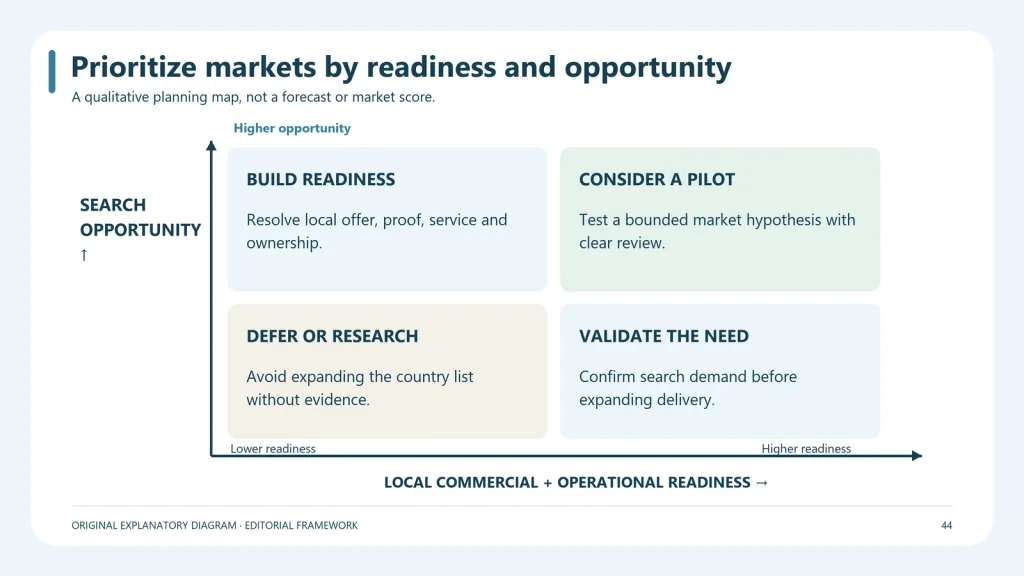
A country list is a poor substitute for a market model. Record the actual customer, language preference, product availability, service area, currency, support route, and fulfilment limitations. Identify the pages that would help that customer choose and act. If the organization cannot serve the market reliably, label it as research rather than a launch commitment.
Use evidence already available: country-level enquiries, sales objections, customer-support questions, search data, local terminology, and operational capacity. Mark missing information. Do not infer a whole country’s intent from a translation of one English keyword or a global traffic chart.
How to compare international SEO retainer proposals
Use these steps as a working sequence; agree responsibilities and verification before implementation.
- Define target markets, languages, offers, funnel stages, qualified demand, owners, and review period.
- Score each market for demand, readiness, competition, localization effort, operations, and evidence.
- Audit locale architecture, URLs, canonicals, hreflang, internal links, rendering, sitemaps, and templates.
- Create localized content briefs with search language, proof, examples, policies, reviewers, and update owners.
- Plan authority work, digital PR, partner relationships, and brand safeguards without buying unsupported guarantees.
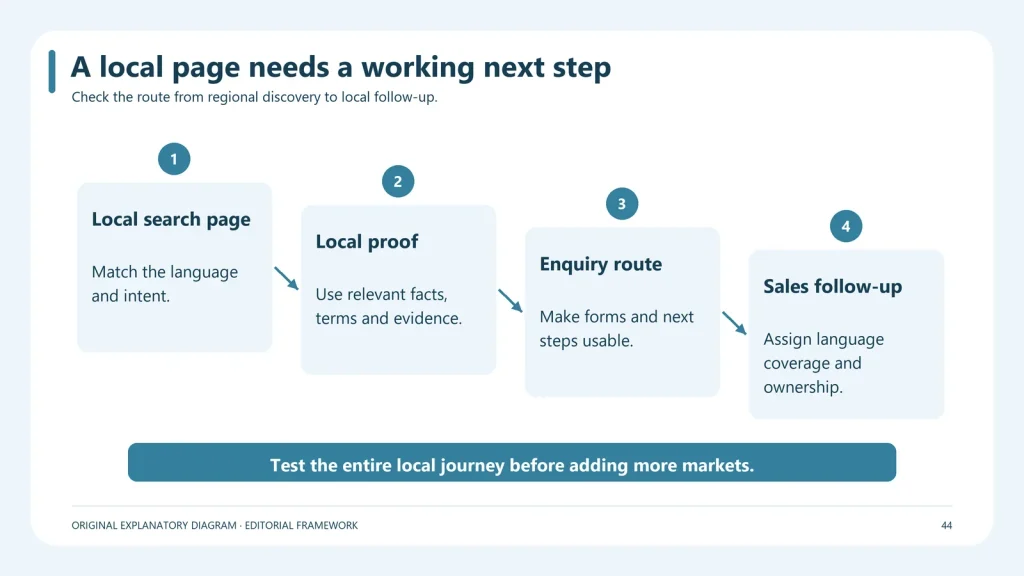
- Connect pages to local forms, sales routes, currencies, support, consent, and measurement.
- Report technical, content, visibility, enquiries, quality, and revenue evidence by market with caveats.
- Renew or reallocate the retainer using the evidence, capacity, and next market decision.
Buy deliverables with acceptance evidence
| Workstream | Deliverable to specify | Acceptance evidence | Dependency |
|---|---|---|---|
| Market research | Audience, query, competitor and offer brief | Country and language assumptions stated | Local commercial input |
| Technical diagnosis | Prioritized issue register by template | Example URLs and reproducible checks | Developer and platform access |
| Localization | Page brief and reviewed local copy | Intent, terminology and task review | Native-language reviewer |
| Implementation | Approved template or content release | Staging checks and post-release sample | Release owner |
| Measurement | Market-specific decision report | Definitions, dates, limitations and action | Analytics and sales records |
Do not accept an audit document as evidence that a defect has been fixed. Separate diagnosis, specification, implementation, verification, and maintenance. Each can have a different owner and a different fee boundary. That distinction is particularly important when a central agency advises a local development team.
Treat architecture as a decision with trade-offs
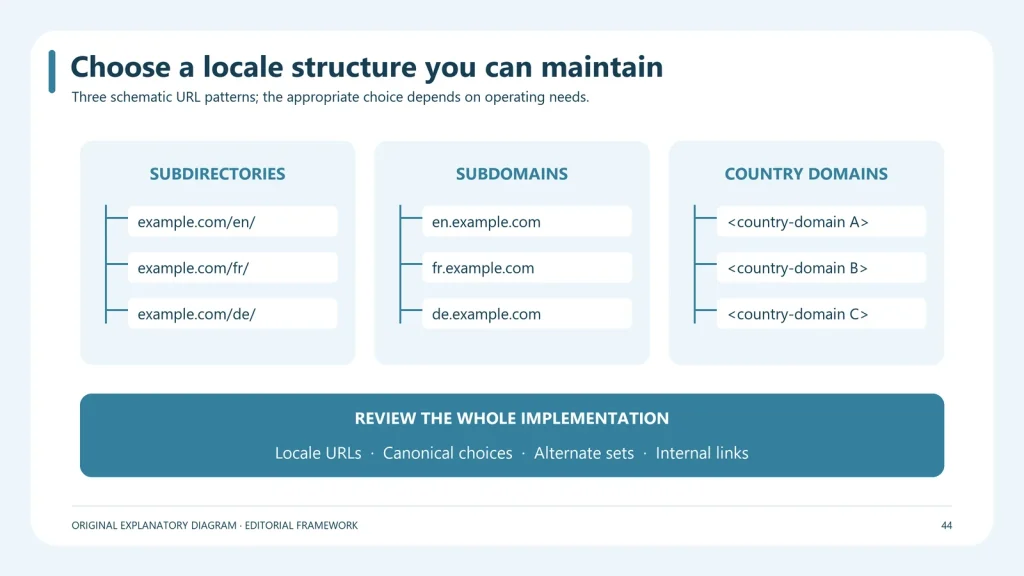
Before changing URLs, inventory what exists. Map countries and languages to actual page families, redirects, navigation, canonical choices, and alternate versions. Identify where the wrong market is exposed to users or where local pages lack an owner. Ask the technical lead to explain the least disruptive path that the team can maintain.
Google’s multi-regional and multilingual site guidance, updated December 10, 2025, recommends different URLs for different language versions rather than relying on cookies or browser settings to change the language. It also advises avoiding automatic redirection between language versions. These are useful acceptance questions for the retainer: can the reviewer open each intended version directly, and can a visitor switch versions deliberately?
Google’s localized-page guidance, updated September 21, 2026, says each annotated language version must list itself and the other versions; page pairs need reciprocal links. Ask for a page-family map and a check of those relationships after release. That technical evidence demonstrates implementation work, not a promise of indexing, rankings, or country-level revenue.
Localize the decision, then the sentence
Local content needs a reason to exist beyond replacing words. Compare the customer question, expected proof, relevant product range, units, delivery promise, support route, and next action. A page may need a different example or a clearer explanation of who can buy; that is an editorial and commercial decision before it is a translation task.
For an illustrative exporter, a translated quotation form is incomplete if it asks buyers to select a region the company does not serve. The useful deliverable is a reviewed local buying path, including its failure states. Have a local reviewer inspect the page and form together, with the source brief available, rather than approving copy in an isolated document.Request an international SEO scope
Make authority work inspectable
If the scope includes digital PR, ask for the proposed audience, editorial angle, source material, outreach approval, and reporting method. Require clear treatment of paid placements, sponsored content, and brand permissions. Do not approve a quantity of links without knowing how they will be obtained or what a relevant reader will gain.
The agency should be able to show the work it controls: research, a useful asset, approved outreach, and a record of responses. Coverage, referral traffic, rankings, and sales remain outcomes to observe. A retainer should not turn those uncertain outcomes into a guaranteed inventory item.
Review the market separately before reading the global total
| Decision question | Evidence to inspect | Interpretation limit |
|---|---|---|
| Was the intended work released? | URL and template change log | A recommendation is not a release |
| Is the target market finding relevant pages? | Appropriately filtered search and landing data | Country, language and query are different dimensions |
| Can visitors complete the local task? | Reviewed local path and event records | Traffic alone does not prove usability |
| Are enquiries commercially useful? | Accepted, rejected and pending sales records | Sales timing and definitions affect counts |
| What should change next? | Evidence, confidence and named decision owner | An association does not establish causation |
Keep period, filters, currency, and definitions visible. A small new market and an established market should not disappear into one average. Use the Search Console Performance report documentation to check current dimensions and reporting limitations before building the reporting specification.
Renew against readiness and the next useful question
Set renewal criteria at the start: work accepted, issues unresolved, local capacity available, and the next decision that requires funding. An unfinished development dependency may call for a revised scope rather than more content. A market with limited evidence may justify a narrow test instead of immediate expansion.
Ask Marketboo to discuss a market-by-market scope with deliverables, implementation ownership, local review, reporting, and exclusions shown separately. Confirm which activities the engagement actually includes. The tables here are a procurement model, not a published Marketboo price list, service guarantee, or proof of country-specific results.
FAQ
What are international SEO services?
They coordinate search strategy, technical architecture, localized content, authority, measurement, and governance across defined markets and languages.
Should every country get the same SEO scope?
No. Scope should reflect demand, readiness, language, competition, offer, operations, and evidence. A country label alone is not a strategy.
What does a multi-market retainer cost?
Cost depends on markets, languages, technical complexity, content volume, authority work, implementation, and review requirements. A responsible scope states assumptions rather than a universal price.
How should international SEO success be measured?
Use market-specific visibility and qualified actions, then connect them to sales or revenue evidence where possible. Keep attribution qualified.
Does international SEO guarantee leads?
No. Search work can improve discoverability and clarity, but demand, product fit, competition, trust, operations, and sales response remain variable.
Who implements technical SEO changes?
The retainer should name the SEO, developer, CMS, translator, market, and approval responsibilities for each change.
How can Marketboo structure the retainer?
Ask Marketboo for a proposed scope by market, with deliverables, implementation owners, local review, and reporting. Confirm the actual activities and exclusions rather than assuming every workstream in this guide is included.
Conclusion
International SEO services become easier to assess when each market has a clear customer task, owned deliverables, and acceptance evidence. Buy a process that can explain what changed and why the next investment is justified. Expand the portfolio when the business and evidence support it, rather than measuring progress by the number of translated pages.Map your markets with Marketboo