Google Ads for SaaS companies works best when campaign structure reflects the buyer’s question and conversion tracking follows a lead beyond the form. Separate meaningful search themes, match every ad to a useful landing page, and define what makes a demo or trial commercially relevant. Connect campaign events with CRM stages so the team can distinguish a submission from a qualified conversation. Set a bounded budget from company-specific economics, review actual queries and sales feedback, then decide what to improve. A sound process supports better decisions; it does not guarantee a lead count or customer cost.

Software teams often launch paid search because an organic page is not yet attracting enough demand, a competitor appears above them, or leadership wants a faster way to test a market. The platform can put a message in front of people searching, but the auction does not know whether a user fits the product, has budget authority, or can be served in the target region. That judgment is the advertiser’s job. Campaign structure, landing pages, forms, conversion events, and sales feedback need to work together so spend learns from real buying progress rather than easy-to-count actions.
There is no single Google Ads account structure that fits every SaaS product. A self-serve tool with a short evaluation can use a different event and page path from an enterprise platform with security review, implementation, and a long sales cycle. A company with limited search volume may need fewer campaigns to avoid fragmenting learning, while a multi-product business may need budget separation for distinct goals. Build structure around decisions the team will make, not around an arbitrary number of ad groups.
Google Ads for SaaS companies: define the conversion
A form fill can be a useful interaction, but it does not automatically represent a qualified lead. Write down which events matter to the company and how each is counted. Common stages include landing-page engagement, trial signup, account activation, demo request, demo booked, demo attended, sales accepted, opportunity created, and closed-won. A team may not need all of them, but each reported outcome should have a clear definition and source of truth.
| Funnel stage | Suggested business definition | Measurement source | Important distinction |
|---|---|---|---|
| Trial signup | A unique user completes the signup flow | Product analytics or CRM | Signup is not activation or payment |
| Activated trial | A user completes an agreed value milestone | Product event system | Define the milestone with product and sales |
| Demo request | A person submits a valid request | Website event and CRM | Remove tests, duplicates, spam, and existing accounts as appropriate |
| Qualified demo | A request meets the documented company, use-case, and market criteria | CRM with sales review | Qualification is not guaranteed by a platform form |
| Attended demo | The prospect attends the scheduled meeting | CRM or calendar integration | Booked meetings and held meetings are separate |
| Opportunity | Sales creates an opportunity under the company’s policy | CRM | Pipeline value should follow finance and sales rules |
| Customer | A new customer meets the chosen conversion definition | Billing or CRM | State whether it is signed, activated, or paid |
Google Ads conversion tracking can measure actions on a website or app after ad interactions, but the advertiser must configure the actions and choose how to use them.[1] Do not optimize every action as if it were equally valuable. A free trial may be the right goal for a product-led business; a sales-accepted demo may be more useful for a high-touch product. If volume is too low for a later-stage event, use a reliable earlier signal while continuing to review qualification and customer outcomes separately.
Marketing, sales, product, and RevOps should agree on definitions before launch. For example, decide whether an existing customer requesting support counts as a lead, whether student or competitor submissions are excluded, which countries are supported, and how duplicate people or companies are handled. A written definition prevents a platform dashboard and a sales report from using the same label for different things.
Map search intent to campaigns and pages
A paid search program should start from the company’s product and buyer, then identify the searches that signal a need. Search terms can refer to the product category, a workflow problem, a feature, an integration, a competitor, a migration, pricing, or a support question. The wording is evidence of a possible task, not proof of identity or authority. Compare the query report with lead details, sales calls, and the page that received the click.
| Search family | Example query intent | Typical page | What the ad should clarify |
|---|---|---|---|
| Brand | Searcher already knows the company or product | Homepage or strongest brand page | Product name and relevant next step |
| Category | Searcher compares software in a known category | Category or solution page | Who the product is for and its differentiating use |
| Use case | Searcher describes an operational problem | Specific use-case page | The workflow the software supports and its fit boundary |
| Feature | Searcher seeks a defined capability | Feature page or documentation | Availability, plan requirements, and important limitations |
| Integration | Searcher wants compatibility with a named system | Integration page | Connection type, supported data, setup, and prerequisites |
| Competitor | Searcher evaluates an alternative or comparison | Fair comparison page | Honest strengths, tradeoffs, and a relevant evaluation path |
| Pricing or demo | Searcher is assessing commercial terms or a sales conversation | Pricing, demo, or contact page | What happens next and what information is needed |
| Informational problem | Searcher is researching a broader question | Helpful guide or resource | Whether a relevant product pathway exists without forcing a demo |
The destination should answer the searcher’s question. Sending every click to the homepage makes measurement simpler but often creates a mismatch. A visitor searching for an integration needs details about that connection; a visitor evaluating enterprise security needs relevant documentation or a clear path to it. A demo form cannot compensate for a page that has not explained the product.
Choose campaign structure around meaningful controls
A practical starting account may separate campaigns by business line, country or language, brand versus nonbrand intent, and distinct budget or conversion goals. Each campaign adds an operational decision surface. Separate a group when the team needs different budgets, targeting, exclusions, landing pages, reporting, or bidding goals. Keep closely related terms together when they share the same message and destination.
Avoid excessive fragmentation. If each ad group receives too little data to evaluate, the team may spend time managing labels rather than improving queries, pages, and conversion quality. Conversely, combining brand, competitor, and broad category searches into a single budget can hide which activity is producing results. The right structure makes a meaningful difference visible without turning every synonym into its own campaign.
| Campaign family | Keep separate when… | Review decision |
|---|---|---|
| Brand | The company needs to control brand demand, defend its name, or measure branded activity separately | Evaluate incremental value and avoid blending with new-demand campaigns |
| Nonbrand category | Category queries need their own pages, budget, or sales interpretation | Check query quality and landing-page fit |
| Use case | Distinct workflows require distinct messages or product proof | Keep only themes that the product can support |
| Competitor | Legal, message, budget, and risk management require separate control | Review claims and cost against a clear business rationale |
| Market or language | Availability, support, currency, or landing pages differ | Confirm local terms and sales coverage |
| Product line | Product economics, buyer, or sales motion materially differ | Compare outcomes under the right product-specific definition |
Use keyword planning and search-term reporting as inputs, not guarantees. Google’s Keyword Planner can generate ideas and provide estimates under selected settings.[2] Actual delivery depends on eligibility, auction conditions, match behavior, settings, and competition. Search-term reports show queries associated with activity subject to the reporting view’s rules and data availability. Examine them regularly to find irrelevant themes, new language, and opportunities the page does not yet cover.
Match types affect how keywords can match to searches. Review Google’s current documentation rather than assuming the written keyword must appear exactly.[3] Build a small set around meaningful intent and test it. Negative keywords can exclude unwanted themes, but overbroad exclusions may prevent valuable queries. For example, “free” might signal poor fit for one enterprise offer but be important for a company’s free trial. Use observed search behavior and business rules to decide.
Write ads that match the page and buyer
A responsive search ad lets an advertiser provide assets that Google can combine. The ad should explain a real benefit, product use, or differentiating detail and give a clear next step. Make claims that product owners can support. If implementation requires administrator setup, if an integration is limited, or if a feature is only in a particular plan, do not hide that condition behind a broad promise.
A useful ad-to-page match has three parts: the query expresses a need, the ad acknowledges a relevant solution, and the page proves what the product does. If the query is “software for approval workflows,” an ad can name the workflow and the destination can show the process, roles, permissions, and reporting. If the page only says “work smarter,” the buyer still has to infer whether the software fits.
Google’s responsive search ad documentation describes asset requirements and how assets may be combined.[4] Provide enough distinct but consistent headlines and descriptions for the platform to test variations, while making sure every combination remains accurate. Review asset performance as one source of information, not as a complete test of business impact. Avoid pinning every asset unless there is a business or legal reason to control position.
Ad extensions or assets such as sitelinks can provide useful paths to pricing, integrations, product features, or customer stories. Link only to destinations that are current and appropriate for the campaign. A sitelink to a generic resource can distract from the intent; a direct route to security or pricing information may help a buyer decide whether to continue.
Build landing pages for evaluation, not just form submission
A landing page is part of the offer. It should restate the ad’s promise, explain the product in the buyer’s language, show credible evidence, and make the next step clear. For sales-led SaaS, useful proof may include implementation expectations, team fit, integration behavior, security materials, support model, customer examples, and honest limitations. For a self-serve product, show the first action, activation path, trial terms, and what happens after signup.
Keep the form proportional to the value and complexity of the next step. A simple trial may need only a work email and password; a tailored enterprise consultation might justify company size, use case, or integration requirements. Every field should have a reason. If sales never uses a field, remove it. If qualification matters, compare shorter and longer forms using qualified outcomes, not raw conversion rate alone.
Test mobile layouts, load time, accessibility, form errors, confirmation states, and the sales follow-up path. A lead can be lost because the confirmation page fails, the thank-you event fires twice, or the CRM route assigns it to the wrong team. Verify the full journey after every important page or tracking change. If the product uses a trial, verify activation events and not only account creation.
A page should also make the business’s claims easy to confirm. If it says a product integrates with a particular platform, explain what is supported. If a customer story includes a result, provide approved context for that result. Avoid fake urgency, hidden terms, or a demo request button that does not describe whether the visitor will speak with sales, receive an email, or view a scheduled product walkthrough.
Connect Google Ads to analytics and CRM
At minimum, verify that clicks lead to sessions, the intended action triggers once, and the CRM receives the right source and contact data under the company’s policies. Preserve a stable identifier or campaign data as allowed and approved by analytics and privacy owners. Do not send personal or sensitive information in query parameters or event labels.
For longer sales cycles, platform conversions can be paired with eligible offline outcomes. Google documents offline conversion imports and enhanced conversions for leads as ways to connect certain CRM events with ad interactions, subject to current implementation requirements and policies.[5][6] RevOps and analytics should validate identity handling, timestamps, deduplication, consent, and which lifecycle events are suitable to use. A CRM status that sales updates inconsistently will not become reliable simply because it is imported.
Use a minimal decision-grade event set. A product-led company may need a trial-start and activation event. A sales-led business may report demo request, qualified demo, opportunity, and customer. Do not optimize to a high-volume event that has little relationship to the business outcome without explicitly recognizing the tradeoff. If volume is insufficient to optimize toward a later-stage event, maintain it in reporting and improve data quality over time.
Keep platform and business reporting side by side. Google Ads can report attributed conversions under its settings; analytics may use another attribution scope; CRM records sales outcomes. Differences are expected. State the reporting window, attribution model, key event definition, and source of truth for each number. Do not force systems to match by changing a definition after seeing the result.
Set budgets from company economics
SaaS Google Ads budgets should reflect the company’s target market, sales capacity, expected acquisition economics, and ability to learn. Separate media spend from agency fees, internal labor, software, creative, and sales costs. Work backward from finance-approved acquisition limits and use account-specific assumptions for CPC, click-to-conversion rate, qualification, show rate, close rate, and retention. If those rates are unknown, build explicit scenarios and call them assumptions.
A simple planning chain is: expected clicks equal budget divided by assumed CPC; expected first-step conversions equal clicks multiplied by the observed or assumed conversion rate; qualified outcomes equal conversions multiplied by the qualification rate; and expected customers depend on downstream attendance and close rates. Each step should be labeled by period, market, currency, and source. This is a model, not a promise. The most important improvement may be a better landing page or lead definition rather than a higher bid.
Google Ads uses campaign budget controls and explains average daily budget behavior and monthly spending limits in its current guidance.[7] Translate the finance-approved monthly amount into campaign settings carefully, taking account of campaign-level budgets and the platform’s rules. Daily delivery can vary. A plan should not assume that every day spends exactly the same amount or that a monthly budget buys a fixed number of demos.
A useful pilot has both a media limit and an operating plan. The media cap controls auction spend; operating work includes landing-page changes, analytics support, creative review, and the time sales needs to qualify inquiries. Record those costs separately so the program does not look inexpensive because internal work is invisible. Before launch, state the question the pilot should answer: can this search theme attract relevant visits, can the page turn that intent into a valid action, or do those actions reach an agreed CRM stage? One test should not be expected to answer everything. Set an early checkpoint for tracking and lead fit, then a later one for sales outcomes to mature. Mark unknown CPC and conversion assumptions as estimates, and cap spend at a level the company can support.
How to launch and improve a SaaS Google Ads program
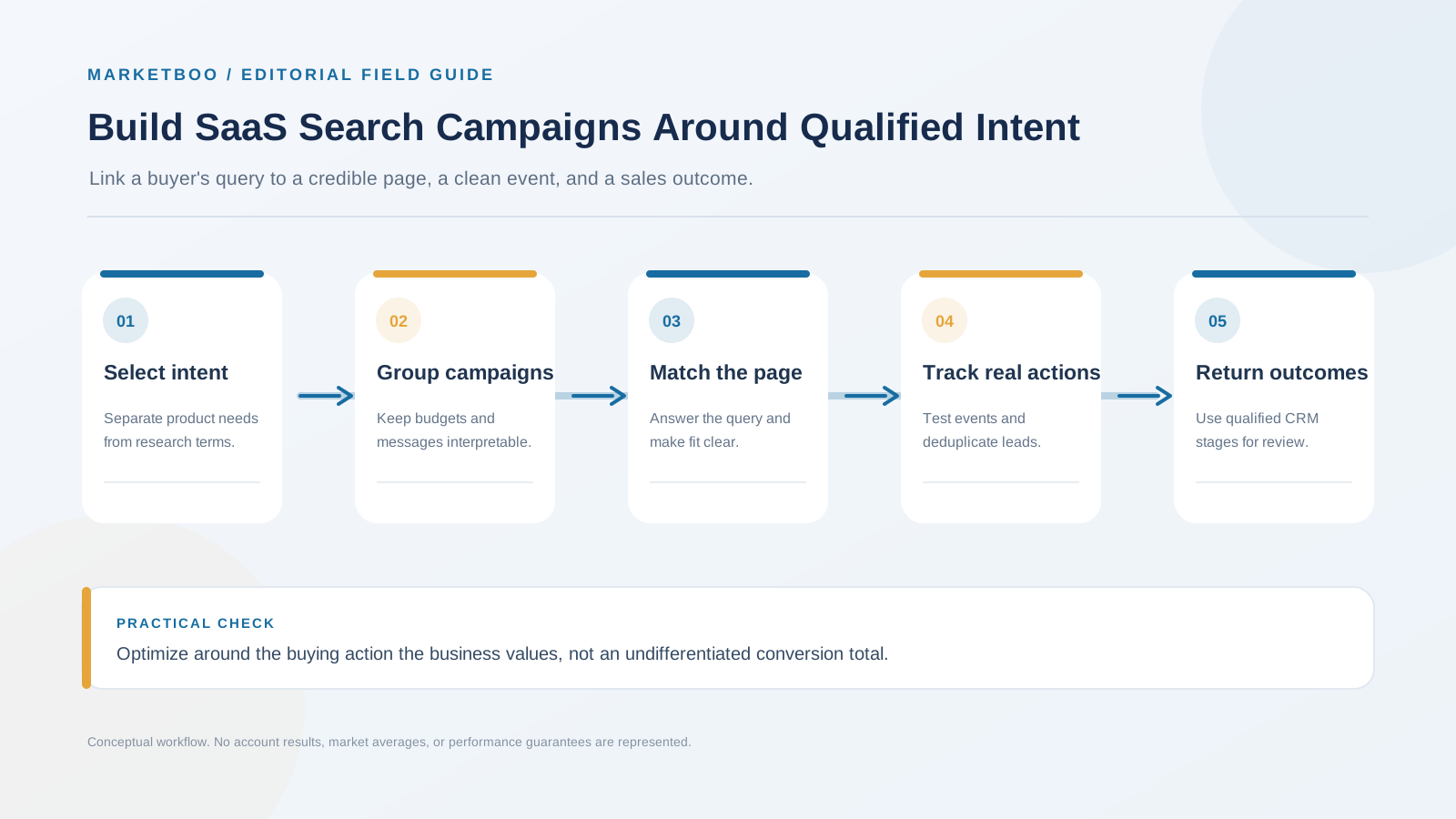
- Define the business goal. Choose one product, market, sales motion, and meaningful conversion. Document who qualifies and what later outcome matters.
- Map queries to buyer questions. Build themes from product category, use case, feature, integration, brand, competitor, and pricing intent. Validate language with customers and sales.
- Choose the account structure. Separate campaigns only for meaningful control, such as different budgets, markets, destinations, or business goals. Avoid needless fragmentation.
- Select keywords and exclusions. Use planning tools to discover candidates, configure match types intentionally, and record why negatives are added. Review actual query reports after launch.
- Create an accurate ad and landing-page pair. Match wording to the real product, show proof and limitations, and select a next step suitable for the search intent.
- Validate tracking and CRM handoff. Test tags, consent behavior, event firing, deduplication, source capture, forms, CRM stages, and follow-up. Keep a record of test conversions.
- Set a bounded budget and review date. Use company economics and capacity to define the pilot. State what evidence would cause the team to continue, revise, or pause.
- Review query and lead quality. Inspect search terms, landing pages, valid conversions, qualification, and sales feedback. Correct obvious mismatch before increasing spend.
- Run controlled improvements. Change one major element at a time where practical—query set, ad message, page, form, or bidding approach—and annotate when the test begins.
- Scale only after outcomes mature. Compare qualified stages and customer economics, not just clicks or form volume. Increase budgets in a way the sales and customer-success teams can absorb.
Common SaaS paid-search mistakes
Sending every search to the same page
Different queries require different evidence. A generic homepage can create message mismatch and make it hard to identify which product interest produced an inquiry. Build or improve the page that serves the query before increasing traffic.
Treating every signup as a qualified lead
A free user, existing customer, student, job seeker, competitor, or out-of-market business may not match the sales goal. Define quality and retain disqualification reasons. Use raw signup numbers to understand volume, but do not equate them with pipeline.
Overusing competitor and broad category searches
Competitor terms may have different legal, cost, and conversion considerations, while broad category searches can attract research or support intent. Create separate controls and pages where the business case warrants it. Avoid claims that misrepresent a competitor or imply affiliation.
Fragmenting campaigns beyond available evidence
Too many tiny campaigns can create administrative overhead and make results unstable. Group terms that share a page and action. Separate them when the business needs different budget, risk, or measurement controls.
Optimizing to platform conversions without sales feedback
A campaign may increase the event it is told to find. If that event is a low-friction request that sales rejects, the platform dashboard can improve while business outcomes worsen. Review CRM stages and adjust the conversion strategy accordingly.
Assuming attribution equals incremental growth
A platform may credit a conversion according to its attribution rules, but the user could have discovered the company elsewhere or returned through another channel. Report attribution as attribution. If the budget decision depends on incremental lift, choose a suitable experiment and seek qualified measurement support.
Expanding before the product can serve the market
An ad can attract buyers in a country where the company has no support, currency, compliance, or onboarding capability. Confirm operational readiness and the truth of the landing-page promise before targeting new markets.
FAQ
Is Google Ads effective for SaaS companies?
It can help software companies reach people searching for product categories, workflows, features, integrations, or alternatives. Effectiveness depends on query intent, product fit, landing-page quality, tracking, competition, sales execution, and economics. Evaluate qualified outcomes and customer results rather than assuming clicks or form submissions indicate success.
Which Google Ads campaign should a SaaS company start with?
Many teams begin with a bounded search campaign tied to a specific product, market, and high-intent query set. The right format depends on how buyers search, what evidence is available, the sales motion, budget, and tracking maturity. Start with a testable hypothesis and a landing page that fits the intent.
Should a SaaS company bid on its brand name?
That depends on competition, organic visibility, business goals, and whether paid brand activity adds incremental value. Report brand campaigns separately so they do not make nonbrand acquisition appear stronger. Review policy and competitive context, and test the decision when incremental impact matters.
How should SaaS companies track demos from Google Ads?
Define a demo request event that fires only on successful completion, deduplicate records, and capture the source in analytics and CRM as approved. Keep booked, attended, qualified, sales-accepted, opportunity, and customer stages distinct. For eligible later-stage outcomes, review Google’s offline import or enhanced conversions guidance with analytics and privacy owners.
What is a good cost per SaaS lead?
There is no universal cost that applies across SaaS products, markets, deal sizes, and sales motions. A useful cost is connected to a written qualification definition and downstream customer economics. Calculate from your own data, show the sample and period, and label assumptions when history is limited.
Should Google Ads send traffic to a demo page or a product page?
Send the visitor to the page that best answers the query and supports the next step. A high-intent search may justify a demo path, but the page still needs product evidence. A broader use-case or integration query may need explanation before a form. Test the path using qualified outcomes.
How much should a SaaS company spend on Google Ads?
Set a bounded amount using finance-approved acquisition economics, search volume and cost assumptions where available, sales capacity, and the evidence needed for the test. Separate media from operating costs. If inputs are uncertain, use scenarios and update them with observed results instead of copying a generic budget.
Make paid search answer a real buyer question
A SaaS Google Ads program is strongest when each query has a clear business reason, each ad makes a truthful promise, and each landing page supplies evidence a buyer can use. Tracking then connects the visit to a defined action and, where appropriate, the CRM outcome that the company values. This creates a foundation for deciding what to refine, what to pause, and where additional budget may be justified.
For campaign planning that connects search, paid media, and sales-stage measurement, explore Marketboo’s global paid media services. If the main constraint is team capability rather than campaign capacity, review hands-on ad coaching to build a more repeatable internal process.
This is the practical role of Google Ads for SaaS companies: guide a clear next action and make the result measurable.