

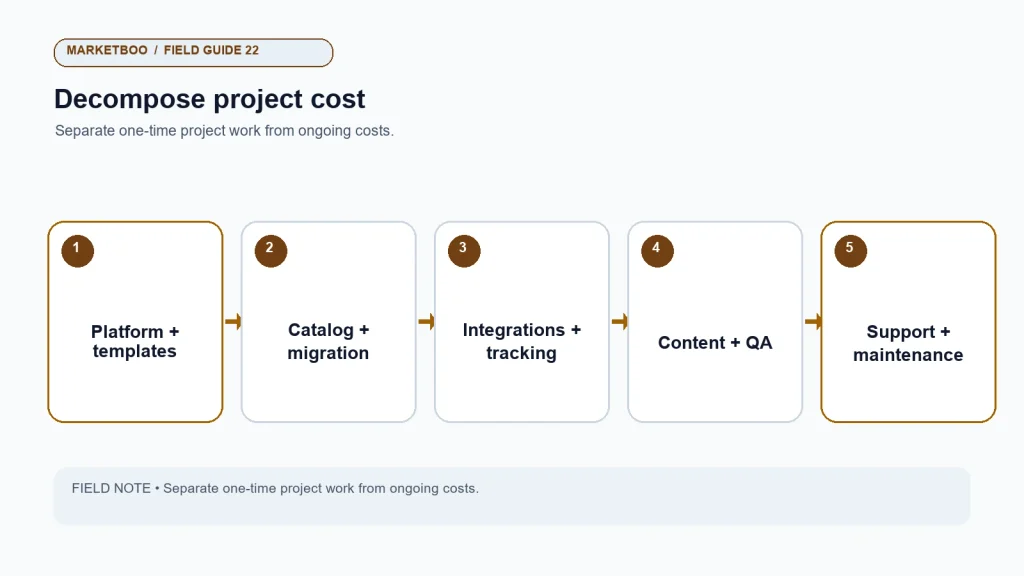
The short answer: Ecommerce website redesign cost depends on the scope of the storefront and the work required to move it safely—not only on the visual design. Platform, product and content volume, custom templates, data migration, integrations, languages, analytics, SEO, accessibility, QA, and post-launch support can all change a proposal. Compare quotes against the same deliverables and assumptions. Separate one-time project work from recurring platform, app, hosting, maintenance, and support costs, and separate all of those from advertising spend. If a price excludes migration, testing, or ownership handoff, the business still has to pay someone to do that work.
How ecommerce website redesign cost depends on scope
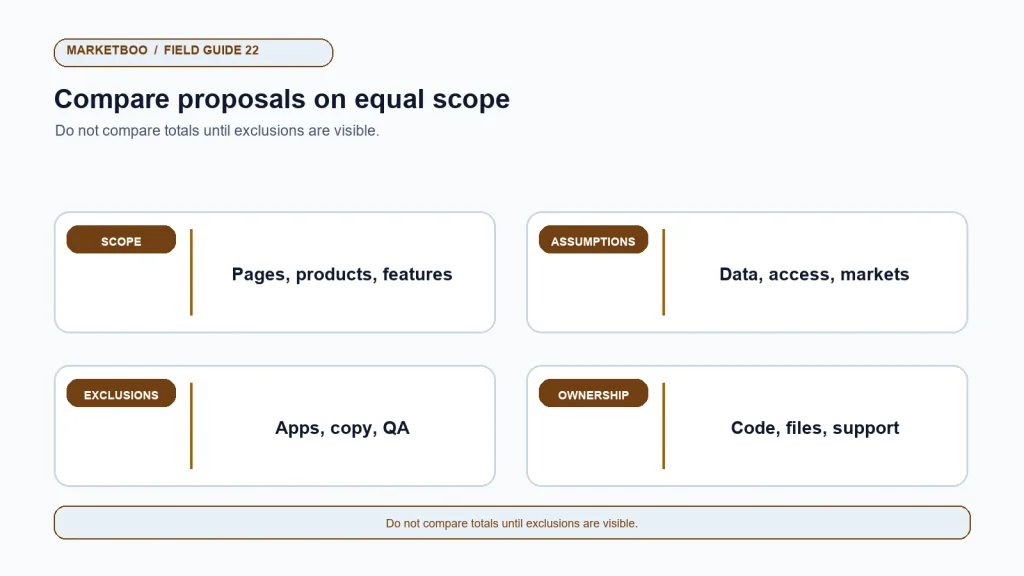
Two ecommerce redesign proposals may both say “new site,” yet one could be a theme refresh using existing product data while another includes a platform migration, custom shopping experience, multilingual content, CRM integration, product photography, redirect planning, and post-launch monitoring. Comparing only the total price rewards the proposal that leaves more work unstated.
The useful question is not “What does a redesign cost?” but “What work, risk, and ongoing obligation does this business need the project to cover?” A reliable estimate requires discovery. The vendor needs to understand product volume, catalog quality, current platform, integrations, markets, customer tasks, content readiness, technical constraints, and decision owners. If those facts are missing, a quote should state assumptions and ranges rather than imply certainty.
This article does not publish an unsupported market price range. The workbook contains no verified country-specific pricing data or dated cost benchmark. Use the comparison method below to request and evaluate actual proposals in the business’s currency and scope.
Separate project price from total cost of ownership
Project price covers agreed work and deliverables for the redesign. Total cost of ownership can also include software subscriptions, hosting, payment processing, app licenses, security, content updates, maintenance, support, internal staff time, training, and future feature work. A proposal with a lower project fee may require more internal effort or ongoing third-party spending. A higher project fee may include discovery, migration, QA, and post-launch support, but the buyer should verify what is actually included.
Build two views. The first compares one-time project scope. The second estimates recurring and internal operating costs for an agreed time horizon. Do not mix those in one number without explaining what it includes. Advertising spend is also separate: it is a marketing budget, not a website build cost.
| Cost view | Include | Questions to ask |
|---|---|---|
| One-time project | Discovery, design, development, content migration, integration, QA, launch | Which deliverables and revision rounds are included? |
| Recurring platform | Platform plan, hosting where applicable, domains, apps, payment tools | What is billed by third parties and in which currency? |
| Maintenance and support | Updates, monitoring, defect response, backups, content changes | What hours, response times, and exclusions apply? |
| Internal effort | Product data, content, approvals, testing, training, project management | How many hours and which roles must the company supply? |
| Growth work | New features, templates, integrations, campaigns, localization | How will work be scoped and approved later? |
The main drivers of ecommerce redesign cost
Platform and migration complexity
A project that stays on the current platform may reuse product records, customer workflows, and operational processes. A platform migration can add data mapping, URL changes, payment and fulfillment checks, account setup, staff training, and integration work. Legacy data may be inconsistent or incomplete, so the team may need to clean product attributes before importing them.
Ask whether the proposal includes data export, mapping, transformation, test imports, reconciliation, and error handling. Define what happens to customer accounts, order history, subscriptions, gift cards, reviews, redirects, and product variants. Some of these may be controlled by the platform or third-party app, so the business must verify current capabilities and limitations.
Product catalog and page templates
The number of products is not the only complexity measure. Variants, product families, compatibility rules, bundles, subscriptions, regional availability, and different content needs can require distinct templates or data structures. A catalog with many similar items may be manageable through a few templates. A smaller catalog with complex configurators may require more custom work.
Request a template inventory: homepage, collection, category, product, search, cart, blog, resource, campaign, and any special product flow. Ask which components can be configured by the business after launch and which need developer support. Verify whether product content entry and image preparation are included or assumed to be supplied by the client.
Custom design and development
A theme adaptation differs from custom interaction design and custom frontend behavior. The number of templates, responsive states, animations, filters, search features, and design-system components affects scope. Ask how design decisions will be tested with real content and mobile tasks. If a design uses a component that depends on an app or paid license, identify that cost separately.
The business should also understand code ownership, repository access, documentation, deployment, and who maintains the site after launch. A vendor should describe customizations that could make future upgrades harder. This is not a reason to avoid custom work; it is a reason to understand the maintenance trade-off.
Content, photography, and localization
Product descriptions, category copy, brand photography, video, icons, technical specifications, and translation can all affect the project. Some proposals migrate existing content without editing; others include copywriting and product information cleanup. Ask who owns claim verification and who approves translations. A language switcher does not make a store’s product availability, currency, shipping, or support information appropriate for every market.
Clarify image rights, source files, usage period, territories, and whether assets can be reused in paid advertising. If the business supplies images, agree on formats, crop requirements, and replacement responsibility. If the vendor creates new photography or video, define shoot days, deliverables, talent, editing, and licensing.
Integrations and business systems
Ecommerce sites often connect to inventory, fulfillment, CRM, email, tax, reviews, search, analytics, subscription billing, marketplaces, and customer support. Each integration adds questions about data ownership, field mapping, authentication, testing, errors, and business continuity. A simple embedded tool is different from a custom bidirectional integration.
Ask for an integration map and test plan. Name the technical contact at both the vendor and the system provider. Verify which accounts, API access, or vendor fees are needed, and who pays them. If an integration is outside scope, record who will implement and test it.
Search migration and analytics
Changes to URLs, content, page templates, internal links, canonicals, indexation, structured data, and redirects can affect search behavior. A redesign estimate should say whether it includes URL inventory, redirect mapping, metadata migration, sitemap checks, search testing, and post-launch monitoring. Do not accept “SEO included” without a list of tasks.
Analytics work can include a baseline, event plan, tag configuration, consent behavior, test orders, CRM or ad platform connections, and reporting. If measurement is not in the proposal, the company should assign a separate owner and budget. A site can look finished while critical events fail to record.
Quality assurance and launch support
QA across devices, browsers, product types, checkout paths, regions, and payment methods takes time. Ask how many pages and journeys will be tested, whether automated checks are included, how bugs are classified, and who retests fixes. A “launch” line that only means pushing code is not the same as release management with a rollback plan and monitoring.
Post-launch support needs a defined period, response time, and defect boundary. Does it cover only vendor-caused defects or also content edits and new requests? Who handles platform outages, third-party app failures, or a payment-provider issue? Clarity protects both the buyer and vendor.
Normalize vendor proposals using a work breakdown
Give every vendor the same project summary, product estimate, system list, target markets, required templates, existing URL inventory, content responsibilities, and launch requirements. Ask each to show what is included, what is excluded, what is assumed, and what would trigger a change request. If discovery is required before a firm estimate, compare the discovery deliverables and fee separately.
| Work package | Vendor A | Vendor B | Cost or scope question |
|---|---|---|---|
| Discovery and requirements | Are workshops, inventory, and architecture included? | ||
| UX and information design | Which user tasks and page types are covered? | ||
| Visual design and components | How many templates and revision rounds? | ||
| Development | Theme configuration, custom code, and testing environment? | ||
| Product/content migration | How many records/pages and who cleans data? | ||
| Integrations | Which systems, test cases, and third-party charges? | ||
| Search and URL migration | Inventory, redirects, metadata, sitemap, monitoring? | ||
| Analytics and consent | Event map, implementation, and test evidence? | ||
| QA and accessibility | Devices, templates, user flows, and defect retests? | ||
| Launch, training, handoff | Rollback, documentation, source files, staff training? | ||
| Maintenance and support | Included period, response time, and exclusions? |
Ask vendors to disclose the estimation basis: fixed fee, time and materials, milestone billing, or another model. For variable work, request a not-to-exceed limit or an approval step before exceeding a threshold. Clarify taxes, currency, travel, hosting, licenses, and payment terms. The buyer should compare contract risk as well as design and price.
Estimate client-side effort and hidden dependencies
The vendor’s quote cannot cover decisions only the business can make. The company may need product managers to confirm facts, sales to review leads and page language, legal to review claims and policies, operations to test fulfillment, and a leadership sponsor to approve scope. If those people cannot allocate time, the schedule may move or the vendor may charge for rework.
Make a dependency list with owner, due date, expected input, and consequence if late. Product data, final prices, photography, privacy decisions, shipping rules, market scope, and CRM fields are common dependencies. The project plan should show when each input is needed and whether the vendor is waiting, working with placeholder content, or changing scope.
| Client dependency | Needed from | When needed | Risk if late |
|---|---|---|---|
| Product truth and specifications | Product/merchandising | Before final page copy | Incorrect or incomplete product content |
| Pricing, discounts, shipping, returns | Commercial/operations | Before checkout QA | Customer-facing terms may be wrong |
| Claims and case evidence | Legal/product/marketing | Before creative approval | Unsupported statements or launch delay |
| CRM and analytics access | Marketing operations | Before integration testing | Events and lead routing cannot be verified |
| Final images and rights | Brand/content owner | Before content freeze | Visual gaps or unlicensed reuse |
| Launch approval | Sponsor/release owner | Before release | No accountable go/no-go decision |
A cost-comparison example without fake prices
Suppose Proposal A is lower and includes theme setup, six templates, and launch deployment. Proposal B is higher and includes discovery, product data cleanup, a redirect map, test orders, analytics validation, staff training, and a support period. The difference is not necessarily waste. It may represent work the business otherwise needs to purchase or perform internally. The buyer should ask whether the extra scope is needed and whether the deliverables are verifiable.
If the company has an experienced technical team, it may handle migration and QA internally. If no one owns those tasks, excluding them from the quote does not eliminate the cost; it transfers the work and risk to the business. Estimate internal hours and opportunity cost where possible. Do not assign a dollar amount if the organization cannot defend it; document the workload as a dependency instead.
This comparison also works in reverse. A high quote may include unnecessary custom features or a complicated process. Ask the vendor to separate must-have work from optional work and explain the consequence of deferring each item. A smaller first release can be appropriate when it protects checkout, customer information, search-critical pages, and operations while postponing lower-priority features.
Build a budget model before approving the estimate
The goal is not to predict every invoice to the dollar. It is to identify the work categories, decision risks, and recurring obligations that may affect the project. Start with the vendor’s one-time estimate, then add the client’s internal effort, recurring platform and app costs, and post-launch support. For uncertain work, ask for a discovery milestone or an estimate range with explicit assumptions.
Use a simple scenario model. The low case includes only the agreed must-have launch scope. The expected case adds the likely migration, content, integration, and QA work. The high case captures known risks such as poor product data, an undocumented custom integration, or additional market requirements. Do not invent a contingency percentage. Ask the project sponsor and finance owner how the organization handles risk allowance and who can approve it.
| Budget line | Low / base / high evidence | Approval question |
|---|---|---|
| Vendor project fee | Quote, discovery estimate, or change-order rate | Which assumptions could change this amount? |
| Product/content cleanup | Product count, data quality sample, owner availability | Who supplies and verifies the final information? |
| Integrations | System inventory and complexity notes | Which systems are tested and who pays provider fees? |
| Search migration | URL count, redirect map, template scope | Who verifies key paths and post-launch outcomes? |
| Training and handoff | Staff roles and documentation needs | Can the team maintain routine updates independently? |
| Recurring platform/apps | Current vendor agreements and plan choices | What renews after launch, and in whose account? |
| Internal time | Named roles and estimated involvement | Which work will be delayed elsewhere? |
Some project costs are one-time but may be revisited later. A custom configurator, data model, or integration may need maintenance as the catalog and platform change. Ask which work creates ongoing obligations and whether documentation, training, or source access is part of the handoff.
Use change requests to manage new requirements
A change request should explain the user or business need, the proposed scope, alternatives, cost and schedule impact, dependencies, and what happens if the work is deferred. The project sponsor decides whether to approve it. The vendor should not silently trade off QA or search migration to accommodate a new feature without written agreement.
Ask for a change-control threshold: which small adjustments are included, who can approve them, how they are priced, and how they affect the launch date. Clarify whether the team can remove lower-priority scope to keep the same budget. A project that cannot change is brittle; a project that changes informally is difficult to manage.
A good change process preserves the baseline estimate. The team should be able to see the original scope, approved changes, current forecast, and remaining risks. This lets finance and leadership understand whether a larger final cost came from poor estimation, new requirements, or client-side delays.
How to compare ecommerce redesign proposals
- Describe the business outcome. Name the customer task or operational problem that the new site should improve.
- Inventory the current store. Count page types, products, variants, URLs, markets, integrations, and owners.
- Define a minimum launch scope. Separate critical customer paths from optional enhancements.
- List migration requirements. Include products, content, customers, orders, redirects, SEO fields, and app dependencies as applicable.
- Map integrations and testing. Identify systems, credentials, field mappings, owners, and test environments.
- Ask for work-package estimates. Require inclusions, exclusions, assumptions, quantities, and a change-control method.
- Separate one-time and recurring costs. Include platform, app, maintenance, support, internal effort, and advertising separately.
- Check ownership and exit. Confirm code, account, data, source file, documentation, and access rights.
- Compare acceptance criteria. Ask how the vendor will demonstrate working pages, checkout, integrations, tracking, and search migration.
- Choose a proposal the team can operate. Evaluate scope, risk, internal capacity, and support alongside the total fee.
Questions to ask before signing
Who owns discovery findings and design files? Which changes are considered scope additions? Is product copy included or supplied by the company? How many products or pages are in the estimate? Which integrations are tested? Who creates the redirect map? Is analytics implementation included? What is the warranty or support period? Can the business access the site and code if the relationship ends? Which third-party fees will continue after launch?
Ask the vendor to walk through a realistic failure: a payment test fails, a key redirect is wrong, or the product feed omits a variant. Who gets notified, who diagnoses it, how does the business decide whether to launch, and what is the fallback? The answer reveals operational maturity better than a generic promise that the team “handles everything.”
Also check how the vendor is compensated when requirements are uncertain. A fixed fee may encourage a clear scope but require formal change requests. Time-and-materials billing can accommodate discovery but needs budget visibility and approval controls. Milestone payments can align invoices with deliverables, but the milestone must be objectively defined. None of these models guarantees quality by itself. Match the contract model to the project uncertainty and the company’s ability to review work.
Ask what happens if the vendor estimate depends on information that later proves inaccurate, such as the number of product records, quality of the export, availability of an API, or rights to photography. The proposal should describe how the parties will validate assumptions early and what evidence triggers a revised estimate. This reduces surprises and gives the company a chance to re-scope before substantial work is committed.
Evaluate risk transfer, not just the quote total
A proposal can shift risk to the buyer through assumptions, excluded integrations, limited QA, or a narrow defect warranty. Read the contract alongside the work breakdown. Ask who is responsible when a vendor-supplied component fails, how defects are classified, what response is included, and what happens if the platform changes during development. The business may accept a limitation, but it should understand who will pay for the remedy.
Check payment milestones against deliverables the company can review. A deposit may be normal under a contract, but later payments should correspond to clear outputs or phases. Confirm what happens to partially completed work if the project pauses. The buyer should understand whether it can access completed designs, code, documentation, and product data if the relationship ends before launch.
This review should involve procurement or counsel when the contract is material. The article provides comparison questions, not legal advice. Terms vary by vendor, jurisdiction, platform, and negotiated agreement.
State currency, tax, and payment timing in every comparison
Vendor quotes may use different currencies, tax treatment, payment schedules, or assumptions about exchange rates. Record the currency, quote date, tax inclusion, deposit, milestone schedule, and validity period. If the business operates across countries, ask who is responsible for transaction taxes and any local vendor charges. Do not convert figures without noting the rate date and method.
Payment timing affects cash flow even when total scope is similar. A proposal may require a substantial deposit before discovery, while another bills monthly or at acceptance milestones. Compare the schedule with the company’s approval process and expected deliverable review. Ask how disputed work or a delayed dependency is handled. Finance should review the terms before the business signs.
Marketboo offers website development and design and SEO/GEO services. If you are comparing proposals, contact Marketboo with the project scope and integration list. Request a written estimate that identifies assumptions, deliverables, ongoing work, and responsibilities. Compare it with other proposals on the same basis.
Frequently asked questions
How much does an ecommerce website redesign cost?
The cost depends on platform, custom functionality, product and content migration, integrations, languages, design scope, analytics, SEO, QA, and support. This article does not publish an unverified price range. Ask for a scoped proposal in a stated currency, with one-time and recurring costs separated.
What makes an ecommerce redesign more expensive?
Custom templates, complex product data, platform migration, integrations, localization, original content or photography, search migration, extensive QA, and ongoing support can add work. The key is to ask which items are necessary for the business and which can be deferred without creating customer or operational risk.
Should SEO be included in a website redesign quote?
If search continuity matters, the proposal should name specific tasks such as URL inventory, redirects, metadata, internal links, indexation checks, sitemap review, and post-launch monitoring. “SEO included” is too vague. Assign an owner and verify current search guidance for the site’s migration.
Is a theme redesign cheaper than a full ecommerce rebuild?
A theme refresh may reuse more of the current platform and workflows, while a rebuild may change architecture, integrations, or product data. Actual cost depends on the project. Compare the required scope and ongoing maintenance instead of assuming the label determines the price.
What ongoing costs should I budget after a redesign?
Consider platform fees, hosting where applicable, apps, payment services, maintenance, support, security, content updates, internal operations, and future development. The exact items depend on the platform and contract. Ask which third-party fees are recurring and who manages renewals.
How do I compare two redesign quotes fairly?
Give vendors the same brief and compare work packages, quantities, assumptions, exclusions, revision rounds, migrations, integrations, QA, support, ownership, currency, and payment terms. Estimate client-side effort separately. A lower total may exclude work the business still needs.
What should be included in post-launch support?
Define support period, covered defects, response expectations, escalation, monitoring, documentation, and excluded new requests. Clarify responsibility for platform outages and third-party failures. A successful release still needs a named owner after the vendor’s launch work ends.
Buy the work the project actually needs
Ecommerce website redesign cost becomes easier to manage when the company compares complete scopes rather than headline prices. Start with customer and business outcomes, inventory the current store, expose dependencies, and separate one-time implementation from recurring operations. Ask for evidence that the new experience and its critical paths work before accepting a launch milestone.
A proposal should tell the business what it will receive, what it must supply, what remains uncertain, and how changes are handled. Use that clarity to select a scope that fits the store’s complexity and internal capacity. When a quote is precise but the project is not defined, ask for discovery before treating the number as a commitment.