Quick answer
Quick answer: Choose between LinkedIn Ads and Google Ads for B2B lead generation by the buyer’s next task. Google Search is a reasonable first hypothesis when relevant buyers already name the product, application, or problem. LinkedIn may fit when the buying group is better described by professional role or account context and needs education before searching. Define the same sales-stage outcome, use a clear offer, separate platform credit from business records, and compare accepted opportunities with spend and operating effort. Use both only when the tasks are complementary and the team can support the measurement and follow-up.
Google can meet buyers already searching for a supplier, while LinkedIn can introduce an idea earlier. Choose between them by the buyer’s next task, then compare accepted projects rather than platform labels.
The channel debate
- Quick answer
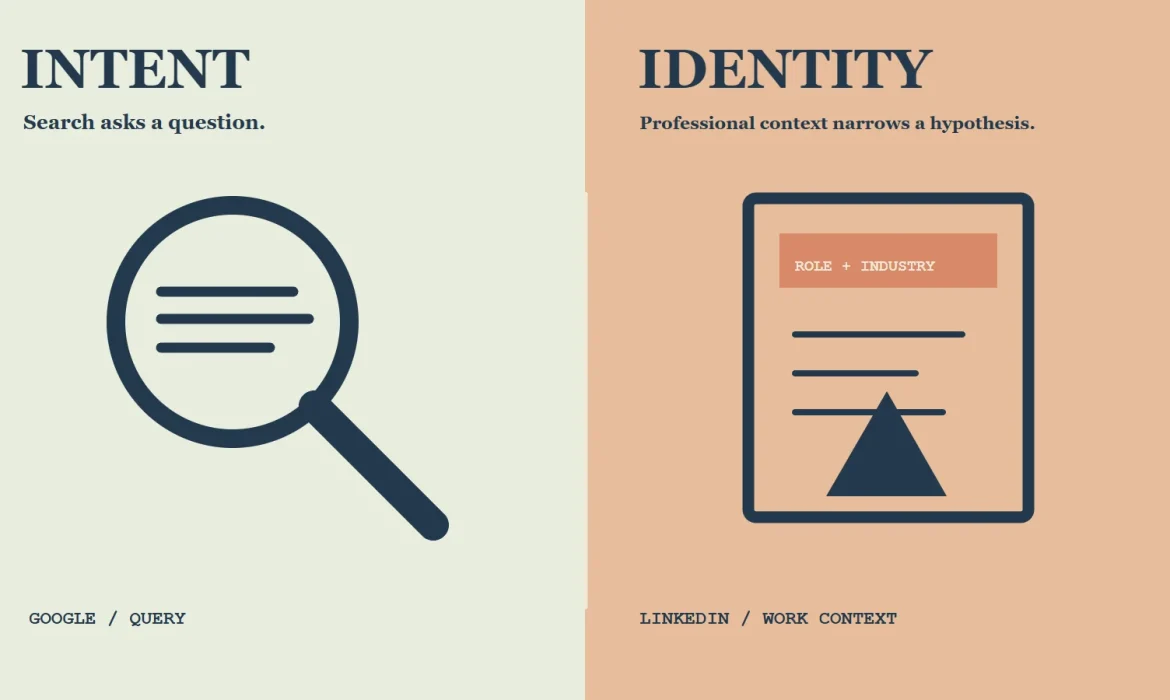
- LinkedIn Ads vs Google Ads for B2B lead generation: start with buyer intent
- Argument one: choose Google when the problem is already being named
- Argument two: choose LinkedIn when the right professional needs context
- Cross-examination: five buyer situations
- A familiar statistic that should not choose the budget
- The buying-group problem: one lead is rarely the whole purchase
- Put a common commercial denominator underneath both platforms
- Compare the cost of operating each channel, too
- The small test: two hypotheses, one sales definition
- A market expansion can reverse the first-channel choice
- The Google evidence is real; a LinkedIn comparison is not in this case file
- Build different messages from the same product evidence
- When a combined plan is justified
- Three objections to settle in the budget meeting
- What a useful channel brief contains
- The review packet / Show a decision, not a collection of screenshots
- The choice to make this quarter
- How to Choose Between LinkedIn Ads and Google Ads
- Frequently asked questions
LinkedIn Ads vs Google Ads for B2B lead generation: start with buyer intent
A procurement manager typing a product specification is doing something different from an operations director reading an industry discussion. Both could become relevant buyers. They are not necessarily ready for the same request, and the campaign should not pretend they are. “Book a sales call” may be appropriate for a supplier search but premature for someone first encountering a new operating approach.
This comparison focuses on Google Search and LinkedIn’s professional advertising context. Google Ads includes other campaign types, and LinkedIn offers different formats; they should not be collapsed into two universal behaviors. Confirm current format, targeting, and measurement options in the actual accounts before turning the recommendation into a media plan.
The strongest initial question is specific: Which buyer, in which market, needs which piece of information next? Once that is answered, the team can decide whether it needs query capture, professional audience selection, education, or a coordinated sequence. A platform preference is a poor substitute for that commercial brief.
Argument one: choose Google when the problem is already being named
Google Search can put a product or supplier offer in front of someone expressing a related query. This is useful when buyers know the category, use recognizable terminology, and need a vendor or specification. The campaign can connect query groups to application pages, product details, and quote routes.
The strength has limits. Some queries are research, education, employment, or consumer demand rather than commercial procurement. A technical term can have different meanings across industries and countries. Google’s matching options also mean the actual search may differ from the keyword the advertiser selected. Google’s keyword-matching documentation is the primary reference; inspect actual search terms before calling all traffic high intent.
Search demand can also be thin. A specialized solution may be valuable to a small set of companies but rarely named in a query. In that case, a narrow search campaign can still be useful, yet it may not absorb a large budget or create awareness of an unfamiliar category. A campaign limited by relevant demand does not become more effective simply because leadership wants more volume.
Choose a search offer that continues the query. A buyer asking for a custom pump supplier needs product capability, serviceability, and a practical inquiry route. A researcher comparing materials may need an application note before requesting a quote. A search campaign can support both tasks, but the page and success event should reflect the difference.
Argument two: choose LinkedIn when the right professional needs context
LinkedIn’s advertising site describes professional targeting options such as job title, function, and industry. It also describes a network of more than one billion active professionals. That is LinkedIn’s own worldwide scale claim, not an independently verified estimate of reachable decision-makers in your country or category. LinkedIn’s advertising overview provides the platform’s description.
Professional attributes help frame a hypothesis: for example, plant engineering leaders in a named industry may care about a specific capacity constraint. They do not prove that every selected person controls a purchase or that a job title maps cleanly across countries. Validate audience size and relevance in the account and compare a sample of inquiries with the buying group sales actually serves.
The offer must justify interruption. A focused application note, a technical comparison, a useful event, or a procurement worksheet can give the intended professional a reason to act. A broad company brochure with a contact form may create very little value for someone who was not searching for the supplier. Start with a problem they recognize and evidence that helps them make a business decision.
LinkedIn also creates an operating requirement. Someone needs to supply accurate expertise, produce the asset, manage the form or page, and follow up without treating every download as immediate buying intent. If that capacity is absent, professional targeting alone will not create a good lead program.
Cross-examination: five buyer situations
| Buyer situation | Better opening hypothesis | Main risk to test |
|---|---|---|
| Buyer searches an exact part or specification | Google Search with a matching page | Irrelevant variants or an unavailable item |
| New category needs explanation to a defined role | LinkedIn with a substantive educational offer | Relevant audience, weak reason to engage |
| Search volume is small but target accounts are identifiable | Bounded LinkedIn test alongside narrow Search | Paying to reach people outside the buying group |
| Supplier shortlist is already being assembled | Search pages that answer commercial comparisons | Weak proof or friction at the inquiry step |
| Multiple roles must understand a technical purchase | Role-specific content and a coordinated plan | Counting several contacts as separate opportunities |
These are planning hypotheses rather than measured channel rankings. A particular product can reverse the recommendation if search language, audience availability, price, or sales coverage differs. Use the table to define the test, then let the evidence revise the plan.
A familiar statistic that should not choose the budget
Pew’s 2026 survey reports LinkedIn use among 33% of U.S. adults. The study’s fieldwork ran January 30–June 18, 2026. That is self-reported platform use across adults, not a measure of B2B buying influence, paid reach, or frequency. It uses a different population and method from LinkedIn’s global network claim. Pew’s fact sheet explains the scope.
Do not place the two figures on the same chart as if they were competing market-size estimates. One describes U.S. adult use; the other is a platform’s description of worldwide network scale. Neither tells a manufacturer how many qualified inquiries it can buy. That question needs a market brief, account estimates, a relevant offer, and sales classification.
CPC averages are useful only when country, industry, objective, format, and period align. Treat them as context, then replace assumptions with authorized research and observed test results.
The buying-group problem: one lead is rarely the whole purchase
Many technical purchases involve a user, an evaluator, procurement, finance, and a final approver. A channel can reach one of those people without reaching the person authorized to place the order. Ask sales which role typically starts the discussion, which role validates the solution, and which role signs the commercial agreement. That map changes the purpose of the first conversion.
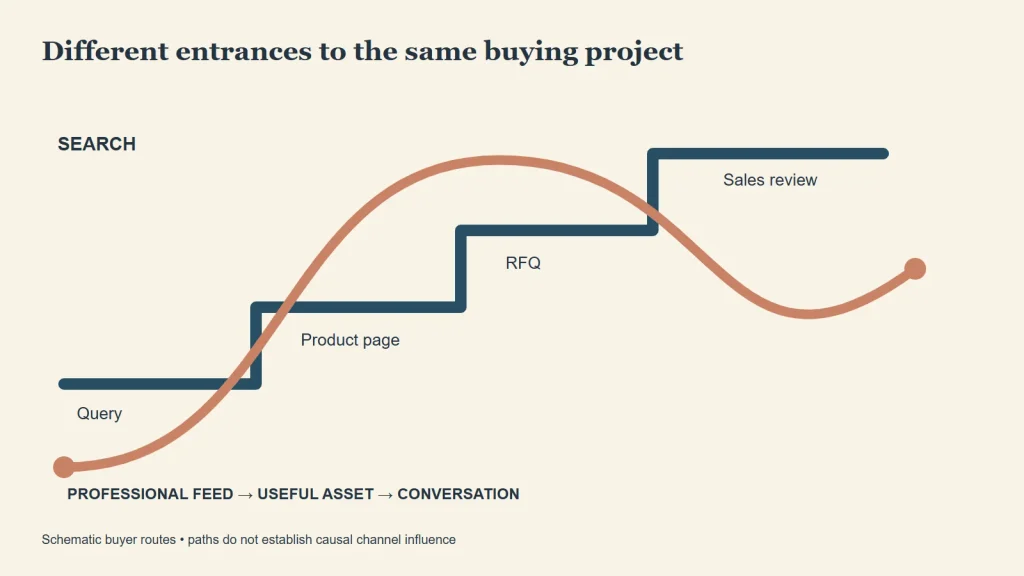
A LinkedIn campaign aimed at operations leaders may create awareness of a process problem. A later Google search by procurement may locate supplier terms or product specifications. The company should preserve those distinct tasks without claiming that every member of the buying group followed one observable sequence. Some interactions will remain outside the available measurement.
Prepare assets for the actual handoff. A technical evaluator may need a compatibility table; procurement may need delivery and quality documentation; finance may need a cost model with stated assumptions. If the campaign offers only a generic sales call, interested readers may have nothing useful to circulate internally. The right supporting material can make the first response easier for sales to continue.
Count commercial projects, not just contact records. Several people may be working on the same purchase. Use an approved account or opportunity record to connect people where the business can do so reliably. Keep the original contact and source history available, but report unique commercial projects at the appropriate stage. A multi-contact buying group should not inflate the pipeline simply because a campaign reached more than one person.
Put a common commercial denominator underneath both platforms
Define an accepted lead before launch. For a fictional industrial supplier, it might mean a real organization in a serviceable country, an application within capability, and an agreed next step with sales. A LinkedIn document download and a Google quote request can remain distinct intermediate actions, while both ultimately feed the same acceptance rule.
Keep project identity separate from contact identity. An engineer who downloads a guide and a procurement colleague who later requests a quote may belong to one buying project. The CRM should preserve both interactions without automatically claiming two opportunities. This is particularly important when one channel reaches the buying group and another receives the final inquiry.
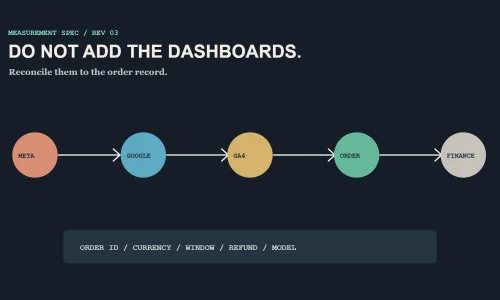
Report the funnel in layers: spend, clicks or visits where comparable, unique inquiries, accepted projects, quotes, and revenue when mature. Record source and offer at intake. Sales should apply short reason codes to rejected or pending records so the campaign team can distinguish weak targeting from an unreviewed queue.
Set a common evaluation window while acknowledging different timing. A guide downloaded this week may lead to a conversation later than an explicit supplier query. Review comparable intake cohorts rather than dividing this month’s spend by revenue from projects created last year. A same-month report can be operationally useful and still be insufficient for a final return judgment.
Compare the cost of operating each channel, too
Media CPC is only one input. A Search program needs query research, exclusions, relevant pages, event checks, and sales feedback. A LinkedIn program may require a substantive asset, professional audience review, creative production, form or page management, and follow-up appropriate to an educational offer. Both require competent operation; the work differs.
Ask the internal team what it can supply on time. If engineering can approve a detailed application note but the website cannot support a useful inquiry page, that constraint affects the sequence. If the company has strong product pages but no one to produce or review an educational asset, a focused Search test may be easier to operate initially. Ease of operation is a practical planning factor, not proof of superior long-term return.
Price the client work that stays in-house. A provider’s retainer may exclude translation, page implementation, CRM routing, and production. Another proposal may include some of those tasks. Compare the total operating envelope for the same period and make the dependencies visible. Otherwise the channel with the smaller media bill may turn out to require a larger unsupported workload.
Keep reusable work separate from test-specific work. A corrected product page or approved specification library may benefit several channels after the initial project. A paid asset license with a short usage period may not. This distinction helps finance understand setup costs without pretending they either repeat forever or have unlimited future value.
| Operating input | Google Ads test | LinkedIn Ads test |
|---|---|---|
| Demand or audience work | Query themes, exclusions, and search intent review | Professional roles, account context, and audience assumptions |
| Message asset | Ad variations matched to a relevant page | Educational or commercial asset with a clear next step |
| Measurement handoff | Search terms, event checks, and sales-stage feedback | Audience response, form or page events, and sales-stage feedback |
| Capacity question | Can the team maintain query and page reviews? | Can the team produce, approve, and refresh the asset? |
Use the table as a scoping prompt, not a promise that either channel will cost less. Record which inputs the company supplies, which the provider supplies, and which remain unpriced before setting the comparison budget.
The small test: two hypotheses, one sales definition
Write one hypothesis for each channel. For Search: “Buyers searching these application and supplier terms will find this page useful enough to submit a relevant inquiry.” For LinkedIn: “Professionals with these roles in this industry will exchange contact details for this application note and some will accept a relevant sales conversation.” Each statement identifies a different buyer action.
Use a defined product, country set, offer, page, authorized budget, and review point for each arm. Keep a record of where the arms differ intentionally. Identical creative is not a fair requirement when the channels serve different tasks, but identical commercial acceptance rules are a useful discipline.
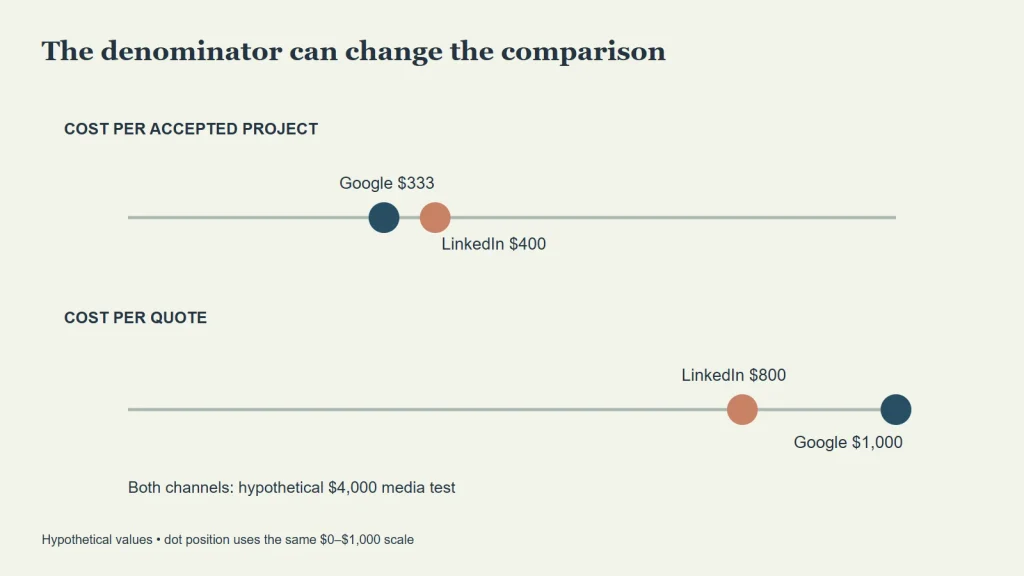
The graphic uses invented test values only to show how the channel ranking can change when the team measures accepted projects instead of quotes. It is not Marketboo or client performance data.
A token budget in each account can make the plan look balanced and teach the team almost nothing. Start with the better-supported test if neither can produce a useful sample. If neither arm can generate enough relevant observations, start with the better-supported hypothesis and document why. A sequential test has limitations because market conditions can change; describe those limitations rather than calling it a randomized experiment.
Decide what will stop or interrupt the test. Broken forms, unsupported claims, and unowned inquiries need repair. A sparse but relevant sample may justify more time. Consistently irrelevant traffic may justify a narrower query map or audience. A budget meeting becomes easier when those responses were agreed before results arrived.
A market expansion can reverse the first-channel choice
Consider a fictional supplier with familiar product terminology in Country A and a poorly understood category in Country B. In A, buyers already search for the relevant specification and the company has a matching page. In B, potential users describe the operational problem but do not consistently name the solution. The first commercial task may therefore be different even though the product is unchanged.
The company tests Search capture in A and a professionally targeted educational offer in B. It does not call the resulting difference a pure platform experiment: country, demand, language, and offer also differ. The useful result is a decision about each market’s next step, not a universal declaration that one platform beats the other.
Before expanding either test, a fluent reviewer checks terminology and sales coverage. Job titles can vary by market, and literal translations can miss the buying function. Search terms can also carry local meanings that do not match the supplier’s internal vocabulary. A local review is a commercial safeguard, not simply a copyediting task.
If the business later wants a stronger channel comparison, it can design one within a more comparable market and product context. Document which variables remain different and what the sample can support. A carefully limited conclusion is more useful than a broad claim built from unmatched tests.
The Google evidence is real; a LinkedIn comparison is not in this case file
A supplied Marketboo summary for robotic arms and automation components reports a Google Ads campaign across Europe and North America. For July 1–September 28, 2026, the source lists about RMB 35,600 in spend, 5,092 clicks, 139.69 conversions, and roughly RMB 255 per recorded conversion. The campaign description names product models, applications, and supplier or manufacturer terms. The case material separately reports 80+ monthly effective inquiries across advertising, email, and phone, without allocating those inquiries to Google Ads.
There is no LinkedIn campaign result in the supplied record. So a fair article cannot put a LinkedIn CPL beside RMB 255, calculate a winner, or imply that the same buying group was reached on both channels. The case can support a narrower comparison question: Google Search captured recorded interactions around product and procurement queries; what would a LinkedIn test need to prove before it earns budget?
For LinkedIn, write a role-and-offer hypothesis—for example, a specified engineering role in a named industry receiving an application note. Record the audience settings, eligible market estimate, asset, media spend, unique leads, and sales acceptance. For Search, preserve the actual query group, landing page, and configured conversion. Keep a common downstream definition of an accepted project, but do not pretend that a Search conversion and a LinkedIn document request are identical events.
The 80+ multi-channel monthly figure is a reason to ask for source records, not a basis for declaring either channel successful. Before comparison, reconcile duplicate contacts, determine the qualification rule, and map each inquiry to a project where possible. If the sample is small or the sales cycle is still open, label the result provisional.
In this case, Google has a reported account snapshot and LinkedIn has no comparable evidence. That is an honest starting point. It gives the business a test design without manufacturing channel data or treating a professional network’s advertised scale as a count of reachable industrial decision-makers.
Build different messages from the same product evidence
For Search, start with the query’s promised answer. A supplier ad may emphasize a documented capability, application, and inquiry route. The page should deliver that information immediately. Avoid cramming every company benefit into an ad that needs to answer a specific product question.
For LinkedIn, start with a work problem a defined role recognizes. A technical comparison can show a meaningful trade-off, not just a product beauty shot. Let the asset establish why the company has something useful to contribute. Product claims still require the same evidence and approvals as they do in Search.
The two routes can share a fact library: specifications, verified case materials, process photographs with permission, delivery boundaries, and frequently asked technical questions. The format and request change with the buyer task. This reduces production duplication while preserving the reason each channel exists.
Use destination pages deliberately. A guide page should explain what the reader receives and what follow-up to expect. A quote page should make the commercial inquiry easy. Sending both audiences to a generic homepage makes it harder to learn whether the channel, the offer, or the page caused weak response.
When a combined plan is justified
A coordinated plan makes sense when each channel has an assigned role and the business can measure the handoff. LinkedIn might introduce an application approach to a defined professional group while Search captures later product and supplier research. That is a hypothesis about complementary tasks, not proof that one exposure caused the later search.
Keep the reporting views distinct. Platform-attributed conversions help operators understand their own account. Analytics offers a cross-channel view under stated attribution rules. The CRM records unique projects and sales stages. Finance verifies realized revenue and costs. None should be silently substituted for the others.
Consistent campaign parameters help identify website traffic. Google’s URL-builder documentation explains the tagging fields. Use controlled naming, test redirects, and keep personal information out of URLs. Native lead forms also need their own stable identifiers and integration checks; UTMs alone do not solve that path.
Marketboo’s global paid-media service page can be reviewed with these channel-role and measurement questions in mind. Teams evaluating a smaller internal program can compare hands-on coaching with outsourced operation based on the work their own staff can sustain.
Three objections to settle in the budget meeting
“Search must win because the buyer is already looking.” Existing intent is valuable only when the query is relevant, the supplier can serve the need, and the page supports the next step. Search can also collect research or mismatched requests. Ask for actual search-term and sales evidence rather than relying on the label.
“LinkedIn must win because it is a professional network.” Professional context can help select an audience, but it does not make the offer useful or guarantee buying authority. Ask whether the role, industry, geography, and asset form a coherent hypothesis. Then test whether the resulting contacts meet the sales definition.
“We should run both so we do not miss anything.” A portfolio is reasonable when the company can operate both roles. It can also dilute a small budget, overwhelm creative supply, and delay learning. Authorize the number of tests the team can support with relevant assets, reliable routing, and a meaningful review.
These objections should end in written decisions: the first buyer task, the chosen offer, the evidence still missing, the authorized spend, and the review date. That record gives the next meeting a starting point better than another debate about platform preference.
What a useful channel brief contains
Use a one-page brief for each authorized test. Name the product, market, buyer role or query group, offer, destination, primary action, acceptance rule, media ceiling, production work, sales owner, and expected reporting lag. Add the reason this channel was chosen and the observation that would make the team reconsider it.
Attach the supporting facts rather than burying assumptions in a forecast. A search-volume export needs its country and period. A professional-audience estimate needs its account settings and retrieval date. A margin model needs its revenue and cost definitions. An impressive number without scope is not a stronger planning input than a clearly identified unknown.
At the review, compare the observed record with the original hypothesis. Did the intended people respond? Was the offer understood? Did sales accept the projects? Was the sample large and mature enough for a cost judgment? Answering these questions can support a concrete next action even when a final channel winner is not yet justified.
The review packet / Show a decision, not a collection of screenshots
For each channel, prepare the same first page: market and offer, authorized and actual media, unique inquiries, accepted projects, pending records, and the next proposed action. Then attach the channel-specific diagnostic. Search needs actual query and page evidence; LinkedIn needs audience and asset evidence. Shared commercial measures and different operational detail can coexist.
Add a short maturity note. State when the intake period closed, how many records sales has reviewed, and which project stages remain provisional. If the company has a ninety-day engineering cycle, a thirty-day media report can still assess collection, relevance, and follow-up, but it cannot honestly settle lifetime return. Review the mature cohorts separately.
Where a channel produces no accepted project, report the spend and zero accepted projects. Do not display an invented finite acquisition cost or hide the row. Ask whether the lack of output reflects a broken path, an unsuitable offer, irrelevant reach, insufficient opportunity, or a sample too small to judge. Those explanations lead to different next actions.
Finish with a bounded request. The owner might approve another defined period, a better application page, a narrower audience, a revised offer, or a pause. Name the evidence supporting that request and the information the next review should resolve. This makes a comparison useful even before enough revenue exists to declare a channel winner.
The choice to make this quarter
Select Google Search when the immediate opportunity is a known, relevant query and the site can answer it. Select LinkedIn when the buying group can be described professionally and the offer gives that group a reason to engage before searching. Use both when the tasks are complementary and the team has the budget, assets, and sales process to support them.
If neither condition is met, fund the missing prerequisite: market language research, a better product page, an educational asset, or reliable lead follow-up. An additional platform does not repair an unclear offer. The best first-channel decision is the one that yields an interpretable test and leaves the business with evidence for its next move.For LinkedIn Ads vs Google Ads for B2B lead generation, make the first choice by buyer task, evidence, and team capacity rather than a generic platform preference.
How to Choose Between LinkedIn Ads and Google Ads
- Define the buyer and commercial action. Describe the company, roles, problem, and next step the campaign should support. Agree with sales on how an accepted inquiry or opportunity will be recorded.
- Check for existing search demand. Review relevant search themes and queries for the product or problem. Separate commercial questions from research, employment, or other intent that does not fit the offer.
- Decide whether role-based reach matters. List the professional roles or account characteristics that matter to the sale. Check current LinkedIn advertising documentation to confirm what targeting options are available for the intended plan.
- Write a channel hypothesis. State why the buyer’s next task may fit Google search, LinkedIn advertising, or a combination. Record what evidence would support or weaken that hypothesis.
- Match the offer to the buyer’s task. Create a landing page and next step that answer the question behind the channel choice. Use product and company claims that the business can substantiate.
- Set comparable test and tracking rules. Define the test period, approved spend, campaign tags, conversion actions, CRM stages, and reporting owner. Keep the comparison consistent and note differences in attribution.
- Review accepted opportunities, not only platform totals. Compare recorded inquiry quality, sales progression, spend, and operating effort using the same definitions. Decide whether to continue, revise, combine, or stop based on the evidence and the team’s capacity.
FAQ
Are LinkedIn Ads or Google Ads usually cheaper for B2B leads?
There is no reliable universal answer. Costs depend on the market, audience, offer, competition, setup, and how the business defines a lead; compare cost alongside lead acceptance and sales progression.
When might Google Ads be a better first test?
It may be a useful hypothesis when relevant buyers already search for the product, application, or problem. First confirm that the queries and landing pages match the company’s actual offer.
When might LinkedIn Ads be a better first test?
It may be worth testing when reaching specific professional roles or account types is central to the plan. Verify the current targeting options and whether the offer gives that audience a useful next step.
Can a B2B company use LinkedIn and Google Ads together?
Yes, if the company can support both plans with distinct roles, budgets, landing experiences, and measurement. A combined plan is not automatically better; it should answer a clear business question.
How should a business compare lead quality across the two channels?
Use the same sales-stage definitions and reporting period, then reconcile inquiries with CRM outcomes. Account for differences in attribution and avoid treating platform-reported conversions as directly interchangeable.
How much budget should a B2B company allocate to each platform?
Set channel limits from the approved test budget, expected operating workload, and the evidence the team needs. Do not use generic percentages as a forecast or substitute for reviewing results.
What if the business has few relevant Google searches?
Recheck query language and buyer intent, then consider whether professional-audience outreach or another channel better fits the buyer’s task. Low observed search demand alone does not prove that a channel will generate qualified leads.