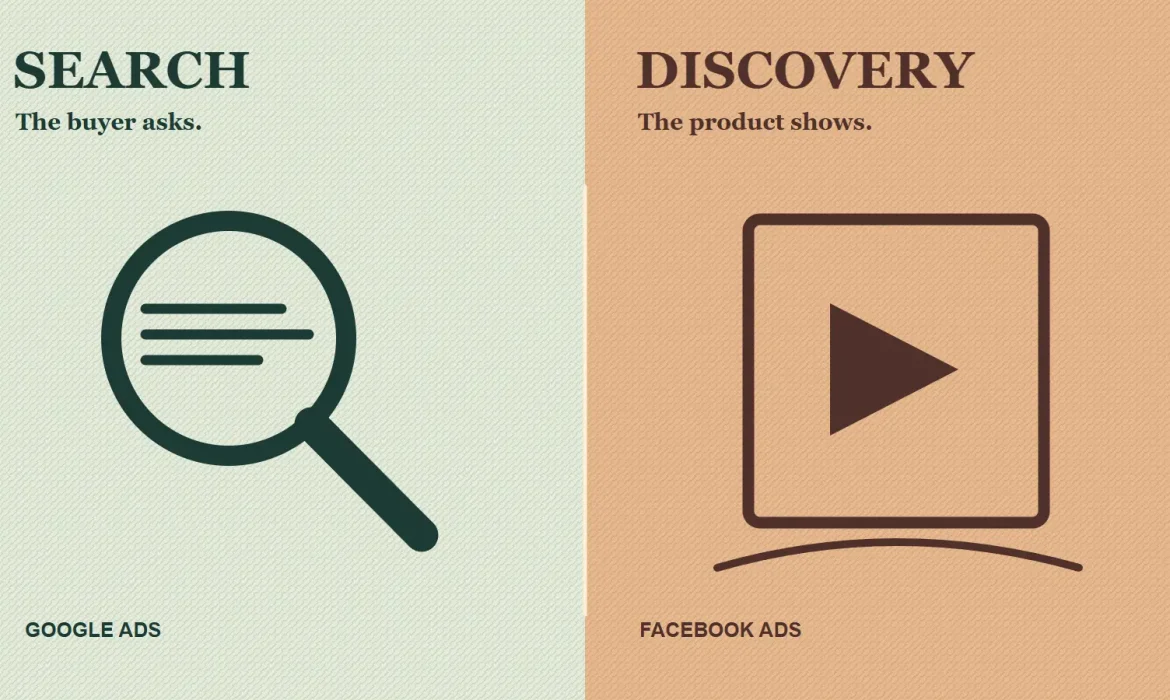
Google Ads vs Facebook Ads for export lead generation is a choice about the buyer’s next step. Search can respond to an expressed product or supplier need. Facebook can introduce an application, demonstrate a capability, or support a return visit. Start with the channel your offer and team can support, then compare tests using the same definition of a sales-accepted inquiry.
Compare the buyer journeys
- Start with the question the buyer is asking
- Google Ads vs Facebook Ads for export lead generation: compare the buyer task
- What Facebook Ads can help an exporter introduce
- Compare the channels on a shared business outcome
- Put the audience statistic in the right column
- Make the first-channel decision with a readiness check
- Use one focused hypothesis per channel
- A worked example for a custom industrial supplier
- When a blended plan makes sense
- Channel comparison worksheet
- How to choose between Google Ads and Facebook Ads for export leads
- Translate the same product into different channel messages
- Avoid the trap of comparing platform dashboards alone
- What to do when neither channel is ready
- Channel-selection questions
- Pick the channel that answers today’s business question
Start with the question the buyer is asking
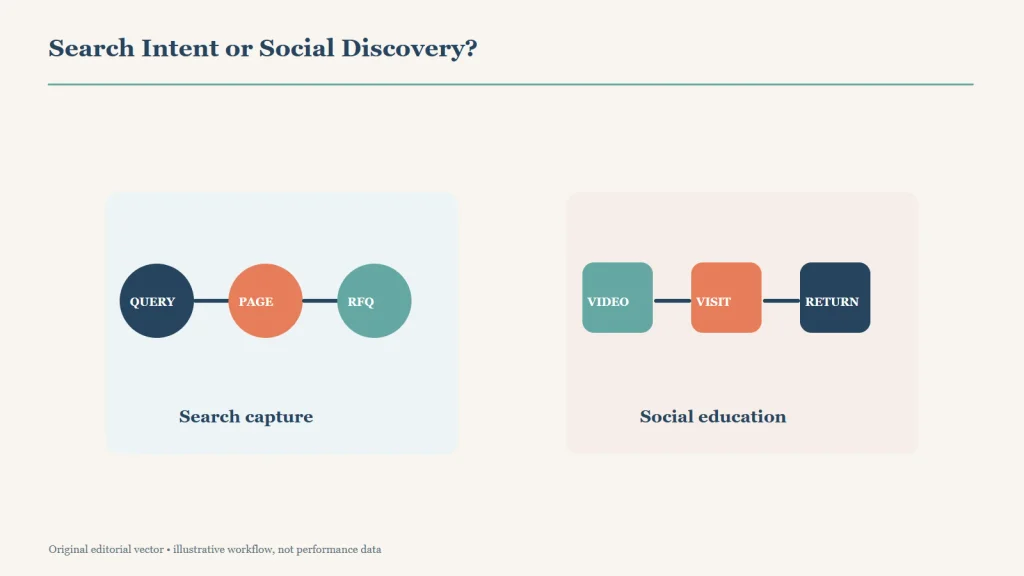
A buyer typing a product specification into Google has already taken an observable action: searching. The advertiser can respond to that query with a relevant page, a clear capability statement, and a next step. A person encountering a Facebook post or ad may not be searching for a supplier at that moment. A social ad can show the product in context, introduce a problem, or make a technical capability more familiar. These paths can support one another, but they begin from different signals.
That difference is useful when deciding where to begin. If sales already hears prospects use consistent product or application terms, a search test may provide a direct way to capture the demand. If the product is difficult to understand until someone sees it operate, social creative may help explain it. A manufacturer can also use both: search to reach specification-driven buyers and social content to support education or return visits. The mix depends on the buyer and the company’s assets, not on a platform slogan.
Map a few real buyer journeys before committing money. Ask sales what prospects search for, which questions arise before a quote, and what evidence builds confidence. Review RFQs, distributor emails, product page searches, and recorded objections where the company is permitted to use them. The result should be a list of buyer questions and the best response for each, not a list of channels copied from a competitor.
Google Ads vs Facebook Ads for export lead generation: compare the buyer task
Google Ads can be a strong first test when demand is already expressed in queries the company understands. Search terms may name a product, material, application, manufacturer type, replacement part, or sourcing need. The advertiser can organize those terms around intent and direct each group to a matching page. This allows a clear test of whether buyers in a target market search for the offer and whether the company can convert that interest into an inquiry.
Search also has limits. A low-volume industrial category may not provide enough opportunities for a short test. Broad queries can attract students, job seekers, consumer repair traffic, or people looking for a different product. The account needs search-term review, negatives, location and language settings, and pages that satisfy the query. Search is not automatically “high intent” just because a person entered a phrase. Intent must be evaluated in the words, context, and downstream behavior.
For a manufacturer, search campaigns may require content depth. A buyer looking for a custom component wants to know whether the company can meet a specification and how to request a quote. A generic homepage may not answer that. If no product or application page exists, the first investment could be website work rather than media. A search click has value only if the destination helps the buyer assess fit.
What Facebook Ads can help an exporter introduce
Facebook advertising can place a product or offer in front of audiences based on the campaign’s targeting and delivery options. It may help a business explain an application, show a production process, promote a technical resource, or revisit people who have already engaged, subject to current platform availability and data rules. For products that benefit from a visual demonstration, the format may help answer a question before the buyer begins a search.
Social campaigns also require a creative operating system. The team needs a few different concepts, accurate claims, appropriate usage rights, and a plan for comments and inquiries. A single static image repeated indefinitely is unlikely to answer every buyer question. If a business has no one to develop or approve content, the channel can stall even when the audience idea is sound. In B2B, the content should speak to a real buying or engineering concern instead of presenting generic brand claims.
Lead forms and messages require a qualification and response process. A submitted form may not equal a valid export inquiry. Ask sales to define country, product, and buyer fit. Route the record into a monitored system, capture campaign context, and return useful status information to marketing. Before collecting or transferring business contact data, have qualified privacy and technical owners review the process for the markets involved. A platform’s form option does not replace the company’s data responsibilities.
| Decision factor | Google Ads may be a better first test when… | Facebook may be a better first test when… |
|---|---|---|
| Buyer signal | Product or supplier queries are known | Buyers need an introduction or demonstration |
| Offer | A clear search-to-page match exists | A story or use case can explain value |
| Content | Technical pages are ready | Creative can be produced and reviewed regularly |
| Sales process | Search inquiries can be routed | Social leads can be qualified and followed up |
| Measurement | Query and conversion tracking are testable | Form, message, or site actions reach the CRM |
| Main risk | Irrelevant queries and thin pages | Low-intent volume and slow response |
Compare the channels on a shared business outcome
Do not compare Google’s platform CPL with Facebook’s platform CPL if they use different conversion definitions or attribution windows. Decide what counts as an inquiry, a sales-accepted lead, an opportunity, and a quote. Use the same rule for both channels and disclose the review period. A business can still report platform metrics, but they should remain labeled as platform-specific views rather than being presented as perfectly comparable facts.
For B2B export sales, lead quality depends on more than an email address. Check whether the company can serve the country, whether the request concerns a supported product, whether the contact is part of a business buying process, and whether sales has taken the next action. A lead from an early-stage engineer may be useful even if it is not ready for a quote, but it should be counted in the appropriate stage. Define these stages before a test begins so the team does not change the rules to favor one channel.
Track the path at more than one layer. UTM parameters and analytics can help identify visits; ad platforms can report their conversions; a CRM can record contact and sales status; finance can report realized revenue. These systems may not agree. Keep the records separate, identify the reason for differences where possible, and avoid adding platform-attributed totals together. If the business lacks a robust attribution model, an honest directional comparison is still more useful than an unsupported claim of exact channel contribution.
Put the audience statistic in the right column
A channel comparison becomes misleading when a large audience is treated as evidence of buyer intent. Pew Research Center reports that 70% of U.S. adults use Facebook in its October 2026 fact sheet, based on fieldwork from January 30 to June 18, 2026. That is useful context for a U.S. market discussion. It does not say how many of those adults are industrial buyers or whether an exporter can reach them economically.
| Evidence | Supports this conclusion | Does not establish |
|---|---|---|
| Pew: 70% of U.S. adults use Facebook | The platform has broad adult adoption in the U.S. | Your reachable B2B audience or likely CPL |
| Relevant product queries in your own research | Buyers express a recognizable search need | Every paid click will be a qualified RFQ |
| Accepted inquiries linked to a consistent cohort | A test produced records that meet your sales definition | Incremental revenue without further analysis |
An exporter should place each observation in the right column of the decision. A visual product may need education even when search demand exists. A technical supplier may start with search while developing better demonstrations for social. Neither choice is invalidated by the size of the other platform.
Ask a narrower question for the next investment: can this channel, offer, and destination help this buyer take a useful next step? That question produces a testable plan and a more persuasive business case than declaring one platform the winner for every export company.
Make the first-channel decision with a readiness check
Start with search readiness. Can the company name the query themes, serve the markets, and direct each theme to a useful page? Is there enough product language to distinguish procurement intent from general research? Can the account and form be tested? If the answer is yes, Google may be a practical first experiment. If the answer is no, the team may need sales research, page development, or a smaller keyword investigation before spending.
Then assess social readiness. Can the team explain the product visually or through a strong educational angle? Can it produce multiple original concepts and get technical approval? Does the sales team have a process for social leads and comments? Can it measure the next step without over-collecting information? If these elements are present, Facebook may be a useful first experiment. If creative capacity is the constraint, a small content-production sprint may be more valuable than buying impressions immediately.
The readiness check should identify a first test, not declare a permanent channel winner. Markets change, search demand can saturate, and social creative can reveal new language that becomes useful for search pages. The decision should be revisited when the business enters another country, adds a product, changes its sales model, or collects enough downstream data to identify a different bottleneck.
Use one focused hypothesis per channel
A useful Google hypothesis might be: “Buyers in the U.S. search for our custom enclosure capability using application terms, and a dedicated engineering page will produce qualified RFQs.” The test requires a query group, a page, a form, and a lead-acceptance rule. If search volume is low, the team should decide whether to extend the observation period or test another related intent. It should not broaden the keywords indiscriminately simply to create more clicks.
A useful Facebook hypothesis might be: “A short process demonstration will help distributor prospects understand the company’s custom finishing capability and begin a conversation.” The test needs an original video or image concept, an offer or next action, a form or landing page, and a CRM route. If engagement rises but qualified inquiries do not, inspect the message and follow-up before claiming success. The platform signal may show interest; the sales system shows whether that interest fits the business.
Keep the test clean enough to interpret. If the company changes the target country, offer, creative, page, and form simultaneously, it cannot identify which change mattered. Some real-world adjustments are necessary, but date and document them. Use a modest number of comparisons that the budget can support. A well-designed small test may produce an inconclusive result; that is preferable to a confident conclusion from an uncontrolled setup.
A worked example for a custom industrial supplier
Suppose a fictional exporter makes custom conveyor components and sells to integrators and plant operators. Sales receives detailed RFQs from people who already know the application, but prospective buyers often ask for an example showing how the component fits into a production line. The company has a technical product page and a sales engineer who can review inquiries, but it has limited video production time. These facts suggest that the two channels could have complementary jobs.
The team starts with Google Search for a narrow group of custom-component and application terms. It tracks form submissions, then asks sales to accept or reject each inquiry using a written rule. Separately, it creates one short process demonstration for Facebook that explains the application and directs interested viewers to the same technical page. The social test has a separate budget and creative record. Both campaigns use the same CRM lead stages, while platform-reported conversions remain distinct.
After an agreed observation period, the search campaign may show fewer interactions but a higher share of accepted quote requests, while the Facebook test may generate more visits and some earlier-stage conversations. The company should not automatically choose one winner. It may keep search for active demand and improve the social nurture path, or stop social if the creative workload exceeds the value of the learning. The numbers and outcomes here are fictional; the example illustrates a decision, not a performance promise.
When a blended plan makes sense
A blended plan is useful when each channel has a distinct role and the company can measure the handoff. Google might capture a known product search; Facebook might support educational content or re-engagement. The same buyer may encounter both. Coordinate naming, landing pages, audiences, budgets, and exclusions so the channels do not work against one another. If retargeting is used, verify current platform rules and the company’s consent requirements for the relevant data.
Do not blend channels just to create the appearance of an integrated strategy. If the business cannot determine which campaign is spending, which offer a buyer saw, or who follows up, the system is too opaque. Begin with an operating map that shows campaign purpose, audience or query, page, conversion, CRM owner, and reporting source. A small business may have only one person managing the process; the map can still be simple and valuable.
Budget should follow the role and evidence. Search may be constrained by available queries; Facebook may be constrained by creative throughput or lead follow-up. Give each channel a ceiling and a condition for expansion. When the business changes the allocation, record whether it is responding to search demand, lead quality, creative learnings, inventory, or sales capacity. This makes the channel mix understandable to leadership and easier to revise later.
Channel comparison worksheet
Use a shared worksheet to evaluate the first test. Give each factor a qualitative rating and attach evidence. Do not turn the total into a pseudo-scientific score unless the team has a reason for the weights. The point is to surface a decisive gap. For example, a high search-readiness rating with no useful landing page is a contradiction that should be resolved. Likewise, a strong social audience hypothesis without creative capacity is not a complete plan.
| Question | Google evidence | Facebook evidence | Current owner |
|---|---|---|---|
| Are buyer questions and terms documented? | Sales and marketing | ||
| Is a relevant destination page ready? | Web or product marketing | ||
| Can the creative be approved and produced? | Creative and product | ||
| Can inquiries be qualified and followed up? | Sales operations | ||
| Are conversion and source records testable? | Analytics or CRM | ||
| Is the market serviceable and supported? | Operations and sales |
If evidence is missing, assign a research task instead of guessing. A short interview with sales, a page audit, or a tracking test may answer the question better than launching two underprepared campaigns. Keep a version of the worksheet so the team can see what changed after each market test. The exercise becomes useful when it informs a decision, not when it produces a decorative matrix.
How to choose between Google Ads and Facebook Ads for export leads
Buyer evidence
- Collect buyer questions, RFQs, search language, and sales objections.
- Identify whether buyers are actively searching or need product education.
- Confirm country serviceability, sales coverage, and product-page readiness.
Channel readiness
- Check the team’s capacity for keyword management or creative production.
- Define one sales-accepted lead rule for both channel tests.
A shared decision
- Assign a focused hypothesis and separate budget to each channel role.
- Test tracking and CRM routing before paid delivery begins.
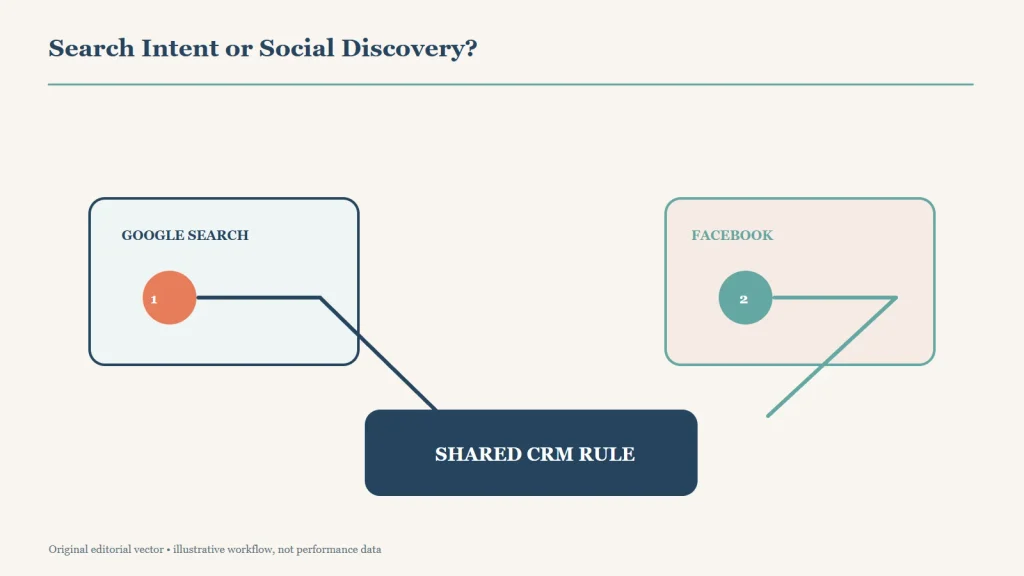
- Review downstream quality and attribution limits before choosing a next step.
Translate the same product into different channel messages
A product can be described differently without changing the underlying facts. A search ad may answer a query such as a material, dimension, application, or supplier requirement. A Facebook creative might show the manufacturing process or explain why a particular design choice matters. The destination should preserve the same approved product information while presenting the detail appropriate to each visitor. The company should avoid making one channel’s message more absolute than the other merely because the format is shorter.
Write a message map before production. For each buyer question, note the factual answer, evidence source, channel format, page section, and owner who approves it. If an ad says a component handles a specific operating condition, link that claim to current engineering documentation. If the company cannot substantiate a performance comparison, replace it with a concrete feature or process description. The message map makes the campaign easier to localize and reduces the risk that a translated version adds a promise the original did not make.
The map also helps identify what should not be advertised yet. A new product may lack a complete specification sheet or an approved image. A market may require a local contact or a different fulfillment statement. A buyer may need a distributor rather than a direct quote. Those gaps can guide the first operational task. It may be better to prepare a page or sales handoff than to launch ads that generate inquiries the company cannot answer confidently.
Avoid the trap of comparing platform dashboards alone
The two platforms may report different conversion counts because the user journey and measurement rules differ. One platform may see an ad interaction and later credit a conversion under its own attribution settings; another may record a different touchpoint. Analytics can use another attribution model, and the CRM may only record the lead’s first or latest source. None of these systems necessarily has a complete view of the customer’s entire buying committee or offline research.
Create a reconciliation note. State the dates, source systems, conversion actions, lookback rules that are known, currency, and deduplication method. Compare records at a safe and appropriate level. If the team cannot match platform events to CRM records, identify the technical or process gap. Do not force the numbers to agree by changing labels or deleting unmatched records. If the measurement is incomplete, say which conclusions remain unavailable.
Different platform roles may also mean different time-to-value. Search can capture a buyer near inquiry; social content may introduce a product to an earlier-stage prospect. If the company has a long sales cycle, consider whether the content path has a documented follow-up or return mechanism. A channel that creates interest but has no next step may appear weak in an immediate CPL comparison. That does not prove it is valuable; it means the business needs a suitable way to test the role it claims the channel plays.
What to do when neither channel is ready
Sometimes a company has neither a clear search map nor a repeatable creative process. In that case, the next move may be customer research, page development, a product demonstration, or sales-response setup. Paid traffic is not a substitute for these foundations. A small research sprint can collect the vocabulary sales hears, identify supportable claims, and determine which markets the company can serve. The team can then build a narrower and more useful campaign brief.
The business may also need to fix attribution before comparing. If forms fail to reach the CRM, the channel decision cannot be made from business outcomes. If sales does not record lead status, the team can compare form volume but must call lead quality unknown. If a product page has no specifications, clicks may leave without the evidence needed to inquire. These conditions should be listed as readiness gaps with owners and dates.
Readiness work is not wasted advertising spend; it is an investment in a test that can produce interpretable evidence. The company should still set boundaries on how much research or development is justified. If the opportunity is too small to support the work, the decision may be to pause market entry. A clear “not yet” protects the business from a campaign that cannot answer its own question.
Channel-selection questions
Is Google Ads better than Facebook Ads for exporters?
Neither is universally better. Google can capture active product or supplier searches; Facebook can support discovery, demonstration, or return visits. Choose according to demand, creative, page readiness, sales process, and measurement.
Which channel should a small exporter test first?
Test the channel that can answer the most important current question with the resources available. Existing search demand and a strong product page may favor Google; a visual product and capable creative process may favor Facebook.
Can Facebook generate B2B export leads?
It can be tested, but the business needs a relevant offer, accurate creative, useful qualification, CRM routing, and sales follow-up. Platform form volume alone does not establish lead quality.
Can I compare cost per lead between Google and Facebook?
Yes, if both use the same lead definition, market, period, currency, and downstream acceptance rule. Keep each platform’s attribution view separate and explain remaining differences.
Does Google Search always reach higher-intent buyers?
No. Search intent varies by query. Some searches are educational, irrelevant, or outside the company’s market. Review actual terms and connect them to page behavior and sales feedback.
Should both channels use the same landing page?
They can share a page if it meets both audiences’ needs, but the message and next step should match the ad. A search query may require technical detail while a social visitor needs more context first.
How long should I test each channel?
Set a period that fits search volume, budget, sales response, and lead maturation. Decide the review date and evidence threshold in advance. If the sample is too small, report the result as inconclusive.
Pick the channel that answers today’s business question
Google and Facebook can support different parts of an exporter’s customer journey. The right first move depends on what buyers already know, what the product needs explained, and what the company can measure and support. Define the outcome with sales, keep the test narrow, and make attribution limitations visible. Add a second channel when it has a clear complementary task—not simply because a competitor uses it.
For help planning international paid campaigns, review Marketboo’s global paid media services. If you want your team to learn the selection and measurement process while keeping account access, explore hands-on advertising coaching.