
The short answer: Enterprise SEO management and analytics require a shared operating system for decisions, implementation, and measurement across teams. Assign a business owner, define intake and approval routes, connect SEO recommendations to engineering and content workflows, and use a transparent prioritization method. Report search performance alongside implementation status, user impact, and limitations. Do not make SEO a collection of unowned audit tickets or rely on one central team to approve every detail. The right governance model gives local teams clear standards while letting accountable owners make changes efficiently and escalate material risks.
Enterprise SEO management and analytics need shared decisions
An enterprise SEO lead identifies an important issue: a page template emits conflicting canonical references after a product migration. The report has screenshots, affected URLs, and a recommended fix. Yet the ticket sits because no developer owns the template, product cannot confirm the intended URL, analytics has no baseline, and the release manager does not know whether the change qualifies for the next deployment.
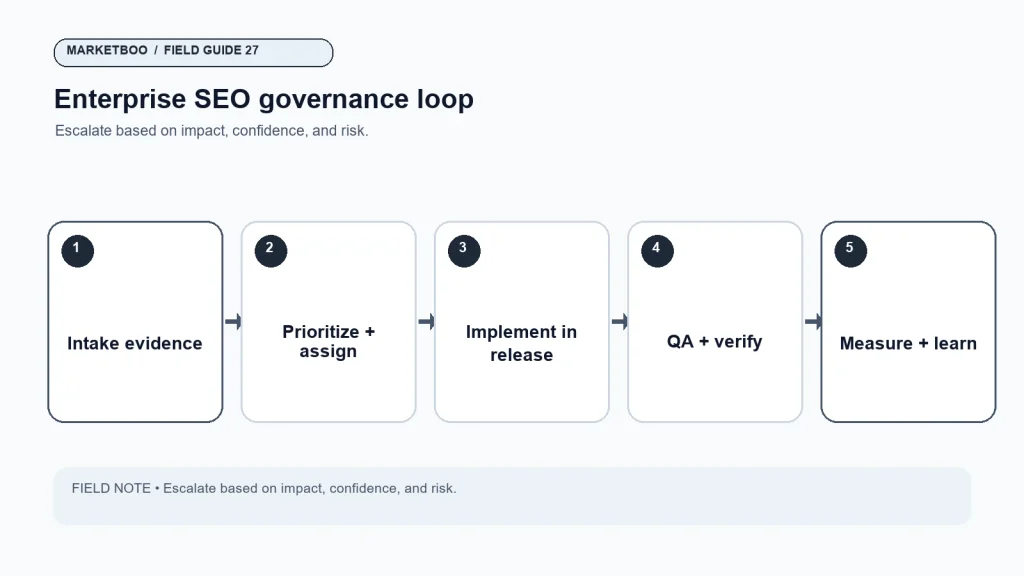
This kind of delay is rarely solved by another audit. The organization needs a workflow that connects diagnosis to decision, implementation, verification, and measurement. Enterprise SEO management and analytics is partly a technical discipline and partly a governance problem: the company must know who can decide, who can make the change, who tests it, and how the outcome is reviewed.
Define governance without centralizing every decision
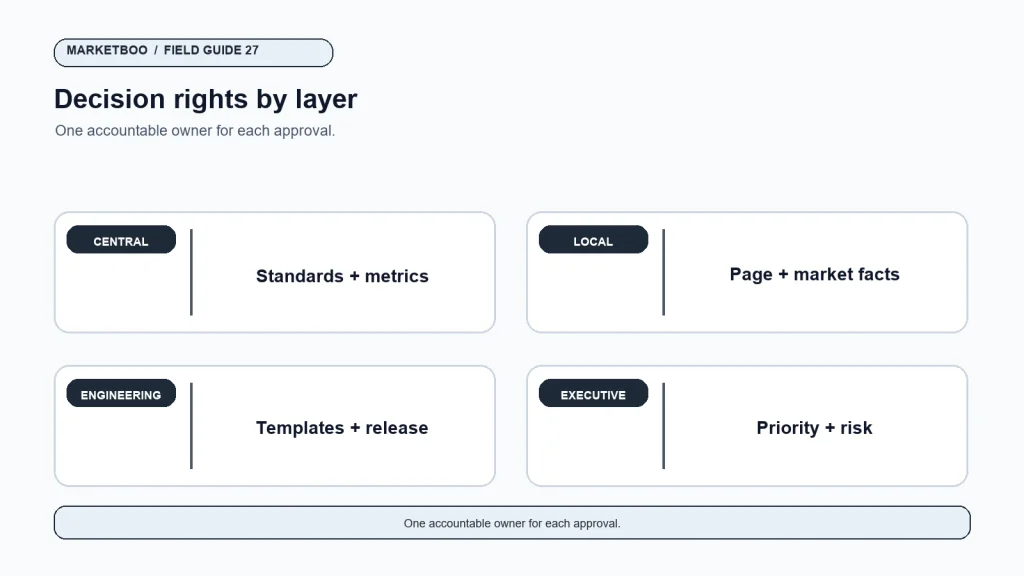
Governance is the set of roles, standards, and escalation paths that make work predictable. It should protect the site from inconsistent changes while allowing teams close to a product, region, or CMS to act. A central SEO team may own standards, measurement definitions, technical guidance, and high-risk reviews. Local teams may own page content, product details, publishing schedules, and region-specific evidence.
Write down the decisions that require central approval, those that need consultation, and those local owners can make. A page title edit for a campaign may not need the same route as a domain migration, template change, indexation control, or mass URL change. If every edit needs the same approval, high-risk decisions wait behind routine work. If nothing requires review, teams can create conflicting content and technical signals.
| Decision type | Typical decision owner | Consulted roles | Evidence to record |
|---|---|---|---|
| Page copy and product facts | Business/content owner | Product, legal, SEO | Source facts, audience, approval date |
| Template and internal link changes | Product or engineering owner | SEO, UX, accessibility | Requirements, test cases, release version |
| Redirect or URL migration | Technical release owner | SEO, content, analytics | Old/new map, rationale, test evidence |
| Canonical or indexation rules | Technical owner | SEO, platform, regional teams | Intended URL pattern and exceptions |
| International or regional changes | Regional business owner | SEO, localization, legal | Language/market rules and parity check |
| Measurement definitions | Analytics/RevOps owner | SEO, marketing, finance | Metric source, query, time frame, caveats |
Use a lightweight RACI or decision-rights map, but keep it readable. A responsibility chart does not resolve a disagreement unless someone is empowered to make the final call. Name a decision owner and escalation deadline for every cross-functional issue.
Build an SEO intake queue that engineering can use
SEO requests often arrive in several formats: audit exports, Slack messages, content briefs, analytics observations, and bug reports. Consolidate them into an intake form with the affected URL or template, observed behavior, evidence, user or business impact, recommended action, dependency, owner, and verification method. Do not send developers a list of terms like “fix crawlability” without a reproducible example.
Each ticket should state the desired behavior, not just a diagnosis. For a redirect issue, identify source URL, destination, expected status, and test. For a canonical issue, show affected template, rendered output, expected target, and exceptions. For a content issue, name the audience question, evidence source, and approval owner. Keep the implementation solution open when engineering may need to choose the safest technical approach.
The intake owner should deduplicate similar tickets and group template-level problems. Fifty URL examples may point to one shared template. Conversely, one URL may represent a severe high-value customer task. Triage by pattern and impact rather than ticket count.
Prioritize with transparent evidence
Enterprise teams need a way to compare items without creating a false precision score. Record impact, confidence, affected templates or URLs, effort, dependency, urgency, and reversibility. A fix affecting an active migration may be urgent even if estimated traffic is low. A broad content idea with uncertain value may be a test. A legal or security issue may require immediate escalation through the correct specialist route rather than a marketing priority queue.
Use categories such as release blocker, high-impact fix, planned improvement, experiment, and monitor. Define the criteria with engineering and business stakeholders. Do not use search volume as the only priority signal; not every important B2B page has large query volume, and a high-volume term may not match the business.
| Priority dimension | Question | Evidence |
|---|---|---|
| User impact | Can a user reach or understand the intended page? | Reproducible task, page, or error evidence |
| Search impact | Is crawling, indexing, rendering, or result presentation affected? | Crawl, Search Console, or rendered page data |
| Business value | Which product, market, or conversion path is involved? | Business owner and CRM or product context |
| Confidence | Is the diagnosis confirmed or still a hypothesis? | Test, sample, source, and known gaps |
| Reach | One page, a template, a region, or many URLs? | URL inventory and affected pattern |
| Effort/dependency | Who must implement and what must be decided? | Engineering estimate, dependency owner |
| Risk/reversibility | Can a change be safely tested and rolled back? | Release plan and recovery option |
Prioritization should be reviewed when new evidence arrives. A ticket’s position is not a promise that it will be implemented by a certain date. If the business chooses not to do the work, record that decision and the accepted risk.
Connect SEO recommendations to release workflows
SEO should be involved at the moments when decisions can still change: requirements, information architecture, template design, content review, QA, and release. Waiting until after deployment turns preventive checks into emergency fixes. Create a change checklist for high-impact releases that includes URLs, redirects, canonical rules, indexation, structured data, internal links, analytics events, page rendering, and rollback.
Not every content edit needs to wait for a central SEO meeting. Create standards and guardrails in the CMS: required title and description fields, content ownership, canonical defaults, accessible image text alternatives, and review routes for noindex or redirect decisions. Automate checks where appropriate, but keep a human owner for exceptions.
Use a release register for major migrations and template changes. Record scope, affected domains, staging URL, launch date, technical owner, SEO reviewer, test cases, go/no-go status, and post-release monitoring. When a release causes a search or analytics change, the register helps the team distinguish the timing and implementation from other market factors.
Build SEO checks into product requirements
Every new template or platform feature can create repeated outcomes across thousands of pages. Add SEO requirements when the product team defines the feature, not after the design is fixed. A requirements checklist might include crawlable links, stable URL behavior, canonical defaults, page titles, pagination, localized versions, indexation controls, analytics events, and accessible content fields. The exact list depends on the site and should be maintained by the responsible owners.
Create acceptance tests that can be repeated. For a new product template, verify a sample page, a page with variants, an unavailable product, and a localized version if the feature supports them. For a migration, test old-to-new paths, canonical targets, sitemap entries, internal links, structured data where relevant, and rendering. Record which environment and release version was tested. A checkbox without a sample URL and result is weak evidence.
Define an exception path for teams that cannot meet a standard. A product or regional group may have a legitimate reason to use a different URL pattern or content model. Require a named owner, rationale, risk note, and review date. This allows the organization to preserve deliberate flexibility without silently allowing one-off technical decisions to spread.
Protect measurement definitions from local drift
Large organizations may have different analytics properties, channel groupings, CRM stages, and reporting calendars. A central metric dictionary should define shared terms such as organic session, qualified lead, opportunity, sourced pipeline, and influenced pipeline. Local teams can add market-specific fields, but they should not redefine common terms without recording the difference.
| Metric governance field | Example decision |
|---|---|
| Canonical name | Organic-sourced opportunity |
| Source system | CRM opportunity and first-known-source field |
| Inclusion rule | First recorded acquisition source equals organic search |
| Exclusions | Duplicate opportunities, test records, existing customer renewals if outside scope |
| Currency and date | Finance-approved currency and opportunity-created date |
| Owner | RevOps data steward |
| Limitation | First recorded touch may not equal first actual exposure |
When data is incomplete, label the gap instead of patching it with a local spreadsheet formula that no one else can reproduce. A shared metric dictionary makes quarterly comparisons more reliable and helps new analysts understand why a chart differs from another team’s report.
Analytics that connect implementation to business outcomes
Enterprise SEO reporting should answer at least four questions: What changed in search? What work shipped? Which users or business paths may be affected? What should the team do next? Rankings and clicks alone cannot show whether engineering implemented the fix or whether qualified customers progressed.
Create a measurement dictionary with metric name, source, definition, query or filter, time zone, currency, segment, owner, and caveat. Search Console, web analytics, CRM, crawler data, and internal release logs measure different things. Avoid blending them into one metric without documenting how records are joined.
| Reporting layer | Example measures | Source | Decision it supports |
|---|---|---|---|
| Search visibility | Impressions, clicks, queries, pages | Search Console | Where search appearance changes |
| Site behavior | Organic sessions, events, landing paths | Web analytics | What visitors do after arrival |
| Business outcome | Qualified leads, opportunities, orders | CRM or commerce platform | Whether organic visits match the business goal |
| Technical status | Crawled URLs, errors, rendering findings | Crawler, logs, platform | Which technical patterns need investigation |
| Delivery | Ticket status, release date, affected template | Project system | Whether recommendations were implemented |
| Risk and quality | Redirect errors, indexation changes, content review | QA log and monitoring | Whether release conditions remain safe |
Use cohort comparisons for major changes where feasible. Compare the same page groups, market, date range, and definitions; annotate campaigns, seasonality, migrations, and product launches. If a company cannot connect a CRM opportunity with an organic session reliably, report separate aggregates and describe the gap.
A cadence that respects different work speeds
Weekly operational review can address blockers, ticket ownership, release dependencies, and urgent changes. Monthly performance review can compare search and business signals, confirm shipped work, and adjust priorities. Quarterly governance review can examine standards, CMS changes, markets, team responsibilities, and recurring failure patterns.
The cadence should not create meetings without decisions. For each meeting, keep a queue of decisions required, owner, due date, evidence, and consequence of delay. If stakeholders cannot attend, provide an asynchronous approval route for routine items and reserve live escalation for material risk.
Example monthly review agenda
- Confirm data coverage, periods, and any tracking changes.
- Review shipped work and unresolved release blockers.
- Examine search visibility and site behavior by page group or market.
- Compare qualified outcomes and CRM stages under the agreed rules.
- Identify significant changes and possible confounders.
- Choose the next few actions and name implementation owners.
- Record deferred work, accepted risk, and the evidence needed to revisit it.
Make ownership work across regions and brands
Multi-market organizations need a shared technical baseline and room for local knowledge. The central team can define templates, canonical behavior, analytics naming, sitemap controls, and minimum editorial standards. Regional teams can own language, product availability, local regulations, customer proof, and market-specific user tasks. The boundary should be explicit.
Do not assume that translated pages have equal content or intent. A local team should review terminology, claims, pricing, contact paths, and customer support availability. Hreflang and canonical decisions should be coordinated so the site does not present the wrong market page. When one region cannot supply content or proof, document the exception rather than shipping a placeholder as final.
Create a market owner list with language, region, content approver, technical contact, analytics segment, and escalation path. A release should identify which regions are affected and whether the change is global or local. This avoids a template fix in one market unexpectedly changing all language versions.
Treat technical SEO work as a product backlog
Enterprise SEO recommendations compete with security, product, platform, and compliance work. They need a clear description and acceptance test to earn engineering time. The SEO lead should present user impact, affected scale, evidence, and expected behavior. Engineering should estimate feasibility and risk. Product owners should explain business priorities. The final decision should be recorded so teams do not re-litigate the same request every quarter.
Use a two-way backlog. SEO can propose improvements; engineering can identify platform constraints and propose safer alternatives. Content teams can flag editorial workload. Analytics can identify gaps in measurement. A collaborative backlog gives each role a way to improve the plan and preserves the final decision.
Measure implementation quality as well as search outcomes. A ticket marked “done” should have a release version, test result, and owner. A deployment can be technically complete but fail the intended behavior. Keep retests and exceptions visible.
Reduce recurring failure patterns with enablement
If the same issues return after every audit, the organization may need a training or product change rather than another round of tickets. Repeated title problems may indicate that editors do not understand the CMS fields. Recurring redirect errors may indicate that release teams lack a URL-change checklist. Inconsistent analytics names may reflect a template that lets each team create events differently. Use a recurring-issue review to decide whether to fix a process, tool, standard, or skill gap.
Create role-specific guidance. Editors need a concise checklist for page purpose, title, heading, internal links, and source review. Developers need implementation notes, acceptance criteria, and test examples. Product managers need to know which requirements should be raised at design time. Analysts need the metric dictionary and query logic. Regional teams need local language and market responsibilities. Avoid one large SEO handbook that no role can apply in its daily work.
Run short enablement sessions around an actual release or recurring issue. A developer can walk through a canonical bug with the SEO lead. A content team can practice mapping a customer question to the correct page type. A regional team can review how local content and shared templates interact. Record the decision and update the relevant standard after the session.
| Repeated issue | Possible underlying cause | Enablement or system change |
|---|---|---|
| Missing or duplicate metadata | CMS fields unclear or not validated | Add field guidance and publish checks |
| Redirect chains after releases | URL changes lack an owner and test | Require redirect map and status test in release template |
| Pages not internally linked | Content workflow ends at publishing | Add link review and related-page owner |
| Unstable reporting totals | Teams use different filters or CRM stages | Version metric definitions and shared queries |
| Similar thin pages multiply | Brief process rewards volume | Add a consolidation and differentiation review |
| Staging pages become accessible | Release controls are disconnected from CMS | Add environment gate and launch test |
Governance should also have a feedback loop. Ask users whether standards are understandable, whether an approval takes too long, and which checks are automated or duplicative. Retire rules that no longer fit the platform. A standard should lower friction or risk; if teams work around it, the process may need redesign.
Plan for incidents and emergency changes
SEO governance is tested during a migration, outage, security event, or urgent product change. Establish an incident route with a technical incident owner, communications owner, SEO contact, and release decision maker. During an incident, customer safety, system availability, and accurate communication may take priority over routine search changes. The SEO role should provide relevant evidence without delaying critical operational action.
After the incident, record what happened, which URLs or templates were affected, what was changed, and how recovery was verified. Check crawl and indexing effects when appropriate, but do not make speculative edits while the cause is unknown. A short post-incident review can reveal that a monitoring alert, release check, or backup owner was missing.
Make the program sustainable for the people doing the work
Governance has a labor cost. The organization should estimate time for intake triage, reviews, implementation, QA, reporting, training, and regional coordination. If the same specialist is expected to review every release and every page, the process can become a bottleneck. Use standards, automation, templates, and delegated approvals to reserve specialist time for decisions with wider impact.
Track where requests wait: business definition, technical estimate, content review, legal approval, or release window. Use the delay pattern to improve the workflow instead of asking teams to work faster without changing dependencies. If a particular review routinely takes weeks, the organization may need a service-level agreement, a backup reviewer, or a narrower scope of approval.
Avoid using search-impact language to create urgency unsupported by evidence. Describe the actual customer or technical risk, how broad the affected pattern is, and what would confirm recovery. This builds credibility with engineering and incident teams and makes it easier for them to include SEO in future release planning.
How to create an enterprise SEO governance workflow
- Name the executive sponsor and SEO owner. Give the program authority to resolve priority conflicts and maintain standards.
- Map teams and decision rights. Identify who owns content, templates, releases, analytics, CRM, regions, and escalations.
- Create one intake route. Require URL or template, evidence, desired behavior, impact, dependency, and verification method.
- Deduplicate and classify work. Group shared template issues and separate urgent blockers, improvements, experiments, and monitoring.
- Prioritize transparently. Review impact, confidence, scale, effort, dependencies, risk, and reversibility without false precision.
- Connect to delivery systems. Create tickets with technical acceptance criteria and release links; assign an implementation owner.
- Add SEO gates to major changes. Include architecture, content, URL, canonical, indexation, analytics, QA, and rollback checks.
- Maintain a measurement dictionary. Define sources, filters, periods, time zones, segments, CRM stages, and limitations.
- Run operational and performance reviews. Use weekly or monthly forums only for decisions, blockers, and evidence-based action.
- Audit governance quarterly. Review recurring delays, exceptions, regional issues, quality failures, and standards that no longer fit.
Where outside support can help
An outside SEO partner can help audit a technical pattern, prioritize a backlog, design reporting definitions, or coach teams through cross-functional processes. The enterprise must still provide access, product owners, engineering capacity, and a decision path. Ask for specific deliverables, evidence, dependencies, and how recommendations will enter the company’s project system.
Marketboo describes SEO/GEO services for businesses that need organic search support. For a governance or analytics conversation, contact Marketboo with your CMS, site structure, release process, markets, and reporting constraints. Confirm the current scope and who owns implementation before starting.
Frequently asked questions
What is enterprise SEO management?
Enterprise SEO management is the system of people, standards, workflows, and measurement that helps a large or complex organization maintain search visibility across many pages, teams, markets, or platforms. It connects diagnosis to implementation, QA, and review.
Who should own enterprise SEO?
An SEO lead should coordinate standards and priorities, with an executive sponsor to resolve conflicts. Content, engineering, product, analytics, regional, and business owners should retain decisions that depend on their expertise. The organization should name one accountable owner for every major approval.
How should enterprises prioritize SEO tickets?
Compare user and business impact, confidence, affected scale, effort, dependency, risk, and reversibility. Group template-level issues and document accepted risks. Avoid relying on search volume or an opaque numeric score alone.
What should enterprise SEO analytics include?
Include search visibility, site behavior, qualified business outcomes, technical status, implementation delivery, and known risks. Define each metric’s source, filter, period, owner, and limitation. Keep Search Console, analytics, CRM, and crawler data distinct unless the join method is documented.
How do you get SEO changes into an engineering roadmap?
Use an intake route that describes evidence, desired behavior, impact, dependencies, and test criteria. Assign an engineering owner, connect the recommendation to the release system, and review the ticket at established planning points. Explain risk and business relevance instead of sending only an audit export.
How can enterprise SEO teams work across regions?
Set shared technical standards and analytics definitions, then assign local owners for language, product availability, claims, and user needs. Record which changes are global versus market-specific and coordinate URL, canonical, and hreflang behavior with technical owners.
How often should an enterprise review SEO governance?
Use operational reviews for active blockers, performance reviews for evidence and priorities, and periodic governance reviews for standards and ownership. The cadence should match release volume and team size; meetings should produce named decisions and actions.
Governance is successful when work ships and can be reviewed
Enterprise SEO management and analytics become useful when teams can move from observation to implementation without losing ownership or evidence. A clear intake form, decision map, release gate, and measurement dictionary reduce the cost of repeated debate. They also let the company see which recommendations were implemented, which were deferred, and what happened next.
Start with one high-value workflow, document the decisions, and test whether teams can use it. Expand the standards where they reduce real risk. Keep local knowledge close to the work and centralize only the decisions that need consistency. The result should be a process that helps the enterprise act, not another report waiting for an owner.