The short answer: B2B SEO vs PPC for lead generation is not a permanent either-or choice. Paid search can help a team test messaging or reach active queries under a defined budget, while SEO can build useful pages that attract relevant search visits over time. Which should receive priority depends on demand, sales-cycle length, page readiness, budget, competition, and the team’s ability to measure and follow up. If the company needs fast evidence, PPC may be a bounded test; if it has durable customer questions and can invest in content and technical work, SEO may support longer-term discovery. Many B2B programs use both, but each needs a distinct role and measurement rule.
B2B SEO vs PPC for lead generation is a timing decision
A marketing leader with a quarterly pipeline target may need inquiries in the near term. The same company may know that buyers research technical questions long before speaking with sales. PPC and SEO can address those different moments, but the choice is shaped by the pages, data, and people available today.
Paid search is media placement bought through an advertising platform, commonly in response to selected queries or audience conditions. Organic search visibility is earned through pages that search engines can discover, understand, and choose to show. PPC can be paused or adjusted by budget and campaign settings, but it does not guarantee a qualified lead. SEO may continue to attract visits after the initial work, but it takes investment and does not promise a ranking or fixed timeline.
The comparison below is not a claim that one channel always costs less or performs better. A real decision requires the company’s market, unit economics, customer demand, sales data, and capacity. Avoid comparisons based on a single generic cost-per-click or ranking statistic without context.
Compare the channels by operating reality
| Decision factor | B2B SEO | PPC / paid search | What the team should decide |
|---|---|---|---|
| Time horizon | Often supports ongoing discovery; progress depends on work and search behavior | Can begin serving after campaign setup and approval, subject to delivery | When is evidence needed and when does the sales outcome mature? |
| Budget control | Labor, content, development, tools, and agency work | Media spend plus management, creative, and landing-page work | What is the approved cap and which cost items are included? |
| Intent signal | Query and landing-page behavior can reveal information needs | Selected queries and campaign settings can focus reach | Are the queries commercial, informational, navigational, or mixed? |
| Asset requirement | Useful, accessible, crawlable pages and technical foundations | Relevant ads and a matching landing page | Can the company fulfill the promise on the page? |
| Learning | Content engagement, queries, conversions, CRM outcomes | Delivery and conversion observations under campaign settings | What single decision will the test answer? |
| Durability | A page may continue to be found, but needs maintenance | Traffic usually depends on continued budget and delivery | How should the company balance ongoing cost and maintenance? |
| Measurement | Search Console, analytics, CRM, and business outcomes | Ad platform, analytics, CRM, and business outcomes | Which attribution and qualification definitions will be used? |
When PPC can be the right first move
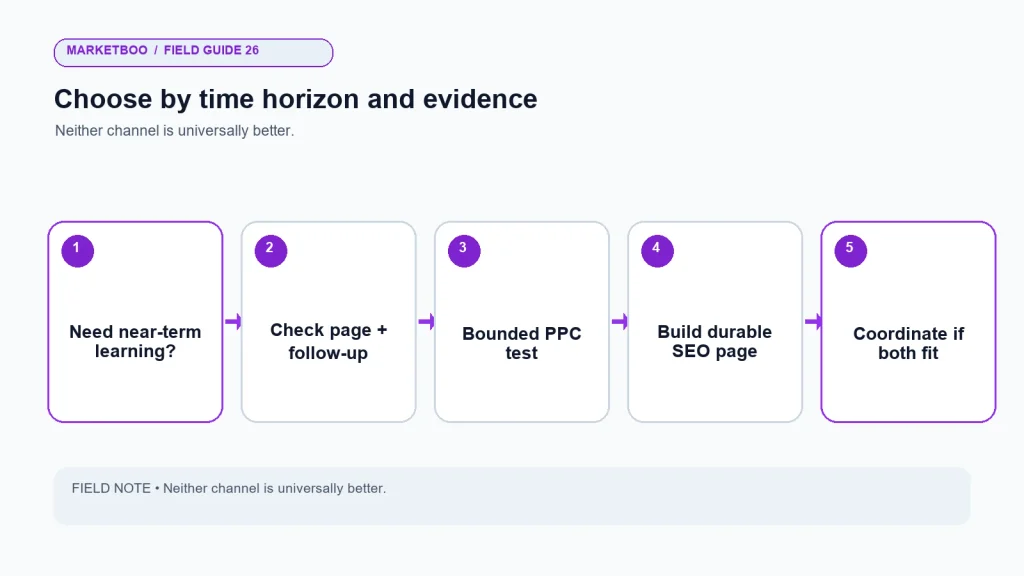
PPC can be useful when the company needs a bounded test around a specific buyer question, has a page that answers that question, and can observe what happens after the click. It can test whether a message attracts the intended audience or whether an offer receives qualified responses under controlled spend. It can also support a time-sensitive event or product launch when the business has the staff and page readiness to follow up.
Before the campaign, verify the query, location, ad promise, destination, conversion event, CRM routing, and spend cap. If a form leads to an unmonitored inbox, a paid campaign may create cost without a sales process. If the landing page lacks product detail, it may produce clicks but little useful evidence. The campaign should have a stopping condition and an owner who can respond to lead quality.
PPC can also reveal language customers use in search, but the team should avoid treating a small sample as a complete market study. Query volume may be limited, seasonality matters, and one campaign’s audience is not necessarily representative of every buyer. Treat the result as one source of evidence alongside sales and customer research.
When SEO can be the right first move
SEO may deserve priority when customers ask persistent questions that the company can answer with original, useful information and the business can invest in a page foundation. This may include product explanations, technical documentation, service pages, comparisons, implementation details, and location or industry-specific information. The work should support a real user task rather than publish pages solely to repeat keywords.
Before investing, inspect whether the site can be crawled and indexed, whether relevant pages already exist, what Search Console shows, and which content gaps are supported by customer or search evidence. Make sure the company can maintain product facts and page quality. SEO is not a free channel: strategy, writing, technical development, measurement, and review all require resources.
SEO can be a weak first choice if the company needs immediate short-term evidence and has not identified a buyer question or page owner. Publishing content without a distribution or conversion path can lead to low-value traffic. Similarly, ranking movement is not a substitute for lead quality.
Scenario tree: choose a starting point
If the sales team needs qualified conversations soon: Check whether the company has a high-intent query, a credible landing page, enough budget for a bounded test, and capacity to follow up. If yes, a PPC test may be appropriate. If no, repair the offer, page, or sales handoff first.
If prospects consistently research a topic before contacting sales: Identify the questions, confirm which ones the company can answer distinctively, and build or improve the relevant pages. SEO can be the foundation, while paid promotion may test distribution or query intent.
If the company does not know which message resonates: Use customer interviews and sales evidence first. Then run a small paid or content test with one clear hypothesis. Do not assume that a channel report alone will resolve positioning.
If the website has a conversion or measurement problem: Fix the path before scaling either channel. Confirm forms, product facts, events, CRM routing, and mobile experience.
If the company already has both channels: Align query and landing-page roles. Paid campaigns can cover selected terms while organic pages build broader answers; use shared conversion definitions and note when one page receives traffic from both.
| Current condition | Initial action | Why | Revisit when |
|---|---|---|---|
| Urgent demand, working page, follow-up capacity | Bounded PPC test | Can test a defined intent under a spend cap | Qualified outcome evidence matures |
| Durable research questions, content capacity | SEO page and technical plan | Builds a maintainable answer path | Search and CRM evidence changes |
| Unclear offer or buyer | Customer/sales research | Channel spend cannot resolve unclear product truth alone | Message hypothesis is specific |
| Broken form or event | Fix measurement and conversion path | Prevents paid and organic evidence from being misread | Test actions are recorded reliably |
| Existing paid and organic demand | Coordinate landing pages and reports | Reduces duplication and exposes coverage gaps | Query intent or result changes |
Compare cost without pretending the numbers are universal
Paid acquisition costs can include ad spend, management, creative, technical setup, landing-page changes, and internal follow-up. SEO costs can include agency or staff time, content, technical changes, tools, editorial review, and maintenance. Comparing PPC cost per lead with SEO cost per lead can be misleading if one source uses all media expense and the other excludes staff costs, or if qualification and attribution definitions differ.
Set a comparable unit. For example, compare cost per sales-accepted opportunity using the same time period and CRM stage. Include the same categories of labor and production or identify exclusions. For SEO, decide how to allocate one-time technical work. For PPC, include media fees and creative. If closed revenue has not matured, report leading indicators and open pipeline separately.
| Cost question | SEO accounting | PPC accounting |
|---|---|---|
| Direct cost | Content, technical, agency, tools, labor | Media spend, management, creative, tools, labor |
| Time allocation | One-time fixes and ongoing maintenance | Setup and ongoing optimization |
| Outcome stage | Organic inquiry, qualified lead, opportunity, closed result | Campaign lead, qualified lead, opportunity, closed result |
| Attribution | First known source or defined organic interaction | Platform-attributed and CRM source views |
| Fair comparison | Same qualification, currency, and cohort window | Same qualification, currency, and cohort window |
The company should not ask which channel is cheaper until it defines the outcome and cost base. A low-cost lead that never qualifies is not equivalent to a qualified opportunity. A page that attracts visitors over time is not equivalent to a one-week campaign. Compare what each channel is designed to do.
Choose based on query intent, not channel identity
The same keyword can include several intents. A search for a technical problem may come from a student, an engineer, a current customer, or a buyer evaluating vendors. Before allocating budget, inspect the result page and the query context. What content types appear? Are searchers asking for definitions, vendors, documentation, comparisons, or a direct solution? Then verify whether the business can meet that need.
For paid campaigns, use exact query and search-term evidence where available to identify irrelevant intent and adjust targeting or exclusions according to current platform controls. For SEO, build pages around the specific question and provide the depth the searcher needs. If a query is mainly navigational or support-oriented, the company may need to protect its own documentation or customer path rather than create a lead-generation page.
An intent review also helps avoid a common mismatch: an ad promises a demo but leads to a general corporate homepage; an SEO article answers a technical problem but pushes an unrelated sales form. The destination should continue the question and make the next step proportionate. B2B customers can require several visits before speaking with sales, so not every page should optimize for immediate form submission.
| Intent pattern | Paid approach to test | Organic approach to build | Qualification check |
|---|---|---|---|
| Problem-aware | Query-specific ad with educational landing page | Practical guide or diagnostic page | Does the visitor match the served market? |
| Solution-aware | Product or service ad with proof | Service/product page and use-case detail | Is the use case within product scope? |
| Comparison | Carefully qualified comparison creative | Accurate comparison page | Are claims sourced and current? |
| Brand/navigation | Protect access where justified | Clear brand, contact, and product paths | Are existing customers being routed correctly? |
| Technical support | Avoid broad lead-gen by default | Documentation or help resource | Is this a support need rather than a prospect? |
Agree on a decision threshold before launch
A channel test should have an economic and operational boundary. Set a spend cap or work budget the business can afford. Define what the team needs to observe before it will continue: a relevant audience response, qualified conversation, usable query pattern, or a measurable improvement to a page task. The threshold should be based on the business’s economics and available sample, not a copied industry rule.
Also define a stop condition. A test may stop because the page is broken, the product is unavailable, the audience is outside the service area, or the sales team cannot respond. A stop is not necessarily a channel failure. It may be a signal that the company needs a different offer or operational foundation.
If the test produces some interest but no closed contracts within the review period, do not automatically declare failure. Check sales-cycle age, lead fit, and progression. Conversely, do not keep a campaign alive indefinitely because the sales cycle is long. Set a review cadence and evidence requirement that the business can defend.
Include operational readiness in the threshold. The team should know who reviews search terms, who updates a page, who can approve a claim, and who follows up with an inquiry. A channel can look efficient in a dashboard while the business misses prospects because notifications go to the wrong person. Capacity and routing are part of the economics.
Coordinate channel ownership around the destination page
SEO and PPC often compete for ownership of the landing page. Marketing may want a short campaign page, while the SEO team wants useful content and stable internal links. Sales may need a form that captures qualification details. The page owner should resolve these needs based on the visitor’s task, not force one channel’s reporting preference onto the whole site.
Agree who can edit the page, how claims are reviewed, which events are measured, and how campaign variants are preserved. If paid traffic uses a temporary page, decide whether it should remain accessible, be consolidated, or be removed after the campaign. If an organic page is used in ads, check that its call to action and offer remain current. A shared change log can prevent one team from undoing another team’s test.
Review query and landing-page overlap quarterly or after a major product change. Search intent can shift, campaigns can add new offers, and a page that once served both channels may no longer fit either. A short cross-functional review is usually enough: state the query, the audience, the current page, the conversion path, and the evidence that will guide the next update.
How SEO and PPC can work together
The channels can share customer language, landing-page learning, and measurement definitions. PPC search terms and sales conversations can suggest which questions deserve a useful organic page. SEO pages can provide deeper explanations for paid traffic. The team can identify queries with paid visibility but weak organic coverage, or organic pages that need a stronger call to action. Such coordination should support the customer journey, not force identical content or count the same opportunity twice.
Use a joint query map. Label queries by intent, landing page, current organic visibility, paid coverage, business value, and owner. If the same query has both paid and organic listings, the team can choose whether both are needed based on the result page, conversion evidence, and risk. Do not assume the paid click would otherwise become an organic click; that requires separate evidence.
Align the destination experience. If the paid ad promises a solution for a specific problem, the page should provide that answer and allow visitors to explore related organic content. If SEO traffic lands on a guide, the next step should be appropriate to the reader’s stage rather than an aggressive sales form for every visitor.
Review the trade-offs with a quarterly decision brief
Channel allocation changes as product demand, budgets, competitors, sales capacity, and page readiness change. A quarterly decision brief helps leaders revisit the choice without treating the previous plan as permanent. It should summarize the target customer, the channel roles, the work completed, current evidence, forecast assumptions if any, and unresolved risks. Keep the summary short enough for a leadership review and link to the underlying definitions.
For SEO, show which pages were created or improved, what search and site signals changed, whether qualified interactions emerged, and which technical or content tasks remain. For PPC, show spend, selected query or audience context, landing-page behavior, lead qualification, and downstream pipeline. Present the channels side by side only after aligning dates, currency, and qualification. If one channel has a mature cohort and the other is still early, mark that difference.
Before requesting budget, state what additional investment would buy: more coverage, faster learning, new creative, a technical fix, a new page, or increased reach. Explain what evidence would justify stopping or reallocating. This keeps the budget conversation connected to a decision rather than a preference for one channel.
Decision memo outline
| Question | Brief response |
|---|---|
| What buyer need are we addressing? | |
| Which channel role is proposed? | |
| What is the evidence so far? | |
| What has not matured or cannot be attributed? | |
| What resource or change is requested? | |
| What is the review or stop condition? |
For a company with limited budget, the memo can recommend sequencing. For example, improve the landing page and tracking first, then run a bounded PPC test while creating an organic page around the same customer question. Sequencing reduces the chance that both channels send visitors to an unready destination. It also helps the company learn whether the primary barrier is acquisition or conversion.
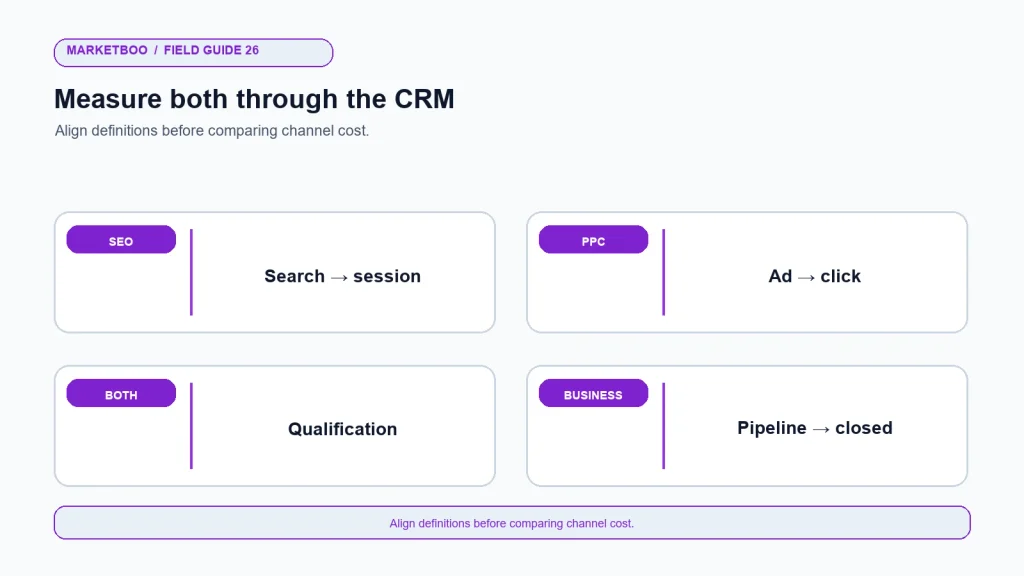
Measurement crosswalk
| Funnel question | SEO evidence | PPC evidence | Shared business record |
|---|---|---|---|
| Was the audience reached? | Search impressions and landing pages | Impressions and reach | Market, query or audience definition |
| Did someone engage? | Organic clicks, page activity | Clicks, site sessions | Analytics definitions and consent behavior |
| Was there an inquiry? | Organic conversion event | Campaign conversion event | CRM contact and source fields |
| Was the inquiry relevant? | Target-fit and sales disposition | Target-fit and sales disposition | Agreed qualification criteria |
| Did pipeline progress? | CRM stage under source/influence rule | CRM stage under source/influence rule | Opportunity owner and date |
| What was the financial outcome? | Closed revenue and contribution | Closed revenue and contribution | Finance-approved value and cost definitions |
Google Search Console and Google Analytics have different reporting definitions. Ad platforms also use their own attribution settings. Keep each source visible and describe how the data is combined. A well-labeled source view is more useful than a single chart that hides conflicting definitions.
How to choose between B2B SEO and PPC
- State the near-term business need. Decide whether the immediate goal is learning, demand, pipeline, or a durable answer path.
- Map the buyer’s query and stage. Use sales conversations, customer questions, and search evidence to identify intent.
- Check the landing page. Confirm that it is accurate, useful, mobile-ready, and connected to a working next step.
- Review measurement. Test events, CRM routing, qualification fields, attribution definitions, and data ownership.
- Assess budget and capacity. Include media, labor, production, technical work, and sales follow-up.
- Choose a channel role. Select SEO, PPC, or a defined combination based on the evidence and time horizon.
- Set a bounded test or work plan. Name the question, owner, dates, budget, deliverables, and stop/continue rule.
- Report comparable outcomes. Use the same currency, qualification criteria, sales stage, and cohort window.
- Explain uncertainty. Separate clicks, leads, sourced pipeline, influenced pipeline, and closed contribution.
- Reallocate based on evidence. Continue, revise, or stop; do not defend a channel simply because it was chosen first.
Questions to ask an agency
Ask a prospective provider which channel it recommends and what evidence supports the recommendation. Ask what the business must supply, how the landing page and CRM will be reviewed, what costs are excluded, and how the provider will report when results are inconclusive. For an integrated plan, ask how organic content and paid campaigns share landing pages and definitions without double-counting pipeline.
Marketboo offers SEO/GEO services and global paid media. If your team needs help comparing channel roles, contact Marketboo with the target market, sales cycle, current pages, tracking setup, and budget constraints. Request an explanation of assumptions and dependencies; a channel recommendation should not be presented as a result guarantee.
Frequently asked questions
Is SEO or PPC better for B2B lead generation?
Neither is universally better. PPC may fit a bounded test or near-term query demand when the page and follow-up are ready. SEO may fit persistent questions and a longer-term content investment. Choose based on sales cycle, budget, audience evidence, and team capacity.
Does PPC produce leads faster than SEO?
Paid campaigns can begin serving after setup and approval, but qualified outcomes still depend on delivery, page quality, audience fit, and sales response. SEO timelines vary and cannot be guaranteed. Compare the time to useful evidence, not only the time to a click.
Is SEO cheaper than PPC over time?
There is no universal cost comparison. SEO includes ongoing content, technical, labor, and maintenance costs; PPC includes media, management, creative, and follow-up costs. Compare the same qualified outcome and cost categories over a relevant period.
Should B2B companies run SEO and PPC together?
They can, when each channel has a clear role and the company can measure outcomes consistently. Shared query research, landing pages, and CRM definitions can improve coordination. Avoid assuming that a paid click would have become an organic click without additional evidence.
What should I measure for SEO versus PPC?
Measure visibility and engagement as leading signals, then compare inquiries, qualification, pipeline, closed revenue, and contribution under defined rules. Keep platform-attributed results distinct from CRM source and influence data.
Can PPC validate a keyword before I create SEO content?
PPC can provide an observed response to selected queries and messages under its campaign conditions. It does not establish all organic demand or guarantee that an SEO page will rank. Combine the evidence with customer questions, Search Console, sales feedback, and page intent.
Should I pause PPC when I rank organically?
Not automatically. Check the query, paid and organic result layouts, conversion evidence, cost, and business objective. Organic visibility does not guarantee the paid clicks will shift to your listing. Test changes with a documented measurement plan before pausing a campaign that supports a defined goal.
Choose a role for each channel
B2B SEO vs PPC for lead generation is a decision about customer intent, time horizon, evidence, cost, and team readiness. Use PPC when a bounded paid test or immediate query reach fits the problem. Use SEO when the business can produce useful answers for durable questions and maintain them. Use both when their roles complement each other and measurement can distinguish their contribution.
Start with the page and the sales path. A campaign cannot repair an unclear offer, and a strong page cannot compensate for missing follow-up. Name the customer question, define the business outcome, and select the smallest channel plan that can produce useful evidence. Then change the plan as the company learns.