
A useful Google Ads budget for SaaS starts with the customer economics the company can support, then works backward through the clicks and sales stages needed to reach that outcome. Instead of asking for one universal monthly spend, model a market, conversion path, qualified-demo definition, close rate, and payback limit. The result should be a range of scenarios with visible assumptions—not an industry average or a forecast. This guide shows how to build the model, connect it to Google Ads and CRM data, and decide what to test before expanding spend.

SaaS budget conversations often get stuck between teams. Marketing asks for enough money to generate data. Finance asks what revenue it buys. Sales asks why recent leads were not qualified. Google Ads reports conversions, while the CRM has a different count. A useful answer is rarely a single CPC benchmark. It is a small, auditable model that explains how money becomes clicks, clicks become conversations, conversations become opportunities, and what the company can pay for a customer without putting cash flow or margins at risk.
The word “budget” also hides several decisions. There is the media limit for a campaign, the average daily budget entered in Google Ads, the cost of running the program, and the fully loaded acquisition cost finance uses to evaluate growth. These figures are related but not interchangeable. Name each one, state the period and market, and show which costs are included. That discipline makes a small test easier to approve and a larger program easier to control.
What a Google Ads budget for SaaS can and cannot tell you
A budget model estimates the possible output of a defined set of assumptions. It can show the click volume implied by an assumed cost per click, the number of forms implied by a landing-page rate, and the expected qualified demos or customers implied by later-stage rates. It can also show how the economics change when an assumption moves. It cannot guarantee that the platform will deliver those clicks, that the visitors will fit the product, or that sales will close the resulting opportunities.
Search costs and conversion rates are not fixed properties of “SaaS.” A cybersecurity platform selling to enterprise IT, a lightweight scheduling tool for small businesses, and a developer API with a self-serve motion face different searches, competition, sales cycles, and product economics. One company can see different results by country, language, brand awareness, query type, landing page, season, and campaign settings. A benchmark without these conditions may be interesting but not useful for planning.
Use this worksheet to define the unit of analysis before calculating.
| Decision item | Definition to record | Why it matters |
|---|---|---|
| Market and language | Country or region, currency, language, service availability | Demand and commercial eligibility vary by market |
| Campaign scope | Brand, category, competitor, use case, or another search group | Campaign families can have different intent and cost |
| Media period | Planned monthly amount and campaign dates | Prevents a partial month from being compared with a full period |
| Primary conversion | Booked demo, attended demo, trial, or another action | A raw form event is not automatically a business result |
| Qualification rule | Company fit, role, use case, geography, or agreed criteria | Aligns marketing and sales definitions |
| Sales outcome | Sales accepted, opportunity, closed-won, or revenue | Connects early events to later results |
| Cost boundary | Media only or fully loaded with labor, fees, tools, and onboarding | Makes CAC comparisons honest |
| Economic constraint | Gross-margin payback, allowable CAC, or finance rule | Gives the test a decision boundary |
A company can begin with incomplete data if it labels it. Mark each input as observed, estimated from a comparable campaign, or planning assumption. Add a source, sample size, period, and owner. Decide when the estimate must be replaced with observed data. This prevents a convenient number from quietly becoming a reported fact.
Work backward from the economics
Start with the acquisition cost the business can reasonably support. For a subscription company, that decision may involve gross margin, retention, payback, expansion revenue, cash collection, and the mix of monthly and annual contracts. Finance should supply these definitions. A generic rule about how much SaaS companies “should” spend cannot replace the company’s own customer economics.
A simplified media-only customer acquisition cost is:
Media-only CAC = paid media spend ÷ customers attributed to that spend
The formula is simple, but the denominator needs a definition. Are customers counted when a contract is signed, when payment clears, or after activation? Is the attribution window long enough for the sales cycle? Are brand searches included? Are repeat signups removed? A precise calculation with an ambiguous denominator is still misleading.
A fully loaded CAC is a separate measure:
Fully loaded CAC = attributable acquisition costs ÷ new customers acquired
The numerator may include media, agency or contractor fees, staff time, software, creative production, sales development costs, and onboarding if finance includes them in acquisition. There is no universally correct boundary for every decision, but there must be a consistent one. Compare like with like across channels and periods. Showing media-only CAC beside fully loaded CAC can help distinguish channel efficiency from total acquisition economics.
Payback is another constraint, but teams need to agree on what it measures. A simplified gross-profit payback estimate is:
Payback months = fully loaded CAC ÷ monthly gross profit per customer
For annual contracts, finance may model cash collection and gross profit over time rather than divide a contract value by twelve. For usage-based products, usage can change after signup. For businesses with onboarding services, implementation costs and time-to-value can materially affect first-year economics. A simple formula should expose these questions, not erase them.
Google Ads budget controls affect media spending. Google explains average daily budget behavior and monthly spending limits for most campaigns; verify its current documentation before translating a monthly plan into campaign settings.[1] A platform budget mechanism does not establish the value of a demo or prove that the resulting customers are profitable.
Build a funnel from one commercial path
A SaaS account may have several conversion routes. A self-serve visitor could start a trial without talking to sales. A large prospect might request a demo. A partner may ask for a technical review. Model one route at a time so high-volume, low-intent actions do not make a sales-assisted path look healthier than it is.
Let:
- B = monthly media budget
- C = average cost per click for the campaign group being modeled
- L = share of paid clicks becoming a recorded first-step lead or signup
- Q = share of first-step conversions meeting the demo qualification rule
- S = share of qualified demos that are attended
- W = share of attended demos becoming customers
Then:
- Clicks = B ÷ C
- First-step conversions = clicks × L
- Qualified demos = first-step conversions × Q
- Attended demos = qualified demos × S
- Expected customers = attended demos × W
- Media cost per qualified demo = B ÷ qualified demos
- Media-only CAC = B ÷ expected customers
Every rate should refer to a real event, a cohort, a date range, and a system of record. If one report counts booked meetings and another counts meetings held, do not combine them as though they described the same stage. If product analytics counts workspace creation and the CRM counts sales opportunities, retain both and label the distinction.
A budget worksheet is easier to audit if it records metric, value, unit, source, observation window, confidence, owner, and review date. “Demo qualification rate = 40%” is incomplete. A more useful entry says “sales-qualified meetings divided by all demo requests, based on new paid-search cohorts from July through September; CRM owner: RevOps; confidence: medium.” The reviewer can then decide whether the rate is comparable to a proposed campaign.
Worked example: arithmetic only, not a benchmark
The following values are arbitrary and show only how the calculation works. They do not describe Marketboo, a typical SaaS company, or an expected result. Assume a one-month media budget of $12,000, an $8 average CPC, a 4% click-to-form rate, 40% of form submissions meeting the agreed demo qualification rule, a 65% show rate, and a 20% close rate from attended demos.
| Funnel stage | Formula using example assumptions | Illustrative output |
|---|---|---|
| Media budget | Assumption | $12,000 |
| Paid clicks | $12,000 ÷ $8 | 1,500 |
| Form submissions | 1,500 × 4% | 60 |
| Qualified demos | 60 × 40% | 24 |
| Attended demos | 24 × 65% | 15.6 expected, about 16 |
| Expected customers | 15.6 × 20% | 3.12 expected, about 3 |
| Cost per qualified demo | $12,000 ÷ 24 | $500 media cost |
| Media-only CAC | $12,000 ÷ 3.12 | About $3,846 |
Expected values can be fractional even when real customers are not. Keep unrounded values in calculations and round only for presentation. If a test produces 60 forms but only two qualified demos, the observed result matters more than a model that expected 24. The difference is a reason to investigate the assumptions and the path, not to hide the observed data.
The example shows why cost per lead alone is not enough to approve spend. A lead could be outside the supported market, a student doing research, an existing customer, a competitor, or a business whose use case the product does not serve. A paid channel may appear efficient at the form stage while creating work sales cannot use. A higher cost per lead may be acceptable if it creates more qualified conversations and better customer economics. The company needs to define which tradeoff it can support.
Use scenarios to show uncertainty
A scenario model is useful when it makes uncertainty visible. Create low, working, and high cases from the company’s own evidence. The low case should not be a scare number; the high case should not be a sales target disguised as math. For each case, answer: what must be true for this outcome to occur, and what evidence would cause us to revise it?
One clear method is to hold budget, CPC, and early conversion constant, then vary a single uncertain rate. Using the same hypothetical inputs above, keep $12,000 spend, $8 CPC, a 4% form rate, 65% show rate, and 20% win rate. Vary only the share of form leads that qualify:
| Qualification assumption | Qualified demos | Media cost per qualified demo | Expected customers | Media-only CAC |
|---|---|---|---|---|
| 25% of form leads qualify | 15 | $800 | 1.95 | About $6,154 |
| 40% qualify | 24 | $500 | 3.12 | About $3,846 |
| 55% qualify | 33 | About $364 | 4.29 | About $2,797 |
These percentages are arbitrary assumptions for sensitivity analysis, not market data or probability estimates. If the company has no historical qualification rate, run a capped test and state how much evidence is needed to update the estimate. A small sample can expose obvious mismatch, but it may not estimate a future rate precisely.
Sensitivity analysis often shows that CPC is not the largest lever. If high-intent clicks land on a weak page, page clarity may matter more than bids. If volume is strong but qualification is poor, investigate search terms, ad promise, form, qualification rule, and product fit. If demos are qualified but attendance is low, booking and follow-up may be the constraint. If accepted opportunities rarely close, investigate pricing, competition, onboarding, or sales execution instead of automatically blaming the ad account.
Separate campaign families before averaging their results
Brand, nonbrand category, competitor, and use-case campaigns serve different roles. Brand activity may capture existing demand; nonbrand activity may seek new buyers; competitor activity may attract comparison shoppers; and use-case searches may reach people who know a problem but not a category. Each group may need separate landing pages and different tests. Blending them can make a paid acquisition program look more effective because brand demand is included.
If the business has established brand recognition, report brand and nonbrand outcomes separately. Ask whether paid brand activity adds value beyond organic brand visibility, while respecting legal and competitive constraints. Attribution can help organize observed touchpoints but does not automatically prove that every credited conversion was caused by an ad. If incremental impact is the decision, design an appropriate experiment or holdout with measurement support.
Do not make the structure so fragmented that groups have too little data or require constant manual attention. Separate when the team needs to protect budget, evaluate a distinct offer, route to a different page, target a different market, or measure a different outcome. If two groups would lead to the same message, page, audience, and decision, splitting them may add maintenance without useful control.
Before launch, verify that each targeted country or region can be served. Search opportunity does not mean the company has a sales team, support coverage, legal ability, currency, or onboarding capacity there. Check language and terminology with people familiar with the market. Translation by itself does not establish demand or product fit.
Connect campaign data with qualified outcomes
A conversion setup for SaaS needs more than one “lead” event. Document the trigger, deduplication rule, owner, source of truth, and correction process for each key stage. A booked meeting may be cancelled; a user may submit a form twice; a trial may be opened by an existing customer; a business email may appear after an initial personal address. Decide how these cases are represented before campaign data reaches finance.
Google documents offline conversion imports and enhanced conversions for leads as ways to connect eligible CRM outcomes to ad interactions, subject to technical setup and policy requirements.[2][3] These tools can help close the gap between the website form and a later sales stage. They do not fix inconsistent CRM statuses, erase privacy obligations, or eliminate attribution uncertainty. Have analytics, RevOps, and privacy owners review the design before sending customer data.
A practical data path is:
- A person clicks an eligible ad and lands on a tagged page.
- Analytics and Ads tags record the permitted interaction and defined web conversion.
- A form or product event creates or updates a CRM record under the agreed deduplication rule.
- Sales reviews the record and assigns a consistent status and reason.
- RevOps and analytics reconcile eligible outcomes with campaign data.
- Marketing reviews results by cohort and adjusts query coverage, message, landing page, or spend.
Do not send every CRM status back as if it were equally valuable. Select a small number of decision-grade outcomes. A company may keep many events for reporting while using only one reliable action for bidding. The right event depends on volume, delay, reliability, and the commercial model.
Decide what evidence is enough to change the budget
There is no universal number of clicks that proves a SaaS campaign works. The evidence needed depends on the conversion rate, variation, sales-cycle length, business risk, and the decision. A tracking test needs less data than an expansion into a new country. Separate the questions “Can the tracking work?”, “Are the queries relevant?”, “Are the unit economics attractive?”, and “Can sales absorb more demand?”
Use decision gates rather than a magic threshold:
- Instrumentation: Are clicks, sessions, forms, and CRM records reconciled?
- Relevance: Do search terms and lead details match the intended product, buyer, and geography?
- Experience: Does the landing page deliver the ad’s promise and offer a useful next step?
- Quality: Are qualified-demo rules applied consistently by sales?
- Economics: Is the mature cost per qualified outcome within the company’s stated tolerance?
- Capacity: Can sales and customer success respond without damaging service quality?
A failed early gate can make later calculations meaningless. If the conversion event fires when someone clicks the button even if the form fails, the conversion rate is not a valid input. If sales updates statuses inconsistently, the qualification rate may reflect workflow rather than buyer quality. Fix measurement defects before drawing a budget conclusion.
A pilot budget should also leave room for learning. The company might reserve a portion for validated campaigns and a smaller portion for experiments, but the split should reflect cash tolerance and the cost of delay. Do not turn an illustrative allocation into a rule. Label the experiment budget, its learning goal, review date, and stop condition.
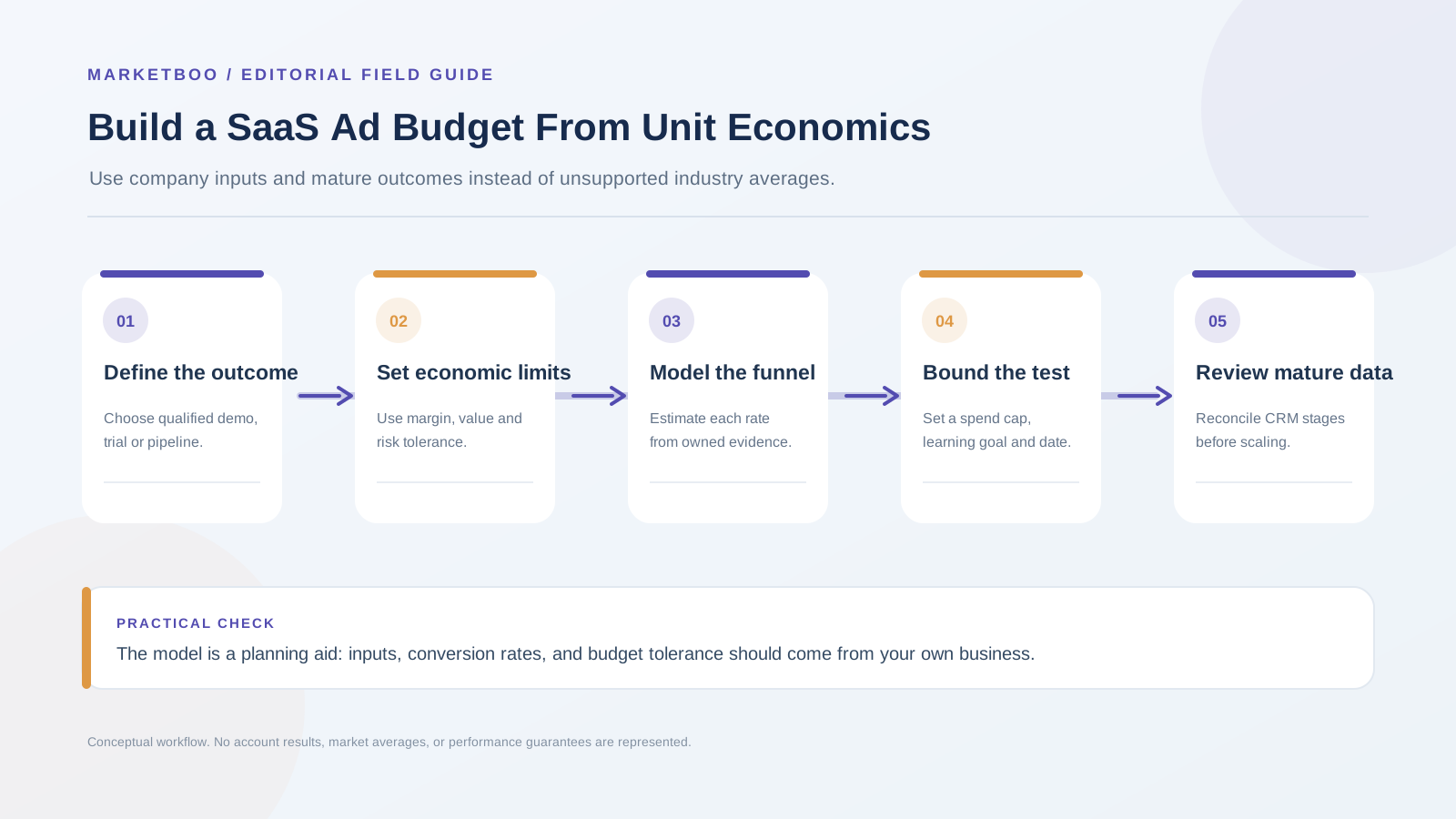
How to build a SaaS Google Ads budget plan
- Choose the decision. State whether the plan seeks a pilot, a new market, a campaign expansion, or a steady-state budget. Set a review date.
- Select one commercial path. Separate trial, demo, and other conversion motions. Record the product and market under consideration.
- Set the economic boundary. Ask finance for the relevant gross-margin, payback, retention, and cost definitions. State whether the ceiling is media-only or fully loaded.
- Define the funnel events. Align marketing, sales, and RevOps on booked, attended, qualified, accepted, opportunity, and customer statuses as needed.
- Collect dated inputs. Use recent account and CRM cohorts where comparable. Record the source, sample, period, and confidence for CPC, landing conversion, qualification, show, close, and deal-value assumptions.
- Build the calculation chain. Calculate clicks, each funnel stage, cost per qualified demo, and acquisition cost without rounding intermediate values.
- Run sensitivities. Change a few uncertain assumptions and show how each one changes the decision. Explain why each range is plausible.
- Check query, page, and operational fit. Confirm market coverage, ad promise, page proof, forms, privacy review, and sales response capacity.
- Approve evidence gates. Set the pilot limit, tracking checks, quality criteria, and conditions for continuing, revising, or pausing.
- Update from mature cohorts. Reconcile spend and CRM outcomes after the relevant sales stages have time to mature. Replace assumptions with observations and preserve the earlier model for comparison.
Finance owns economic definitions; RevOps owns CRM stage integrity; marketing owns campaign and page hypotheses; sales owns lead feedback; analytics owns measurement; product and customer success clarify fit, activation, and retention. One person in a startup may hold several roles, but the responsibilities still need to be explicit.
Common budgeting mistakes
Treating CPC as the answer
A low CPC is not efficient if the query attracts research traffic that cannot become a customer. A high CPC is not necessarily wasteful if the buyer intent and sales economics support it. CPC describes the measured account and period; it does not reveal incremental value or lead quality.
Combining all conversions into one number
If the account combines trial starts, demo requests, webinar registrations, and existing customer logins, the total cannot answer whether demand generation is working. Keep events distinct and choose a primary goal deliberately.
Extrapolating from a tiny sample
A few conversions can create an unstable rate. Show counts and periods alongside percentages. Avoid presenting a precise cost per customer from a sample with one or two wins without stating the uncertainty and sales-cycle risk.
Counting pipeline before it is qualified
A demo request is not an opportunity, and an opportunity amount is not closed revenue. Report each stage under its definition. Include cancellation, disqualification, no-show, and maturity where relevant.
Ignoring sales capacity
A model may assume that sales can follow up quickly and close the same share as lead volume rises. If the team is already at capacity, added leads can slow response and weaken conversion. Budgeting includes operational readiness, not only auction cost.
Scaling before the landing page earns trust
Software buyers often need to verify integrations, security, implementation, limitations, use cases, and who the product serves. A generic page can leave the visitor unsure and force sales to answer basic questions. Align the destination with the query and offer an honest next step.
Confusing attribution with incrementality
A platform can claim credit under its attribution rules while some conversions might have happened through another channel or without the ad. Attribution helps organize evidence; it does not prove causal lift. If incrementality determines the budget decision, use an appropriate experiment and interpret it carefully.
Frequently asked questions
How much should a SaaS company spend on Google Ads?
There is no universal monthly amount. Base the plan on affordable acquisition economics, campaign scope, target market, sales capacity, and the amount of evidence needed. Use account-specific assumptions and a capped pilot when history is limited. Copying another company’s budget may not fit your CPC, conversion path, qualification rate, payback ceiling, or sales cycle.
What is a good cost per demo for SaaS?
It depends on what “demo” means, whether it is attended and qualified, what costs are included, and how many demos become customers. Report booked, attended, and qualified demos separately where useful. Compare the resulting acquisition cost with the company’s economics rather than relying on a benchmark from a different market or sales motion.
Should Google Ads optimize for trial signups or demos?
Use the event that best represents the commercial outcome while remaining reliable and measurable. A self-serve company may prioritize a trial that reaches activation. A sales-led company may prefer qualified demos or a later CRM event. Keep other actions for analysis, but do not let low-value volume obscure the outcome the company wants to improve.
How do I calculate cost per qualified demo?
Divide the applicable campaign spend by the number of demos meeting a written qualification rule in the defined measurement window. State whether the denominator includes booked or held meetings, how duplicates and existing customers are handled, and how attribution is assigned. If the count is very small, show the count and period rather than implying a stable rate.
How long should a SaaS Google Ads test run?
Long enough to answer the test question and allow relevant sales stages to mature. A tracking check, query relevance test, and customer economics review need different evidence. Set the decision date based on the sales cycle, avoid changing several major variables at once, and fix critical implementation failures as soon as they appear.
Should brand campaigns be included in the same SaaS budget model?
They can share an account, but report them separately when the business needs to understand incremental acquisition. Brand queries may capture demand created elsewhere, while nonbrand campaigns try to reach new prospects. Keep spend and outcomes visible by campaign family, and test incrementality if the decision depends on it.
How should CRM conversions be connected to Google Ads?
First agree on reliable CRM stages and confirm the data can be used under the company’s consent, privacy, and platform-policy requirements. Google documents offline imports and enhanced conversions for leads as options for eligible outcomes.[2][3] Coordinate with analytics and RevOps, validate matching and deduplication, and send only decision-grade events.
Build the budget around evidence
A practical Google Ads budget for SaaS connects a spending limit to a defined buyer path, a finance-approved economic ceiling, reliable CRM stages, and a review decision. It separates media from fully loaded costs, labels assumptions, and uses scenarios to show which unknowns matter. It also accepts that an early test might reveal a page, qualification, or measurement problem before it reveals a reason to spend more.
The math is straightforward; the definitions and handoffs deserve care. Once the company agrees on what counts as a qualified demo, which costs are included, how outcomes are attributed, and what evidence supports expansion, the budget discussion becomes concrete. For campaign planning and sales-stage measurement, review Marketboo’s global paid media services. To discuss a market-specific model built from your actual inputs, contact the team.