
Google Ads vs LinkedIn Ads for B2B is a choice between different ways of creating an opportunity. Google Search Ads can meet buyers when they actively search for a product, supplier, or solution. LinkedIn Ads can put a message in front of a selected audience through available campaign and matched-audience tools. Choose Google when valuable searches already exist and a relevant page can answer them; choose LinkedIn when a defined role or account needs education, reach, or retargeting before a search occurs. If both conditions matter, use both with separate jobs, shared qualification rules, and comparable downstream measurement.

The question sounds like a platform contest, but the practical decision is about timing and evidence. A search campaign starts with a query. A LinkedIn campaign starts with an audience and a message. Either can generate useful B2B conversations; either can spend money without producing a viable opportunity. The channel that is right for a manufacturer, software company, or consulting firm depends on buyer behavior, the market, the offer, the available creative, and how the sales team handles a response.
This comparison focuses on B2B lead generation and consideration. It does not assume that one platform has a lower cost per lead, a higher conversion rate, or a universal advantage. Those outcomes depend on the campaign and account. Google Ads API documentation describes search-term views and keyword planning; LinkedIn Help Center documentation describes Lead Gen Form audiences, form specifications, and conversion tracking.12346 These are platform capabilities, not evidence that a specific company’s campaign will succeed.
The useful distinction in Google Ads vs LinkedIn Ads for B2B
Google Search is usually strongest when a person can express the need in a query: a product name, supplier category, service, comparison, specification, or problem. The search reveals a moment of expressed intent, though it does not prove budget, authority, or readiness to buy. LinkedIn may be useful when a company has an audience it wants to educate before those people search. Its Help Center documents retargeting members who opened or submitted a Lead Gen Form through a Matched Audiences feature.3 That interaction signals engagement, not that a member is currently buying.
The channels answer different questions:
- Google Search asks: Which relevant buyers are looking for this now, and what page would help them take a next step?
- LinkedIn asks: Which people or organizations should see this message, and what information or offer would be useful before they search?
This difference shapes the entire campaign. Search ads depend on the match between query, keyword settings, ad, and destination. LinkedIn depends on audience definition, creative relevance, campaign objective, and what the prospect is asked to do. Google Ads can also include campaign types beyond search, and LinkedIn uses multiple formats; a fair comparison should name the campaign type rather than treating each brand as one interchangeable placement.
Side-by-side comparison by buying task
| Decision factor | Google Search Ads | LinkedIn Ads | What the B2B team should decide |
|---|---|---|---|
| Starting signal | A query entered by a user | Professional, company, or audience criteria selected by the advertiser | Does active search exist, or must the brand reach a defined audience earlier? |
| Intent visibility | Query wording offers a clue, not a complete qualification | Audience membership offers a clue, not a purchase signal | Which signal is more informative for this offer? |
| Useful role in the journey | Capture demand, compare suppliers, answer a stated need | Build awareness, educate roles, reach target accounts, retarget audiences | Which journey gap is blocking progress? |
| Message requirement | Address the query and deliver the expected answer on the page | Earn attention in a professional feed with a relevant message or asset | Can the team produce enough useful landing-page and creative material? |
| Main audience constraint | Relevant query demand and campaign eligibility | Available matchable professional or account audience and targeting settings | Is the target narrow enough to matter but viable for delivery? |
| Lead action | Website form, call, product inquiry, demo or quote request | Website conversion, Lead Gen Form, event or content response, depending on setup | Which action represents a real next step rather than a platform count? |
| Common failure mode | Irrelevant or broad searches, weak destination, low demand | Audience too small or imprecise, generic creative, premature lead ask | What should be tested first to find the constraint? |
| Best initial evidence | Search themes, page actions, qualified leads and later sales stages | Audience delivery, engagement, form quality and later sales stages | Which metrics can both marketing and sales verify? |
| Typical planning question | “What are prospects searching for?” | “Whom do we need to reach and what should they learn?” | Can the team answer both with a single campaign job? |
The table is a planning framework, not a set of platform performance guarantees. It can help a team stop debating from preference and start debating from buyer behavior. If sales repeatedly says that prospects arrive after searching for a specific service, that may support an intent-capture test. If the market has a small, known list of target accounts and the offer requires several stakeholders to understand it, professional audience targeting may deserve a test. The right evidence comes from customer research, sales notes, actual search terms, and campaign results.
When Google Search Ads fit a B2B campaign
Google Search Ads may be a better starting point when buyers can describe the problem or product using language that has enough relevant demand in the target market. Search terms can reveal how people phrase product, category, and supplier needs. Google Ads API documentation includes a Search Term View for reporting search-term performance and a keyword-planning tool for generating keyword ideas.12 Use those tools to identify terms and patterns, then validate fit with your team. Keyword ideas and planning estimates do not guarantee that a market contains enough buyers or that a query will turn into a sale.
Search can be especially practical when the company already has:
- A defined product, service, or commercial offer.
- A page that answers the likely question with clear information.
- A way to distinguish relevant inquiries from unrelated ones.
- A sales team that can respond to a quote, consultation, or demo request.
- A measurement path that connects an ad interaction to later lead outcomes.
The destination matters. A person searching “custom industrial packaging line” may need evidence of relevant applications, constraints, equipment or integration scope, and how to begin a project discussion. A search for a precise software integration may need a dedicated integration page and a working demo path. Sending all searches to the homepage makes the buyer do the work of finding the promised answer. If the page cannot substantiate the ad, the campaign may attract clicks while undermining trust.
Search often rewards specificity at the account level. Separate distinct offers or markets when they need different ads, pages, budgets, or sales routing. Avoid duplicating campaigns only to make the structure look detailed. Use search-term reviews to learn whether the targeting expresses the company’s actual offer. Google Ads documentation describes keyword planning and campaign criteria, including negative criteria; exclusions should reflect unwanted intent without accidentally blocking useful phrases.212
When LinkedIn Ads fit a B2B campaign
LinkedIn Ads can fit a campaign when the buyer is better identified by the audience the company wants to reach than by a specific search. Its Lead Gen Form tools can also support retargeting based on form engagement.3 Check available options in Campaign Manager before launch because account eligibility and product configuration can change.
This can matter when:
- The addressable market is a defined set of accounts or professional roles.
- A solution needs to explain a new category or business case before buyers search.
- Several roles influence evaluation, and each needs a different reason to pay attention.
- The campaign has useful expertise, research, events, product education, or a clear perspective to share.
- The business can create an appropriate follow-up rather than treating every click as sales-ready.
A professional audience filter does not equal purchase intent. A director at a target company may be the wrong person for this problem, may not be in the market, or may never see a relevant message. Account lists can also be incomplete or become stale. Before launch, check whether the selected audience is large enough for delivery under current platform rules, whether the attributes describe the actual buying committee, and whether the creative would make sense to the people included.
LinkedIn Lead Gen Forms can reduce friction by presenting a form within the ad experience, and LinkedIn’s Help Center describes the form structure, specifications, and recommendations.45 Convenience is not qualification. Prefilled profile details may need confirmation, and a short form may generate interest that sales still needs to qualify. Add only fields that are useful and allowed for your campaign, test the data received, and make the next step clear. If the real goal is a technical review, a generic “learn more” form can create ambiguity about what the prospect asked for.
LinkedIn can also support retargeting or account-based campaign sequences, subject to available audiences and the advertiser’s configuration. Sequence content according to buyer questions rather than repeating the same sales ask. For example, an initial industry explanation can lead to a case example or technical resource, then to a product conversation for those who engage. Build the sequence around real information the company can support; avoid implying that repeated impressions mean a person is ready to buy.
Choose one channel using the evidence you have
The first decision is not “which platform is better?” It is “where is the current bottleneck?” If the problem is that nobody can find the offer when searching for it, search may address that gap. If target buyers do not know why the category matters or which roles should be involved, an audience-based campaign may be more appropriate. If the website is unclear or sales does not follow up, neither platform solves the underlying problem by itself.
| Business condition | Starting test to consider | Why it may fit | Guardrail |
|---|---|---|---|
| Buyers search a clear product or service category | Google Search | There may be active intent to capture | Validate query relevance, destination fit, and actual market demand |
| A complex solution requires education before buyers know what to search | LinkedIn content or video campaign to a defined role/account | The advertiser can introduce a problem or point of view to selected professionals | Do not label engagement as pipeline without sales evidence |
| Target accounts are known and few | LinkedIn company or matched-audience activity, if eligible | Account coverage can be aligned to the sales list | Review list quality, audience scale, and account overlap |
| Search volume seems limited but the offer could create demand | LinkedIn may test education; search can cover existing category or problem terms | The campaigns have different jobs | Keep them separate in reporting and avoid assuming one replaces the other |
| The buying process begins with a technical request or quote | Search may capture explicit intent; LinkedIn may support earlier education | Both can serve different stages | Ensure qualification criteria and sales response are agreed |
| Website conversion and CRM attribution are unreliable | Fix measurement before scaling either | Channel comparison is not credible if the result cannot be reconciled | Validate events, deduplication, lead routing, and time windows |
| The team has no usable content or product-specific landing pages | Improve the destination and message first | Both platforms need a credible next step | Do not buy reach for a broken or misleading experience |
When a business has limited budget, begin with the channel closest to evidence rather than dividing spend evenly. An existing set of qualified search queries is evidence for testing search. A named list of accounts and a strong educational asset are evidence for testing LinkedIn. If neither exists, conduct buyer and sales research before choosing a platform. A small, deliberate test can answer a narrower question than a broad campaign with two platforms and no clear distinction.
Consider the team’s capability as part of the decision. Search requires ongoing query review, page alignment, conversion setup, and budget control. LinkedIn requires audience and creative planning, professional relevance, frequency management, and a clear content or lead path. Both need sales feedback. If the team can only maintain one well, that constraint is real. A poorly maintained two-channel program is not automatically more sophisticated than one useful channel.
Compare costs without inventing a benchmark
There is no responsible universal CPC, CPM, cost-per-lead, or cost-per-opportunity that determines the winner for every B2B advertiser. Costs vary by country, auction, audience, offer, season, campaign objective, bid strategy, and configuration. The spreadsheet brief for this topic has no verified search-volume, CPC, or keyword-difficulty data. Therefore, use no such values as facts. Build a budget from the company’s own targets and observed results.
A planning model can help make assumptions visible:
- Set a test period and a maximum spend the organization can afford to learn from.
- Estimate the range of reachable search or audience opportunities using available platform planning tools and account data.
- Define the action that matters, such as a valid consultation request, qualified RFQ, or sales-accepted meeting.
- Estimate conversion and qualification rates from the company’s own history, or label a new assumption explicitly as a scenario.
- Include the staff time and follow-up capacity needed to respond.
- Review downstream value and sales progression after the cycle has had time to mature.
For a simple scenario, suppose the company sets a hypothetical campaign budget of B dollars and observes C qualified opportunities during the test. Cost per qualified opportunity is B divided by C, provided C is greater than zero and the qualification definition stayed consistent. That arithmetic does not predict future performance; it gives the team a transparent historical result. If the company changes the market, page, offer, audience, or sales definition, the comparison needs a note.
Do not compare Google cost per click with LinkedIn cost per lead as if they were equivalent outcomes. One metric measures an interaction; the other may measure an in-platform form submission. Compare similar business stages: qualified inquiries per dollar, sales-accepted leads per dollar, opportunity creation, or another agreed result. Include what each system counted, the reporting period, attribution window, and any costs that sit outside media spend, such as creative production or landing-page work.
If the business has limited volume, avoid overreading small differences. A channel with one accepted opportunity and another with none in a short window may not establish a stable winner, especially when deal values and sales cycles differ. Keep the decision proportional to the evidence: continue a bounded test, refine the audience or terms, or pause if a clear mismatch is present. Note the uncertainty in the report so stakeholders do not confuse an early signal with a reliable forecast.
Define a fair comparison and measurement plan
A fair channel comparison holds the commercial objective and qualification rules as consistent as practical while recognizing that the platforms have different creative and targeting mechanics. Use the same market, product scope, and sales acceptance definition when comparing campaign outcomes. Keep channel-specific conversion events separate when the action differs. A search campaign may lead to a quote form while a LinkedIn campaign offers a technical guide; comparing raw form totals would not tell the team which generated more sales opportunity.
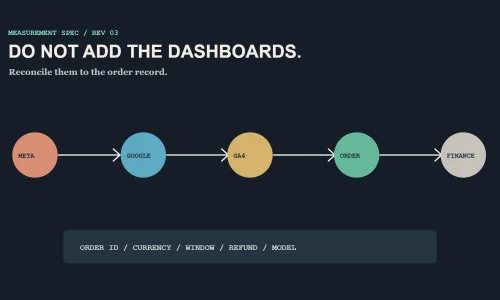
Google Ads conversion management documents describe conversion actions and options for bringing offline activity into measurement.8 LinkedIn’s Conversion Tracking documentation explains setup and reporting, while its Help Center also documents conversion attribution, conversion windows, and comparison with third-party reports.6791011 Platform reports may apply different attribution settings, windows, modeling, and timing. Never assume matching dates and labels mean the systems are counting identically.
Use a measurement ledger such as:
| Field | Rule to record before the test | Why it matters |
|---|---|---|
| Primary business outcome | Sales-accepted meeting, qualified RFQ, opportunity, or other agreed stage | Prevents “lead” from changing meaning between teams |
| Initial conversion | Website inquiry, demo request, Lead Gen Form, or content registration | Shows what the platform is optimizing or reporting |
| Qualification criteria | Product fit, role or account, geography, timing, and exclusions that apply | Makes lead review consistent |
| Attribution setting | Platform setting and any internal reporting rule | Helps explain differences between ad and CRM totals |
| Reporting date | Click, lead creation, qualification, or opportunity date | Prevents date-window mismatch |
| Duplicate rule | How repeat forms, account contacts, and existing opportunities are handled | Avoids inflated totals |
| Sales response owner | Person or team and expected internal process | Separates media quality from follow-up gaps |
| Cost basis | Media spend only or fully loaded campaign cost | Keeps channel comparisons honest |
| Review checkpoint | When each stage will be examined | Allows long-cycle outcomes to mature |
Where possible, pass a stable source identifier and campaign context into the CRM using the organization’s approved tracking design. Preserve the original source when a lead later returns through another route. Mark multi-touch influence separately from last-click credit. A buyer may see a LinkedIn ad, later search the brand, attend an event, and then request a demo. No single channel report tells the whole story.
Platform data should be reconciled with a company source of record. Google and LinkedIn document conversion reporting and external measurement workflows, but the advertiser remains responsible for correct configuration, event definitions, and lawful data practices.689 Review data collection and sharing with qualified technical and privacy owners, especially before using customer lists or transferring identifiable information.
Combine channels when each has a distinct job
The strongest plan is sometimes a sequence rather than a single-channel answer. LinkedIn can expose a useful idea to an audience the company has identified; search can capture buyers who later look for the product, category, or brand. These are plausible pathways, not guaranteed attribution.
A disciplined combination gives each campaign a role:
- Use search to answer a declared need with a tightly matched page.
- Use LinkedIn to explain a problem, perspective, use case, or offer to relevant professionals.
- Use retargeting only where the audience and consent configuration are appropriate.
- Send each campaign to a destination that matches its stage and promise.
- Measure initial actions separately and compare downstream quality using common CRM definitions.
- Coordinate frequency and sales outreach so the buyer does not receive repetitive or conflicting messages.
For example, a team might use LinkedIn to promote a technical webinar to target accounts, then use search to capture active queries around the solution category. Make each piece useful on its own and acknowledge channel overlap in reporting; do not count each assisted touch as a separate new customer.
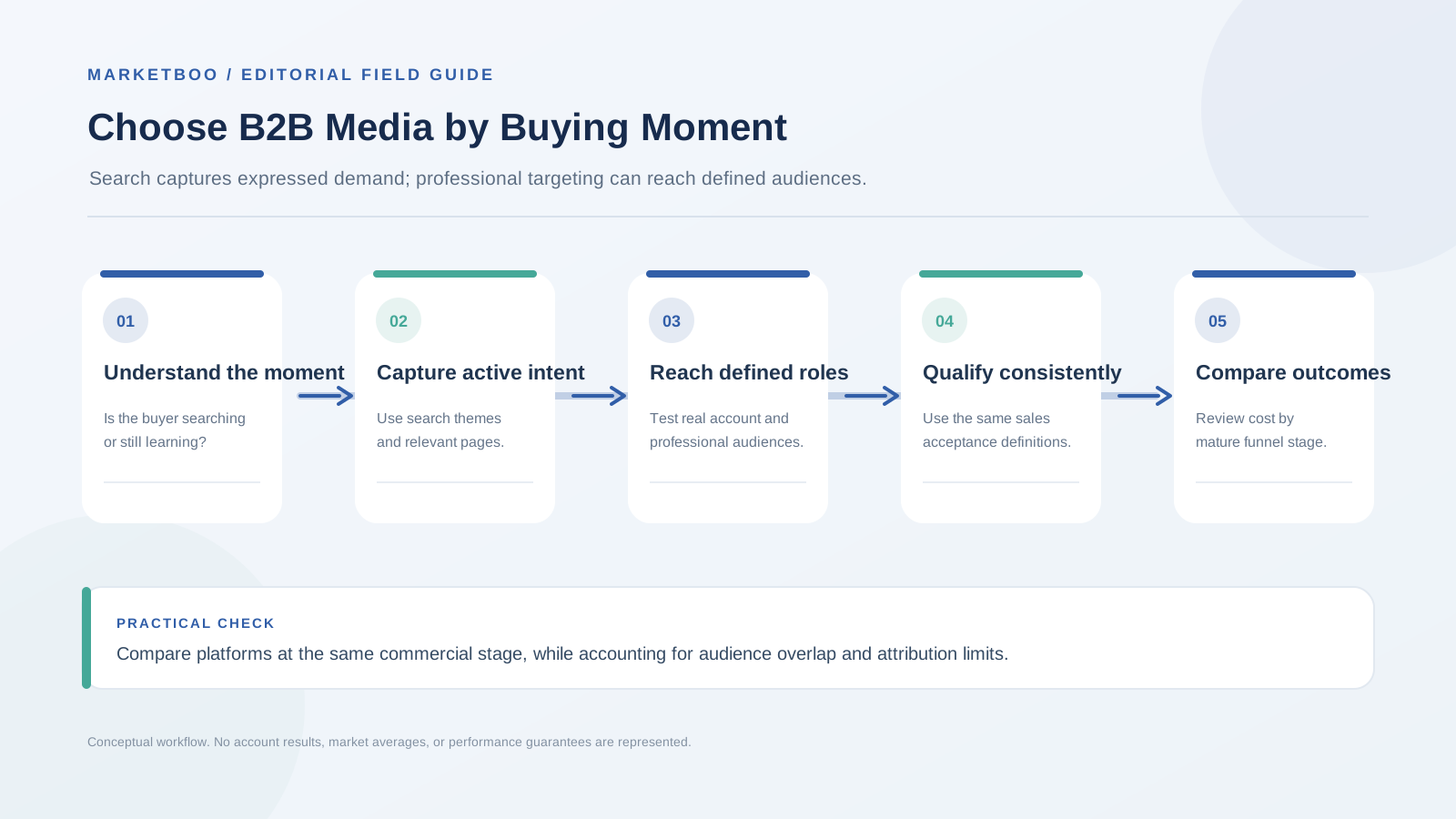
How to choose between Google Ads and LinkedIn Ads for B2B
Use these steps to make a channel decision that can be reviewed later.
- Describe the buying situation. Identify the offer, target market, main buying roles, sales cycle, and what causes a prospect to begin looking. Use customer interviews, sales notes, support questions, and existing search behavior rather than relying only on internal assumptions.
- Check whether demand is already expressed in search. Use keyword planning to find possible language and inspect existing query data when available.2 Validate each theme with product and sales owners. Treat estimates as planning inputs, not proof of demand or a forecast.
- Check whether a professional or account audience is actionable. Define the roles and organizations you actually want to reach. Review LinkedIn’s available targeting and matched-audience options in the current account, then verify that the selection is not so narrow or broad that the campaign loses meaning.3
- Choose a channel-specific first action. A search campaign might ask for a quote, demo, or consultation from someone with a defined need. A LinkedIn campaign might offer an event, guide, product explanation, or consultation suited to the audience’s awareness. Avoid using the same ask simply for convenience.
- Prepare and verify the destination. Match the page to the ad, describe fit and limits accurately, test the form or registration, and confirm mobile usability. Ensure that a sales request goes to the right owner and that an educational request receives the promised asset or follow-up.
- Define common sales stages and attribution notes. Agree on submission, qualified lead, sales acceptance, opportunity, and closed business. Record platform conversion settings, date rules, duplicate handling, and the source-of-truth system. Keep channel-specific first actions distinct.
- Set a bounded test budget and a realistic review window. Base the limit on the organization’s ability to learn and follow up. Choose a checkpoint that accommodates the campaign volume and sales cycle. State what fault or result would trigger a pause, revision, continuation, or expansion.
- Launch one focused hypothesis per channel. Separate tests if their audiences, offers, or landing pages differ. Keep a change log. If using both channels, make sure each has a role and the team can identify where a lead originated.
- Review query, audience, and sales evidence together. For Google, inspect query themes and page actions; for LinkedIn, review audience delivery, creative response, and form or site behavior. For both, ask sales to disposition leads using the same quality criteria.
- Make a proportionate decision. Keep, revise, pause, or expand based on the evidence and its limits. A channel with weak delivery but strong fit may need a setup revision. A channel with engagement but no commercial movement may need a better offer or longer maturation window. A channel repeatedly producing out-of-scope leads may need to stop.
The channel plan should change when the evidence changes. If search terms reveal an active category with qualified demand, give that intent a clear path. If a new solution has little recognizable search language, a targeted education campaign may help explain the problem before buyers start searching. If the CRM shows that the sales team cannot follow up, improve the handoff before increasing volume.
What should a B2B team do with limited budget?
Pick the channel that can answer the most important uncertain question with the least operational complexity. If the company already receives relevant search inquiries organically or through referrals, a controlled paid-search test can show whether ads reach more of those buyers. If the target is a finite set of accounts and the company has a useful asset tailored to their roles, LinkedIn may be the clearer experiment. The team’s existing content, website, sales capacity, and tracking readiness matter as much as the media budget.
Avoid splitting a small budget automatically. A division can leave each campaign without enough opportunity to learn, particularly when audiences or search terms are narrow. Instead, document why a particular channel comes first and what evidence would make the company test the other one. If the company truly needs both, keep the scopes small and distinguish their objectives.
Marketboo provides international paid media support. You can review Marketboo’s global paid media services when planning account structure and channel roles across markets. The useful engagement begins with a clear offer, target buyer, and measurement question—not an unsupported promise about which platform will win.
FAQs: Google Ads vs LinkedIn Ads for B2B
Which platform is better for B2B lead generation?
Neither platform is universally better. Google Search can be a fit when buyers actively search for the offer; LinkedIn can be a fit when the advertiser needs to reach defined professional or account audiences. Compare qualified sales outcomes under consistent rules rather than comparing clicks with form fills.
Is Google Ads better for high-intent B2B buyers?
Search wording can indicate an expressed need, such as a product, service, or supplier query. It does not prove budget, authority, or readiness. Review actual terms, destination-page fit, and sales outcomes before calling a campaign high intent.
Is LinkedIn Ads better for reaching decision-makers?
LinkedIn offers professional and company targeting attributes, but a selected job title or company does not guarantee that the person is a decision-maker or currently buying. Define the buying committee, verify available targeting, and use sales feedback to assess fit.
Should a company use both Google Ads and LinkedIn Ads?
Use both when they have different, measurable jobs—for example, LinkedIn for education or account reach and Search for active demand. Keep first actions separate, share qualification rules, and account for audience overlap. A combined plan is not automatically more effective.
How should I compare Google and LinkedIn costs?
Compare outcomes at the same business stage, such as sales-accepted leads or qualified opportunities, using a consistent cost basis. Record reporting windows and attribution settings. Do not treat cost per click and cost per in-platform form as equivalent metrics.
Which channel should a B2B startup test first?
Start where there is stronger evidence and operational readiness. Existing relevant search demand may favor a focused search test; a defined account list and useful educational asset may favor LinkedIn. If the website, follow-up, or tracking is not ready, fix that first.
Can the two ad platforms be compared directly in their dashboards?
Their dashboards can help monitor platform delivery, but attribution windows, modeled data, conversion settings, and event definitions may differ. Reconcile both with the CRM or another agreed business source of truth, and state the limits of any cross-platform comparison.
Conclusion: choose by the buying moment, then measure the handoff
Google Ads vs LinkedIn Ads for B2B is best resolved by asking whether the next opportunity comes from a buyer who is already searching or from a relevant professional who first needs a reason to pay attention. Search can capture expressed demand; LinkedIn can reach professional and account audiences with an educational or commercial message. Neither targeting method alone guarantees a qualified sales conversation.
Select the channel closest to evidence, give it a focused job, and make the landing experience match. Define the same sales stages for both, record attribution settings, and use CRM outcomes to decide whether to continue, revise, pause, or combine. If your team wants an outside review of the campaign roles, market coverage, and follow-up path, contact Marketboo to plan a cross-platform paid media assessment.