
LinkedIn Ads cost depends on the audience, market, bid and campaign choices, offer, and the business’s own conversion path. There is no single CPC or cost-per-lead figure that can reliably set every B2B budget. Build a transparent model from stated assumptions, separate media spend from agency and production costs, and show how the estimate changes when click cost or lead quality shifts. Replace assumptions with a dated account forecast and observed campaign and CRM data before making a larger commitment.

Model LinkedIn Ads cost from the business outcome backwards
| Model input | Planning question | Keep visible |
|---|---|---|
| Objective | What action is the campaign for? | Event and owner |
| Audience | Who can actually be reached? | Market and account assumptions |
| Rate | What conversion assumption is being used? | Date, source, confidence |
| Quality | What makes a lead acceptable? | Sales definition |
| Window | When will the decision be made? | Start, end, review date |
Start with a range, not a magic number
Treat the budget request as a decision memo. State the commercial goal, market, audience, objective, flight dates, currency, and the evidence the test must produce. Separate a limited learning allocation from a later expansion budget. Finance should know which amount is authorized now and which depends on results.
Show what the estimate includes. Media spend, creative, landing-page work, tracking, agency fees, taxes, and sales handling are different cost lines. A quotation that excludes most of them cannot be compared directly with an all-inclusive proposal. Keep the assumptions beside the total so the budget remains intelligible after the planning meeting.
Name the variables that move the estimate
LinkedIn’s official pricing explanation states that optimization goal and bidding strategy determine what is charged, while an auction determines ad cost. That supports an account-specific model; it does not supply a universal CPC or cost-per-lead rate. Read LinkedIn’s advertising cost and pricing explanation.

An auction price is specific to the campaign conditions. Audience, geography, objective, competition, bid choices, placement, creative, and timing can all affect delivery and observed cost. A benchmark from another advertiser cannot tell you what your next qualified opportunity will cost.
Build an assumption register with four labels: observed in your account, current platform forecast, illustrative input, and unknown. Add a date and owner. A forecast is useful planning evidence, but it is different from an achieved result. Avoid combining a historical CPC from one audience with a lead rate from an unrelated offer and calling the combination a forecast.
Convert a commercial goal into a media model
| Illustrative input or calculation | Value |
|---|---|
| Monthly media budget (assumption) | $3,000 |
| Average CPC (assumption) | $15 |
| Estimated clicks = budget ÷ assumed CPC | 200 |
| Landing-page lead rate (assumption) | 4% |
| Estimated form leads = clicks × assumed rate | 8 |
| Illustrative cost per form lead = budget ÷ leads | $375 |
| Sales-qualified share (assumption) | 25% |
| Illustrative qualified leads | 2 |
| Illustrative cost per qualified lead = budget ÷ qualified leads | $1,500 |
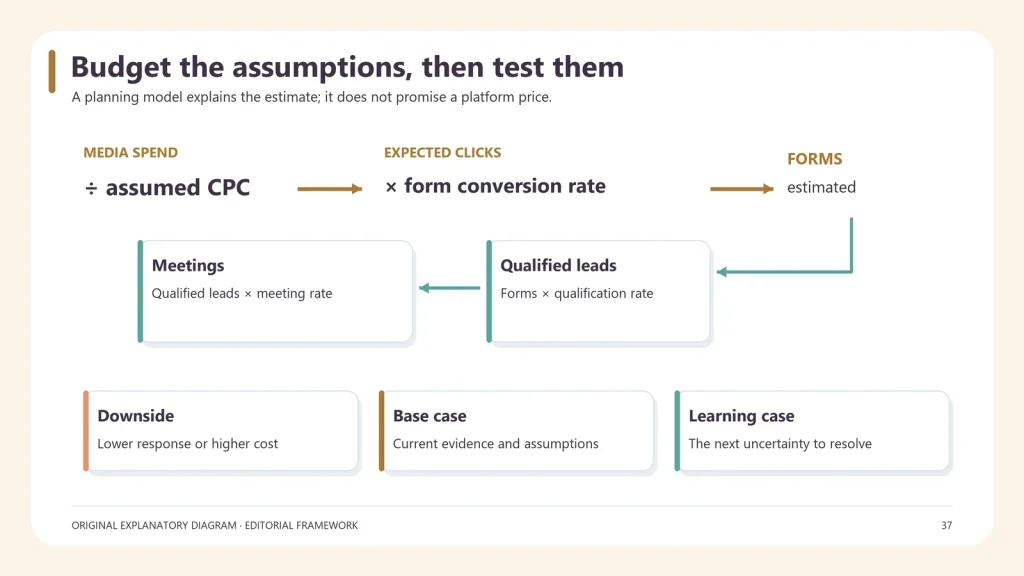
The model below is illustrative arithmetic, not a LinkedIn price quotation or market benchmark. With $3,000 of media spend and an assumed $15 CPC, the model buys 200 clicks. At an assumed 4% form conversion rate, that yields eight forms and $375 per form. If 25% meet the stated qualification rule, the estimate becomes two qualified leads at $1,500 each.
Each assumption carries a different uncertainty. The click price belongs to media delivery; form conversion reflects the offer and destination; qualification depends on account fit and sales review. Replace them separately with dated account evidence. A lower CPC can coexist with a higher qualified-lead cost if the extra clicks come from unsuitable buyers.
Work backward as a second check. Required qualified leads divided by the qualification rate gives forms needed; forms divided by the form rate gives clicks needed; clicks multiplied by CPC gives modeled media spend. If the required response volume exceeds sales capacity, the commercial plan needs revision even when the spreadsheet balances.
Separate click, form, and qualified-lead cost
Use the denominator that answers the decision. CPC = media spend ÷ clicks. Cost per form = spend ÷ valid unique forms. Cost per qualified lead = spend ÷ records meeting the agreed rule. State whether spend includes media only or all acquisition costs. Otherwise two correctly calculated numbers can still be incomparable.
A qualification result needs a review window. Leads submitted yesterday may still be waiting for contact, while last month’s cohort has had time to progress. Show pending records beside accepted ones, and compare cohorts of similar maturity. If no lead qualifies, report zero qualified leads and say the cost ratio is undefined; do not display a reassuring zero cost.
Build base, downside, and learning scenarios

A base case expresses your current assumptions, not certainty. A downside case should show what happens when important inputs weaken. A learning case should cap the spend needed to answer one question. Keep all three editable and retain the previous version when evidence changes.
For another illustrative sensitivity check, keep spend at $3,000 and CPC at $15, but reduce form conversion from 4% to 2%. Forms fall from eight to four and, at 25% qualification, modeled qualified leads fall from two to one. The cost per qualified lead doubles to $3,000. That is why improving the destination or offer may matter more than negotiating a small creative saving.
These are expected-value calculations, not promises of whole leads or probabilities of success. Small cohorts can produce very different realized counts. Use the sensitivity to identify the most consequential unknown, then design the first test around it.
Protect the budget with explicit guardrails
Daily budget does not mean a hard daily cap. In LinkedIn’s budget documentation checked October 15, 2026, the daily amount is an average. For a continuous schedule with no end date, a given day may spend up to 100% more, while the Monday–Sunday total is limited to seven times the daily amount. Its example is a $100 daily budget: up to $200 on one day and $700 in that week. This describes platform pacing, not a recommended budget or click price. Confirm the current rule and your account’s schedule before approval. LinkedIn campaign and ad set budgets.
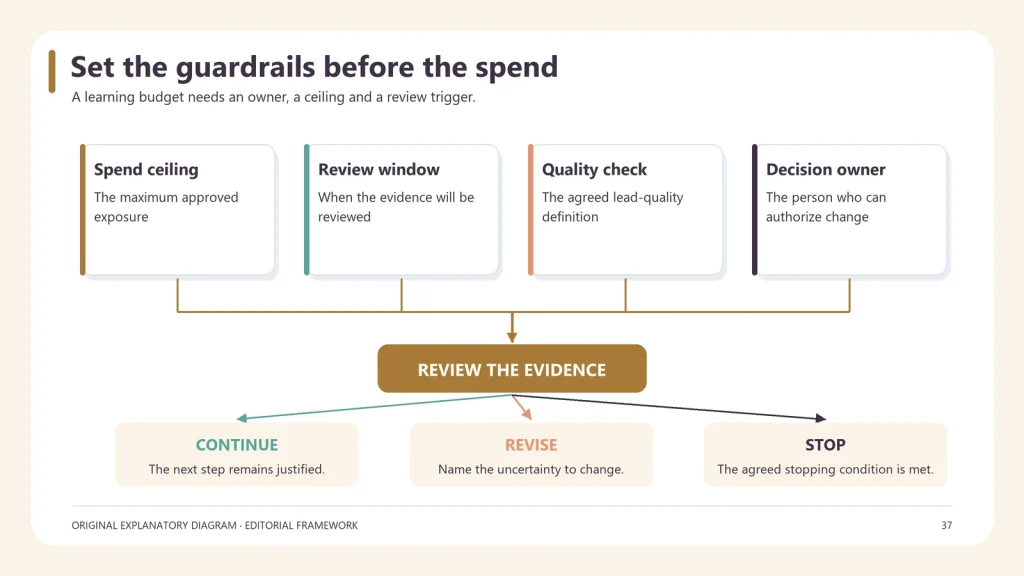
Define the spending ceiling, review cadence, and authority to pause. Give technical failures different rules from weak performance: missing conversions or lost records require investigation before more spend, while a disappointing early rate may need a longer observation window. Agree on the distinction before the campaign runs.
Keep funds for approved creative or landing-page repairs separate from the media allocation. A silent transfer between them makes the model impossible to reconcile. Record who approved each change, why it was needed, and what existing assumption it replaced. Check billing and account permissions before launch so an administrative problem is not mistaken for an audience problem.
Review creative and audience efficiency
Read click cost alongside account and role fit. Cheap clicks from an irrelevant audience are expensive if the business cannot use the responses. A more costly message may deserve further testing when it produces relevant conversations, but small numbers still require restraint.
Choose the next change by the observed break. Weak relevance suggests an audience or message problem; useful attention without forms suggests offer or destination friction; forms without qualification suggest fit or expectation problems. Preserve versions and change one principal factor where feasible. That makes the next result easier to interpret.
Connect platform spend to pipeline evidence
Join campaign and CRM records using an agreed identifier and cohort window. Preserve audience, creative, destination, submission date, owner, qualification, and opportunity status. Report unmatched records rather than forcing them into a campaign. A complete-looking dashboard built on unverified joins offers false precision.
Define “sourced” and “influenced” before presenting pipeline. They describe attribution rules, not automatic proof of causation. A deal can have several marketing and sales interactions. Show the rule and its limitations, and keep realized revenue separate from an open opportunity’s value.
Update the model when the facts change
Update assumptions when the audience, offer, conversion rule, tracking, or sales process changes. If a repaired event increases recorded conversions, label it as a measurement correction until you can establish a performance change. Do not blend incompatible periods to make a trend look smoother.
At the review, answer three questions: what did the authorized spend buy, which assumption became more reliable, and what remains uncertain? The next allocation should purchase a useful next decision, rather than simply repeat last month’s amount.
| Scenario | Use | Decision rule |
|---|---|---|
| Base | Most defensible working case | Fund and review |
| Downside | Protect against weaker rates | Cap or pause |
| Learning | Buy information deliberately | Keep one hypothesis |
| Qualified lead | Connect media to sales quality | Reconcile CRM |
| Pipeline | Assess commercial relevance | Keep attribution qualified |
How to submit a LinkedIn Ads budget for approval
Keep the owner, evidence, and verification point beside every step.
- Write the commercial outcome, market, audience, time window, conversion definition, and budget ceiling.
- List each assumption for delivery, click, form, qualification, response, and opportunity, with source and date.
- Calculate base, downside, and learning scenarios so a single benchmark cannot control the decision.
- Map the landing or form path, tracking, CRM state, response owner, and attribution limitations.
- Launch a bounded test and record spend, audience, creative, event, quality, and operational context.
- Review stage costs with finance, marketing, sales, and analytics instead of reading CPC alone.
- Change one high-value assumption or creative hypothesis and document why the model changed.
- Archive the cohort, update the forecast, and approve the next spend decision explicitly.
Evidence note: Platform behavior, account settings, permissions, local rules, and service scope can change. Verify current documentation and qualified review before implementation.Get a LinkedIn Ads budget estimate
FAQ
What does LinkedIn ads cost mean?
It can mean media spend, cost per click, cost per form, cost per qualified lead, or a broader acquisition cost. Define the denominator before comparing numbers.
Why do LinkedIn ad costs vary?
Audience competition, objective, market, creative, delivery, offer, seasonality, and account settings can change the observed cost.
Is there a universal LinkedIn CPC?
No universal CPC is reliable for every market and objective. Use current account evidence or a clearly labeled planning assumption.
How should a finance team budget a first test?
Set a learning window, ceiling, scenario range, review owner, and stopping rule. Keep media spend separate from creative, landing, and sales-operating cost.
Should CPL be the main KPI?
CPL is a stage metric. Add contact, qualification, opportunity, response, and pipeline evidence when those stages are observable.
Can Marketboo quote a fixed LinkedIn ads cost?
A responsible estimate needs the target market, audience, offer, path, budget window, and measurement assumptions; it is not a guaranteed price or result.
When should the budget model be updated?
Update it after material changes to audience, offer, creative, conversion path, platform behavior, sales definition, or observed cohort evidence.
Conclusion
A responsible LinkedIn budget is a model that exposes its assumptions and a decision date. Use a clearly labeled scenario to set a bounded test, separate media from operating costs, and replace the illustrative inputs with the account’s own forecast and qualified-lead evidence before scaling.Ask Marketboo to review your assumptions