A YouTube marketing agency for B2B should turn real buyer questions into accurate, useful videos and connect each episode to a relevant next step. The operating system includes expert research, a sourced brief, clear recording, captions and accessible packaging, accurate titles and chapters, responsible repurposing, and a review plan for changed facts. Evaluate impressions and click-through in context, then examine watch behavior and qualified actions separately. Views or a platform-wide CTR range are not a promise of pipeline; use a defined channel cohort and disclose attribution limits.
The commissioning memo for a YouTube marketing agency
A B2B episode earns its place when it answers a question that an identifiable buyer needs to resolve. Ask the proposed agency to bring one episode brief to the pitch: who needs the answer, what decision follows, which expert can support it, and what the viewer should do next. A sample brief exposes research and editorial judgment more clearly than a reel of polished transitions.
Define searchable video as a useful answer with an accurate, descriptive package. A title, description, chapter list, and related web page help explain what the episode contains. They cannot create expertise that the recording lacks or promise a particular search position.
Choose a question with a decision behind it
Build the question register from sales objections, implementation questions, customer-support themes, and search research the team can actually access. Preserve the language of the question and its source. Then distinguish the viewer’s stage: understanding a problem, comparing approaches, checking fit, or implementing a solution.
“Explain our platform” is a weak commission because it leaves the viewer’s task open. A more useful hypothetical brief is “How should an operations team check whether an approval delay is caused by the workflow or missing information?” The expert can show the diagnosis, identify conditions, and offer a checklist that continues the task.
| Viewer task | Episode form | Evidence to prepare | Useful continuation |
|---|---|---|---|
| Understand a problem | Focused explainer | Definition, boundaries, and source | Diagnostic guide |
| Compare approaches | Criteria-led walkthrough | Equivalent conditions and trade-offs | Comparison worksheet |
| Check implementation | Demonstration | Version, prerequisites, and reproducible steps | Setup checklist |
| Assess evidence | Expert review | Source, method, and limitations | Full reference or qualified discussion |
How to commission an expert-led B2B video
Assign a named owner and review point for each step.
- Collect buyer questions, sales objections, customer language, product evidence, and the next action for each topic.
- Create an episode brief with promise, expert, outline, sources, examples, caveats, and review owner.
- Record a clear demonstration or explanation with rights, accessibility, sound, framing, and correction notes.
- Publish descriptive title, description, transcript or captions, chapters, thumbnail, links, and update date.
- Repurpose only the sections that retain meaning, context, attribution, and a useful destination.
- Connect the video to a relevant page, form, sales asset, or next episode with measurable events.
- Review attention, return behavior, enquiries, quality, and sales feedback without treating views as revenue.
- Archive source files, permissions, claims, versions, and the next refresh or correction trigger.
Approve the reasoning before booking the studio
The production brief should contain the opening answer, reasoning sequence, example, limitations, source list, and intended next step. Give statistics a source date and product demonstrations a version number. These details help an editor identify which sentence must change when the underlying fact changes.
Run a short editorial rehearsal. Ask the expert to explain the answer without slides. Note the sentence where a non-specialist loses the thread, the claim that lacks support, and the point that requires a visual demonstration. Repair those problems in the brief before committing recording time.
A named expert should approve the technical meaning, while the editor owns clarity and the production lead owns execution. Keep those approvals distinct. An expert title is useful context for readers; it does not establish the truth of every statement in the recording.
Record proof the viewer can follow

Make intelligibility the first production check. Record a sample, listen to it through ordinary headphones, and view a screen demonstration at phone size. If the process depends on reading tiny interface text, change the shot or narrate the important value. An expensive camera cannot rescue an answer the audience cannot hear or interpret.
When showing a workflow, state its starting conditions. Identify sample data as sample data, remove confidential information, and explain where another organisation would need a different approval or configuration. Record a clean explanation of the caveat so the editor does not have to choose between brevity and accuracy.
Keep a timecoded review note for incorrect names, claims, or screens. Where a correction changes the conclusion, re-record the relevant passage instead of covering it with a vague caption. Retain the approved version with the source files.
Accessibility belongs in the production budget
WCAG 2.2, the W3C Recommendation of October 5, 2023, criterion 1.2.2, specifies captions for prerecorded audio in synchronized media, with an exception for clearly labeled media alternatives to text. Use this as a concrete reference when commissioning accessible video; automatic output still needs review for technical terms, speaker meaning, and important sound information.
For the companion web page and applicable text or images of text, criterion 1.4.3 sets a minimum contrast ratio of 4.5:1, or 3:1 for large text, with stated exceptions. These are accessibility criteria, not engagement benchmarks. Meeting one criterion does not establish that a video program or website meets every accessibility requirement.
Budget for caption correction, a readable transcript, and a check of the information carried by visuals. A transcript that reproduces the speech without explaining a necessary chart can leave the essential argument inaccessible. Ask the reviewer which information a viewer would miss without the sound or the image.
Package the answer without exaggerating it
Write the title after identifying the episode’s actual answer. Use the task and scope; remove claims the recording does not support. The thumbnail should help a prospective viewer recognise the subject. Chapters should describe meaningful sections, while the description should provide sources, relevant links, and any version or scope limitation.
Open with the answer or the problem being resolved, then move quickly into the evidence. Avoid delaying a narrow explanation with a lengthy company introduction. If the topic needs an assumption, state it before the demonstration rather than hiding it at the end.
Test every destination after upload. A video about an implementation problem should lead to an implementation resource or a relevant discussion, with a named owner for enquiries. A generic homepage can add an unnecessary navigation problem between interest and action.
Repurpose with a traceable editorial chain
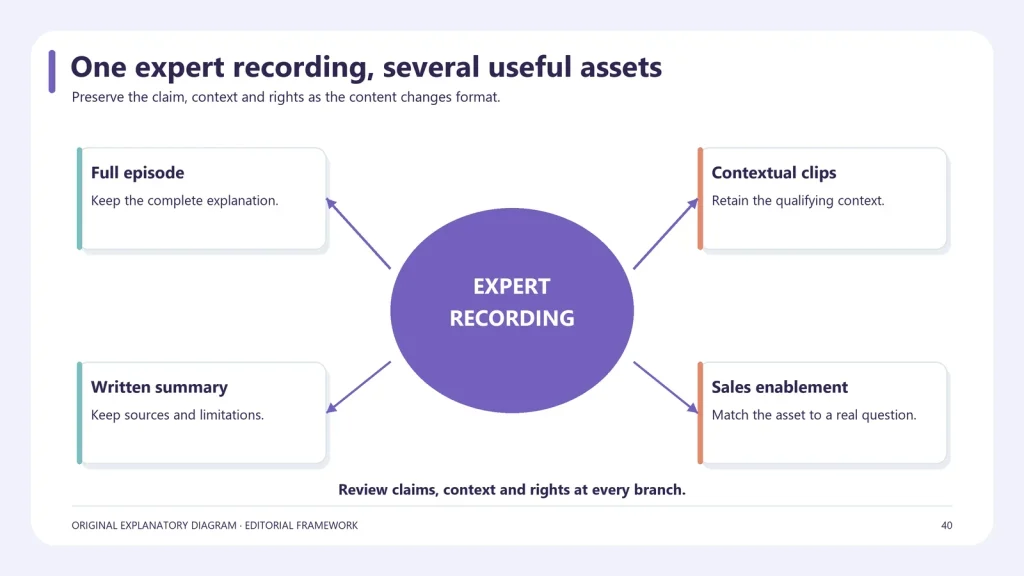
Use the long recording as a source, not an automatic publishing feed. A short clip needs enough context to preserve the answer; an article needs structure, references, and explanations suited to reading. Choose a derivative because it solves a distinct audience task.
Retain the parent video ID and timecode with every derivative. If a product setting changes, the correction owner can identify the affected clip, transcript, article, email, and sales asset. Also check that guest, music, image, and customer permissions cover each planned use and duration.
| Asset | Editorial job | Correction dependency |
|---|---|---|
| Full episode | Explain the reasoning and conditions | Approved script, source, and product version |
| Short clip | Resolve one narrow question | Parent timecode and preserved caveat |
| Article | Offer a readable, sourced reference | Updated facts and diagram explanations |
| Sales resource | Support a defined evaluation conversation | Current offer and approved claims |
Use a diagnostic report instead of a single success score
Separate discovery, viewing, and business action. Where the channel provides the data, inspect impressions and click-through by traffic source; then inspect viewing behaviour, destination visits, and qualified enquiries as different stages. Compare episodes with similar purposes and reporting windows. A short product announcement is a poor control for a detailed implementation tutorial.
Hypothetical example: a video with fewer views may still generate several relevant technical questions. Those questions can justify keeping the episode available and testing its distribution; they do not establish that the channel creates profitable pipeline. Record what qualified the questions and how the business learned about their source.
Choose one next intervention from the evidence. Weak clicks from a comparable impression source suggest a packaging test. Strong initial interest followed by confusion at the demonstration suggests an explanation problem. Relevant viewing with no destination action warrants a link, offer, and handoff check. These are diagnostic hypotheses, to be tested within the channel’s own context.
Set the correction and handover rules before launch
Maintain a compact claim register: statement, source, date, approving subject-matter owner, and affected assets. Assign refresh triggers such as a product release, revised policy, or superseded statistic. An update date should reflect an actual review, not a cosmetic change.
The business should retain access to the channel, source recordings, captions, thumbnails, permissions, and reports. Specify who can pause publication or retire a misleading episode. A sustainable production agreement makes it possible to correct an answer without depending on one unavailable presenter or editor.Build a B2B YouTube content plan
FAQ
What does a YouTube marketing agency do for B2B?
It can research buyer questions, plan episodes, produce or coordinate video, optimize metadata, repurpose content, and measure useful next steps.
How long should a B2B YouTube video be?
Use the time needed to answer the question clearly. Topic complexity and viewer purpose matter more than a universal duration target.
Does YouTube SEO guarantee rankings?
No. Descriptive packaging and useful video can improve discoverability signals, but ranking and audience response remain variable.
Should experts read a script?
A structured brief can protect accuracy while allowing a natural explanation. The format should match the expert and the audience.
What should a B2B channel measure?
Combine topic coverage, watch behavior, return viewing, relevant clicks, enquiries, quality, and sales feedback with clear limitations.
Can a video be repurposed into an article?
Yes, when the article adds context, sources, and a useful reading path rather than copying a transcript without editing.
How can Marketboo help?
Marketboo publishes social strategy, content development, channel coordination, and reporting services. Confirm the YouTube research, recording, editing, accessibility, and expert-review responsibilities in a written proposal.
Conclusion
Choose a YouTube marketing agency that can turn one buyer question into an accurate episode, an accessible reference, and a useful next action. The durable asset is an answer the business can stand behind and correct. Use discovery, viewing, and qualified actions to decide what to improve next.Plan your expert video workflow with Marketboo