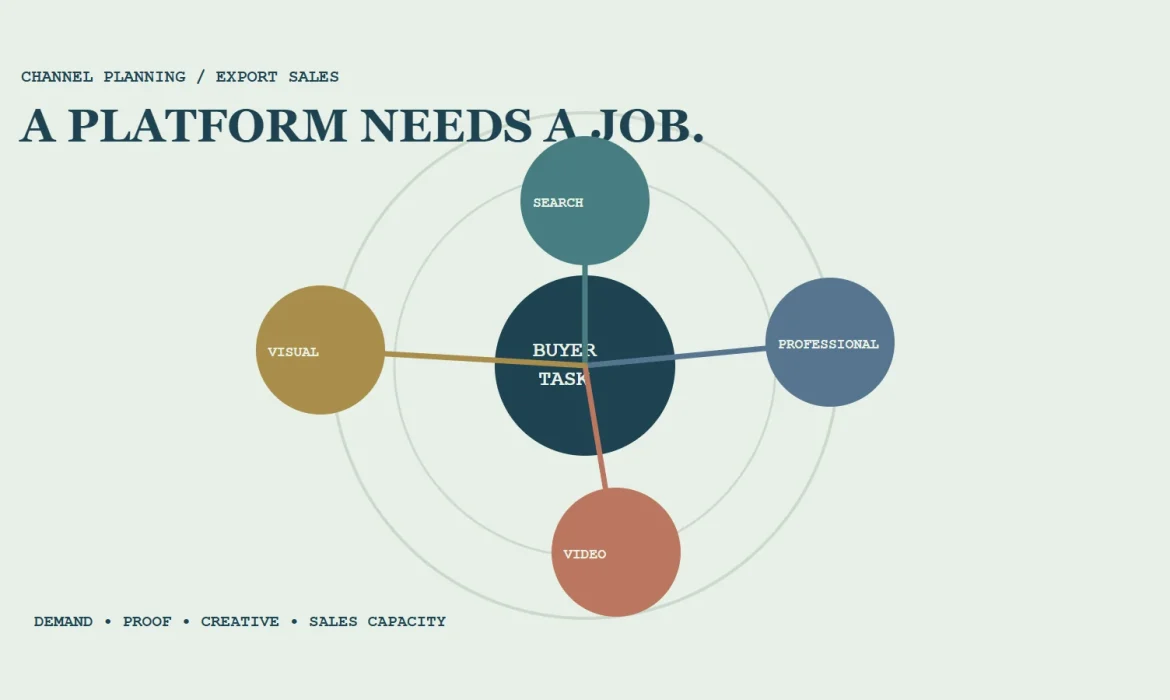
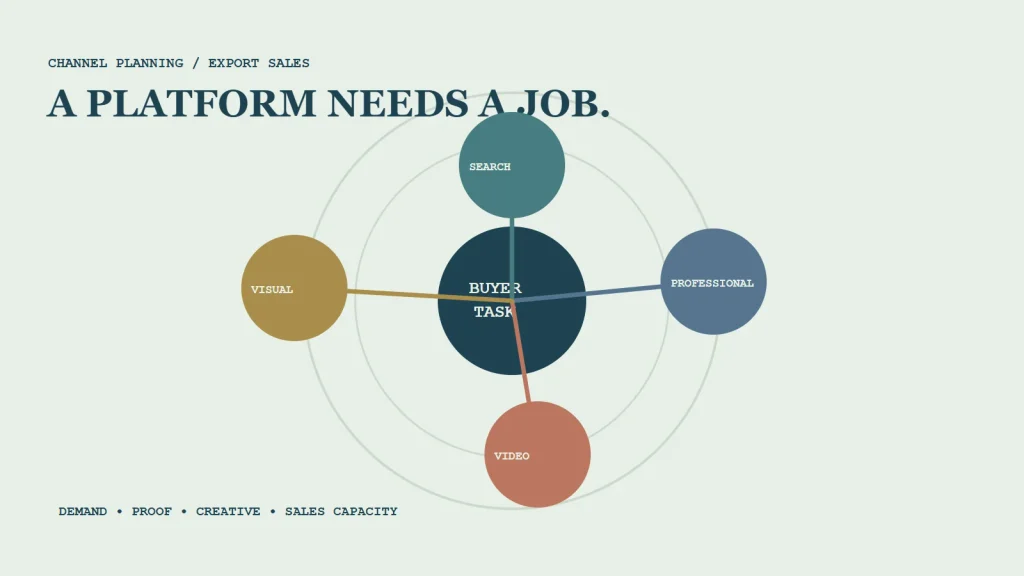
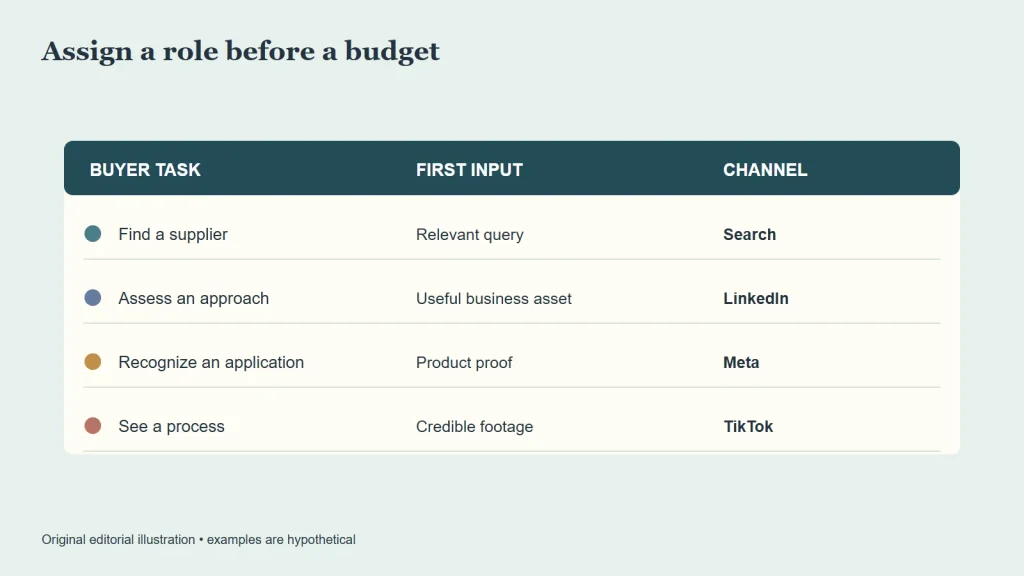
The best ad platforms for B2B export lead generation depend on where the buyer starts. A product search, a professional audience, and a short video demonstration each ask the buyer to do something different. Give each channel a job before assigning it budget. A smaller plan with a clear sales handoff is easier to learn from than a portfolio no one has time to operate.
Quick Answer
The best ad platform for B2B export lead generation depends on the buyer’s task, target country, offer, and the team’s ability to operate and follow up. Use Google Search as a candidate when buyers express a serviceable need in queries; assess LinkedIn when a professional audience and business offer are defined; consider Meta or TikTok when the product can be explained with suitable creative and leads can be qualified. Treat each choice as a test, not a universal ranking. Compare total workload and cost, set a lead definition, and expand only when evidence and sales capacity support it.Choose the channel role
- Quick Answer
- How to choose the best ad platforms for B2B export lead generation
- Role card / Google Search captures a question already asked
- Role card / LinkedIn puts a professional problem in context
- Role card / Meta makes a useful offer visible in a feed
- Role card / TikTok shows a product or process in action
- Beyond the first four cards / Video research and specialized media
- The audience map: six numbers that do not predict six returns
- A decision tree for the first channel
- Market review / Serviceability is a targeting input
- Four supplied campaign records, four different operating questions
- Build the production and measurement budget beside the media budget
- Give the sales cycle a place in the channel review
- The comparison table sales and finance can share
- Capacity matrix / Can the team operate the proposed portfolio?
- A launch order for a resource-constrained exporter
- The stop rule belongs in the brief
- Decide when the budget is allowed to move
- How to Choose an Advertising Platform for B2B Export Leads
- Frequently Asked Questions
How to choose the best ad platforms for B2B export lead generation
An export purchase may begin with a specification, a production problem, a distributor search, or an idea the buyer has not yet put into search language. Those starting points require different messages and proof. Ranking platforms without naming the task is like ranking transport options without saying what must be moved or where it needs to go.
Write three facts first: the buying organization, the country the business can serve, and the next useful action. “International manufacturers” is too broad. A more usable brief might identify maintenance teams in a supported region seeking a replacement assembly, or distributors assessing a new product line. The specificity determines how targeting and landing pages should be evaluated.
Then mark the operating limits. Which languages can sales support? Can the factory supply the order size? Are claims and documentation ready? Who handles inquiries outside office hours? A channel can produce relevant interest while the business lacks the ability to convert it into a conversation. Fixing that constraint may be the best use of the next budget increment.
The decision guide below uses role cards rather than a universal ranking. It covers Google Search, LinkedIn, Facebook and Instagram within Meta advertising, and TikTok. YouTube or specialized industry media may also have useful roles, but they require their own audience, placement, and creative review.
Role card / Google Search captures a question already asked
Use Search when buyers name the product, application, specification, or supplier need. The campaign can direct a defined query group to information that helps the buyer assess fit. A manufacturer with clear product terminology and a functional RFQ path often has a coherent first Search hypothesis.
Check demand before designing a large account. Search cannot manufacture unlimited relevant queries for a niche category. Use authorized keyword research with country, language, and period recorded, then compare actual search terms after launch. This guide does not supply verified search volumes or current CPCs for your products.
Separate commercial queries from learning, employment, and consumer uses. Google’s matching options can connect keywords to searches that are not identical to the entered phrase. Google’s current matching documentation explains the definitions; the account’s search-term record shows what actually happened.
The common failure is a page that makes the buyer restart the search. A specific component query should not land on a company homepage with no specification or obvious inquiry route. Before increasing bids, check whether the destination answers the task the ad attracted.
Role card / LinkedIn puts a professional problem in context
Use LinkedIn when the buying group can be described through professional attributes and a relevant asset can earn attention. A technical guide, application comparison, event, or procurement worksheet may create a useful first interaction. The lead should still be qualified against the actual business criteria.
LinkedIn describes job-title, function, and industry targeting and a network of more than one billion active professionals. This is a platform-reported worldwide scale statement, not a count of reachable decision-makers in a particular export market. LinkedIn’s advertising overview is the source. Check account estimates and actual buyer fit before treating the audience as a commercial opportunity.
The common failure is generic material distributed to an expensive-to-reach professional audience. Selecting the right role does not create a reason to download a vague brochure. Ask what decision the material helps the reader make and whether sales can continue that discussion without jumping immediately to an unrelated pitch.
Role card / Meta makes a useful offer visible in a feed
Facebook and Instagram can help show applications, production capabilities, product demonstrations, and relevant offers to people who are not actively searching at that moment. The creative has to explain enough context for the intended buyer to recognize relevance. A feed campaign should not be judged solely by whether it behaves like a supplier search.
Qualification and routing matter. A low-friction form can attract contacts outside the serviceable market or people looking for a consumer product. Define the required country, application, or company fit without adding fields nobody uses. Then ensure each inquiry enters an owned queue and returns a reason-coded sales outcome.
The common failure is confusing inexpensive submissions with useful projects. Keep platform form counts, unique inquiries, and sales-accepted projects in separate columns. If sales has not reviewed the latest contacts, label them pending. An unanswered form is not a sales rejection. Separate pending records from disqualified ones before changing the creative.
Role card / TikTok shows a product or process in action
TikTok may be worth a bounded B2B test when the value is visible: a process improvement, a machine demonstration, a material comparison, or a practical product application. That does not establish that the platform is suitable for every industrial category. The intended professional must recognize the context and have a sensible next step after the video.
Test the business audience rather than inferring it from views. A technically impressive clip can attract students, hobbyists, or consumers while producing few relevant inquiries. Use clear application language, a matching destination, and sales classification to understand who responded. Avoid describing engagement alone as export lead generation.
The common failure is copying a consumer trend without a commercial offer. Production capacity, claim support, creator permissions, and a page that explains the product remain necessary. If the team cannot produce credible demonstrations or answer inquiries, fund those prerequisites before adding another channel.
Beyond the first four cards / Video research and specialized media
YouTube can serve a different task from a short feed demonstration. Buyers may use a longer video to understand operation, installation, maintenance, or a technical trade-off. A useful test should identify the audience and placement context, the educational value of the video, and the action available afterward. Broad platform popularity does not establish the suitability of a particular inventory source.
Ask the operator to describe the placement and exclusion approach using current account options. Review whether the content is appearing in an appropriate context and whether downstream inquiries match the application. A cheap view buys attention, not necessarily an inquiry. Look at what the viewer did afterward and whether sales could use that contact. A video can be useful for education while its direct inquiry economics remain unproven.
Reddit or an industry-specific community may expose highly relevant discussions, but advertising and participation have different rules. Evaluate the actual community, commercial format, audience evidence, and moderation expectations. Do not disguise promotion as an independent recommendation or invent customer experiences. A candid paid offer and useful contribution are easier to defend than a covert sales tactic.
Industry publications, directories, newsletters, and specialist networks may reach a narrower but relevant group. Request a media kit with geography, audience method, placement, dates, reporting, and lead-delivery terms. A publisher’s claimed subscriber count is not the same as delivered impressions or verified buyers. Ask what can be measured and run a bounded test where the available evidence justifies it.
These options are not automatically inferior to large platforms or automatically better because they are specialized. They add a supplier-evaluation problem: inventory quality, audience verification, contract scope, and reporting comparability. The same commercial acceptance rule should follow inquiries into the CRM so the business can judge relevance rather than rely solely on the publisher’s report.
The audience map: six numbers that do not predict six returns
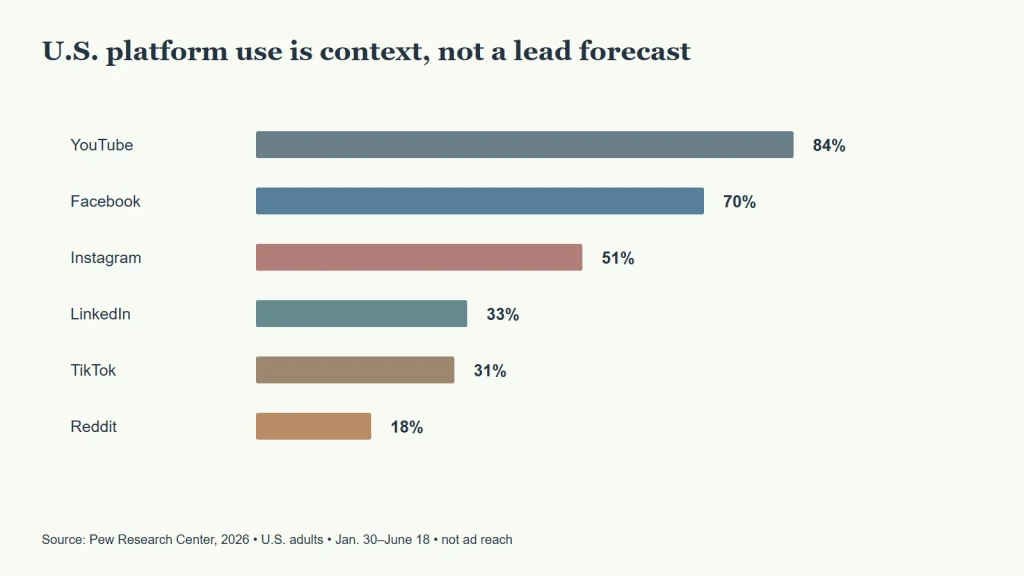
Pew Research Center’s 2026 U.S. adult survey reports use of YouTube by 84%, Facebook by 70%, Instagram by 51%, LinkedIn by 33%, TikTok by 31%, and Reddit by 18%. Fieldwork ran January 30–June 18, 2026. These are self-reported platform-use figures, not advertising audience estimates or B2B buyer shares. Pew’s survey and methodology provide the measurement scope.
| Platform | U.S. adults reporting use | Proper use of this statistic |
|---|---|---|
| YouTube | 84% | Broad context for considering video research and education |
| 70% | Broad feed-use context | |
| 51% | Visual-platform context | |
| 33% | Professional-platform use context | |
| TikTok | 31% | Short-form platform context |
| 18% | Community-platform use context |
The figures should not be added: people can use several platforms. They should not be projected to Germany, Brazil, or another export market. Nor does the highest percentage identify the cheapest accepted project. Use local evidence and campaign tests for those questions. The table helps frame where an audience may spend time, while the role cards help decide what commercial task can be supported there.
A decision tree for the first channel
- Can buyers name the product or supplier need in a serviceable market? If yes, investigate a focused Search test.
- Is the audience more clearly described by professional role than by existing query demand? If yes, assess LinkedIn with a specific business asset.
- Can product value be demonstrated quickly and followed by clear qualification? If yes, assess a Meta or TikTok test against creative and sales capacity.
- Does every proposed route lack a relevant page, credible offer, or staffed follow-up? Fund the missing prerequisite first.
This tree prioritizes the most supportable starting hypothesis. It does not prohibit a combined plan or establish that the branches are mutually exclusive. A company can have strong supplier queries and a useful educational offer for a larger buying group. It should still identify which question the first budget is meant to answer.
Market review / Serviceability is a targeting input
Before comparing country-level results, write down where the business can actually deliver, invoice, support, and respond. A country may generate inexpensive interest while requiring product documentation, language coverage, or commercial terms the company does not yet have. That is a market-readiness issue, not automatically a poor platform result.
Use a short market file: supported products, relevant buyer vocabulary, language owner, delivery route, sales coverage, and known restrictions requiring qualified review. Attach the evidence and dates rather than relying on a country label in an ad account. The label identifies an intended market; it does not prove every reached person or inquiry is serviceable.
Have sales review a sample of accepted and rejected records from each market. If one region consistently asks for a different specification or distribution arrangement, update the offer or commercial plan. Do not assume the same translated page and lead definition work everywhere. A shared reporting structure can coexist with market-specific acceptance criteria when those differences are explicit.
Return to the channel decision after those inputs are clear. Search may need different vocabulary, a professional campaign may need a different role definition, and a feed demonstration may need a different use case. These are concrete adaptations that can be tested. Simply moving the same generic offer to another platform leaves the underlying market question unanswered.
Four supplied campaign records, four different operating questions
Industrial automation: A Google Ads case for robotic arms and automation parts in Europe and North America reports approximately RMB 35,600 in spend, 5,092 clicks, 139.69 platform conversions, and about RMB 255 per conversion for July 1–September 28, 2026. The project material separately reports 80+ effective monthly inquiries across advertising, email, and phone. Use this case to ask how search terms, technical pages, and CRM acceptance should be connected. Do not attribute all 80+ inquiries to Google.
Vehicle exports: A case covering electric-vehicle exports across Central Asia, the Middle East, and North Africa reports around RMB 32,800 spent, 189,000 clicks, 244 conversions, and RMB 0.17 CPC. The project notes describe low conversion rate and a need to screen inquiries. This supports a discussion about cheap traffic versus qualified dealer demand, not a claim that the account produced a particular number of accepted distributors.
Capital equipment: A large industrial-equipment campaign reports RMB 54,900 spent, 33,900 clicks, 62.96 Ads conversions, and about RMB 872 per conversion in the three-month snapshot. A separate six-month project summary reports 30+ effective inquiries monthly and three sales over RMB 2 million in total. The time windows and attribution are not reconciled. For a high-ticket sale, request the CRM cohort and order dates before connecting those outcomes to the ad spend.
Nigeria motorcycles: A half-month campaign summary reports roughly RMB 5,528 spent, 30,000 clicks, 155 conversions, and RMB 35.66 per conversion. The project team separately reports 10+ inquiries daily and three orders totaling about 50 motorcycles. Local factory and dealer context matters, but the source does not show that every order came from an ad.
All four examples are from supplied Google Ads case material. They do not compare Google against LinkedIn, Meta, TikTok, or specialist publishers. They do show how product economics, market, and the definition of a conversion change the question a buyer should ask. The source slides have not been independently audited; verify account exports and permission before publication.
Build the production and measurement budget beside the media budget
Creative is not a free input. A social budget without planned assets may produce little learning because the team repeats one concept until it fatigues. Estimate the cost of scripting, product samples, filming, editing, creator permissions, subtitles, and localization. A simple in-house video may cost less in cash but consume employee time. Record both. Review whether the creative budget supports distinct hypotheses rather than just more versions of the same idea.
Measurement has a cost too. The business may need analytics configuration, CRM fields, event QA, call tracking, landing-page work, or a reporting workflow. These costs can be one-time or recurring. If measurement is not ready, allocate some of the initial project budget to fix it before increasing media. A reliable count of inquiries and sales acceptance is more useful than a sophisticated dashboard that cannot be reconciled to the order or CRM system.
Keep these non-media costs visible in the finance plan. If the company’s approved budget is $20,000 for the quarter and creative plus analytics require $4,000, the media allocation is not $20,000. The remaining $16,000 must be divided according to the plan. This example is simple arithmetic, not a recommended spend level. A budget becomes more credible when finance can see the full cash requirement and the team can explain what is being purchased.
Give the sales cycle a place in the channel review
An ecommerce purchase may be visible shortly after a click, while an export lead can take weeks to become a quote or opportunity. The budget review should match the time it takes for the outcome to mature. If the team moves money every few days based on unfinished lead records, it may favor the channel whose conversions appear fastest rather than the channel that creates useful opportunities. Mark new leads as pending until sales has had a reasonable chance to review them.
For B2B, set a distinct observation date for platform delivery and sales acceptance. The first review can identify technical issues and query relevance. A later review can assess lead fit and quote progression. If budget must be decided earlier, make the uncertainty explicit and use the best available leading indicators. Do not call those indicators booked revenue or qualified pipeline unless the CRM definition supports the label.
For ecommerce, include the post-purchase period in the review. An immediate purchase count may not reveal cancellations, returns, chargebacks, or customer-service load. The team can choose a shorter operational window for pacing and a longer financial window for evaluation. Both are useful if named. A budget decision should not wait indefinitely for perfect attribution, but it should distinguish the early signal from the mature business result.
The comparison table sales and finance can share
| Channel role | First evidence to collect | Commercial check | Common reason to wait |
|---|---|---|---|
| Search capture | Relevant query demand and page fit | Accepted RFQs by query group | No suitable product page |
| Professional education | Reachable role hypothesis and asset usefulness | Accepted conversations or projects | No substantive business offer |
| Feed demonstration | Distinct creative and clear qualification | Unique, serviceable inquiries | No owned lead queue |
| Short-form process proof | Recognizable application and credible footage | Buyer relevance after the visit | Views without a commercial path |
Use the same definition of an accepted project wherever practical. Keep native actions distinct: a document download, a video view, and an RFQ are not interchangeable leads. Record the campaign’s intended first action and then follow it to a shared sales stage. That gives operators useful diagnostic measures without forcing finance to sum incompatible events.
Include media, management, production, translation, and implementation in the total plan. A new platform can add more operating work than the media allocation suggests. If one person is already struggling to supply creative and classify inquiries, a fourth channel may reduce learning across all of them.
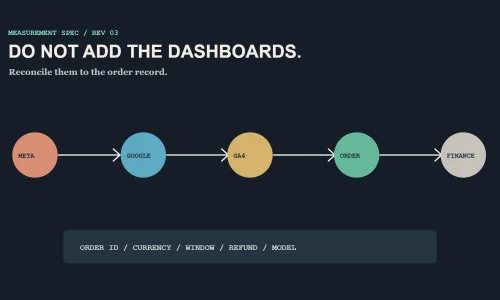
Do not compare revenue credited by each platform by simply adding it. The same project can encounter several campaigns. Keep a deduplicated CRM or order ledger for business totals and show attribution views separately. Differences are expected when systems use different windows and rules; document them rather than selecting whichever dashboard looks best.
Capacity matrix / Can the team operate the proposed portfolio?
| Capability | Search | Professional feed | Visual feed or short video | Specialized publisher |
|---|---|---|---|---|
| Essential input | Query and application language | Role-specific business offer | Demonstrable product evidence | Verified audience and placement |
| Reusable asset | Product/application page | Substantive guide or comparison | Approved footage and objection answers | Relevant landing page or lead asset |
| Main review | Search relevance and RFQ quality | Role fit and accepted conversations | Buyer relevance and creative promise | Delivered inventory and accepted inquiries |
| Internal dependency | Technical product reviewer | Subject-matter contributor | Product, production, and support owners | Procurement and sales reviewers |
Score each required capability as ready, available with a dated action, or unavailable. These labels assess readiness, not channel quality. A platform with a strong theoretical audience may still be a poor next purchase if the team cannot supply its essential input. Conversely, a modest initial test can be practical when the necessary page, offer, and sales coverage already exist.
Make the workload visible in hours and deliverables where possible. If the plan requires a new technical guide, weekly video editing, daily lead classification, and several language pages, assign actual owners. Do not assume one campaign manager can absorb all of it inside the media fee. A portfolio should fit the organization that must operate it.
A launch order for a resource-constrained exporter
Imagine a fictional supplier with a functional product page, known supplier queries, two salespeople, and no steady video production. Its first program can test Search in one supported country while sales builds a reliable inquiry classification habit. The next investment may be an application asset that supports both the page and a later LinkedIn hypothesis.
Adding Meta or TikTok before any usable demonstration exists would create a production project as well as a media test. That may still be worth doing, but it should be budgeted honestly. The decision is not between a modern platform and an old one; it is between funded operating sequences with different dependencies.
A different exporter might already have strong demonstration footage and distributor terms but little named search demand. Its launch order could differ. The role-card method allows that difference without changing the standard of evidence. Each test still needs a market, offer, route, owner, cash boundary, and commercial review.
When leadership requests a fixed percentage split, show the funded questions instead. One amount tests query capture, another produces an approved asset, and a later amount is conditional on the first review. This staged plan makes commitments and dependencies visible while preserving room to adapt to the actual market evidence.
The stop rule belongs in the brief
Record why a test would stop: an unsupported product claim, a broken inquiry path, persistent irrelevant reach, exhausted eligible demand, or economics that no plausible operational fix can support. Also record which conditions would justify extending it, such as relevant but immature sales records. Stopping a test can be a useful result when the decision is based on the intended question.
Keep the learning artifact after the media stops. Save the query map, audience settings, offer, creative versions, page, classified records, and conclusion with dates. The next team should be able to see what was tested and what remains unknown. That reduces the chance of paying again to rediscover the same constraint under a different platform label.
Decide when the budget is allowed to move
Set the review criteria before launch. A functional failure calls for repair. Repeatedly irrelevant traffic calls for a targeting, query, or message review. A relevant but small sample may call for a longer test or a decision that the opportunity is too limited to justify more work. The action should follow the evidence, not a predetermined platform split.
Distinguish a reallocation from a valid experiment. Moving money because a platform’s last week looked better can change country mix, audience, and offer at once. Save the baseline and identify what the next allocation is supposed to reveal. If the data are too sparse for a confident comparison, state that plainly.
Marketboo’s global paid-media services can be reviewed on the clarity of channel roles, creative dependencies, and sales feedback. An internal team can use hands-on ad coaching to build its own role cards and review rules. The useful platform is the one whose job the team can explain, operate, and evaluate with evidence.
A supplier review can use the same role cards. Ask an agency to identify its proposed first question, the work included, and the evidence it will return. If a proposal recommends every major platform from the start, request the operating rationale and the production capacity behind each one. A smaller plan can be expanded after the first review; an oversized plan can spend its learning budget before the company has enough staff to interpret it. The useful comparison is the funded work and the decision it supports, rather than the number of platform logos on the proposal. The best ad platforms for B2B export lead generation are those the team can fund, operate, measure, and support in each market.
How to Choose an Advertising Platform for B2B Export Leads
- Map the product and markets. List products, applications, serviceable countries, buyer roles, and the sales constraints a campaign must respect.
- Name the buyer’s task. Describe whether the buyer is searching, comparing professional solutions, or discovering the product through visual content.
- Write a test question. Give each candidate channel one answerable question, such as whether relevant searches exist or a defined audience responds.
- Match the offer and page. Check that the campaign has a relevant destination, useful product information, a credible next step, and a staffed lead route.
- Map operating requirements. List creative, translation, landing-page, tracking, approval, and follow-up work; assign an owner and check team capacity.
- Compare the full test cost. Include media and stated service, creative, localization, implementation, and follow-up assumptions. Keep unknown costs visible.
- Define measurement before launch. Separate platform conversions from contactable inquiries and sales-accepted leads; name the data source for each.
- Review before expanding. Compare the test question with lead quality and workload. Record what is learned and the condition for continuing or stopping.
FAQ
What are the best ad platforms for B2B export lead generation?
No single platform fits every exporter. Compare Google Search, LinkedIn, Meta, TikTok, or specialist media against buyer task, market, offer, capacity, and follow-up.
Should a B2B exporter choose Google Ads or LinkedIn Ads?
Treat it as a buyer-behavior test. Search may fit expressed demand; LinkedIn may be worth assessing when the professional audience and offer are defined.
Can Meta or TikTok work for B2B products?
Consider them when suitable creative can explain the product and the team can qualify and follow up on responses. Validate the fit with a bounded test.
How should I split budget across advertising platforms?
Start with business questions, eligible demand, test costs, and operating capacity. Set a review rule instead of applying a universal percentage.
Do social-platform usage statistics prove B2B lead potential?
No. Population-level usage describes surveyed platform use, not advertising reach, buyer intent, or lead performance for a particular market.
Which metrics should I compare across channels?
Report spend and platform conversions separately from contactable inquiries, accepted leads, quotes, and later outcomes, with periods and attribution limits.
How many channels should a small export team launch?
Choose a scope the team can fund, operate, and review. Give each test a clear owner, offer, and sales handoff.