
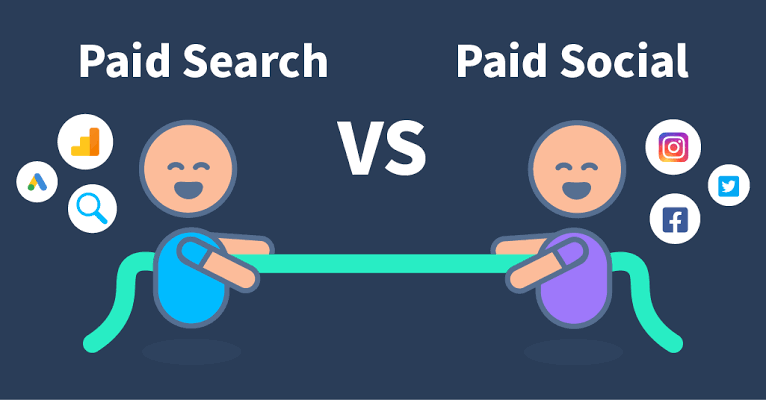
Paid social vs paid search is a choice between different ways to meet a potential customer, not a choice between “brand” and “sales.” Paid search can respond to a person expressing a need in a query; paid social can place a message in front of someone who may not be looking for the product yet. Either can support discovery, consideration, or conversion depending on the offer, audience, format, and measurement. To pick a first channel, ask where demand already exists, how the sale happens, whether the business can measure a meaningful action, and which creative or landing-page work is ready. If those inputs are unclear, fix the decision before splitting a small budget across both.
Two founders, one launch deadline
On Monday, a small software company has enough money for one test. One founder favors search because a person typing “inventory software for distributors” seems closer to buying. The other favors paid social because the company needs to explain why its workflow differs from spreadsheets. Neither argument settles the decision. The team needs to know whether that search phrase represents an audience it can serve, how many such searches exist, what action matters, and whether the company has a useful demonstration for people who have not yet named the problem.
“Paid search” generally describes ads shown in response to search behavior, often through keyword or query-related campaign paths. “Paid social” describes paid distribution within social platforms, where audiences may be reached through platform-selected or advertiser-defined signals and creative plays a larger role in making the message relevant. Exact targeting, campaign types, and controls vary by platform and account. These definitions are practical, not exhaustive product taxonomies.
The wrong first question is “Which channel is cheaper?” Cost depends on the market, competition, offer, audience, landing experience, objective, and measurement setup. A low-cost visit that never becomes a viable prospect may be more expensive in business terms than a higher-cost visit that advances a qualified buyer. The team should compare the cost of the next useful step, then assess what can be learned from the test.
Define the two routes before you compare them
Paid search is often a good fit when people can express the need in language that maps to an offer. The ad and destination should answer that need without overpromising. The query provides context, but not certainty: a searcher may be researching, comparing, troubleshooting, or seeking a free alternative. Search terms and downstream outcomes help the team learn which intent is valuable.
Paid social is often a good fit when a visual demonstration, story, or audience-specific message can introduce the offer or make an existing need feel urgent. A person who watches or clicks may still be early in the decision. A clear next step can be a useful action, but it should be measured against the business objective. Engagement does not automatically mean demand, and a lead form does not automatically mean sales readiness.
In practice, the channels can work together. A person might discover a product in a video, search the category later, and then return through email. A sales prospect may see a social post before searching a competitor comparison. That is why the same customer may appear in more than one reporting system. The business should keep platform results separate, align the reporting period, and use an agreed business source for revenue, qualified leads, or another final outcome.
Match the channel to the buyer’s current task
| Buyer situation | Search may be the first question when… | Social may be the first question when… | What to verify |
|---|---|---|---|
| The need is explicit | People use recognizable queries to find a solution | Search language is weak, but the audience can be reached through relevant context | Query quality, audience fit, and actual downstream action |
| The product needs explaining | Searchers understand the category and are comparing options | A demonstration or story makes the problem and solution clearer | Whether the landing page and creative communicate the same offer |
| The sales cycle is long | Prospects research repeatedly and the company can serve comparison intent | Education and follow-up can keep the company in consideration | How a lead is qualified and how sales feedback returns to marketing |
| The team has limited assets | Product details, proof, and relevant pages are ready | Several useful creative angles can be produced and reviewed | Content capacity, claim evidence, and destination quality |
| Measurement is incomplete | Query-level observations can still be reviewed, but conversions are not yet trusted | Platform event data needs validation before optimization | The source of truth, event definition, and unresolved gaps |
Use the table to identify the most important uncertainty. It is not a performance ranking. “Search may be the first question” means assess whether the path is viable; it does not mean launch without checking query quality or economics.
Four inputs that change the answer
Demand language
Can customers describe the problem in words they actually use? Search can reveal those words, but the team still needs to check whether the query is commercially relevant, within the business’s service scope, and connected to a useful destination. If the category is emerging or the product solves a problem people do not label, a social story may be a better first experiment. Customer interviews, sales calls, support questions, and existing search query data can all inform the language; none should be mistaken for a complete market estimate.
Sales cycle and follow-up
A one-session purchase and a six-month business purchase require different review periods and follow-up. Search may capture a high-intent moment, but the prospect may need a demo, a technical review, or a conversation with finance. Paid social may introduce the company earlier, but the sales team needs a way to tell whether that contact progresses. Choose a metric that reflects the buying process, such as a qualified inquiry or completed purchase, and define what makes it qualified before launch.
Creative and landing readiness
Search ads rely on a relevant answer and a page that delivers on the promise. Paid social needs a message capable of earning attention and moving the person to a next step. Both rely on the offer. If the website has no helpful landing page, the first investment may be page work. If the team has no proof for its strongest claim, the first investment may be evidence gathering. Media can amplify a clear offer; it cannot make an unclear one easier to trust.
Budget and tolerance for uncertainty
A small budget should answer a narrow question. If the company divides it among five platforms, two audiences, three offers, and multiple goals, it may collect activity without learning which assumption mattered. The ceiling should come from cash capacity and the business’s willingness to learn at a known risk. A fixed number from another company is not a substitute for a budget decision tied to your margin and sales cycle.
For instance, a fictional consultant may decide to test one search campaign around a service-specific query because the company already receives relevant inquiries and has a page that explains the service. A fictional home-product brand with a new item may instead test two paid-social demonstrations because there is little category search behavior and shoppers need to see the product in use. Neither scenario establishes a general rule. The first choice is based on inputs the team can inspect.
A conditional channel decision tree
Use these questions in order. If a question cannot be answered, record what evidence is missing rather than forcing a score. The matrix is a prompt for investigation, not a scorecard that can choose a channel without business context.

Channel signals to compare
| Signal | Search deserves a test when | Paid social deserves a test when | Evidence to collect first |
|---|---|---|---|
| Buyer demand | People describe the problem in a specific query | The audience may recognize a need after seeing a demonstration | Customer language, query research, and sales notes |
| Offer explanation | A concise answer can satisfy the searcher’s next question | Visual proof or a story helps explain the offer | Landing-page fit and available creative concepts |
| Sales path | The page can answer a high-intent request | The company can follow up on newly created interest | Response capacity and lead-quality definitions |
| Measurement | The business can connect a query-led visit to an outcome | The business can separate attention from qualified action | Event checks, CRM stages, and a consistent review window |
- Can you define the business action? If not, decide whether the goal is a qualified lead, a purchase, an appointment, or another action that matters. Do not optimize toward a proxy simply because it is easy to count.
- Can your buyer express the need in a query? If yes, review search language, search volume data from an approved source, competition, and page fit. If no, identify the audience or situation where a paid-social message could make the need recognizable.
- Does the product need a visual or narrative explanation? If yes, assess whether the team can develop specific, supportable creative concepts. If no, a direct search response may be easier to test, provided relevant demand exists.
- What is the next step in the sales process? A direct order, quote request, trial, consultation, or demo may require different landing experiences and review windows. Make sure the channel can send people to the right next step.
- Can the business observe quality after the click? For leads, connect marketing activity to qualification and sales feedback where feasible. For ecommerce, reconcile orders and contribution rather than counting every platform-attributed sale as incremental.
- What can the budget realistically answer? Choose one channel and one core hypothesis if the budget cannot support a fair comparison. Keep the exposure within an approved limit and name the review date.
- What finding would make you change course? Write down both a continue signal and a stop or revise signal. If there is no possible observation that would alter the plan, the test is not designed to learn.
This decision tree is useful when teams disagree because it turns preference into questions. One person can still favor search, another social, but both should be able to name evidence that would support or weaken their case.
How to choose the first channel in a working session
- State one customer problem. Describe who faces it, when it occurs, and what they currently do. Avoid a broad phrase like “reach more people” as the campaign objective.
- Write the desired action. Choose an outcome the business can define and the relevant team can observe. For a lead campaign, specify what makes an inquiry qualified; for ecommerce, identify the order event and contribution source.
- Map the path to the action. Draw the search or social touchpoint, destination page, next step, and any sales or support follow-up. Note where a buyer could drop out.
- List the strongest evidence you already have. Use customer language, search terms, product analytics, sales notes, and past campaigns with dates and definitions. Mark assumptions separately from observations.
- Pick the channel that answers the biggest current uncertainty. If you need to know whether people search for the offer, search may test that. If you need to know whether a demonstration makes the offer understandable, social may test that.
- Set one test boundary. Record budget cap, time window, owner, technical checks, and pause authority. Make the amount a business decision, not a copied industry rule.
- Decide how you will review. Set the same reporting window and define where results will be read. For a long sales cycle, include a later quality review instead of judging the campaign only by early clicks.
- Record the learning and next action. Write what happened, what it might mean, what remains unknown, and what one next action follows. Keep the experiment’s scope attached to the conclusion.
The output should be a one-page channel decision, not a 40-slide debate. It should show the chosen question, why the channel fits, what evidence supports the choice, what the test cannot prove, and who owns the next review.
A hypothetical example: a small B2B service firm
Suppose a cybersecurity consultancy wants more conversations with operations leaders. The founder can name two possible routes: search for a specific compliance-related need, or a paid-social campaign offering a short readiness checklist. The team has not yet validated how many local firms search for the exact service. Its sales team also says that prospects usually need an initial assessment before they request a proposal.
The team should not claim a certain number of buyers exists based on one keyword tool or a handful of conversations. It can treat search demand as a question to investigate, then test a narrow campaign if the query set and landing page match the firm’s service. It can also test whether the checklist is relevant to a defined audience and whether the resulting inquiries meet the firm’s qualification criteria. The choice depends on which uncertainty it wants to resolve first and whether its budget can support both tests.
For the exercise, assume the firm has a $2,000 approved test ceiling. That number is hypothetical. The owner could reserve some of the budget for search and some for paid social, but a split is only useful if each portion can generate enough signal to inform a decision. If not, select one route, hold the other as a follow-up, and choose the test with the clearer measurement and best available inputs.
The paid-social version could be a short explanatory video showing the checklist’s use, while the search version could address a specific service query with a landing page describing the assessment. For each one, the firm should record its intended action. A checklist download is not automatically a qualified consultation; a search click is not automatically a qualified buyer. Sales follow-up needs to capture whether the prospect fits the service, what triggered interest, and whether the next step happened.
At review, the team should compare qualified conversations, not just platform-reported lead counts. If the paid-social route produces more forms but fewer relevant companies, the forms are not necessarily a success. If search yields fewer but stronger inquiries, the team should calculate the economics of that path and account for the long sales cycle. If both routes produce little useful data, revisit the audience, offer, page, and measurement before declaring either channel ineffective.
That review still cannot establish causality perfectly. The result may be influenced by seasonality, sales response speed, brand familiarity, and other touches. A responsible conclusion states what was observed, under which settings, during which period, and what the business will test next.
Keep attribution from becoming the argument
Search and social reporting can each credit a conversion based on their own settings and measurement systems. If a buyer sees a social ad, later clicks a search ad, and then purchases after receiving an email, multiple reports may describe the journey differently. The correct response is not to choose the dashboard that supports a preferred budget. It is to define the business outcome and keep the reporting context visible.

Google Analytics’ current attribution documentation explains how attribution approaches assign credit across touchpoints. Platform features and settings may change, so the analytics owner should consult current documentation and account configuration. Use one agreed revenue or CRM source for business decisions, record the platform views separately, and align the date window before comparing channels.
If the organization has enough volume and operational flexibility, it may consider a holdout, geo-based comparison, or another experiment to estimate incremental impact. If it does not, use observational results as observations. A before-and-after increase is not proof that advertising alone caused the change. Note price changes, sales promotions, seasonality, email activity, inventory, and site updates that could affect outcomes.
When paid search deserves the first test
Consider search first when there is a clear, commercially relevant query set; the business can serve the demand; the landing page answers the query; and the team can assess downstream quality. Search can be especially useful when the customer is actively comparing solutions or needs a specific service. The team should still monitor query relevance and exclude searches that do not fit the offer based on actual account evidence.
Delay search if the category language is poorly understood, the offer is not ready, the page does not match the query, or the service cannot meet the demand. Low search volume can also make a small test difficult to interpret. In that case, use customer research or a different way of learning rather than forcing budget into a campaign with no clear question.
When paid social deserves the first test
Consider paid social first when the offer benefits from a demonstration or story, the team can produce several meaningful creative ideas, and the audience context can be described without relying on unsupported assumptions. It may also help a business test which problem statement resonates before a customer is ready to search for a specific product. The team needs to define what counts as a useful action beyond impressions or shallow engagement.
Delay paid social if there is no compelling creative, no evidence for the message, an unclear destination, or no capacity to follow up on leads. If the product is regulated or sensitive, route claims and audience choices through the appropriate reviewer. If the creative depends on a creator’s post, confirm the current permissions before building the campaign around it.
Marketboo’s global paid media service describes cross-channel campaign support. If a team wants help with the decision itself, ask for a review that begins with the business outcome, margins, sales path, and data quality. Any proposed channel role should be testable against the company’s own results rather than presented as a universal ranking.
When the fastest answer is to wait
Teams sometimes choose a channel because they have a deadline, not because the campaign is ready. A date on the calendar can be a real business constraint, but it does not make an unknown event trustworthy or a weak landing page convincing. If a launch must proceed, narrow the promise and the test. Choose a conservative action the business can observe, document the open issue, and schedule a follow-up review. Do not present an early, incomplete signal as a settled channel decision.
Waiting can also be an active marketing choice. The team can collect customer language, prepare a useful page, confirm the offer, check available query data, or create a small set of social concepts. Each task reduces a different uncertainty. If demand is unclear, customer conversations and query research may help. If the creative is weak, production may be the constraint. If conversion data is missing, analytics implementation may deserve priority over media.
For a small business, protect the owner from comparing a search campaign that targets a specific service query with a broad social campaign that introduces the company, then asking which one “won.” Their jobs differ. Define an outcome that fits each role or design a fair test with one shared business measure. Keep the results separate until the overlap and attribution settings have been reviewed.
Questions teams ask about paid social vs paid search
What is the difference between paid social and paid search?
Paid search reaches people in a search context tied to their query or shopping behavior. Paid social distributes advertising in social-platform environments where creative and audience context can introduce or reinforce a message. Exact campaign features vary by platform.
Is paid search better for leads?
It can be useful when prospects actively search for the service and the business has a relevant landing page. It is not automatically better: query quality, qualification, cost, sales follow-up, and the buying cycle determine whether the leads are valuable.
Is paid social better for brand awareness?
Paid social can distribute a message to an audience that may not be actively searching, but the campaign still needs a defined audience, creative, and meaningful measurement. Reach and engagement alone do not prove that awareness translated into demand.
Should a small business run search and social together?
Only if the budget and measurement plan can support both tests. Align the business outcome and reporting window, note audience overlap, and define what each channel is meant to do. If the budget is limited, begin with the clearest hypothesis.
How much should I spend on paid search or paid social?
There is no fixed amount that fits every company. Set the ceiling from cash capacity, margins, buying cycle, and acceptable uncertainty. Label sample figures as assumptions and review actual results against business outcomes.
How do I compare paid social and search results?
Compare the same business outcome over the same time window and identify the source of revenue or qualified leads. Keep each platform’s attribution settings visible because the systems may assign credit differently and may overlap.
What if I cannot measure conversions yet?
Define the conversion event and ask the analytics or web owner to validate it before optimizing toward it. A limited test may still generate directional observations, but report the limitation and do not present clicks or views as sales.
Conclusion: Choose the test that can change a decision
The practical answer to paid social vs paid search is to start where the buyer’s next step is clearest and the business has enough evidence to evaluate it. Search may be the better first question when relevant demand already exists; paid social may be the better first question when a demonstration can create understanding. In either case, define the action, margin, measurement source, budget boundary, and review condition before launch. Then let observed evidence—not platform loyalty—shape the next allocation. If those inputs are difficult to align, request a cross-channel paid media assessment built around the company’s own sales process.