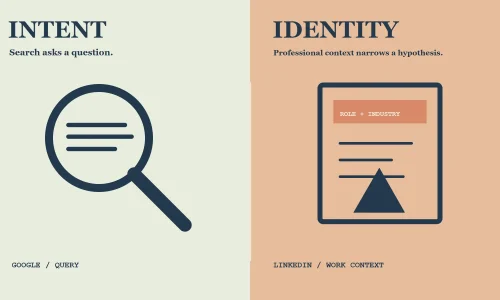

Direct answer: LinkedIn Ads for B2B SaaS make sense when the team can define a professional audience, offer a relevant next step, and measure more than form volume. Plan the path from company and role criteria to creative, landing page or lead form, CRM qualification, and sales follow-up. Estimate a budget from your own assumptions—expected clicks, conversion rate, and qualification rate—rather than copying an unverified cost benchmark. Separate content engagement, marketing-qualified leads, sales-accepted leads, and completed demos. The platform can help reach a chosen professional context, but the campaign still depends on message fit, audience size, tracking, and sales operations.
A campaign report can show strong lead volume while sales considers only a small share worth calling. That gap is not solved by celebrating the cost per form fill. For B2B SaaS, LinkedIn planning needs to connect the audience definition to the offer, the offer to the next step, and the next step to the CRM stages that sales actually uses.
This article follows that chain. It does not assume LinkedIn is always the right platform or quote a universal cost per click. It gives a planning method for teams considering professional audience targeting, content promotion, lead generation, or product demonstrations. The central test is whether the campaign can produce a learning signal that the company can act on.
Plan LinkedIn Ads for B2B SaaS by buying stage
The audience, offer, and CRM path should reflect who is evaluating the software and what they need next. A demo is one possible conversion, not the only useful signal.
Use LinkedIn’s current conversion tracking documentation and Marketing Solutions Help Center to confirm the campaign controls available to the account.
First check if LinkedIn fits the buying motion
LinkedIn may be relevant when professional role, company context, or industry is important to the buying decision and the audience is reachable at a scale the business can support. It may be less suitable when the target list is extremely small, the offer is not clear, the product is purchased through a fast self-serve path, or the organization cannot work the resulting leads. Check current audience tools and account availability rather than relying on assumptions about job-title precision.
The company should compare cohorts at similar maturity and preserve the assumptions behind its funnel model. A current lead count may not yet reflect the eventual sales outcome.
Map how the product is bought. Who identifies the problem? Who evaluates the software? Who approves the purchase? Who implements it? The campaign may need to reach more than one role, but each ad should speak to a coherent need. If the business sells to a committee, a single ‘decision maker’ persona can flatten the real process. Document primary and secondary audiences and decide which one the test is designed to learn about.
Audience-to-offer map
| Stage | Offer example | Primary observation | Downstream check |
|---|---|---|---|
| Problem discovery | Educational guide | Qualified engagement | Target-account and role fit |
| Evaluation | Comparison or workflow asset | Intentful content response | Sales question or product interest |
| High intent | Product demonstration | Demo request or booking | Attendance and use-case fit |
| Post-response | Follow-up sequence | Response time and progression | Accepted lead or opportunity |
Build an audience that can be explained
Translate the customer profile into professional criteria the campaign can actually use: role family, seniority, company attributes, geography, or other currently supported signals. Keep the selection narrow enough to fit the offer but broad enough to collect observations. Avoid stacking so many filters that the audience becomes too small to deliver or measure. If a company list or matched audience is involved, validate its source, freshness, permissions, and current platform requirements.
Create a short audience statement outside the ad interface: ‘This campaign is for operations leaders at software companies with an implementation problem, not for every technology employee.’ Then map each selected setting to that statement. This makes review easier and helps the team detect contradictory targeting. Save a screenshot or export of the final audience settings under internal policy. Recheck the audience when the company changes its target market, sales coverage, or product positioning.
Choose an offer before choosing the format
A product demo is valuable when the buyer is ready to evaluate software and the sales team can respond with a useful conversation. It is a poor default for someone who first needs to understand the category or identify an operational problem. Earlier offers can include a concise guide, webinar, implementation checklist, or comparison resource, provided each one is substantive and connected to the product’s actual audience.
Select a format based on the information the audience needs and the friction the business can support. A native lead form may reduce steps, while a landing page can provide more context and qualify intent. These are trade-offs, not a universal performance ranking. Review the current product options, form behavior, and data terms. Keep the ad’s promise, the form’s questions, the privacy notice, and the follow-up message consistent. If the lead expects a guide and receives an immediate sales pitch, the campaign has created a trust problem.
Calculate budget from assumptions you can defend
Build a scenario model from internal values. Let planned spend be B, expected click cost be C, landing-page conversion rate be R, and qualification rate be Q. The rough scenario is clicks = B ÷ C, responses = clicks × R, and qualified responses = responses × Q. Those inputs are assumptions until replaced by observed account data. The model shows sensitivity: if qualification falls, a cheap response may still be expensive per qualified lead.
Use low, base, and high cases only when the team can explain the assumptions. Do not present the resulting count as a forecast. Include sales capacity, expected response time, demo availability, and the time needed for leads to mature. If the company has no relevant historical data, begin with a learning budget and state that the first phase estimates the inputs rather than proves a scalable acquisition channel. Compare currencies and date windows consistently when working across markets.
Keep the model auditable
| Planning input | Formula or rule | Source to use |
|---|---|---|
| Estimated clicks | Budget ÷ assumed click cost | Comparable account history or test assumption |
| Responses | Clicks × assumed page/form rate | Internal analytics with period and page context |
| Qualified responses | Responses × qualification rate | CRM cohort with agreed definition |
| Cost per qualified lead | Spend ÷ qualified responses | Same currency and maturity window |
| Demo progression | Attended demos ÷ booked demos | CRM or scheduling records |
Match creative to the buyer’s stage
Write the opening around a recognizable work problem, not a product claim that assumes the reader already understands the category. Use specifics the company can support: the task, team, or decision the software helps with. Keep proof precise. A customer name, adoption figure, integration statement, or time-saving claim needs authorization and evidence. If a claim is only true under a configuration or workflow, say so in the ad or destination.
Consider a sequence rather than a single all-purpose ad. A problem-led asset can introduce the issue; a comparison can help a more informed evaluator; a demo invitation can serve a later stage. The message should not imply that every viewer has already engaged with prior content. Creative can help clarify audience fit and reduce irrelevant responses, even when targeting settings cannot perfectly identify every buyer. Have sales review the language for objections and the product team confirm factual details.
Make CRM stages part of the campaign design
Before launch, define what marketing calls a qualified lead and what sales calls accepted. Agree which fields are required, who updates them, and when a record becomes an opportunity. A form fill, a marketing-qualified lead, a sales-accepted lead, a booked demo, and an attended demo are not interchangeable. Keep the conversion event in the campaign aligned with the behavior the team wants to optimize, while reporting downstream stages separately.
Test routing with a sample submission. Verify ownership, alerts, duplicate handling, market assignment, and the next communication. When using offline conversion or enhanced measurement options, validate current product documentation and the organization’s data practices. Send only the approved data required for the intended measurement. The feedback loop is useful only if sales records are timely and consistent. Otherwise the platform receives noisy signals and the dashboard rewards lead volume that the business does not value.
Diagnose demo quality, not only conversion rate
Review how many booked demos are attended, fit the target profile, include a relevant use case, and progress to the next stage. Record why a lead was rejected: wrong company, wrong role, student or vendor inquiry, no use case, invalid contact, or duplicate. The categories should reflect actual sales decisions. If one campaign produces fewer leads but more useful conversations, cost per lead alone will obscure its value.
Use cohort maturity. A recent campaign may have many leads that have not yet completed a sales cycle. Compare cohorts at similar ages or mark them as incomplete. Keep attribution rules visible, especially when paid social assists a later search or direct visit. A rising demo count may coincide with an event, product launch, or sales outreach. Describe correlation as correlation unless the design can support a causal statement. This discipline builds trust between marketing and sales.
A practical campaign map
For a new SaaS launch, one campaign might promote a product-category guide to an operations audience, while a second bounded test invites higher-intent visitors to a demo. Keep budgets, objectives, and CRM stages distinct. The first campaign should not be judged only by immediate demo volume if its job is education. The second should not be judged only by form submissions if sales quality is central.
Before launch, set the hypothesis, audience, offer, landing path, field requirements, success measures, and stop condition. Have the relevant owners review product claims, audience settings, data use, and follow-up. After the test, examine who responded, what they did, and which sales stages were reached. Decide whether to refine the audience, improve the offer, or pause. This is a planning scenario, not a case study or evidence of typical platform outcomes.
A funnel model is a conversation with finance and sales
Before spending, confirm the units in the model. Is budget net media spend or inclusive of production and fees? Is the response a form fill, a booked meeting, or an attended demo? Is qualification assessed immediately or after a review? These distinctions change the denominator. Ask finance how currency and taxes are handled and ask sales how long a lead usually needs to mature. Keep the calculation simple enough that both teams can audit it. A spreadsheet should expose assumptions, not hide them behind a single ‘expected leads’ cell.
Use audience size as a trade-off
A very narrow professional audience can align closely with the ideal customer while limiting delivery and learning. A broader audience may reach adjacent roles but require stronger creative qualification and CRM review. The team should document which trade-off it is testing. If company attributes or roles are layered, inspect whether each restriction serves the buying thesis. Do not narrow by default because a profile sounds precise. Precision in settings is useful only when it corresponds to actual buying authority, influence, or a customer task.
Create a meaningful demo handoff
A booked demo is the beginning of a conversation, not necessarily a successful conversion. Tell the buyer what the meeting covers, who will attend, how long it takes, and what preparation is useful. Route the booking to a representative who understands the campaign offer. Capture whether the prospect attended and whether the conversation matched the advertised use case. If prospects repeatedly cancel or arrive with the wrong expectations, review the form, creative, confirmation message, and sales response rather than raising the budget.
Plan for long cycles
A SaaS purchase may involve legal, security, procurement, IT, and budget review after the first demo. A campaign evaluated too early can undercount its commercial contribution. Establish cohort windows with sales and analytics, and show immature opportunities separately. Do not leave them out of every report, but do not count them as closed revenue either. Use leading indicators such as accepted leads or completed evaluations only when definitions are stable and the company understands their relationship to later stages.
A decision after the pilot
At the review meeting, ask four questions: Did the campaign reach the intended professional context? Did the offer attract people with a real problem? Did the sales team receive and work the responses? Did the observed quality justify another test? The answer may be ‘not yet’ if the sample has not matured. If the audience fit is good but the offer is weak, change the offer. If the offer is sound but leads are outside the target, revisit audience and creative. Make the next test explainable and avoid scaling a result the team cannot reproduce.
Operational details before expanding spend
Think through the buying committee
A SaaS deal may involve a champion who experiences the problem, a technical reviewer, a budget owner, and procurement. They will not all respond to the same promise. A campaign can target one role for a specific learning objective while sales engages other stakeholders later. Record which member the test is intended to reach and what evidence will show fit. Do not infer the full committee from one form submission.
Use lead-form questions with restraint
Each field adds friction and should serve a clear purpose. Ask only what helps route or qualify the conversation, and explain why it is needed. If a question is used to disqualify, make sure sales agrees with the rule and the form does not exclude an appropriate buyer by accident. Review the current platform form options and privacy notice. Test the complete submission and confirmation experience on a mobile device before activation.
Coordinate the demo calendar
A campaign that generates requests for meetings the team cannot schedule creates a poor first impression. Confirm sales capacity, time zones, market ownership, and meeting availability before launch. Monitor the time from request to response and the percentage of booked demos that occur. These are operational indicators. If a request is delayed or mishandled, repair the process before declaring the audience weak.
Make scale a separate decision
A test that works for one segment does not prove every product line, country, or role will work the same way. Before increasing spend, check whether the audience can expand without losing fit, whether the offer remains relevant, and whether sales has capacity. Keep a new hypothesis for each expansion. Scale should be approved from mature, reproducible evidence and commercial judgment, not from a short-lived spike in form submissions.
Protect budget from measurement gaps
If conversion tracking is incomplete or the CRM cannot distinguish a qualified demo, do not compensate by increasing spend to create more data. Repair the measurement path or define a smaller diagnostic test. Confirm that the selected event does not double-count reloads, calendar confirmations, or imported conversions. Ask the analytics owner to document the exact event and window. Better instrumentation does not guarantee performance, but it prevents the team from making budget decisions on a number that does not mean what its label suggests.
Review role and account fit together
A lead can have the right job title and still come from a company outside the target segment. A company can match the profile while the contact has no influence on the purchase. Build a practical review rule using both organization and person context, then note uncertain records. Do not demand personal details that are unnecessary for qualification. The right amount of form friction depends on the offer and sales process. Review rejected examples with marketing and sales before changing audience settings.
Document a mature outcome before launch
Agree what counts as a meaningful result after the first response. A booked call may be useful, but the company may also care about attendance, a relevant use case, technical fit, or progress to a validated opportunity. Decide which fields sales will record and what period is needed for the result to mature. Keep early responses visible without calling them pipeline. A shared definition makes the eventual review more credible and helps marketing refine its offer without asking sales to interpret a different success metric each week.
Set the demo-quality definition before launch
The phrase “qualified demo” should be written in operational terms before the campaign starts. For one company, qualification may require a target account and a defined use case; another may include an attended meeting with a relevant stakeholder. The marketing and sales teams should decide who records the status, when it is assigned, and how long a new lead remains immature. Build the budget scenario from the company’s own cost and conversion assumptions, then show each step separately so a reviewer can change one input without hiding the effect. Once the campaign is live, compare booked, attended, accepted, and later-stage outcomes as distinct events. This creates a fairer basis for a channel decision than comparing a form cost with a mature sales result. Set the test ceiling by the amount the company can spend to learn, not by a generic CPC target. Show the assumptions for reach, response, sales review, and conversion maturity in separate cells or written fields. If one assumption changes, update the scenario and explain why. This allows finance to see what the budget buys in terms of learning conditions while avoiding a promise that a particular number of demos will result.
Plan and assess LinkedIn Ads for B2B SaaS
- Write the buying committee roles and the specific customer task the campaign will address.
- Check current LinkedIn audience controls and confirm the target can be reached at a workable scale.
- Translate the customer profile into settings and document why each setting belongs in the audience.
- Choose a useful offer and decide whether a lead form or landing page best serves its context.
- Review every product, customer, integration, and performance claim against approved evidence.
- Model spend, clicks, responses, qualification, and demo scenarios with labeled assumptions.
- Define CRM stages, required fields, routing, sales ownership, and response expectations before launch.
- Test a submission and verify event tracking, currency, duplicates, notices, and record flow.
- Launch a bounded campaign with a written hypothesis, period, budget, and stop condition.
- Review lead quality and mature pipeline stages with sales before scaling or changing the audience.
Where a SaaS campaign loses qualification

The campaign optimizes for a convenient proxy
A form submit can be counted quickly while demo attendance and sales acceptance mature later. Keep the immediate event visible, but judge the campaign with downstream stages and a stated maturity window.
A demo is offered before the buyer is ready
An early-stage prospect may need a product explanation or comparison before a sales call. Match the destination to the problem the creative promises to solve.
Budget math ignores response capacity
A plan can create more requests than the sales team can answer promptly. Model lead handling alongside media assumptions and decide who owns routing, follow-up, and missed appointments.
Audience precision is assumed from settings
A detailed targeting configuration does not itself establish buying authority or account fit. Review the profile of actual accepted leads and adjust only when evidence supports the change.

Questions about LinkedIn SaaS campaigns
Are LinkedIn Ads worth it for every SaaS company?
No. Fit depends on reachable audience, buying motion, offer, sales capacity, and the quality of downstream measurement.
How much do LinkedIn SaaS ads cost?
Costs depend on market, audience, format, competition, and account settings. Use current account data or a bounded test instead of an unsupported universal benchmark.
Should the campaign send people straight to a demo?
Use a demo offer when the buyer is ready and sales can respond. Earlier-stage audiences may need education or comparison first.
What is the difference between an MQL and SQL?
The organization must define these stages. A typical distinction reflects marketing qualification versus sales acceptance, but criteria vary by company.
How should I budget a test?
Model clicks, responses, and qualified outcomes from labeled assumptions and plan a ceiling the business can afford to learn with.
Can lead forms replace a landing page?
They are different paths with trade-offs in context, friction, and information. Choose based on the offer and verify current form behavior.
What should I optimize after launch?
Review target fit, qualification, demo attendance, pipeline maturity, tracking, and sales feedback, not only raw lead volume.
A practical decision on LinkedIn Ads for B2B SaaS
LinkedIn Ads for B2B SaaS should connect audience, offer, and CRM follow-up before spend is scaled. The next step is to decide what the current evidence can support, assign the work to an owner, and record the conditions under which the decision should be revisited. The company should compare cohorts at similar maturity and preserve the assumptions behind its funnel model. A current lead count may not yet reflect the eventual sales outcome. Keep examples clearly labeled, platform statements tied to current official documentation, and uncertain claims out of any public promise. For campaign planning and measurement support, review Marketboo’s global paid media services. For internal operators who will manage campaigns, hands-on advertising coaching may be a fit. These service links describe possible scope discussions; they do not guarantee a performance outcome.