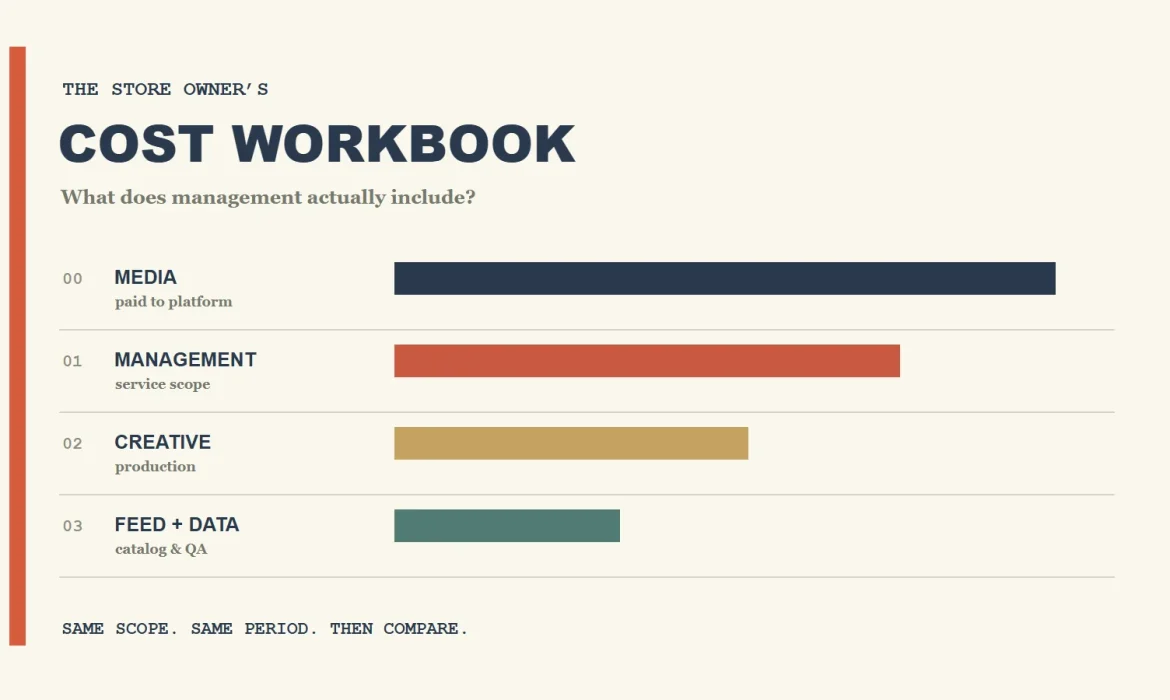
An agency’s monthly quote rarely tells a small store what Google Ads management pricing will actually cost. Media spend is only one line; feed work, creative, tracking, setup, and the owner’s own time can change the total. Google Ads management pricing for a small ecommerce business is easier to judge when every proposal answers the same scope and cash-flow questions.
Quick Answer
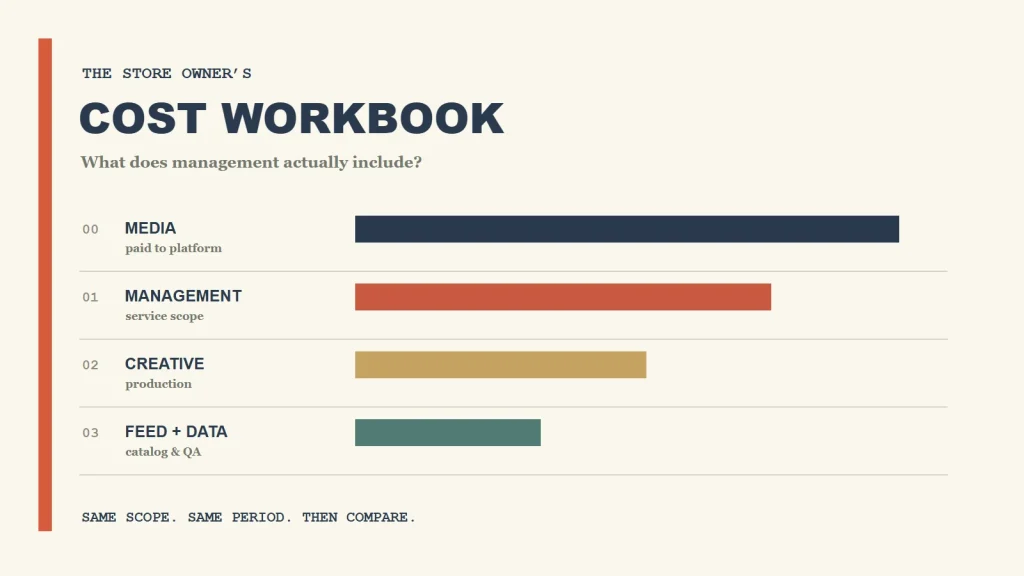
Google Ads management pricing for a small ecommerce business has no single verified rate in this guide; the total depends on what the provider will do and what the store must handle. Compare platform media spend separately from setup, recurring management, creative, product-feed work, analytics, software, taxes, and staff time. Ask every provider to price the same scope and show the fee formula, minimums, excluded work, contract period, and exit costs. Then test the total against the store’s own margins, order volume, fulfillment, and cash flow. Treat case-study ad results as context, not evidence of a standard fee or profit.Inside the cost workbook
- Quick Answer
- Google Ads management pricing for a small ecommerce business starts with total cost
- Tab 1 / Separate the cost lines
- Tab 2 / Translate Google’s budget setting into cash exposure
- Tab 3 / Understand how the management fee is calculated
- Tab 4 / Price the actual operating work
- The product-feed line deserves its own questions
- Tab 5 / Compare equal scope, not equal invoices
- Tab 6 / See whether the store can carry the service bill
- Tab 7 / Read the incentive before accepting a performance clause
- An alternative purchase / Buy guidance when execution is covered
- A fee stress test for a seasonal store
- The quote request that saves a second round of negotiation
- What the campaign case files say about media—and what they do not say about fees
- What the supplied campaign records can tell a store owner
- How to Compare Google Ads Management Proposals
- Frequently Asked Questions
Google Ads management pricing for a small ecommerce business starts with total cost
A small store receives a platform charge, an agency invoice, and several production or software bills. They may arrive in different weeks and use different currencies. Calling the whole amount “Google Ads cost” conceals the decision the owner needs to make: how much cash is required, what work it buys, and whether the orders can support it.
Start with a planning period. A first-month comparison should include setup cash; a recurring-month comparison should identify which setup work does not repeat. A three-month commitment needs its full committed amount as well as a monthly average. A discounted launch month is a poor match for another agency’s regular retainer. Put setup and recurring work on separate lines before comparing totals.
List the store’s operating facts beside the worksheet: active product families, countries, languages, approximate catalog size, promotion frequency, feed condition, existing analytics, and the staff available for approvals. These facts often explain fee differences more clearly than media spend does. A modest budget with a messy catalog can require more work than a larger stable account.
This guide supplies hypothetical calculations rather than a current industry fee survey. Prices should come from written quotes with a date, currency, scope, and provider. The absence of a universal price is not a reason to accept a vague proposal; it is a reason to request the inputs needed for a defensible comparison.
Tab 1 / Separate the cost lines
| Line | What it pays for | Clarification to request |
|---|---|---|
| Google media | Ad delivery on authorized campaigns | Billing owner, campaign budgets, credits, taxes |
| Setup or migration | Initial build and handoff work | Deliverables, acceptance, recurring versus one-time |
| Management | Research, operation, review, reporting | Markets, campaign types, products, cadence |
| Product-feed work | Diagnosing and correcting catalog inputs | Who changes source data and checks the result |
| Creative | Copy, product visuals, video, revisions | Quantity, formats, source files, usage rights |
| Measurement | Event setup, validation, reconciliation | Implementation versus recommendation |
| Website work | Product or landing-page changes | Development, design, copy, testing boundaries |
| Software and client labor | Tools and work retained in-house | Subscription owner and estimated staff time |
Add a column for “included,” “excluded,” or “not yet clarified.” A blank is not the same as free. If the agency can provide an excluded task, request its separate price or change-order rule. If the client owns it, assign an actual person. Otherwise the budget may contain an invisible dependency that delays launch.
Tab 2 / Translate Google’s budget setting into cash exposure
Google’s standard documentation says a campaign may spend up to twice its average daily budget on a given day and calculates the standard monthly spending limit using 30.4 times that budget. An unchanged $50 setting corresponds to $100 in a day and $1,520 under the monthly rule. Confirm the campaign’s applicable conditions and any budget changes. These are platform spending rules, not an agency quote or an order forecast. Google’s overdelivery explanation is the primary source.
Put the platform setting in its own field. A founder saying “we have $1,500 for marketing” may mean total cash, while the agency assumes $1,500 of media plus fees. Resolve that ambiguity before the build. Account authorization should specify who may change budgets and when additional client approval is needed.
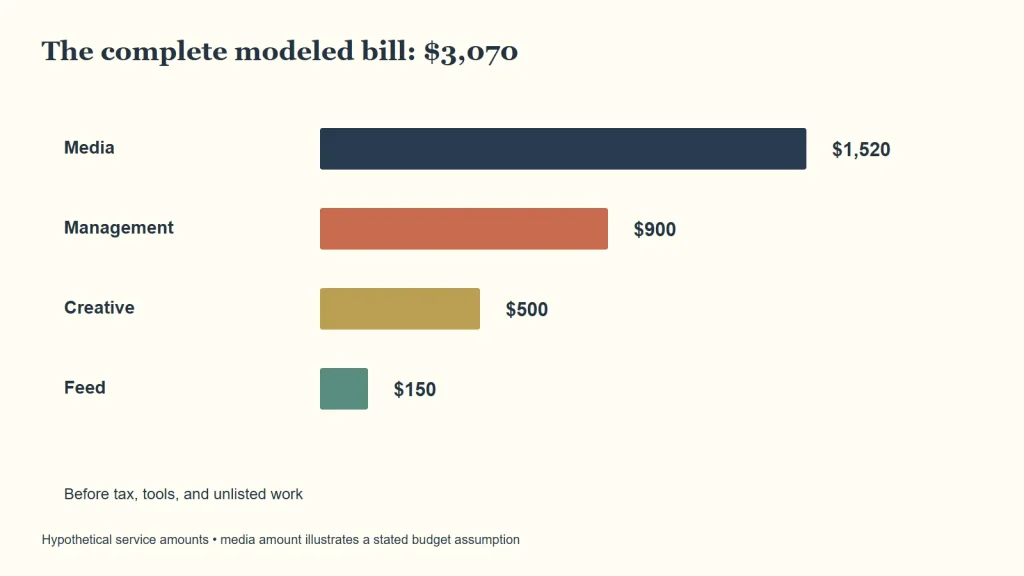
For a fictional month, assume up to $1,520 of media under the stated setting, a $900 management fee, $500 of defined creative work, and $150 of feed cleanup. The modeled total is $3,070 before tax and unlisted costs. None of the service figures is a market-rate recommendation. They show why the agency fee cannot be evaluated without the whole bill.
Payment timing matters. A deposit, platform charge, production milestone, and software renewal may cluster before new orders are collected. Finance should use the actual payment schedule for cash planning rather than dividing every annual or one-time charge neatly into twelve months and assuming that cash is available later.
Tab 3 / Understand how the management fee is calculated
A fixed monthly retainer gives the client a predictable service fee for a defined scope. It may suit a business that wants recurring planning, execution, and reporting. The risk is that scope can remain vague: “ongoing optimization” does not say how many markets, creative reviews, or stakeholder meetings are included. A retainer should specify deliverables and a process for changes in workload. If seasonal activity requires more production, state whether the fee changes or additional work is quoted separately.
A percentage-of-spend model ties the agency’s compensation to media budget. This can scale smoothly when scope grows with spend, but the client should understand the calculation base, any minimum fee, and whether certain costs are excluded. A percentage can rise even if workload does not, or the agency may be incentivized to recommend more spend. Neither outcome is inevitable, but the incentives should be discussed. Ask for a forecast showing how the fee changes at several possible budget levels.
Project pricing covers a discrete deliverable such as an account audit, campaign rebuild, tracking plan, or market launch. The client can see what the project is intended to produce and when it will be reviewed. Project fees work best when acceptance criteria and assumptions are written down. A “setup” can mean many things, from creating a campaign shell to testing a complete lead journey. Specify which tasks, revisions, and handover materials are included.
Coaching or consulting charges for access to expertise while the client keeps more execution responsibility. This can be useful when an in-house marketer needs account-level guidance, a founder wants a review before launch, or a team is gradually taking work in-house. Coaching is not automatically cheaper: the client’s employees must have time to prepare, attend, implement, and follow up. Define session length, preparation, between-session questions, account access, and whether implementation is included.
| Fee model | What it can make predictable | What must be clarified |
|---|---|---|
| Fixed retainer | Recurring agency fee | Scope, markets, cadence, and overages |
| Percentage of spend | Fee relationship to media budget | Calculation base, minimum, and incentives |
| Project fee | Price for a defined build or audit | Deliverables, assumptions, revisions, and handoff |
| Coaching | Access to review and guidance | Preparation, implementation ownership, and support between sessions |
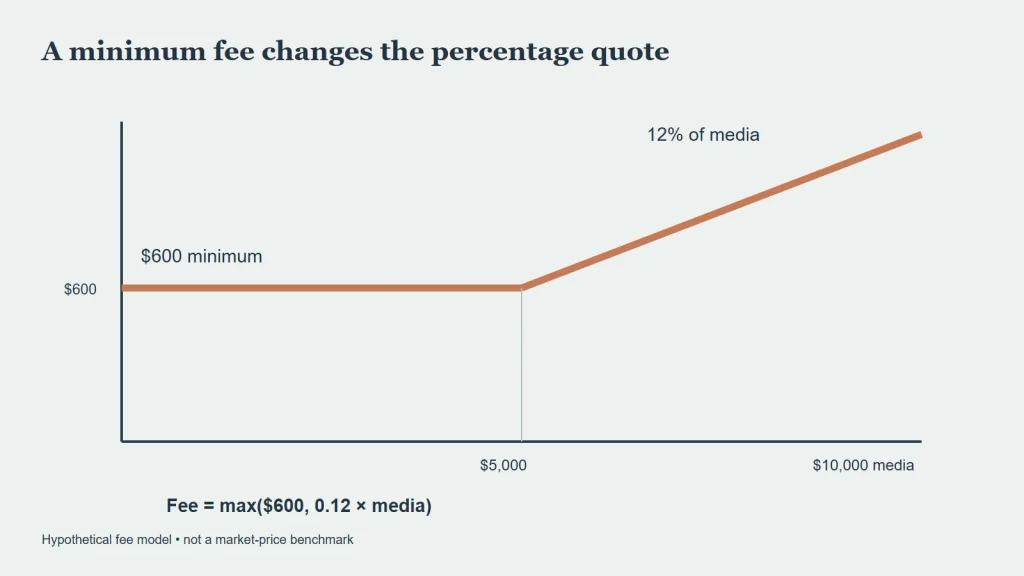
The minimum fee can dominate a percentage quote
Suppose a fictional proposal charges the greater of $600 per month or 12% of media spend. At $2,000 of media, the percentage calculation is $240, so the minimum produces a $600 fee. At $8,000, the percentage calculation is $960, which exceeds the minimum. The owner should compare the actual payable amount at the planned budget, not the percentage printed in the headline.
Ask what is included in the spend base. Does it use served cost, billed media, taxes, credits, or agency-funded tests? What happens if a campaign is paused? Are multiple stores or countries combined? These are contract definitions, not minor accounting details. A percentage model can be workable when the base, scope, and approval rules are explicit.
Performance fees need still more definition. Revenue ROAS can be changed by discounts, returns, attribution windows, and the share of existing customers. If compensation uses a performance metric, specify who calculates it, which costs and revenue adjustments apply, and how late changes are handled. Before signing, ask both sides to work through the fee formula using the records named in the contract. If the arithmetic cannot be reproduced, the clause is not ready.
Tab 4 / Price the actual operating work
Optimization is not one action. It can include reviewing delivery, changing budgets, checking frequency, replacing creative, testing audiences, adjusting placements, auditing forms, or comparing lead quality. Ask the agency to define its own operating cadence and the records it will provide. The provider should be able to explain how it decides whether a change is justified and when it expects to review the result. Avoid language that promises constant improvement without naming what is monitored.
Clarify which changes can be made without approval. A client may allow routine bid or budget adjustments within a limit but require approval for new claims, new countries, large budget changes, or changes to a form’s data fields. The provider should have an escalation route for a disapproved ad, broken destination, or sudden spend anomaly. A written authority matrix helps the team move quickly while keeping commercial and legal decisions with the right owner.
The contract should also specify the reporting cadence. A weekly operational note may be sufficient for a small test, while a monthly review can include sales quality and creative learnings. Decide whether the agency will present raw exports, a dashboard, or both. Set the definitions for spend, platform conversions, unique leads, accepted leads, and revenue. If a metric is unavailable, the agency should say so rather than manufacturing a proxy with an official-sounding name.
The product-feed line deserves its own questions
For a store using product-based advertising, catalog quality is part of the operating system. Ask who reviews titles, identifiers where applicable, availability, prices, variants, shipping inputs, and account diagnostics. The source data may live in the ecommerce platform, a feed app, or another system; the contract should say who can edit it and who verifies the result.
Separate diagnosis from implementation. A monthly report saying “fix feed errors” transfers work to the merchant. A service that corrects approved source fields transfers more work to the provider. Both can be legitimate scopes, but they should not be priced as if they are identical. Ask for a small example of an issue, the proposed owner, and the acceptance check.
Seasonal work also matters. A new collection, a discontinued variant, and a flash promotion can create a different workload from a stable catalog. Agree on the product or change volume included and how exceptions are handled. “Unlimited optimization” is not a useful substitute for understanding what the provider will do when twenty products change at once.
Keep margin information available to the people grouping products. An item with strong revenue and weak contribution should not automatically receive more budget than a smaller, healthier line. The owner can provide approved margin bands rather than exposing every cost detail. The essential requirement is a shared way to recognize which sales the business can afford to acquire.
Tab 5 / Compare equal scope, not equal invoices
Imagine fictional Proposal A at $700 per month, excluding a $500 feed project and all creative. Proposal B is $1,100 per month with the defined feed cleanup included but creative still excluded. Over three months, A’s stated service cost is $2,600 and B’s is $3,300. That $700 difference does not identify the winner until the recurring deliverables, workload, and exclusions are compared.
If B also includes approved landing-page implementation and A only provides recommendations, price the client’s implementation time beside A. If the owner already has a capable developer, the recommendation-only scope may be efficient. If nobody can do the work, a lower invoice may purchase a list of unresolved tasks. The worksheet should reflect the business’s actual capacity.
Use an explicit assumption for owner time. Ten hours at an internal planning rate of $40 per hour adds $400 of modeled labor cost. That rate is illustrative, not a claim about the founder’s wage or a cash invoice. It helps expose the trade between buying service and supplying work internally. Keep modeled labor separate from cash required so neither is misunderstood.
Also compare committed risk. A cancellable monthly service and a six-month minimum may show similar monthly prices but different exposure. Include setup payments, notice periods, unused production credits, tool commitments, and handoff charges. Ask for the total due if the store stops after the first review point.
| Three-month comparison field | Proposal A | Proposal B |
|---|---|---|
| Recurring service fees | Enter written quote | Enter written quote |
| One-time setup and feed | Enter committed work | Enter committed work |
| Excluded creative or development | Add a dated estimate | Add a dated estimate |
| Modeled client labor | Hours × stated internal rate | Hours × stated internal rate |
| Total cash commitment | Cash lines only | Cash lines only |
| Total modeled operating cost | Cash plus disclosed labor model | Cash plus disclosed labor model |
| Exit at the review date | Notice, exports, outstanding fees | Notice, exports, outstanding fees |
Tab 6 / See whether the store can carry the service bill
For a hypothetical store, use $70 of net sales per acquired order and $28 of contribution before acquisition and fixed overhead. Suppose media costs $16 per order and allocated management plus creative costs $8 per acquired order. The remaining contribution is $4. Media-only ROAS is $70/$16, about 4.38, yet the margin remaining for overhead and profit is narrow.
If order volume falls, fixed service costs are spread over fewer orders. A $1,200 combined monthly service and production bill contributes $6 per order at 200 acquired orders and $12 at 100. The fee did not change, but the unit economics did. This is one reason a small store should test service affordability with a range of volumes rather than one optimistic sales forecast.
Do not use revenue alone to solve the model. Include discounts, product cost, fulfillment subsidy, payment fees, and a reasonable returns allowance based on the store’s evidence. Keep new-customer and repeat-order assumptions visible. If customer lifetime value is unproven, show it as a separate upside scenario instead of the only reason the plan appears viable.
A target ROAS is an output of these assumptions, not an agency credential. The operator can work toward it, but competition, customer demand, product fit, and operations affect the result. Ask the agency to explain what it will do when the business model cannot support the observed acquisition cost rather than promising to optimize any product into profitability.
Tab 7 / Read the incentive before accepting a performance clause
Some small businesses ask to pay only when a campaign produces a lead or sale. This can align a provider’s compensation with an outcome, but it can also encourage disputes about definitions or pressure the provider to maximize the easiest event rather than the most useful one. Before accepting such a structure, state which system records the event, which markets count, how duplicate and existing customers are handled, and what happens if tracking fails. Define whether media spend, service fees, returns, and cancellations are included in the calculation.
For lead generation, the phrase “qualified lead” requires a written rule and a timely review process. If sales has ten business days to accept a lead but the agency’s fee is calculated immediately, the measurement window is misaligned. If rejection reasons are not documented, either party may dispute the result. The agreement should set an operational path for cases that are pending or contested. A performance-based arrangement is not necessarily safer than a fixed fee; it simply makes the measurement contract more important.
Review the incentive when the scope changes. A provider paid as a percentage of spend may receive more when budget rises, even if the workload increases only slightly. A fixed fee may make budget changes easier to forecast but require a new scope when creative or markets expand. A project fee may reward a clear delivery but not ongoing improvements. Each structure can be appropriate if the commercial reason is transparent and the client retains a way to challenge unsupported recommendations.
An alternative purchase / Buy guidance when execution is covered
Some businesses do not need an agency to own every task. A founder may have an employee who can manage campaigns but needs help with account structure, conversion events, or budget decisions. In that situation, coaching can provide an expert review while the business retains day-to-day access and builds internal knowledge. The fee should state whether the provider reviews a live account, prepares between-session notes, answers questions asynchronously, or implements changes. “Training” can otherwise mean anything from a recorded course to hands-on account work.
Full management may be a better fit when the company lacks operating capacity, needs multiple campaigns managed consistently, or cannot assign internal ownership for daily work. A hybrid arrangement can split responsibilities: the agency manages delivery and reporting while the client owns product strategy, sales qualification, and approvals. The arrangement should not leave critical tasks between teams. Write a simple responsibility matrix and name one person accountable for the handoff.
Do not compare a coaching fee to a retainer without including internal time. The employee who attends training will need time to prepare, implement, and report back. If that time is unavailable, knowledge may not turn into operating capability. Conversely, if the business is paying a retainer indefinitely for decisions that could be learned, coaching may be a useful part of a transition plan. Revisit the model after a defined period and decide whether the team is ready to take more work in-house.
If you are comparing a full-service provider with an in-house plan, use Marketboo’s global paid-media service page as one reference point, then check the specific scope and fees in the proposal.
For an employee who runs campaigns but wants a focused review, Marketboo’s hands-on advertising coaching is a relevant option to compare. Confirm session scope and implementation responsibilities before requesting a proposal.
A fee stress test for a seasonal store
Run the worksheet at a normal month, a quiet month, and a promotion month. Keep the scenario assumptions explicit. A fixed retainer can remain the same while order volume and required production change. A percentage fee can rise with media even when the workload grows less, or fail to cover substantial cleanup at a small budget. The contract should explain which combination of workload and spend changes the price.
Suppose a fictional store pays $900 in monthly management and authorizes $300 of defined recurring creative work. At 150 acquired orders, those service lines allocate to $8 per order. At 75 orders, they allocate to $16. At 300, they allocate to $4. These are allocation examples, not predictions; media cost and product margin still need to be added to judge contribution.
Now include a one-time $600 analytics repair. First-month cash rises by $600, but the recurring invoice does not necessarily rise. Show that cash requirement in the first month and show any chosen amortization separately as a modeling assumption. A store owner should be able to distinguish money due now from an accounting presentation spread over several periods.
Discuss the quiet-month operating scope before signing. Does the provider continue query and catalog checks, report analysis, and preparation for the next launch? Is a lower service tier available if campaigns pause? What notice is needed? The merchant should understand what continuing to pay buys, and the agency should understand which responsibilities remain active.
For promotions, specify the change calendar. A sale can require copy, price verification, feed updates, page checks, and a rollback when the offer ends. Ask how many planned changes are included and who supplies approvals. Paying extra for clearly scoped additional work can be reasonable; discovering the rule after a promotion starts is avoidable friction.
The quote request that saves a second round of negotiation
Send shortlisted providers the same brief: store URL, target countries, active product families, intended campaign types, estimated media envelope, current feed condition, analytics setup, available creative, promotion frequency, and internal owners. State which facts are estimates and which require an initial audit. A better brief improves the chance that the quotes describe comparable work.
Request three figures: first-month cash, recurring-month cash, and total committed cash through the earliest exit date. Ask for a list of excluded work and its pricing mechanism. This format makes minimum terms and one-time charges visible without forcing providers into an artificial universal fee model.
At the decision meeting, keep one unresolved-cost column. If a developer must inspect the theme before pricing a change, use a clearly labeled allowance and name the person who will obtain the quote. Do not turn an unknown into zero to make the proposal fit the budget. A smaller, fully funded scope is often easier to execute than a larger plan built on missing cost lines.
What the campaign case files say about media—and what they do not say about fees
Two supplied Google Ads case summaries help put media budgets into context without pretending to be a management-fee survey. A North American automotive-parts campaign reported about $160,000 of spend over July 1–September 28, 2026. An outdoor-power-equipment campaign reported about $20,700 of spend, 431.85 recorded conversions, around $62,500 in conversion value, and 3.02 reported ROAS over the stated period. Both are Google Ads results; neither source gives the agency retainer, creative invoice, feed-cleanup cost, or owner labor.
That absence is useful in a pricing conversation. If an agency presents a case’s media spend as proof that its fee is affordable, ask for the service scope and invoice separately. The advertiser’s media authorization is paid to the platform; campaign management, creative, analytics, and catalog work are other cost lines. A $20,700 media period does not reveal whether the provider charged a fixed retainer, percentage, project fee, or nothing at all.
Nor should the conversion values be treated as cash profit. The automotive campaign’s $519,000 conversion value and reported 3.24 ROAS need product margin, fulfillment, discounts, returns, and customer acquisition context before they can inform a full operating-cost model. The outdoor-equipment summary mentions repeat-purchase value separately, but the supplied material does not define the time horizon or calculation, so this workbook does not use it as a benchmark.
Ask a candidate to price the same deliverables at two media levels and specify what changes. Include setup, recurring management, feed work, creative production and rights, analytics validation, software, tax, and cancellation exposure. Then place actual client quotes into the workbook. The case data show why budget planning matters; they do not tell a small store what a reasonable agency fee should be.
What the supplied campaign records can tell a store owner
The Marketboo case file contains two U.S./Canada ecommerce Google Ads examples, not agency-fee quotes. Automotive parts: about $160,000 in spend, 3,683 recorded conversions, roughly $519,000 conversion value, and 3.24 reported ROAS from July 1–September 28, 2026. Outdoor power equipment: approximately $20,700 in spend, 431.85 recorded conversions, about $62,500 conversion value, and 3.02 reported ROAS over the stated reporting period.
These values are useful for asking which scope questions a larger catalog creates: How much time goes to product-feed maintenance? Are SKU margins available to the operator? Which work covers seasonal stock changes and creative? They do not disclose management fees, production charges, product margin, fulfillment, refunds, or the exact finance meaning of conversion value. The outdoor-equipment summary also mentions repeat-purchase ROI above five, but provides no calculation horizon or cost definition; this article does not use that number as a benchmark.
When comparing proposals, keep actual platform spend separate from service cost. Ask each agency to quote the same deliverables and state which case claims are attributable to its work. A platform result without a fee schedule cannot tell a small store what management should cost. Use the cost workbook for the quote in front of you; use a case record to ask better questions about the work behind the media number. Google Ads management pricing for a small ecommerce business is clearer when one comparable total includes every recurring and one-time cost.
How to Compare Google Ads Management Proposals
- Set the comparison period. Choose first-month, recurring-month, and full-commitment periods. Keep one-time setup separate from recurring work.
- List every cost line. Record media, management, setup, creative, feed work, software, taxes, and owner time. Mark exclusions or unpriced work.
- Clarify the fee formula. For a retainer, spend percentage, project, or performance fee, write the calculation base, minimums, scope, and approval rules.
- Give providers the same scope. Send each candidate the same store, market, product, creative, reporting, and media assumptions before comparing proposals.
- Calculate cash exposure. Compare first-month, recurring, and committed totals through the earliest exit date, including stated notice and handoff costs.
- Test store economics. Use the store’s own margin, fulfillment, returns, and order data to model quiet, typical, and promotion periods.
- Record the decision. Compare scope, access, reporting, rights, and exit terms. Assign an owner to each unresolved estimate before signing.
FAQ
Does a Google Ads management fee include media spend?
It depends on the proposal. Ask for platform spend and service charges as separate lines, with the payer for each invoice stated.
Which agency pricing models should a small store compare?
Proposals may use a retainer, spend percentage, project fee, or performance component. Compare the formula, included work, minimums, and exclusions.
What is a reasonable management price for a small ecommerce store?
This guide does not establish a verified market benchmark. Compare quotes for the same work against your own cash flow and store economics.
How can I compare two agency quotes fairly?
Give both providers the same products, markets, media assumptions, creative needs, reporting expectations, and contract period.
Should feed work and creative be included?
That is a scope decision. Ask whether each task is included, billed separately, or assigned to your team, and define the deliverable.
Can a campaign case study tell me what an agency should charge?
A campaign case may show reported media outcomes, but it does not establish a management fee. Verify records and obtain permission before public use.
Should I use ROAS alone to decide whether a quote is affordable?
No. Attributed revenue and media spend do not include all margin, fulfillment, returns, fees, and operating costs.