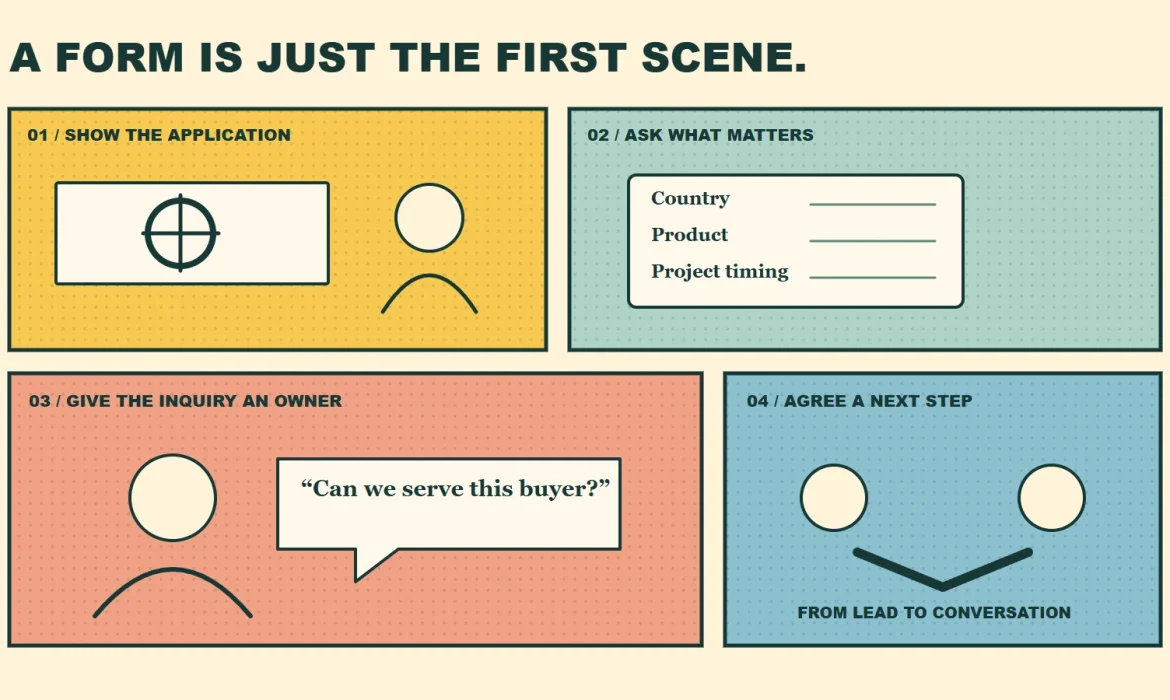
Facebook lead generation ads for exporters work best when the offer, qualification questions, and sales response belong to one process. A completed form is a starting point. It becomes useful when the company can serve the country, supply the product, and agree on a next step with the buyer. Build that route before judging a campaign by the number of submissions in the dashboard.
The lead-handling route
- Decide whether Facebook fits the buying motion
- Define an inquiry that sales will actually accept
- Choose countries with a market-and-operations scorecard
- Audience size is context; qualification is the operating problem
- Build an offer that earns the form submission
- Decide between an instant form and a website inquiry
- Ask enough questions to qualify without creating friction
- Route every inquiry into a named process
- Review sales quality, not just cost per lead
- A practical test plan for an exporter
- A formula card for a sales-feedback review
- Common reasons exporter lead campaigns disappoint
- How to launch Facebook lead generation ads for exporters
- Questions that come back from the lead desk
- Treat every lead as the start of a business process
Decide whether Facebook fits the buying motion
Facebook can put a product, use case, or business offer in front of people who may not be actively searching for a supplier at that moment. That can help when the product is visually demonstrable, when the audience can be described by market or business context, or when a useful resource can introduce a problem the buyer recognizes. It is not an automatic fit for every industrial product. If buyers only purchase through a small number of known procurement organizations and the sales team has no capacity to nurture early interest, another channel or a direct sales approach may be a better starting point.
Start by mapping the buyer journey. Does a procurement manager know the category already, or does an engineer first need to understand the application? Is there a distributor network? Can a potential customer make a meaningful inquiry without a detailed engineering call? These questions help decide whether the campaign should ask for an RFQ immediately, offer a specification guide, invite a product consultation, or direct people to a product page. The offer should match the buyer’s stage rather than forcing every visitor into one form.
Make serviceability explicit. List the countries where the exporter can sell, ship, provide support, and respond within a reasonable time. Include any distributors, exclusions, product restrictions, or local-language requirements. A campaign that collects inquiries from a market the business cannot serve is not a successful campaign, even if the platform reports many conversions. Have sales and operations approve the market list before launch and establish how the team will handle a request from outside it.
Define an inquiry that sales will actually accept
“Lead” is an overloaded word. A platform may count a form submission; marketing may count a contact with a business email; sales may count a buyer whose company, product need, and timing fit the business. Write these definitions separately. A useful system can track the initial submission, a marketing-qualified record if the company uses that stage, a sales-accepted lead, a quote opportunity, and a closed outcome. Do not collapse these stages into a single conversion called “lead” if the business needs to understand quality.
Invite sales to identify the information that makes an inquiry actionable. For a manufacturer, that might be product family, application, estimated quantity, destination, company, and project timing. For an exporter of consumer goods to distributors, the relevant fields may include channel type, expected volume, and country. These are examples rather than universal requirements. Ask sales to review actual past inquiries and point out which missing information delayed a response. Then include only the fields that meaningfully improve routing or qualification.
Agree on a feedback deadline. A new inquiry that sits untouched for several days may appear low quality simply because nobody responded while the need was active. Assign an owner and define a service-level target that fits the team, time zone, and product complexity. Record first response, contact status, acceptance, and rejection reason in the CRM. If the company cannot commit to a follow-up process, fix that operational issue before increasing lead volume.
Choose countries with a market-and-operations scorecard
Do not select countries solely because a platform lists a large reachable audience. Exporters also need to consider product eligibility, shipping cost, duty and tax questions, service coverage, language, sales representation, and payment or procurement practices. The marketing team should not make legal or customs determinations by itself. Where regulations or trade restrictions may apply, consult qualified specialists and official sources before the campaign makes an offer or collects sensitive details.
Score candidate countries against a practical set of factors: current customer evidence, product fit, ability to fulfill, sales coverage, language support, competitive environment, and measurement readiness. A country with existing distributor activity may be a better first test than a larger market with no sales owner. If the business has no history, treat the score as a prioritization tool, not proof that demand exists. Mark assumptions explicitly and define how the test will validate them.
Separate market observations in the account and CRM. Use a consistent country field, campaign naming rule, and lead source. If several countries share one campaign, the business may lose control over where spend goes or what response is needed. Separate budgets when financial control, sales ownership, language, or offer differences justify it. Avoid over-segmentation when the available budget cannot support meaningful learning. The design should balance local accountability with enough observations to review.
| Country factor | Question to resolve before launch | Internal owner |
|---|---|---|
| Product fit | Can the company sell and support this product there? | Product and sales |
| Fulfillment | Can orders ship under the stated terms? | Operations |
| Language | Who reviews ads, form copy, and follow-up? | Local market owner |
| Sales coverage | Who responds and in which time zone? | Sales leader |
| Measurement | Can country and campaign source reach the CRM? | Analytics or CRM owner |
| Policy or legal review | Are claims and data practices approved? | Qualified reviewer |
Audience size is context; qualification is the operating problem
An export sales manager and a media buyer can look at the same form and see different outcomes. The buyer sees a conversion. The manager asks whether the person can buy the product, import it, and agree to the next step. Campaign design has to serve both views.
Pew Research Center’s October 19, 2026 social-media fact sheet reports that 70% of U.S. adults use Facebook. Its survey fieldwork ran from January 30 through June 18, 2026. This establishes broad consumer adoption in one country; it does not measure the share of procurement managers available through a campaign, advertising reach, or willingness to request an industrial quote. It cannot be carried over to another export market as an audience estimate.
The practical response is to let the offer and the qualification process do useful work. A technical application guide can help a buyer recognize fit. A product-family field can route the inquiry. A clear statement about order quantities can prevent a mismatch before sales spends time on it. None of those improvements requires pretending that platform interests prove professional identity.
Agree on the rejection reasons before launch. “Outside service area,” “consumer purchase,” “wrong specification,” and “unreachable” describe different problems. Feed those reasons back into the campaign review so a large reachable audience does not obscure a small, poorly handled commercial pipeline.
Build an offer that earns the form submission
An exporter should give a buyer a reason to share contact information. A spec sheet, catalog, application review, sample request, quote, or technical consultation may be useful depending on the product and the buyer’s stage. The offer must be real and deliverable. If the company advertises a consultation, it needs a person who can conduct it. If it offers a document, the document should be current, clear, and appropriate for the selected market.
Write the ad from the buyer’s problem rather than the company’s desire for more leads. A message might explain how a particular component is used, what information helps the supplier assess a request, or which product dimensions the buyer can compare. Use only claims that can be substantiated. The Federal Trade Commission’s current guidance should be checked for U.S.-targeted advertising claims, and other markets may have their own rules. Have a qualified reviewer assess claims that concern performance, certification, safety, or regulated products.
Creative should make the offer understandable before the form appears. For a B2B exporter, a useful visual may show the product in a credible application, a material detail, a manufacturing process, or a simple selection comparison. Avoid generic stock-style imagery that could represent any supplier. Do not place technical labels or performance promises in an image unless they have been approved and are legible on mobile. Keep the ad, form, and destination page consistent so the visitor does not feel that the offer changed after the click.
Decide between an instant form and a website inquiry
An instant form can reduce the steps between an ad and a submission. That may be convenient on a mobile device, but convenience does not guarantee intent or qualification. A website form can provide more product detail and context before someone submits, but it depends on the site’s speed, usability, and tracking. Neither path is universally better. Choose based on the information the buyer needs, the qualification requirements, the CRM integration, and the team’s ability to follow up.
For an instant form, review the intro text, questions, privacy notice, confirmation message, and destination action. Explain what happens after submission. If the business will call, email, or send a quotation, say which team handles the request and what information may be needed. Avoid asking for sensitive personal or business information that is not necessary. Have the company’s privacy owner review the form and data flow for the applicable markets; a platform form does not itself determine whether a particular collection practice is appropriate.
For a website form, inspect the full path on mobile and desktop. Confirm that the ad link opens the right language and product page, that required fields are understandable, and that the success message appears. Submit a test inquiry and make sure the record reaches the intended CRM queue. Check whether UTM parameters or campaign fields persist through redirects and embedded forms. A button click is not the same as a completed inquiry, and an event firing in analytics is not proof that sales received the information.
| Form path | Works well when | Risks to check |
|---|---|---|
| Instant form | A short inquiry is enough and mobile ease matters | Low-intent submissions, field limits, routing delays |
| Website form | Product context or technical detail is important | Slow page, broken tags, abandonment |
| Message conversation | A buyer needs clarification before sharing details | Unassigned inboxes, inconsistent qualification |
| Download offer | Early research and nurturing are appropriate | Content is outdated or follow-up is unclear |
Ask enough questions to qualify without creating friction
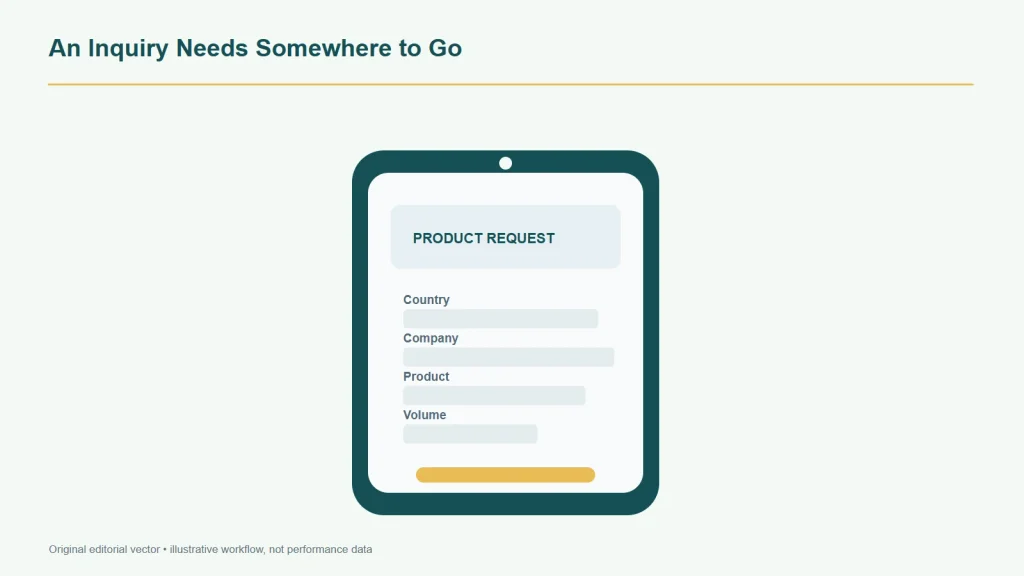
Form design is a trade-off. Every field can help sales, but every added question can make the request feel more work. Begin with a minimum set: business contact, country, product or application, and a field that signals the project or quantity when those details are needed. Then test whether sales can act on the submissions. If too many records remain ambiguous, add one field that answers the biggest gap rather than adding a long questionnaire all at once.
Use clear answer choices when they make it easier to compare needs. For example, a quantity range can be more useful than an open text field if the sales team uses ranges for routing. But do not force buyers into inaccurate choices. Include “not sure yet” when the buyer may be early in research. Avoid asking for information that the company already has or can obtain in a respectful follow-up. The form should help start a conversation, not replicate an internal procurement system.
Review form performance together with lead quality. If submissions fall after adding a field but the remaining records become more relevant, the change may be worthwhile. If the form becomes shorter but sales spends more time disqualifying contacts, it may not be. Track the number of submissions, reachable contacts, sales-accepted records, and time spent on follow-up. The best form is not the one with the most fields or the highest submission count; it is the one that supports the next business step efficiently.
Route every inquiry into a named process
The lead should reach a monitored destination with an assigned owner. That may be a CRM queue, an approved inbox, or a sales system. Avoid relying on a single employee’s personal email. Confirm who covers holidays, time zones, and staff changes. If the lead is routed by country or product, test that rule with sample records from every relevant branch. A technically successful integration can still route the wrong category to the wrong salesperson.
Preserve the context sales needs: campaign, country, product, offer, submission time, consent or notice information as required by the company’s policy, and the fields the person supplied. Do not add personal data to campaign names or URLs. Follow internal retention and access controls. If data is sent to an advertising platform for conversion reporting, have privacy and technical owners approve the fields, identifiers, and implementation. A campaign’s need for optimization does not override the business’s data responsibilities.
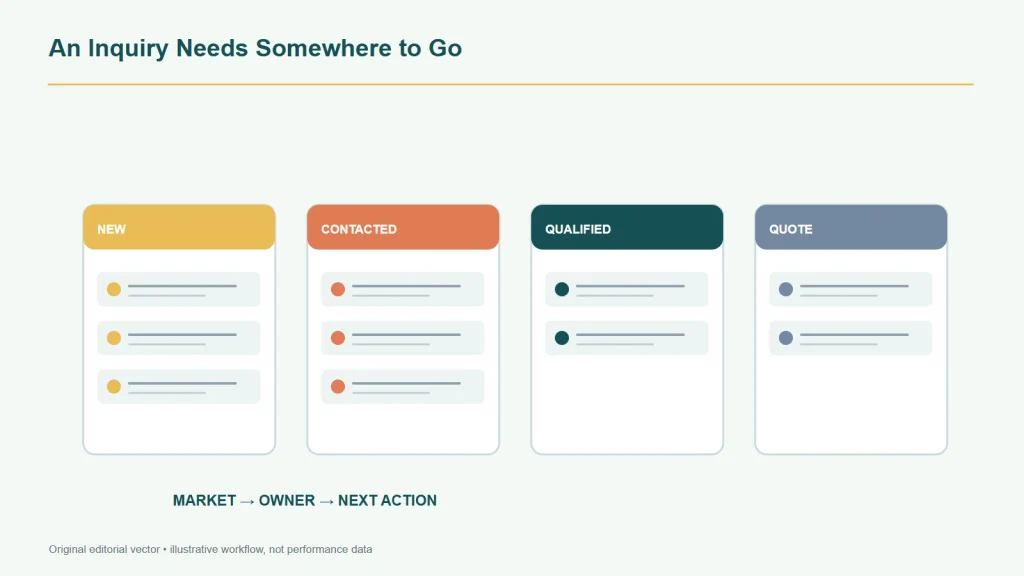
Make response status visible. A lead should not disappear when someone replies. Use a small set of statuses such as new, contacted, qualified, disqualified, quoted, and closed if that matches the sales process. Keep rejection reasons useful and concise. The marketing team can then tell whether the problem is geography, product fit, contact validity, timing, or sales capacity. Review the status definitions periodically; if different salespeople use the same label differently, the analysis will be unreliable.
Review sales quality, not just cost per lead
Cost per lead is media spend divided by the number of platform-reported leads under a chosen definition. Cost per sales-accepted lead uses the number the sales team accepts. Those metrics answer different questions. Report both with labels, dates, currency, and scope. If the platform charges in one currency and finance reports in another, record the conversion rule. Do not compare two campaigns using different attribution windows or qualification standards without explaining the difference.
Useful supporting measures include contactability, response time, acceptance rate, quote rate, and opportunity progression. These measures need enough time to mature. A campaign launched last week may have many new inquiries and few completed sales reviews; that is a timing issue, not necessarily proof of poor quality. Create a pending category so recent leads are not prematurely counted as rejected. For long-cycle products, compare lead cohorts over an agreed period rather than evaluating each source only by same-week revenue.
Use the data to make a specific decision. If a country produces valid inquiries but slow follow-up, improve routing before changing targeting. If a product has many submissions from non-buyers, revise the offer and form fields. If people request a product the company cannot ship, remove that market or clarify availability. If no one completes the form, inspect the page and offer. A metric without a planned action is just a number; a decision rule turns reporting into operating knowledge.
A practical test plan for an exporter
Consider a fictional exporter that sells industrial fasteners to distributors. The team wants to test two countries and has an approved product sheet, but no consistent record of whether past inquiries became quotes. It defines a sales-accepted inquiry as a reachable business contact in a supported market who asks about a listed product category. Sales agrees to return a status and one rejection reason. This definition is intentionally narrow enough for the first test and can be revised after the company sees actual inquiries.
The team builds one creative angle around the product application and one around distributor sourcing. Each ad goes to a form that asks country, company, product interest, and expected quantity range. The confirmation message explains that a sales representative will review the request. The CRM route assigns leads by market and product. The team tests each path using sample submissions before paid delivery begins. The campaign owner keeps a record of the date, asset version, destination, and tracking test.
During the first review, the marketer checks delivery and form completion, while sales checks whether submissions are serviceable. Suppose the test receives 40 submissions, 18 are contactable business records, and 7 meet the team’s acceptance rule. Those are hypothetical counts for explaining the calculation, not campaign results or benchmarks. The team would report the denominator, period, and rule, then inspect why the remaining records did not qualify. It would not call the platform a failure based on the raw 40 alone, nor would it claim success from seven without knowing the next sales stages.
A formula card for a sales-feedback review
Use formulas that everyone can reproduce. If media spend is $2,400 and the platform records 40 form submissions, platform CPL is $60. If sales accepts 7 of those records, cost per accepted lead is about $343. That difference is not a verdict; it highlights why qualification matters. The calculation says nothing about whether the accepted leads will become quotes or customers, and the example amounts are hypothetical.
| Measure | Formula | Example using hypothetical counts |
|---|---|---|
| Platform CPL | Media spend ÷ platform submissions | $2,400 ÷ 40 = $60 |
| Contactable rate | Contactable records ÷ submissions | 18 ÷ 40 = 45% |
| Acceptance rate | Sales-accepted leads ÷ submissions | 7 ÷ 40 = 17.5% |
| Cost per accepted lead | Media spend ÷ accepted leads | $2,400 ÷ 7 ≈ $343 |
| Quote rate | Quotes ÷ accepted leads | Enter only after sales updates the CRM |
Keep the formulas visible in a shared report. If the company changes the definition of “accepted,” annotate the date and do not compare the new rate with the old one as though the rules were unchanged. The same applies to media spend, currency, and attribution period. Finance, marketing, and sales should agree on which reports are used for budget decisions and which are diagnostic platform views.
Common reasons exporter lead campaigns disappoint
The first common failure is choosing countries before verifying fulfillment and sales coverage. The second is promoting a general brand message without a specific reason for a buyer to respond. The third is collecting too little information to route a request, followed by the opposite mistake: asking so much that a buyer abandons the form. A fourth failure is measuring every submission as equal. These issues often appear together, so a troubleshooting review should inspect the full journey rather than changing one audience setting in isolation.
Another problem is the handoff. A lead can be valid but arrive outside office hours, go to an unmonitored inbox, or receive a generic answer that does not address the request. Agree on a response owner and a useful first reply before launch. If a technical specialist must review the request, tell the prospect what to expect. A simple acknowledgement and a clear next step can make the process feel more credible than an automated sequence that has no connection to the buyer’s question.
Finally, teams can overreact to small samples. A few low-quality inquiries may justify a review, but they may not establish a reliable pattern. Mark conclusions as directional when the evidence is limited. Run a controlled follow-up test if needed, preserving the prior form and creative so the team can compare. A good marketer is willing to say “we do not have enough information yet” and specify what would make the next decision possible.
How to launch Facebook lead generation ads for exporters
Market and offer
- Select a product and countries the company can fulfill and support.
- Have sales define a sales-accepted inquiry and rejection reasons.
- Choose an offer that genuinely helps a buyer take the next step.
The inquiry route
- Create market-specific creative with accurate, approved product claims.
- Choose instant form, website form, or messaging based on the buyer journey.
- Ask only the fields needed to route and qualify the inquiry.
Sales feedback
- Test the full submission, data route, CRM status, and sales notification.
- Review quality and response timing with sales before expanding spend.
Questions that come back from the lead desk
Are Facebook lead ads suitable for B2B exporters?
They can be tested when the business can describe the target market, present a useful offer, and respond to inquiries. Suitability depends on product, buyer behavior, creative, qualification, and follow-up capacity.
What should an exporter ask on a lead form?
Ask for the minimum information sales needs to route the inquiry, which may include country, company, product or application, quantity range, and contact details. Confirm the fields with sales before launch.
Are instant forms better than website forms?
Neither is always better. Instant forms reduce steps, while a website can provide more context. Choose based on qualification needs, page quality, routing, and the buyer’s decision stage.
How can a company reduce low-quality form submissions?
Clarify the offer, target market, and intended buyer in the ad; use a small number of useful form fields; route leads quickly; and report sales rejection reasons back to marketing.
What is a good cost per lead for export advertising?
There is no universal number. Compare cost per sales-accepted lead with margin, sales cycle, quote rate, and the business’s ability to serve the market. Label platform CPL separately.
How quickly should a sales team contact a new inquiry?
Set a response target the team can meet based on market, time zone, and product complexity. The key is to assign an owner, monitor response time, and cover absences.
Does an instant form automatically handle privacy requirements?
No. The business remains responsible for reviewing what it collects, how it explains the purpose, where it routes information, and what rules apply in the markets involved. Consult qualified privacy or legal staff.
Treat every lead as the start of a business process
The marketing and sales teams should agree on what happens to a lead that is not ready to request a quote. Some prospects may need a technical guide, a distributor introduction, or a later follow-up. If the business has a nurture process, document the owner’s role and the message the person will receive. If it does not, avoid promising a sequence in the ad or form. A realistic next step is more credible than an automated promise no team can fulfill.
An export lead campaign should connect audience, offer, form, CRM, and sales action. Begin with markets the company can support, use an honest reason for a buyer to respond, and measure the quality of the resulting conversations. Review rejection reasons and response times alongside media metrics. That discipline helps the business learn whether the issue is the channel, the offer, the form, or the handoff before expanding into more countries.
If you need help coordinating paid campaigns across countries, review Marketboo’s global paid media services. If your team wants to keep campaign ownership while improving its lead-generation process, explore hands-on advertising coaching.