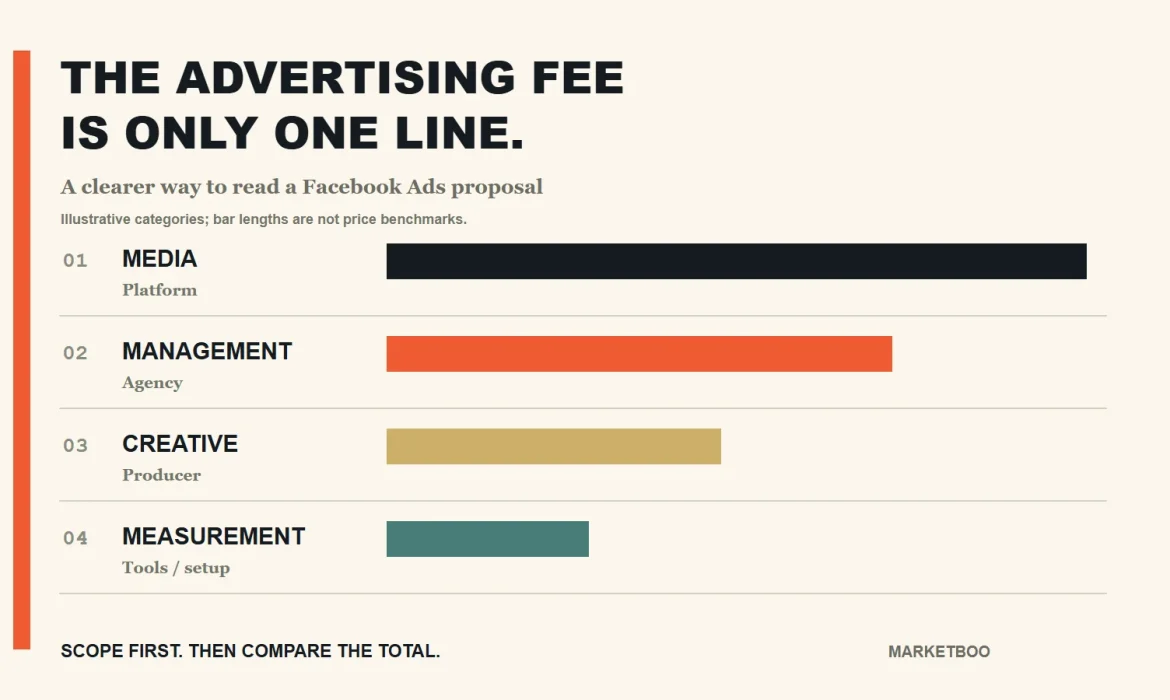
Facebook ads management pricing is hard to compare when one proposal includes creative production and another covers only campaign operation. Start with the full cost of the work: media, management, production, measurement, and any separate projects. Then compare fee models against the same deliverables. The worksheet below makes those differences visible before a low monthly quote turns into a more expensive engagement.
Inside the quote
- A transparent monthly cost worksheet
- Why two Facebook Ads proposals can have different totals
- Facebook ads management pricing: compare four common fee models
- Separate media spend from management and production
- What a real market data point can tell you about a quote
- Ask what “optimization” means in the contract
- Judge value by the work and learning, not a promised ROAS
- The fee questions a small business should ask before signing
- A proposal comparison table you can use in a meeting
- When to choose coaching instead of full management
- Make the first month a scoped test of collaboration
- A simple fee-and-scope decision rule
- A small-business example: calculate the cost of keeping work in-house
- Check the incentive before agreeing to performance pricing
- Two decisions worth resolving early
- Pricing questions from the owner’s desk
A transparent monthly cost worksheet
Consider a fictional small ecommerce business evaluating a one-month test. The owner allocates $5,000 to media, receives a hypothetical $1,500 management proposal, estimates $800 for new creative, and budgets $100 for a reporting tool. The modeled total cash outlay is $7,400 before taxes and any other costs. In this example, the agency fee equals 30% of the media budget, but that ratio is only arithmetic for the scenario. It is not an industry norm or a recommendation.
Now change the scope. If the client supplies approved creative and handles page updates, the production estimate may fall; the client is taking on that labor instead. If the agency adds video production or a second market, the total may rise even though the media budget stays the same. Compare the total cost per month and the work transferred to the client. A lower invoice can be misleading if a founder spends ten hours each week coordinating assets and leads without accounting for that time.
The worksheet should include both expected and excluded items. List the media budget, agency fee, creative, landing page, tracking, software, taxes, currency, and any minimum commitment. Record the source for each estimate and who approves a change. Update the worksheet when the scope changes instead of treating the initial quote as a complete forecast. For cash planning, include the payment schedule and the date the platform charges the card; agency invoices and media billing may not occur on the same date.
| Cost component | Hypothetical amount | Paid to | Scope or assumption |
|---|---|---|---|
| Meta media budget | $5,000 | Platform | One market, one-month planning example |
| Management | $1,500 | Agency | Defined planning, operation, and reporting |
| Creative production | $800 | Producer or agency | Example estimate, not a market rate |
| Reporting tool | $100 | Software provider | Optional line item for the model |
| Modeled total | $7,400 | Multiple parties | Before tax and unlisted costs |
Why two Facebook Ads proposals can have different totals
Two agencies may both describe their service as “Facebook Ads management” while including very different work. One may handle campaign setup and weekly checks; another may include creative planning, production coordination, landing-page recommendations, analytics QA, and monthly sales review. The quoted fee alone cannot reveal whether the scope is comparable. Before asking whether a price is high or low, identify what the business is buying and what it will still need to do itself.
The term “Facebook Ads” is also often used informally to mean advertising across Meta properties. A proposal should name the placements and account assets it covers rather than relying on shorthand. Ask how creative approvals, audience decisions, account access, billing, and reporting are organized. Feature availability and naming can change, so confirm current settings in the account and current Meta documentation when a contract depends on a particular workflow.
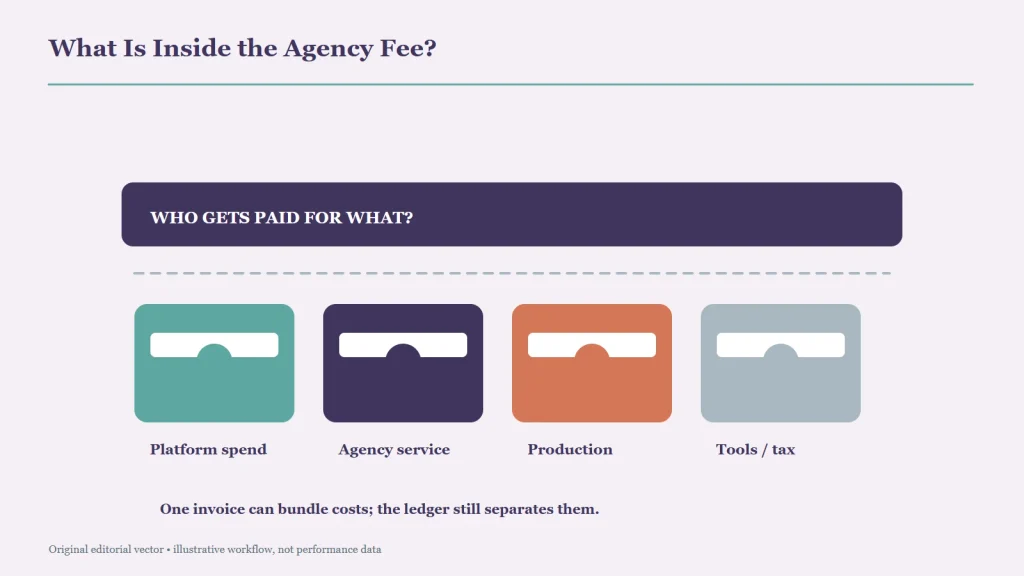
Cost has at least three layers. Media spend is paid to the advertising platform. Agency fees compensate for strategy and execution. Production or infrastructure costs cover assets such as video, photography, copy, localization, landing pages, tracking, and software. Taxes, currency conversion, and account minimums can add another layer. A clean proposal makes those buckets visible so a founder can forecast the total cash requirement and a finance reviewer can reconcile invoices with platform billing.
Facebook ads management pricing: compare four common fee models
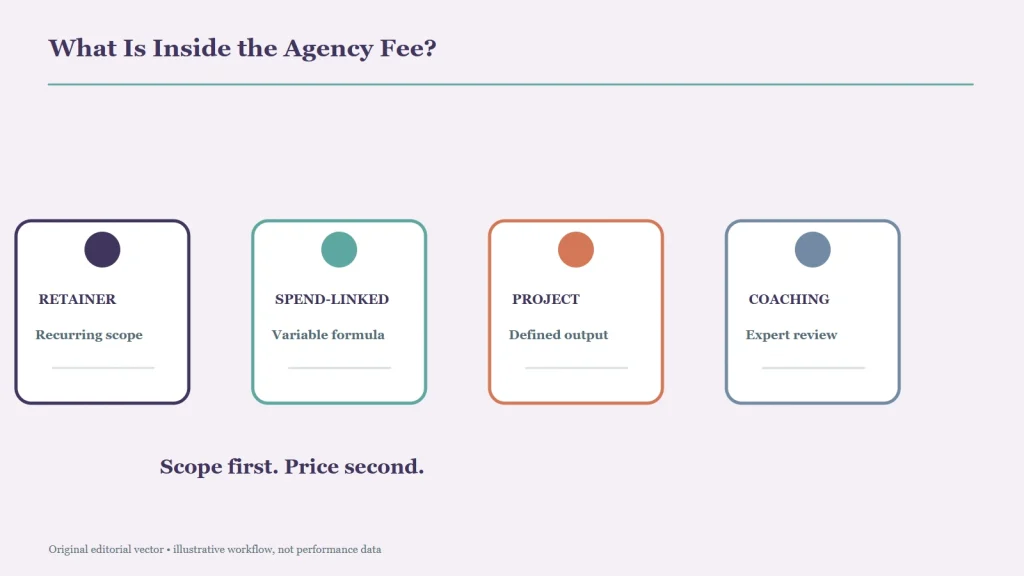
A fixed monthly retainer gives the client a predictable service fee for a defined scope. It may suit a business that wants recurring planning, execution, and reporting. The risk is that scope can remain vague: “ongoing optimization” does not say how many markets, creative reviews, or stakeholder meetings are included. A retainer should specify deliverables and a process for changes in workload. If seasonal activity requires more production, state whether the fee changes or additional work is quoted separately.
A percentage-of-spend model ties the agency’s compensation to media budget. This can scale smoothly when scope grows with spend, but the client should understand the calculation base, any minimum fee, and whether certain costs are excluded. A percentage can rise even if workload does not, or the agency may be incentivized to recommend more spend. Neither outcome is inevitable, but the incentives should be discussed. Ask for a forecast showing how the fee changes at several possible budget levels.
Project pricing covers a discrete deliverable such as an account audit, campaign rebuild, tracking plan, or market launch. The client can see what the project is intended to produce and when it will be reviewed. Project fees work best when acceptance criteria and assumptions are written down. A “setup” can mean many things, from creating a campaign shell to testing a complete lead journey. Specify which tasks, revisions, and handover materials are included.
Coaching or consulting charges for access to expertise while the client keeps more execution responsibility. This can be useful when an in-house marketer needs account-level guidance, a founder wants a review before launch, or a team is gradually taking work in-house. Coaching is not automatically cheaper: the client’s employees must have time to prepare, attend, implement, and follow up. Define session length, preparation, between-session questions, account access, and whether implementation is included.
| Fee model | What it can make predictable | What must be clarified |
|---|---|---|
| Fixed retainer | Recurring agency fee | Scope, markets, cadence, and overages |
| Percentage of spend | Fee relationship to media budget | Calculation base, minimum, and incentives |
| Project fee | Price for a defined build or audit | Deliverables, assumptions, revisions, and handoff |
| Coaching | Access to review and guidance | Preparation, implementation ownership, and support between sessions |
Separate media spend from management and production
Media spend is the amount charged by the platform for delivery. It should be visible in the platform billing or an agreed, auditable billing route. Management fees pay for work such as planning, campaign operations, testing, analysis, and meetings. Creative production may include scripts, editing, photography, design, subtitles, creator fees, or localization. A landing-page developer, analytics specialist, CRM administrator, or consent consultant may be a separate provider. The categories can be bundled, but the proposal should still disclose what the package contains.
Ask whether the agency pays platform invoices on the client’s behalf or whether the client pays directly. If billing runs through the provider, find out how the business can verify actual spend, which entity receives platform credits or refunds, and how billing access is handled when the relationship ends. Confirm that taxes and currency conversion are treated consistently. These are finance controls, not campaign tactics. They prevent a situation where a client cannot distinguish a fee from a media charge.
Production costs can be especially easy to underestimate. A campaign may need several concepts, versions for different placements, new edits, translation, and product-specific pages. A quote that includes “creative” might mean one static image, a monthly concept brief, or a full production crew. Ask how many assets and revision rounds are included, who owns source files, who secures usage permissions, and how long the assets may be used. If client staff will provide footage or product photography, say so in the scope.
What a real market data point can tell you about a quote
There is evidence that advertising prices move, but it does not establish an agency’s management fee. In its fourth-quarter and full-year 2024 results, published January 29, 2025, Meta reported an 11% increase in ad impressions across its Family of Apps and a 10% increase in average price per ad for the full year, compared with 2023. The fourth-quarter figures were different, which is another reason to label the period precisely.
Those are worldwide company-level measures across Meta’s Family of Apps. They are not a Facebook-only CPM benchmark for your country, product, or audience. They also do not justify an automatic 10% increase in an agency retainer. Media prices and service fees pay for different things.
Use that distinction when an agency explains a more expensive proposal. Ask which line changed: auction spending, the number of creative concepts, staff time, localization, tracking work, or a separately priced project. If the answer is “the market got more expensive,” request the account evidence and the specific scope implication. A higher auction price might prompt a new offer or creative test; it does not tell you how many hours the agency will work. A credible proposal keeps those decisions separate and makes the total cost easy to reconcile.
Ask what “optimization” means in the contract
Optimization is not one action. It can include reviewing delivery, changing budgets, checking frequency, replacing creative, testing audiences, adjusting placements, auditing forms, or comparing lead quality. Ask the agency to define its own operating cadence and the records it will provide. The provider should be able to explain how it decides whether a change is justified and when it expects to review the result. Avoid language that promises constant improvement without naming what is monitored.
Clarify which changes can be made without approval. A client may allow routine bid or budget adjustments within a limit but require approval for new claims, new countries, large budget changes, or changes to a form’s data fields. The provider should have an escalation route for a disapproved ad, broken destination, or sudden spend anomaly. A written authority matrix helps the team move quickly while keeping commercial and legal decisions with the right owner.
The contract should also specify the reporting cadence. A weekly operational note may be sufficient for a small test, while a monthly review can include sales quality and creative learnings. Decide whether the agency will present raw exports, a dashboard, or both. Set the definitions for spend, platform conversions, unique leads, accepted leads, and revenue. If a metric is unavailable, the agency should say so rather than manufacturing a proxy with an official-sounding name.
Judge value by the work and learning, not a promised ROAS
An agency may show impressive return on ad spend, but the number is useful only when the revenue source, attribution window, order value, cancellations, discounts, and media cost are understood. Platform reports can attribute conversions according to platform-specific rules. Those reports can help with optimization, but finance may need a separate view of recognized revenue and margin. Ask the provider how it presents each view and what the numbers do not include.
For lead-generation campaigns, cost per lead is similarly incomplete. A lower cost can be accompanied by lower relevance, duplicate submissions, or a slower response from sales. Decide whether the business will use qualified lead cost, sales-accepted lead cost, or another measure for budget decisions. If the CRM has no consistent lead statuses, the agency cannot reliably report downstream quality. That is a shared setup issue to solve, not a reason to accept a dashboard’s raw form count as revenue evidence.
Do not pay extra solely for a promised result that depends on factors the agency cannot control. If performance-based fees are considered, define the conversion, the source of truth, deduplication, refunds, attribution windows, and treatment of existing customers. Describe what happens when tracking fails or inventory runs out. A carefully designed incentive can align work, but an undefined “pay for results” offer may simply move ambiguity into a future dispute.
The fee questions a small business should ask before signing
Ask the provider to identify every recurring and one-time fee. Is there an onboarding charge? Is the first month billed differently? Do fees change with media spend, number of campaigns, creative volume, locations, or platforms? Are ad copy revisions included? Does translation require another quote? Can the client pause service while preserving account access? A proposal should answer these questions without requiring the buyer to infer terms from a slide.
Then ask about the client’s obligations. How quickly must it approve creative? Who supplies product data, pricing, and inventory updates? Who handles comments and customer service? Who investigates a form that does not reach the CRM? If the client is late with an approval, does the schedule move or does the agency continue spending? A pricing model is only fair when the labor and dependencies on both sides are visible.
Check the end-of-contract provisions. The business should understand ownership of accounts, assets, data, reports, and creative files. If a tool or audience was created under the agency’s account, ask how it can be moved or exported. Confirm notice periods, final invoices, outstanding media spend, and the timeline for access removal. Have qualified counsel review legal provisions, especially around data, intellectual property, confidentiality, and liability. A marketing checklist can surface questions, but it cannot replace legal advice.
A proposal comparison table you can use in a meeting
Score proposals on the same factors. A useful comparison includes not just money but operating risk. For example, a provider can quote less and still be the more expensive choice if the client must supply all strategy, testing, and reporting. On the other hand, a full-service quote may include work a business does not yet need. Mark the “must have” tasks separately from the “optional” ones and request a base proposal plus clearly priced add-ons.
| Question | Proposal A | Proposal B | Why it matters |
|---|---|---|---|
| Is media spend separate from fee? | Reconciles platform charges | ||
| What is the monthly operating cadence? | Shows actual service level | ||
| How many creative concepts and edits? | Prevents production surprises | ||
| Who owns ad accounts and source files? | Protects continuity | ||
| How are leads qualified and reported? | Connects platform to sales | ||
| What triggers a scope change? | Controls out-of-scope charges | ||
| How does termination and handoff work? | Keeps the relationship reversible |
Ask each provider to explain any blank cell. A blank is not necessarily a rejection; it may mean the item is excluded or requires discovery. The buyer can decide whether to add the work, assign it internally, or remove it from the first phase. The important thing is not to let a blank quietly become an assumed deliverable. Keep the comparison sheet attached to the signed scope so both parties can refer to the same expectations.
When to choose coaching instead of full management
Some businesses do not need an agency to own every task. A founder may have an employee who can manage campaigns but needs help with account structure, conversion events, or budget decisions. In that situation, coaching can provide an expert review while the business retains day-to-day access and builds internal knowledge. The fee should state whether the provider reviews a live account, prepares between-session notes, answers questions asynchronously, or implements changes. “Training” can otherwise mean anything from a recorded course to hands-on account work.
Full management may be a better fit when the company lacks operating capacity, needs multiple campaigns managed consistently, or cannot assign internal ownership for daily work. A hybrid arrangement can split responsibilities: the agency manages delivery and reporting while the client owns product strategy, sales qualification, and approvals. The arrangement should not leave critical tasks between teams. Write a simple responsibility matrix and name one person accountable for the handoff.
Do not compare a coaching fee to a retainer without including internal time. The employee who attends training will need time to prepare, implement, and report back. If that time is unavailable, knowledge may not turn into operating capability. Conversely, if the business is paying a retainer indefinitely for decisions that could be learned, coaching may be a useful part of a transition plan. Revisit the model after a defined period and decide whether the team is ready to take more work in-house.
Make the first month a scoped test of collaboration
A small first engagement can test communication and reporting before the business commits to a larger scope. Choose one offer, one market, and one conversion path the company can support. Agree on the budget separately from the service fee. Define what the agency must deliver at kickoff, during the test, and at the review. The test should have a time limit and a stop condition; it should not become an open-ended discount project with expanding expectations.
Evaluate the provider’s behavior as well as the media result. Did the team ask for the information needed to understand the product? Were access and approvals handled safely? Did it test the inquiry path? Did the report explain a result and a limitation? Were questions answered in the agreed window? These signals help the business decide whether the working model is sustainable. A short test may not produce a stable ROAS or enough conversions, especially in a narrow market, so do not use it to claim certainty that the data cannot support.
At the review, compare the actual work with the scope, document any learning, and decide whether the next month needs the same deliverables. If the test revealed a tracking gap, quote that repair separately. If creative production was the bottleneck, decide whether the company or the agency should own it. A transparent cost relationship makes it easier to expand responsibly because the client understands what additional spending buys.
A simple fee-and-scope decision rule
Choose the model that fits how much work the company wants to transfer. If tasks and workload are stable, a fixed retainer may be easy to budget. If management effort grows with spend and the fee has a clear cap or formula, a percentage model may fit. If the need is a defined setup, use project pricing with acceptance criteria. If internal capability is the priority, consider coaching with protected time for implementation. A hybrid can work when roles are explicit.
Then compare total cost, accountability, and reversibility. Total cost includes media, services, production, tools, taxes, and the client’s time. Accountability asks who is responsible when an event fails, an asset is late, or a lead is not routed. Reversibility asks whether the business can pause, change providers, and keep its account history. These three questions help a small business avoid mistaking the lowest headline fee for the best commercial decision.
There is no need to choose a fee model once and keep it forever. A company can start with a project to fix tracking, move to a retainer for campaign operations, and later add coaching as an employee takes over. The transition should be intentional and documented. If the provider is unwilling to explain scope, billing, or handoff in plain language, that itself is useful information for the buyer.
A small-business example: calculate the cost of keeping work in-house
The owner should also estimate the internal hours required to make the agency scope work. Suppose a marketing coordinator spends six hours each month preparing product updates and approvals, a designer spends five hours adapting creative, and a sales lead spends two hours reviewing inquiries. Those hours have a cost even if no additional invoice arrives. If the agency proposal excludes all three activities, the business is responsible for them. The exact values will differ by company; the exercise is to count the work, not to assign a universal hourly rate.
Compare the same responsibilities in a second scenario. If the agency takes creative coordination and CRM reporting into scope, the fee may increase, but internal time may decrease. If the business keeps those tasks, it may pay less in cash while using more employee capacity. A useful proposal states which outcome it expects. The client can then ask whether the transferred hours are actually valuable or whether the team prefers to keep the work internally.
The owner should distinguish one-time setup from recurring operation. A tracking repair might cost more in the first month and less afterward. A creative retainer might stay constant even when media spend changes. A spreadsheet that carries setup costs forward as if they repeat every month will overstate ongoing expense; one that omits recurring production will understate it. Show both a first-month total and a steady-state monthly total, with each assumption labeled.
Check the incentive before agreeing to performance pricing
Some small businesses ask to pay only when a campaign produces a lead or sale. This can align a provider’s compensation with an outcome, but it can also encourage disputes about definitions or pressure the provider to maximize the easiest event rather than the most useful one. Before accepting such a structure, state which system records the event, which markets count, how duplicate and existing customers are handled, and what happens if tracking fails. Define whether media spend, service fees, returns, and cancellations are included in the calculation.
For lead generation, the phrase “qualified lead” requires a written rule and a timely review process. If sales has ten business days to accept a lead but the agency’s fee is calculated immediately, the measurement window is misaligned. If rejection reasons are not documented, either party may dispute the result. The agreement should set an operational path for cases that are pending or contested. A performance-based arrangement is not necessarily safer than a fixed fee; it simply makes the measurement contract more important.
Review the incentive when the scope changes. A provider paid as a percentage of spend may receive more when budget rises, even if the workload increases only slightly. A fixed fee may make budget changes easier to forecast but require a new scope when creative or markets expand. A project fee may reward a clear delivery but not ongoing improvements. Each structure can be appropriate if the commercial reason is transparent and the client retains a way to challenge unsupported recommendations.
Two decisions worth resolving early
Should I pay an agency based on ROAS?
Only after both parties define revenue, attribution, cancellations, discounts, margins, and the data source. Platform-reported ROAS may not equal finance’s realized revenue or profit. A performance fee needs explicit rules for edge cases.
When is coaching more cost-effective than full-service management?
Coaching may fit when the company has an internal operator with time to implement changes and wants to build its own capability. Full management may fit when daily execution capacity is missing. Include internal labor in the comparison.
Pricing questions from the owner’s desk
What is a typical Facebook Ads agency fee?
There is no single fee that can be applied fairly to every business. Agencies price different combinations of strategy, management, creative, landing-page work, reporting, and support. Compare itemized scope and total cost rather than relying on an unverified market average.
Is a percentage of ad spend a good pricing model?
It can be workable if the calculation base, minimum, included work, and budget-change rules are clear. Ask how the fee changes at multiple spend levels and whether the compensation structure could influence budget recommendations.
Does an agency fee include Facebook ad spend?
Sometimes a proposal bundles billing, but the client should still see media charges separately from service fees. Confirm who pays the platform, how actual spend is verified, and how credits, taxes, or currency conversion are handled.
Should creative production be included in management pricing?
It depends on the scope. Ask how many concepts, formats, edits, translations, and usage rights are included. If creative is excluded, identify who supplies it and what happens if assets arrive late.
Can a small business hire an agency for one month?
Some providers offer a short project or pilot, while others require a longer term because of onboarding work. If you use a pilot, define the deliverables, budget, review date, and exit process in writing.