A Google Ads strategy for B2B manufacturing companies has to survive the journey from a product search to a usable RFQ. Keywords and bids are only part of that journey. The page must answer a buyer’s technical questions, the form must work, and sales must recognize a qualified inquiry. This guide follows those handoffs so an export manufacturer can build a controlled test and understand what its spending actually produces.
From search to sales
- What Google Ads can and cannot solve for a manufacturer
- Google Ads strategy for B2B manufacturing companies starts with demand
- Structure campaigns around intent and commercial reality
- Control irrelevant searches without blocking useful discovery
- Write ads that make a specific, supportable promise
- Design landing pages around the RFQ decision
- Measure the handoff from click to accepted inquiry
- Set budgets as a controlled learning plan
- Turn a daily setting into a monthly cash plan
- Use a weekly operating review and a longer sales review
- A worked planning example for a fictional component supplier
- Build the first campaign in a sequence the team can audit
- How to launch a Google Ads B2B manufacturing test
- Questions from the manufacturing sales team
What Google Ads can and cannot solve for a manufacturer
Search advertising can place a manufacturer’s offer in front of someone who is actively looking for a product, component, material, or supplier. That makes it useful when buyers already know the category or application language. It does not create a complete market-entry plan on its own. A campaign cannot fix an unclear product catalog, an unsupported certification claim, slow technical response, or a delivery promise the company cannot honor. Treat the ad account as one layer in a sourcing experience, not as a substitute for product marketing and sales operations.
Before building campaigns, identify the job the searcher is trying to complete. A buyer may need a standard component for a current order, an engineer may be comparing material specifications, or a procurement manager may be qualifying a supplier for a future project. These searches can involve the same product family but call for different landing-page depth and conversion actions. A quote request may be right for one query; a specification sheet or application guide may be a better first step for another.
The useful question is therefore not “How many clicks can we get?” It is “Can we reach a relevant buying organization, answer its next question, and pass a usable record to the right salesperson?” Define that outcome with sales before choosing a campaign type. Write down target country, product family, buyer role, serviceability, qualification fields, and what should happen after submission. The definition is allowed to evolve as the business learns, but it should not change silently in the middle of a comparison.
Google Ads strategy for B2B manufacturing companies starts with demand
Manufacturing catalogs are often organized around internal names, part numbers, and engineering classifications. Buyers may search using a common category, a problem, a process, a material, an industry application, or a competitor’s product language. Build a map that puts these expressions beside the product hierarchy. Ask sales and technical staff for the wording they hear in RFQs, distributor conversations, service calls, and trade-show follow-up. That first-party vocabulary is usually more useful than starting with a broad list of generic terms.
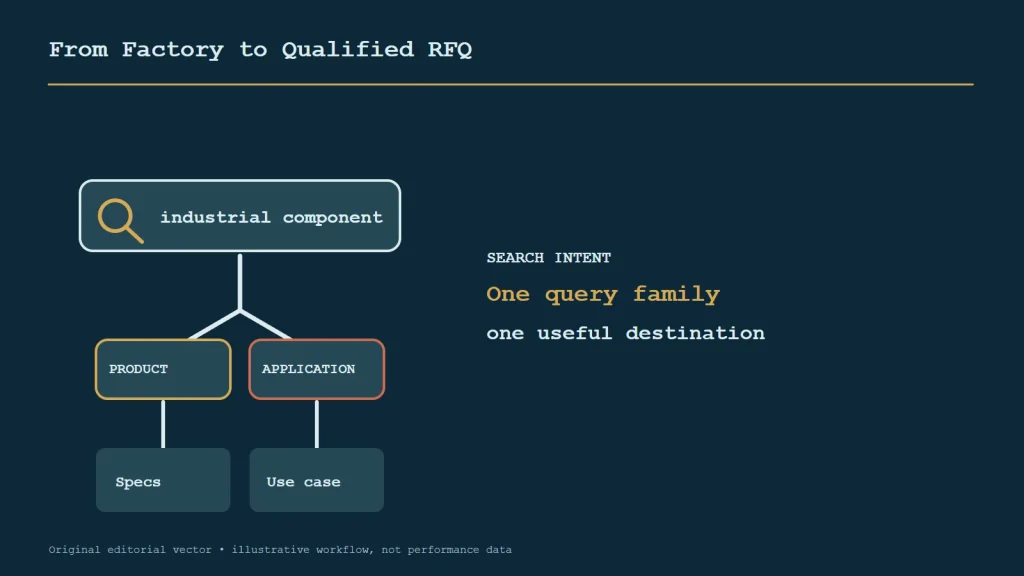
Separate at least five kinds of search intent. Product-specific searches name a category, model, or specification. Application searches describe where the product is used. Problem searches describe a failure or performance need. Supplier searches show procurement intent, while educational searches may indicate early research or a student assignment. These groups are not universal labels; they are a practical way to decide what message and destination belong together. A query should be grouped according to the business task it signals, not merely because two phrases contain the same word.
Review each keyword candidate against operational reality. Can the company supply the item in the searcher’s country? Is there a local distributor, export restriction, lead-time limit, or minimum order? Does the sales team want small sample requests, large project opportunities, or both? A high-volume term can be a poor choice when the business cannot serve most of its searchers. Conversely, a narrow application phrase may be worth testing even if a standard keyword tool shows little volume, provided it maps to a genuine buying use case and the test budget is appropriate.
| Search group | Example query pattern | Likely next question | Useful page destination |
|---|---|---|---|
| Product category | “industrial pump manufacturer” | What types and capacities are available? | Product-family page |
| Specification | “316 stainless valve 2 inch” | Does the item meet the required spec? | Technical product page |
| Application | “valve for chemical processing” | Is it suitable for this environment? | Application page |
| Supplier intent | “custom gear manufacturer USA” | Can this supplier quote my project? | RFQ or capability page |
| Research | “how to select a gear ratio” | What factors should I compare? | Technical guide or calculator |
Structure campaigns around intent and commercial reality
Campaign structure should make a decision easier, not create the maximum number of folders. Separate countries when language, budget control, landing pages, or sales ownership require independent management. Separate product families when different teams own them or the economics and conversion path differ. Within a campaign, group keywords tightly enough that the ad can answer a coherent query set. Avoid splitting every phrase into a separate group if there is not enough data or a distinct message to justify the maintenance.
Choose naming rules before the first build. A practical convention may include market, product family, intent, language, and campaign objective. The naming standard should match how finance and sales want to review results. Keep product terms and applications visible in the names, but do not include personal data or information that should not appear in platform URLs. Consistent names help a team spot when a market or product has been added and make exports less dependent on the original operator.
The campaign settings deserve the same care as the keywords. Confirm the location option, language, network, schedule, devices, and budget with the current account and market plan. A campaign for a region should not accidentally spend in places the exporter cannot ship to or support. If a business wants to test several countries, make the country-level budget and lead-quality view visible from the beginning. A combined campaign can hide that one market consumes spend while another produces the qualified inquiries the sales team actually wants.
Control irrelevant searches without blocking useful discovery
Search-term review is an operating habit, not a one-time setup task. A new account may receive variations that reveal a buyer’s vocabulary, but it can also receive irrelevant searches for consumer repairs, jobs, training, used items, or unrelated product meanings. Create a review process that identifies the reason a query is unhelpful and records the exclusion. The reason helps the team avoid repeatedly adding and removing the same terms without understanding the underlying intent.
Negative keywords need thoughtful handling because their behavior and scope are not identical to positive keyword matching. Use Google’s current documentation and the account’s live settings when deciding how a negative phrase should be applied. Review shared lists carefully, especially when one product line may serve a term that another line should exclude. A broad exclusion such as “cheap” can block a serious procurement search if the company sells cost-effective bulk supply. Classify the query in context before acting.
Do not treat every low-impression or low-click keyword as a failure. Search volume estimates are directional and can vary by market, language, and tool. A narrow phrase can have value if it brings a relevant engineer or procurement contact, but its performance should be evaluated on a longer window and with the right business outcome. Conversely, a phrase with many clicks may be a poor fit if the searcher is looking for consumer retail or instructions rather than a supplier. Let search intent and downstream evidence guide decisions.
Write ads that make a specific, supportable promise
Manufacturing ads should help the right buyer recognize fit. A message might identify a product category, application, design capability, standard, or quote path. Use only claims the company can substantiate. “Fast delivery,” “certified,” “custom,” and “made in the USA” can have specific meanings in a buyer’s decision; verify their use with the people responsible for operations and legal review. Avoid stacking generic superlatives that could belong to any supplier. The best ad is not necessarily the loudest one. It is the one that sets an accurate expectation for the page it opens.
Create message variations around different buyer questions rather than changing a word at a time. One version can emphasize specifications and material options; another can emphasize engineering support or a process capability; a third can focus on the quotation workflow. Keep the destination page consistent with each claim. If an ad mentions custom manufacturing, a generic homepage is not an adequate response. The page should show what can be customized, what information the buyer should provide, and how the next conversation works.
Review assets for market and language fit. A phrase that sounds natural to a U.S. procurement team may not be the term used by a distributor in another English-speaking market. Have a product specialist validate technical terminology and a fluent editor validate regional language. If a campaign runs in several languages, keep an approval record that maps translated ads to the correct page and market. A translation should not silently broaden a performance claim or add a delivery promise that the original team did not authorize.
Design landing pages around the RFQ decision
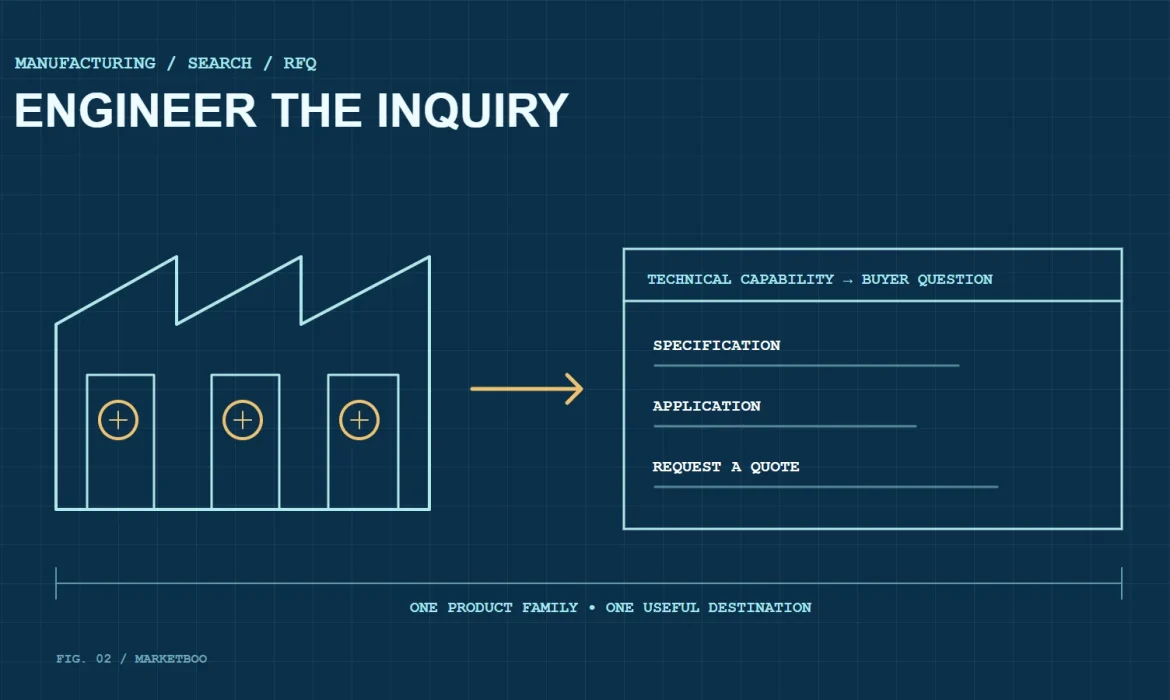
A useful manufacturing landing page answers the questions a buyer needs before asking for a quote: what the company makes, which applications it serves, which specifications are available, what information is needed for a quotation, and what happens next. Organize the page so a buyer can scan the category and then inspect technical detail. Where possible, connect a product page to drawings, downloadable documents, application examples, process capabilities, quality information, and a direct inquiry route. Every supporting claim should be current and approved by the responsible team.
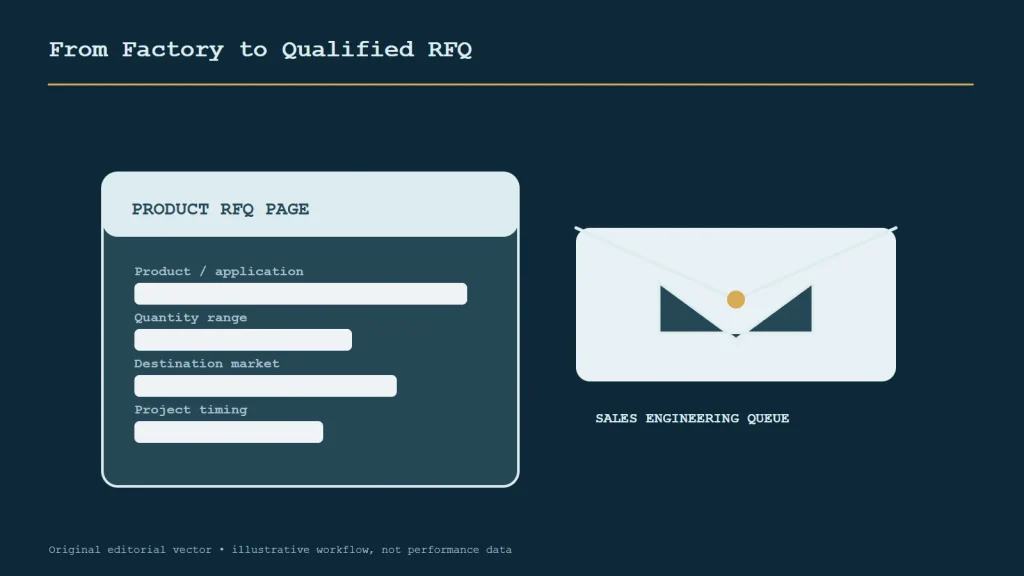
The form should ask for enough information to route the request without turning the first step into a procurement audit. Product or application, quantity range, destination country, timing, and business contact may be useful. The exact fields depend on the product and the sales team’s ability to respond. Explain why the information is requested and what the buyer can expect after submission. If a file upload is important for drawings or specifications, confirm the site’s technical and security requirements before adding it.
Test the entire path on mobile and desktop. Open the page from the actual ad destination, submit a test inquiry, inspect the confirmation, verify the record reaches the intended inbox or CRM queue, and confirm that the source fields are retained. A successful tag firing is not enough if the lead disappears before sales sees it. Record page changes and their dates so a later improvement or decline can be interpreted. If the company has multiple language versions, test each destination separately rather than assuming a common template behaves identically everywhere.
Measure the handoff from click to accepted inquiry
Define the events that matter before launch. A form start, form completion, phone click, file download, quote request, and sales-accepted inquiry are different actions. Select a primary event that represents the business step the campaign is meant to optimize, and keep softer engagement events separate for analysis. Google’s documentation describes conversion measurement as a way to understand actions after ad interaction; the business still has to define which action reflects meaningful progress for its own sales process.
Use a consistent UTM convention for campaign links where applicable, and document the required fields. Avoid free-form campaign names that change from one operator to another. In the CRM, preserve source, market, product, and sales status in fields the team can report. Use platform-specific conversion imports only after confirming data handling, identifiers, timing, and permission with the appropriate technical and privacy owners. The tracking design should be simple enough for a new analyst to understand from the documentation.
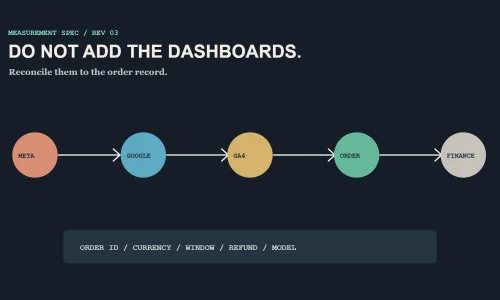
Reconcile platform and CRM totals regularly. Numbers may differ because of time zones, duplicate contacts, consent choices, cross-device behavior, attribution windows, offline imports, and system delays. A discrepancy is a prompt to investigate, not proof that one system is necessarily wrong. Compare records at the level the business can safely inspect, and report the known limits. If sales needs weeks to qualify a project, create a reporting view that distinguishes a current platform action from a later sales outcome.
| Metric | Example definition | Question it helps answer |
|---|---|---|
| Click-through rate | Clicks divided by impressions | Does the ad attract attention for the query? |
| Landing-page inquiry rate | Valid inquiry submissions divided by ad clicks | Does the page and offer support the next step? |
| Sales acceptance rate | Sales-accepted leads divided by submitted inquiries | Are inquiries commercially relevant? |
| Cost per accepted lead | Media cost divided by sales-accepted leads | What does qualified demand cost under this rule? |
| Quote rate | Quotes issued divided by sales-accepted leads | Does the handoff produce a sales action? |
Set budgets as a controlled learning plan
An initial budget should come from the business’s learning goal and financial limits, not from an online “recommended budget” that lacks context. Estimate the amount needed to observe relevant searches and a complete follow-up cycle, then decide what the company can afford to learn. In a low-volume industrial niche, that may mean a longer observation window and a smaller number of controlled hypotheses. In a more active category, a concentrated test may generate signals sooner, but it still does not guarantee a sale.
Google’s published guidance on average daily budgets explains that campaign spend may vary by day and describes a monthly spending limit based on the average daily budget. The current help page should be checked before launch because platform billing rules and campaign settings can change. This is an operational constraint, not a performance benchmark. Finance should understand the maximum planned spend, currency, and billing account before the campaign begins. A budget worksheet can show the approved average daily budget, test duration, and stop condition separately.
Avoid spreading a small budget across many countries, products, and match types simply to “be everywhere.” Each split can reduce the observations available for a decision. Start with the most serviceable market and the clearest product intent, then expand when there is a reason. If the budget is too small to answer the question, state that limitation rather than drawing a confident conclusion from a handful of clicks. The purpose of the first phase is to find a viable path, not to make the report look conclusive.
Turn a daily setting into a monthly cash plan
Do not build the export test around the assumption that every day will cost exactly the same. Google Ads documents that a campaign may spend up to twice its average daily budget on a given day and describes the monthly limit using a 30.4 multiplier. Those limits have conditions; budget edits and some campaign arrangements require a closer reading of the current rules.
| Planning input | Calculation under the standard unchanged-budget rule | What it tells the team |
|---|---|---|
| $100 average daily budget | $100 × 2 = $200 | A day can spend more than the average setting |
| Same unchanged setting | $100 × 30.4 = $3,040 | The documented monthly spending-limit calculation |
| Qualified RFQs | Cannot be derived from the budget setting alone | Demand, fit, page quality, and follow-up still matter |
Bring this calculation into the kickoff meeting with finance and sales. Finance needs a cash envelope; sales needs to know which product and market will receive that investment. Neither team should have to infer the plan from a screenshot of the campaign dashboard. Record the budget owner, the change threshold, and what must be fixed before additional money can be released.
For a manufacturer with a long quotation cycle, keep a separate cohort view of inquiries generated by that spending. A February order may have started with a January click. Treat the spending rule as a cash-control tool and the CRM cohort as a commercial-learning tool; one cannot replace the other.
Use a weekly operating review and a longer sales review
A weekly check can catch broken pages, disapproved ads, unusual spend, irrelevant search terms, missing form records, and changes that require approval. It should not become a reason to make many simultaneous edits. A change log records the setting, date, reason, expected effect, and review point. This allows the team to see whether a later result followed a deliberate test or an accidental adjustment. Establish which settings an agency may change independently and which require the client’s sign-off.
The monthly or sales-cycle review should go beyond platform engagement. Compare countries, product families, query themes, accepted leads, quotes, and known opportunities. Ask sales to explain a sample of accepted and rejected records. If the company cannot obtain that feedback, treat lead quality as unknown and make it a workflow task. Do not report “qualified demand” merely because a form contains a company email address. Qualification should reflect the agreed fit criteria, not an assumption about the contact.
Each review should end with a small set of decisions: keep the current test, adjust a defined part, pause a market, repair measurement, or collect more evidence. A good operating rhythm also preserves useful negative findings. If a phrase consistently attracts the wrong buyer, the exclusion and reason become reusable knowledge. If a page is technically sound but has too little demand, do not ask the agency to rewrite it repeatedly without new evidence. The goal is a better decision, not a higher count of changes.
A worked planning example for a fictional component supplier
Consider a fictional manufacturer of stainless-steel fittings that sells to industrial distributors and plant operators. It can ship to the United States and Canada, has an English product catalog, and receives requests for standard sizes as well as custom configurations. The example company has never tracked sales acceptance consistently. It therefore starts by defining a target inquiry and auditing its form path rather than setting a cost-per-lead goal based on an industry average. No result in this example represents a real Marketboo account.
The team groups queries by standard product, application, material, and custom sourcing. It excludes consumer repair and job-related searches only after reviewing actual search terms and confirming that those visitors cannot be served. Each group points to a page that answers the relevant question. The standard product page lists available dimensions; the application page explains use conditions; the custom page states what information helps engineering prepare a quote. Sales receives the same fields the campaign uses to classify the inquiry.
The first review checks whether the forms arrive, whether the country and product are captured, and whether sales can mark acceptance. Later reviews compare query groups and the downstream actions the company can observe. If one group has clicks but no qualified conversations, the team inspects query relevance, page fit, and follow-up before changing bids. If a group has few observations, it remains inconclusive. This scenario shows how to organize a test; it does not predict the supplier’s cost, conversion rate, or revenue.
Build the first campaign in a sequence the team can audit
The sequence matters because each step depends on the one before it. Product and market decisions determine the query map. The query map determines the campaign and page structure. The page and sales process determine the conversion definition. Only then can the team choose a reporting window and evaluate what it learned. When an agency skips the brief or tracking work, it may still launch quickly, but the business is left with weak evidence and an unclear explanation for later changes.
Document decisions in a place the client can access. This may be a shared project brief, a campaign naming document, a conversion map, a search-term review sheet, and a change log. The exact tools are not important. A new person should be able to discover why a country was included, what was excluded, what the primary event means, and who owns the next step. Documentation is particularly valuable when the manufacturer has several product specialists and sales teams contributing at different times.
If external support is involved, agree on a review cadence that matches both media activity and the sales cycle. The agency can bring platform observations; the client must bring product, fulfillment, and lead disposition knowledge. This exchange is the foundation for a practical B2B program. It also gives the business a way to decide whether to expand into another product family, add a new country, revise the page, or move resources to a different channel.
How to launch a Google Ads B2B manufacturing test
- Name one target market, one product family, and one buyer task the campaign will support.
- Define a sales-accepted inquiry with the sales team, including fit and serviceability criteria.
- Build keyword groups from product, application, specification, supplier, and research intent.
- Review current Google Ads match and location settings and document the intended reach.
- Create an ad and landing page that make the same specific, supportable promise.
- Test the form, phone or inquiry path, analytics event, CRM record, and sales notification.
- Set an approved budget, observation window, weekly checks, and a clear stop condition.
- Review search terms and lead dispositions together before changing bids or expanding scope.
Questions from the manufacturing sales team
Is Google Ads effective for B2B manufacturers?
It can be useful when buyers actively search for the product, application, or supplier and the company can provide a relevant page and sales response. Suitability depends on market demand, product language, competition, budget, and the quality of the inquiry path.
How much should a manufacturer spend on Google Ads?
There is no universal starting figure. Set a budget from the company’s financial limit, the search opportunity, the number of markets and products, and the time needed to review lead quality. Treat platform budget rules separately from expected performance.
Should manufacturing keywords be broad or exact?
Use a structure appropriate to the account’s data and control capacity. Review Google’s current matching documentation and actual search terms. Match type alone cannot replace ongoing relevance checks or a clear campaign objective.
What should a manufacturing RFQ form ask?
Ask for the smallest set of fields needed to route and evaluate the request, which may include product, application, quantity, country, timing, and company contact. Test whether sales can use the information before adding more fields.
Can a manufacturer optimize for offline sales?
A company may connect digital campaigns with later CRM outcomes using documented measurement workflows. Before importing data, confirm platform requirements, identifiers, consent, privacy, and technical ownership with qualified internal reviewers.
Why do manufacturing ads get clicks but few qualified RFQs?
Possible causes include informational searches, inaccurate targeting, a page that does not answer technical questions, a difficult form, unsupported claims, or slow sales response. Inspect the path rather than assuming the bid is the only problem.
How long should a B2B manufacturing test run?
The observation period should account for search volume, budget, technical validation, and sales-cycle length. Agree on a review date and minimum evidence in advance; do not declare success from a small, unqualified sample.