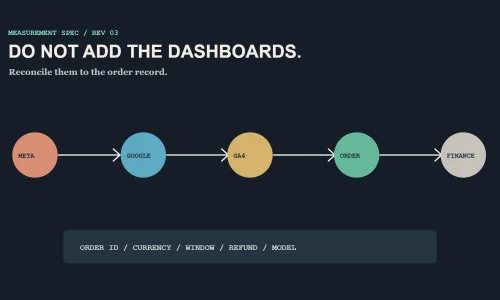

If you are deciding how to choose an overseas advertising agency for a B2B exporter, start by checking whether you can verify what you are buying. Ask every candidate to explain its scope, account access, lead definitions, reporting, fees, and exit process. The best shortlist connects those answers to your product and target markets. Use the evaluation record below to compare evidence before you compare presentations.

In this evaluation
- Why an overseas advertising agency is not just a media buyer
- How to choose an overseas advertising agency for a B2B exporter: start with a brief
- Compare scope line by line, not by the word “full service”
- Keep account ownership and access in the client’s hands
- Make lead quality measurable beyond the platform dashboard
- Test attribution claims without demanding impossible certainty
- Make the agency explain one real billing rule
- Read the report sample as a work product
- Verify references and case studies in context
- Compare fees, contract terms, and the cost of change
- Use a weighted scorecard and a bounded pilot
- What a sensible first 90 days should produce
- Questions to settle before the shortlist becomes a contract
- Choose the partner whose work you can verify
Why an overseas advertising agency is not just a media buyer
An exporter rarely buys advertising in isolation. Campaign performance depends on product-market fit, regional demand, language, shipping promises, sales coverage, page quality, and the speed at which someone answers an inquiry. A media buyer can manage bids and audiences, but the commercial system also needs a way to decide which country is serviceable, what counts as a useful lead, who approves claims, and what happens after a form is submitted. When these responsibilities sit with different people, the agency should help coordinate them rather than pretending the ad account controls every outcome.
That distinction changes how a buyer evaluates expertise. Ask a candidate to trace one real buyer journey from the first search or social impression to an accepted sales opportunity. A useful answer names the handoffs: campaign, destination page, tracking event, CRM record, qualification rule, and sales response. A vague answer tends to skip the uncomfortable steps between a platform conversion and revenue. The agency does not need to own all those systems, but it should be able to identify dependencies, explain what it can verify, and flag what remains the client’s responsibility.
Global work adds operating questions that a domestic-only checklist may miss. Does the team understand the target market’s buying language? Can it support the time zone in which leads arrive? Does the client’s sales team have coverage for every advertised country? Are delivery terms, certification claims, and product availability consistent across languages? The answer need not be “yes” to every question on day one. What matters is whether the provider surfaces the gap and proposes a practical way to resolve it before spending is scaled.
How to choose an overseas advertising agency for a B2B exporter: start with a brief
Before contacting agencies, write a short brief that describes the product line, ideal buying organization, target countries, sales cycle, gross-margin constraints, and current lead-handling process. Include what the company can fulfill, what it cannot fulfill, and which commercial claims have already been approved. This prevents agencies from inventing a market strategy from a keyword list and gives each candidate the same context. If certain details are confidential, provide ranges or anonymized examples rather than withholding the information that makes a proposal meaningful.
Define the business action you want advertising to influence. “More leads” is too loose to govern a test. An exporter might instead seek sales-accepted inquiries from manufacturers in two named regions, with a product family and project window that the sales team can serve. Another company may need quote requests from distributors. These are different outcomes and may require different landing pages, qualification fields, channel choices, and reporting windows. Ask sales to help define acceptance criteria before a proposal is evaluated.
Record the starting point, even if it is imperfect. Note existing account spend, campaign history, conversion definitions, CRM stages, response times, and any past market tests. If historical data is not trustworthy, label it as such rather than treating it as a clean baseline. A capable agency should explain how it will audit the baseline and what decisions must wait until measurement is repaired. The brief should also list internal owners for product information, creative approval, web changes, sales follow-up, and finance reconciliation. A missing owner can delay a campaign more than a missing feature in the ad platform.
Compare scope line by line, not by the word “full service”
Agency proposals often use similar labels for different amounts of work. “Campaign management” may include research, build, daily checks, search-term review, creative testing, landing-page recommendations, conversion setup, and a monthly meeting—or it may include only a subset. Ask for a deliverable map that names each activity, its frequency, the responsible person, and the artifact the client receives. The goal is not to prescribe a particular agency workflow. It is to make omissions visible before they become change orders.
Separate work that is usually bundled from work that requires another specialist. Advertising operations may be included while video production, translation, product photography, web development, CRM configuration, analytics implementation, and legal review are not. If the agency identifies a dependency outside its scope, ask who will own it and how the handoff is documented. “We can help with that” is not enough to price or schedule the work. A written boundary protects both sides from assumptions about unlimited revisions or emergency support.
The scope should also say how the agency will respond when the account has a problem. Who investigates a conversion drop, a disapproved ad, a broken form, a tracking outage, or a sudden change in lead quality? What is the expected acknowledgement time, and which issues require client approval before changes are made? These questions matter more when a business sells internationally because working hours and escalation routes can cross time zones. A modest, clear support model is more useful than a broad promise of constant optimization.
| Scope area | Ask the agency to specify | Evidence to request |
|---|---|---|
| Research | Markets, audiences, intent, and exclusions covered | Brief, query map, assumptions |
| Media operations | Build, monitoring, testing, and review cadence | Sample change log |
| Creative | Formats, concepts, production, revisions, rights | Asset list and usage terms |
| Website and tracking | What is implemented versus recommended | Event map and QA record |
| Lead management | CRM fields, routing, and feedback responsibilities | Lead-stage definitions |
| Reporting | Metrics, periods, owners, and meeting cadence | Redacted report sample |
Keep account ownership and access in the client’s hands
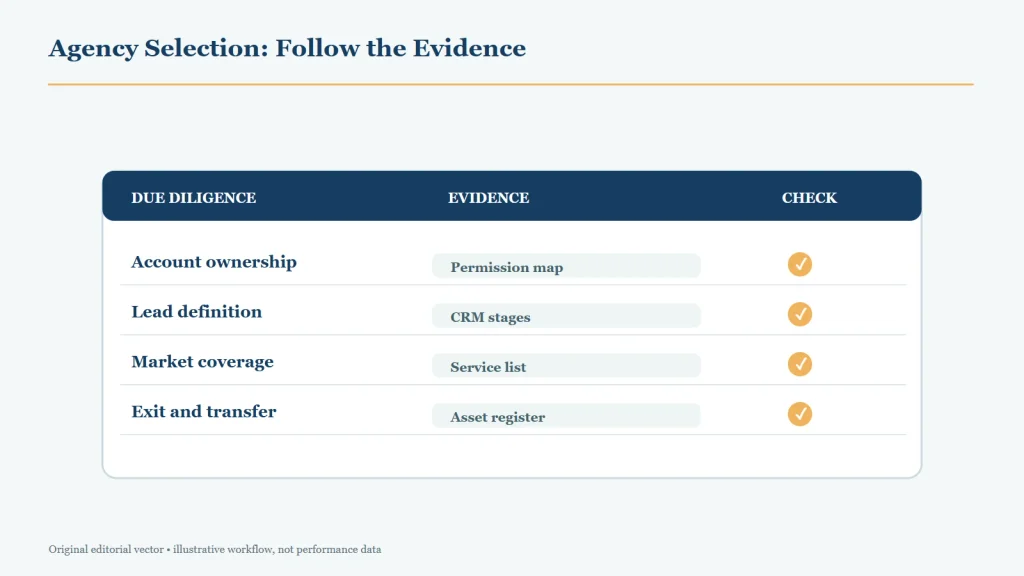
The advertiser should understand which organization owns the ad account, analytics property, tag manager, domain, pixel or equivalent event configuration, CRM data, and creative files. In most arrangements, the business should retain administrative ownership of its core assets while granting the agency the access needed to do its work. The precise setup depends on platform features and the company’s security rules, so have the account administrator confirm the current permission model before onboarding. Do not make account ownership a verbal assumption.
Ask the provider to show how access is granted, reviewed, and removed. The agency should identify named users or business entities, use the narrowest practical permissions, and have a process for staff turnover. The client should know where billing is charged, how invoices reconcile with platform spend, and how access changes are recorded. These are ordinary governance questions, not accusations. A professional supplier should be comfortable explaining them and documenting the answer in the kickoff pack.
Plan for the end of the relationship while setting it up. The agreement should require a current asset inventory, exportable campaign records, tracking documentation, creative source files where contracted, and timely transfer of access. Decide what happens to third-party tools, audiences, and reports after termination. If work is held in the agency’s proprietary system, identify which historical data can be exported and in what format. A relationship becomes safer when the client can continue operating, change suppliers, or pause spend without rebuilding its measurement foundation from memory.
Make lead quality measurable beyond the platform dashboard
Advertising platforms can report actions such as a form submission or a website event. Those actions are useful signals, but they do not automatically tell an exporter whether the contact is a relevant buyer, whether sales accepted it, or whether the opportunity progressed. Establish a shared definition for an inquiry, a qualified inquiry, a sales-accepted lead, and an opportunity. Keep the definitions simple enough for sales to apply consistently. If the team cannot agree on a definition, the first project milestone may need to be measurement and CRM cleanup rather than a larger media budget.
Build a practical feedback loop. Each lead record should preserve the source information the organization needs, such as campaign and country, while respecting its privacy and data-handling rules. Sales should be able to mark a record as relevant, duplicate, out of region, wrong product, student or job seeker, unresponsive, or still under review. The exact categories will vary. What matters is that the marketing team receives a reason, not just a binary “good” or “bad.” The agency can then connect search terms, creative angles, and markets to downstream quality.
Do not reward a supplier for volume alone if the business needs a narrower commercial outcome. A low cost per form may be attractive while it fills the CRM with contacts that cannot be served. Conversely, a higher initial cost may be acceptable if a greater share of leads becomes a quote or opportunity. Show both the platform-reported metric and the client-side quality measure, with their denominators and time periods. If offline outcomes are imported into an ad platform, document what is sent, which identifiers are used, and who approved the data flow. Platform guidance should be checked against the company’s privacy and legal requirements before implementation.
Test attribution claims without demanding impossible certainty
International B2B buying journeys can include search, trade events, referrals, social content, email, direct visits, and multiple people within one buying organization. A single last-click field cannot explain every influence. At the same time, an attribution report should not be so complicated that no one can tell what was measured. Ask the agency to distinguish platform reporting, analytics reporting, CRM source data, and any modeled or imported conversion information. Each system has a different purpose and may use a different lookback window or deduplication rule.
Use a consistent campaign naming convention and a written UTM standard for destinations where applicable. The agency should explain how it will handle redirects, language paths, consent choices, cross-domain journeys, and form submissions. Then have someone outside the agency test a sample journey and compare the records that appear in the analytics property and CRM. A test does not prove that every future visit will be attributed perfectly. It does confirm that the basic plumbing works and that the team understands how to investigate discrepancies.
Agree on how the report will speak about uncertainty. If a platform claims more conversions than the CRM contains, the report should show the difference and explain possible causes without inventing a reconciliation. If a lead returns later through a different channel, note the rule used to assign source credit. An agency that says “our dashboard is the source of truth” without explaining definitions is asking the client to outsource judgment as well as execution. A sound partner makes the data easier to inspect and helps the business decide which measure is appropriate for each decision.
Make the agency explain one real billing rule
A good supplier interview includes an ordinary question with a verifiable answer: “If our Google Search campaign has a $100 average daily budget, what could happen tomorrow?” Google’s overdelivery documentation says spending can reach twice the average daily budget on a given day, with a monthly spending limit based on 30.4 times that budget. Campaign type and changes to the budget matter, so the agency should check the applicable spending-limit rules rather than treating a daily setting as a fixed daily invoice.
For the unchanged $100 setting, those multipliers translate to $200 for the daily limit and $3,040 for the monthly limit under the documented standard rules. These are billing illustrations, not lead forecasts. The useful part of the interview is what comes next. Does the candidate explain served cost versus billed cost? Does it ask who can approve a budget change? Can finance see the setting and reconcile the invoice?
This small exercise tests a larger capability: translating a platform mechanic into a business decision. A polished agency presentation cannot substitute for that. Ask the same question of each shortlisted firm, preserve the answers, and have the person responsible for cash approve the escalation process. You will learn more about operational judgment than you would from another slide of percentage improvements.
Read the report sample as a work product
Request a redacted example of the actual report the team uses, not a presentation deck designed only for a sales meeting. Check whether it shows spend, market, objective, conversion definition, lead quality, changes made, and decisions needed from the client. A useful report lets a sales or finance reader understand what happened without having to decode platform terminology. It should also make missing information visible. A report that contains many charts but no interpretation can still leave the client unable to decide what to do next.
Look for a change log. Each material optimization should include what changed, the reason, the date, and what signal will be reviewed afterward. This creates a basic audit trail and makes it possible to distinguish deliberate tests from random account edits. Ask whether the agency keeps a hypothesis register or test record, especially when multiple markets or products run at once. The format can be a spreadsheet or a platform log; the quality is in whether someone else can follow the sequence and the conclusion.
Finally, check that the report supports a conversation rather than hiding behind a score. The agency should be prepared to explain why it recommends increasing, holding, or reducing spend; which assumptions remain unresolved; and what the client must do. If a recommendation depends on new creative, a faster sales response, or a page change, the report should name the owner and date. Shared accountability is easier to manage when it is written down instead of buried in a monthly call.
Verify references and case studies in context
Ask for references from businesses with a similar sales motion, product complexity, and international footprint. A company that sells low-priced consumer products may have little in common with a manufacturer that needs engineering review before a quote. Similarity is more useful than a famous logo. Where client confidentiality prevents a direct reference, ask for an anonymized case that still describes the market, period, budget range, conversion definition, lead-quality process, and the agency’s exact role.
Do not treat a case study’s headline metric as a forecast. Ask what changed during the period, whether the client changed pricing or inventory, how long the campaign had been active, and whether the result includes media spend only or also service costs. A cost-per-lead improvement is meaningful only when the lead definition and comparison periods match. If the source material lacks those details, the agency should say so. A cautious, auditable case is more useful than a dramatic figure with no denominator.
References should also help you evaluate the working relationship. Ask how the agency handled a tracking issue, a disagreement about lead quality, a missed approval, or a market that did not perform as expected. The goal is to learn whether the team communicates clearly when results are mixed. Strong partners can describe a decision that did not work and what they changed afterward. A provider that offers only flawless stories may be presenting a sales narrative rather than a complete picture of its operating discipline.
Compare fees, contract terms, and the cost of change
Separate media spend from agency fees, creative production, translation, landing-page work, analytics implementation, third-party software, taxes, and any minimum commitment. Ask whether fees are fixed, tied to a percentage of spend, project-based, or blended. None is automatically fair or unfair. The important questions are how the fee changes when budget changes, what work it covers, and whether the agency has an incentive that could conflict with the client’s priorities. A proposal should show the total expected cost under at least two budget scenarios.
Review payment timing, renewal, cancellation notice, pause conditions, scope changes, intellectual-property rights, confidentiality, and responsibility for platform charges. For international campaigns, also confirm currencies and which party bears exchange-rate fees. Have qualified counsel review legal language that affects data, advertising claims, or liability. A marketing team can identify the operational questions, but a checklist is not a substitute for legal advice. If a vendor asks for a long lock-in, request the business reason and the work product that justifies it.
Consider the cost of switching before signing. A short agreement with no documentation can be harder to exit than a longer engagement with clean account ownership and monthly exports. Conversely, a long commitment may be reasonable when the scope includes substantial setup, research, and training. Compare the expected work, transferability, and risk—not just the number of contract months. Your scorecard should give points for a workable exit plan because continuity of data and assets is part of the service value.
Use a weighted scorecard and a bounded pilot
The following scorecard is an editorial example, not a market standard. Adjust the weights to fit the company’s risk. A business entering a regulated or high-stakes market may place more weight on claims approval and data governance. A company with a mature analytics team may care less about basic setup and more about sales-quality feedback. Score each candidate using evidence submitted, not confidence in a presentation. For every low score, write down what proof could change the rating.
| Criterion | Example weight | What a strong answer demonstrates |
|---|---|---|
| Market and product understanding | 20% | Connects country, buyer, offer, and sales cycle |
| Account and data control | 20% | Client ownership, permissions, billing, and export path |
| Measurement and lead quality | 20% | Defined CRM stages and a tested feedback loop |
| Execution and reporting | 15% | Documented cadence, changes, and next actions |
| Creative and landing-page scope | 10% | Clear deliverables, rights, and approval process |
| Contract and handoff | 15% | Specific responsibilities and reversible exit |
Before a full rollout, consider a bounded pilot with one product line, a serviceable market, a defined conversion, and a set review date. Pay for the pilot as a real engagement with a limited scope. The pilot should test the agency’s process as well as the media: onboarding, access, creative approvals, tracking, report clarity, lead routing, and sales feedback. Set a budget that the business can afford to learn from; do not treat an illustrative example in an article as a recommended spend.
At the end of the pilot, decide among three options: continue, revise the scope, or stop. Continue only if the evidence and working relationship support the next step. If results are inconclusive because the sales cycle is longer than the pilot, evaluate the quality of the leading indicators and keep the conclusion narrow. A useful pilot can show that measurement is broken or a market is not ready. That is still valuable information if it prevents the company from scaling an unverified assumption.
What a sensible first 90 days should produce
The first month should establish access, definitions, baseline conditions, and the work plan. Depending on the account, this may involve auditing settings, checking destination pages, creating naming rules, validating events, and agreeing on lead statuses. Do not assume that a campaign must launch on the first day of an engagement. If the existing conversion data is unreliable, spending immediately can make the account harder to diagnose. The agency should explain what must be ready before launch and which items can be improved in parallel.
The next period can test a small number of market, keyword, audience, or creative hypotheses. The exact number depends on budget and available conversion volume. Ask the agency to show why each test is included and how it will decide whether to keep, revise, or stop it. Sales should review a sample of leads during the test rather than waiting until the end. A weekly operating check can identify technical issues, while a longer business review can account for the slower B2B sales cycle.
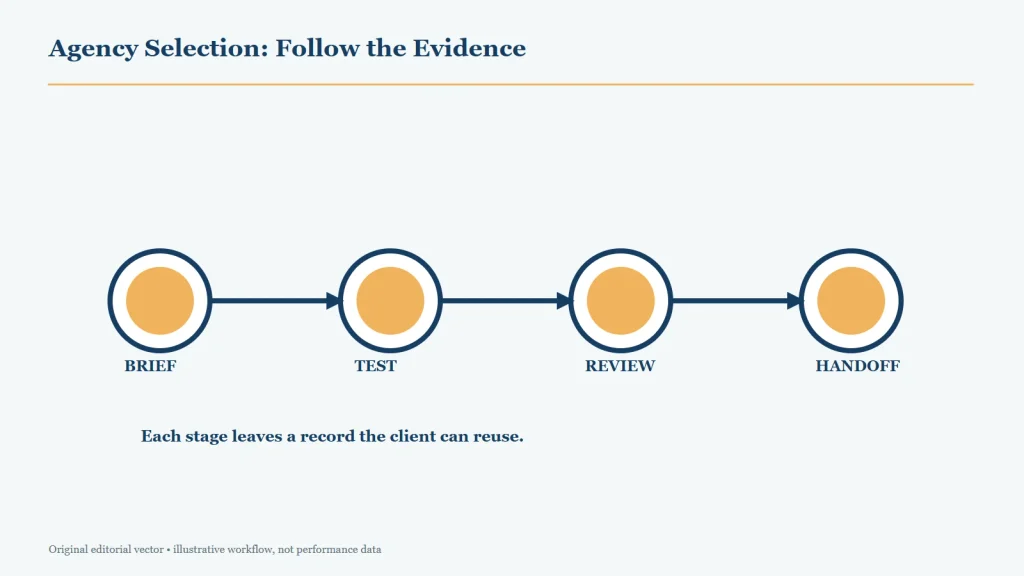
By the end of the initial quarter, the client should have more than a dashboard. It should have a record of assumptions, tested messages, lead-quality feedback, tracking limitations, and recommended next actions. It should also know which decisions belong to the agency and which require client approval. If the project produced data but no reusable learning, ask why. If it produced no decisive result because the sample was small, preserve the record and identify the next observation needed. The first 90 days are a learning and governance period, not a guaranteed ranking or revenue timetable.
Questions to settle before the shortlist becomes a contract
How much does an overseas advertising agency cost?
There is no single reliable fee for every exporter. Cost depends on markets, platforms, spend, creative production, landing pages, analytics work, and support expectations. Compare itemized scope and total cost under realistic budget scenarios instead of relying on an unsupported industry average.
Should the client own the Google or Meta ad account?
The client should ordinarily retain ownership and administrator control of core business assets, while granting the agency the access required to work. Confirm the current platform permission model and document access, billing, exports, and removal procedures.
What should count as a qualified export lead?
Define it with sales before the campaign starts. The definition may include a serviceable country, relevant product, buyer or company fit, and a valid next step such as a quote request. Keep “platform conversion” separate from “sales-accepted lead.”
Can an agency guarantee a target cost per lead?
No target should be treated as guaranteed without a specific, enforceable agreement and clear conditions. Competition, market demand, inventory, page experience, and sales follow-up all affect results. Ask for a test plan and reporting rules instead of a universal promise.
How can I check whether an agency’s case study is credible?
Ask for the period, market, spend scope, conversion definition, lead volume or range, quality process, and the agency’s role. When confidentiality applies, request anonymized evidence that still preserves those facts and the limits of the result.
How long should an agency contract last?
Choose a term that matches setup work and the sales cycle, then make cancellation, pause, scope-change, and handoff conditions explicit. A long contract is not automatically a problem, but the client should understand what it is paying for and how it can exit.
What is the first thing to do if the current account has poor data?
Pause major budget decisions long enough to audit conversion definitions, test the lead path, and compare the ad platform with analytics and CRM records. Label the historical baseline as unreliable if it cannot be reconstructed.
Choose the partner whose work you can verify
The strongest agency choice is not necessarily the largest or the cheapest. It is the provider whose work fits the product and market, whose reports can be checked, and whose operating model leaves the exporter more informed and more in control. Use the same questions for every candidate, ask sales and finance to review the measures they will use, and write account access and exit terms into the agreement. Start with a bounded scope, keep the evidence, and expand only when the next investment has a clear reason.
If you are mapping channels, countries, and campaign ownership, review Marketboo’s global paid media services and compare the described scope with your brief. If your team wants to retain account control while strengthening internal decision-making, explore hands-on advertising coaching as a separate support model.