

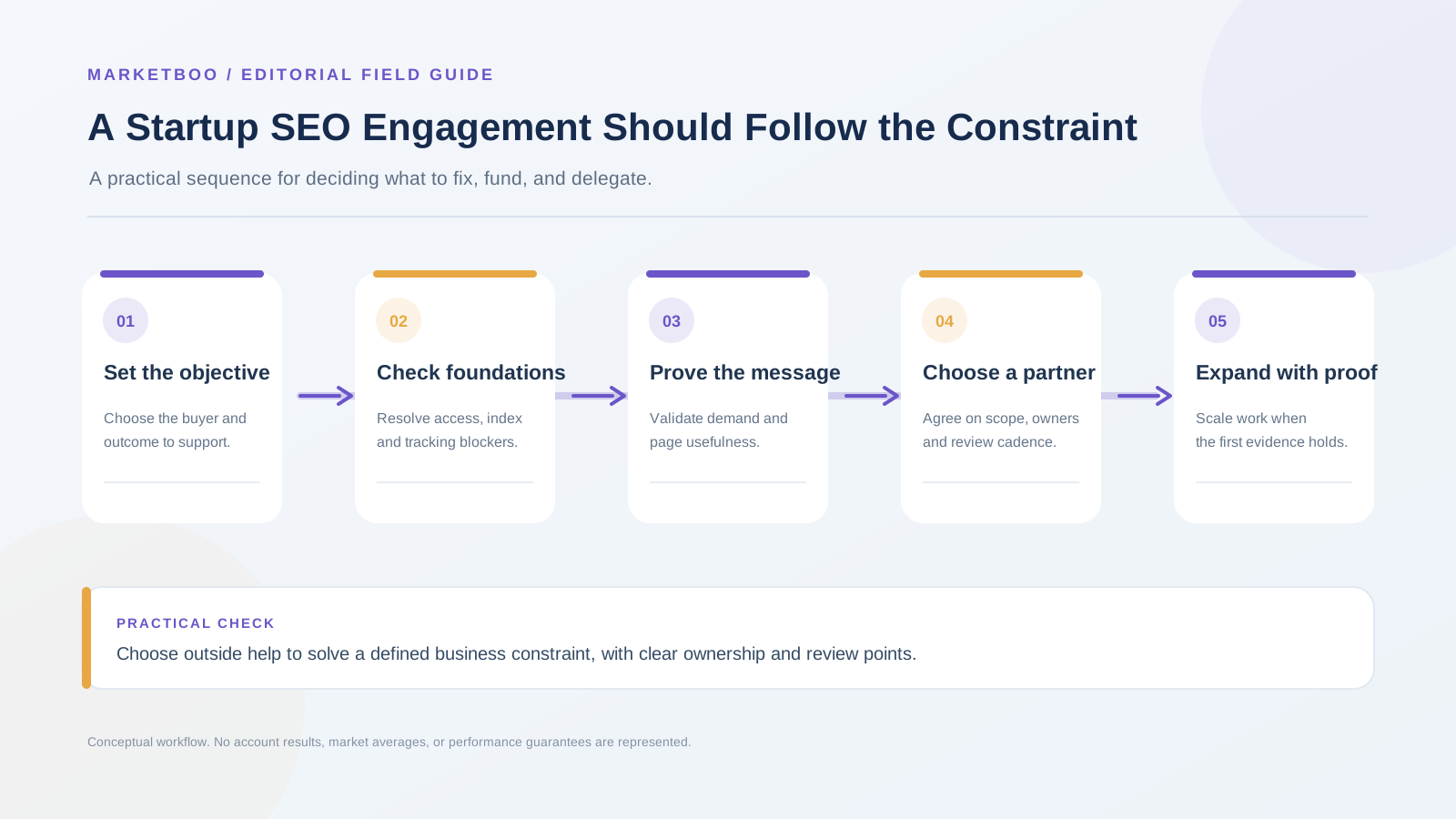
SEO services for startups make sense when the company has a clear audience, an offer people can understand, a website that can support discovery, and someone who can act on qualified interest. Early-stage teams should not hire an agency simply because competitors publish more often. First decide whether the current constraint is technical access, product explanation, demand validation, or execution capacity. The right choice may be a focused audit, a short coaching engagement, an internal owner, or an agency with a defined scope and shared responsibilities.

A founder’s hiring question is usually presented as a channel question: “Should we invest in SEO now?” The more useful question is whether the company can turn the work into learning and follow-through. If the product is still changing every few weeks, the team has no reliable point person for website changes, or sales cannot explain which customers are a fit, a large retainer can create activity without resolving the underlying uncertainty. If the company has validated a customer problem, knows how a buyer describes it, and can support content review and web implementation, a modest search program can help build a durable path to discovery.
Startups face a real tradeoff. They need to conserve cash and move quickly, but search work can take time to compound. There is no universal stage, funding round, or traffic threshold that makes SEO appropriate. A startup selling a self-serve tool to a broad category may begin with a product page and educational content earlier than a company selling a custom enterprise platform into a narrow market. Even in the latter case, search can help buyers verify product capability, security, integrations, and implementation once demand exists. The decision should follow buyer behavior and company readiness, not a slogan about “starting early.”
How SEO services for startups should be phased
A startup is ready to invest in SEO when it can state who the product serves, what problem it solves, which questions buyers ask, and how the website should help them take the next step. It also needs a named owner who can review recommendations, obtain product facts, make or commission site changes, and track outcomes beyond pageviews. If those pieces are partly missing, begin with the smallest engagement that will clarify them. That may mean customer interviews and a technical baseline before a long content program.
This readiness test does not mean a startup must have perfect product-market fit or a large marketing department. It means the work has an honest purpose and a path to implementation. Search data can help expose language and content gaps, but it cannot substitute for evidence that the product matters to someone. A startup should avoid promising that SEO will validate the entire business or produce a predictable number of leads by a chosen date.
Three stages, three different search priorities
Stage labels are shorthand, not a rigid rule. A seed-stage business may already have repeat customers and a clear category; a later-stage company may still be exploring a new product. Use the table to describe the company’s current constraints rather than to assign work based on fundraising.
| Operating stage | Common signal | Sensible search priority | What to avoid |
|---|---|---|---|
| Problem and offer validation | Target user, problem, or positioning still changes | Interviews, vocabulary capture, a clear home page, basic indexability, product explanation | A large volume of speculative articles or scaled location pages |
| Repeatable early acquisition | The team can identify a fit customer and a repeatable sales or activation path | Product and use-case pages, technical cleanup, a small evidence-led content set, conversion tracking | Hiring for “more content” before clarifying who should convert |
| Expansion and new markets | Product and demand are understood in at least one segment | Market-specific page architecture, integration and comparison coverage, internal linking, measurement by segment | Translating pages without validating terminology, service coverage, and local buyer needs |
At the validation stage, the founder should protect time for learning from customers. A simple page can explain the problem, intended user, current workflow, and proposed solution. If the language changes during interviews, update the page and record why. The objective is not to rank for every phrase; it is to understand whether a real buyer recognizes the problem and can tell what the product does.
As the offer becomes repeatable, invest in the pages that shorten evaluation. Buyers need a precise product description, clear use cases, real integration behavior, onboarding requirements, and an appropriate demo or trial path. Support claims with product documentation, customer evidence that is approved for publication, or a subject-matter expert review. Search engines and readers need accessible pages, but the internal team also needs a system for updating them when the product changes.
When expanding, do not assume the same page works for every audience. New markets can change language, purchasing norms, legal or privacy obligations, support availability, and competitive context. A country page should contain useful distinctions and accurate service details, not just a translated heading. A new industry page should explain the relevant workflow and evidence instead of swapping an industry name into a generic template.
DIY, coaching, consultant, or agency?
The choice is not simply “in-house or outsource.” A founder can own the strategy while a specialist addresses technical issues; a small team can write with expert editing; an agency can coordinate content and implementation; or a consultant can help select priorities and transfer knowledge. Match the engagement to the bottleneck, the internal time available, and the company’s appetite for managing work.
| Approach | Best fit when | Startup responsibility | Main tradeoff |
|---|---|---|---|
| Founder-led DIY | The site is small, the team can learn, and time is available | Research customer language, publish accurate pages, review Search Console, coordinate changes | Low external spend but substantial founder opportunity cost and a learning curve |
| Coaching or advisory | The team can execute but needs a decision framework or expert review | Supply access to product, analytics, and web owners; complete agreed actions | Knowledge transfers, while implementation remains internal |
| Specialist consultant | A defined technical, research, architecture, or content problem needs depth | Provide a decision maker and implementation owner | Focused expertise; the company may still need to coordinate multiple disciplines |
| Agency engagement | The company has a clear scope and needs sustained external capacity | Review facts, approve priorities, supply access, and act on sales feedback | More coordinated capacity, with greater need for scope and communication discipline |
| Internal hire | Search is a continuing core function and there is enough work to own | Build an operating environment and cross-functional access | Deep product familiarity, but hiring adds fixed cost and management needs |
A provider is not automatically the better choice because the work is complex. Conversely, outsourcing is not wasteful if an experienced team can prevent an expensive migration problem or help a lean startup move through a backlog. Compare approaches by the work completed, time to decision, learning retained, implementation quality, and the internal effort required. Do not compare only monthly fees without describing who writes, who reviews, who changes the site, and who owns analytics.
The right scope may change over time. A startup might begin with a technical audit and a prioritized implementation plan, then return for content architecture after product positioning settles. Another may need help with a public website rebuild and measurement before investing in ongoing editorial production. A clear provider should be willing to describe this sequence and explain what the company can do itself.
What a useful startup SEO scope contains
A practical scope begins with the company’s objective and assets. Ask the provider to review the current website, the product and sales motion, search evidence, technical condition, internal ownership, and business constraints. The review should identify both opportunities and items that should wait. If the team cannot measure a requested outcome yet, the scope should say so and recommend an instrumentation step.
A focused initial scope might include:
- A working session to define product fit, target segments, markets, key objections, and the desired conversion event.
- A crawl and indexation review of public pages, templates, canonical signals, sitemaps, robots rules, redirects, and rendered content where relevant.
- A query and page assessment that uses available Search Console data, customer language, sales questions, and appropriate keyword research.
- A prioritized URL map showing what to keep, improve, consolidate, create, or defer.
- A small number of page briefs tied to distinct buyer questions and the evidence needed to answer them.
- An implementation plan with an owner, dependency, effort estimate, and validation method for each material recommendation.
- Measurement definitions for visits, trial or demo events, qualification, and CRM outcomes, with attribution limits stated.
- A review cadence that allows the startup to see work delivered, decisions required, and changes made.
The scope should distinguish diagnosis from execution. “Technical audit” does not necessarily mean the provider will fix the problem. “Content strategy” does not necessarily include writing or subject-matter review. “SEO management” can mean very different things between agencies. Convert broad phrases into deliverables, responsibilities, and acceptance criteria. For example, specify whether a deliverable is a crawl report, a working ticket backlog, a set of implemented redirects, or verified QA after launch.
Google’s documentation is a useful source for platform requirements, but an agency should not claim private access to a secret ranking formula. Google’s SEO Starter Guide and Search Essentials describe core practices and eligibility considerations.[1][2] A provider can apply experience and make recommendations, but should separate platform documentation from its own judgment. When an agency cites a data point or case result, ask what population, time period, market, and methodology it represents.
Questions to ask before signing
A founder does not need to evaluate every technical recommendation personally. The goal is to discover whether the provider can explain its reasoning, involve the right specialists, and work transparently with the people who own the product and website. Ask questions that expose the operating model rather than prompting a polished sales deck.
- What did you learn about our product and buyer before recommending this scope? A useful answer references real pages, user questions, product details, and business goals. A generic proposal that could be sent to any startup may not reflect the problem you need to solve.
- Which work is included, and which work is excluded? Ask about research, briefs, writing, editing, engineering implementation, analytics, link acquisition, reporting, and stakeholder meetings. Make the boundary visible in writing.
- Who will do the work and who will review it? Clarify senior oversight, subject-matter review, account communication, and continuity if a team member leaves. The person who presents the proposal may not be the person preparing every deliverable.
- What do you need from our team each month? A sound plan should list access, interviews, product review, engineering capacity, approval turnaround, and sales feedback. If the internal workload is unknown, ask the provider to estimate it by activity.
- How will you decide what we should not publish? The answer should include audience fit, distinct page purpose, factual evidence, maintenance cost, and the existence of a better destination—not merely keyword volume.
- How will recommendations become website changes? Ask whether the provider opens tickets, edits a CMS, writes code, coordinates developers, or validates completed changes. Confirm who has authority to deploy and how risky work is tested.
- How do you handle a recommendation that conflicts with product or engineering reality? The provider should invite verification and document uncertainty. Pressure to publish a claim that product staff cannot confirm is a warning sign.
- Which metrics will we review, and what do they mean? Separate search visibility, clicks, engaged visits, trials, demos, sales-accepted leads, opportunities, and customers. Ask what is available in the company’s tools and how long the funnel takes to mature.
- Can you show a relevant example and explain its limits? Look for context, baseline, timeline, scope, market, and what was attributable to the work. A case study should not be presented as a guaranteed result for your company.
- How do you manage account access, data, and ownership? Confirm that the startup owns its website, analytics, Search Console property, content, and account credentials. Use least-privilege access and a documented offboarding process.
- How do you source external links or digital PR? Ask for the method and the sites or relationships involved. Avoid undisclosed paid links, automated link schemes, or guarantees of a specific number of links. Google’s spam policies describe link spam practices that can violate its guidelines.[3]
- What would make you recommend pausing or ending the engagement? A partner should be able to identify prerequisites and failure conditions, such as no access to implement changes, a product pivot, unreliable conversion data, or an unaddressed site defect.
The quality of the conversation matters. A provider may need time to investigate before answering detailed questions. That is normal. What matters is whether it explains what it knows, what it needs to verify, and how it will communicate findings. Be cautious of answers that replace a method with a promise.
Understand the contract and the operating relationship
SEO engagements can include discovery, technical analysis, content planning, editorial production, CMS support, digital PR, and reporting. Make sure the contract or statement of work distinguishes these. Confirm the number and type of deliverables, revision rounds, approval windows, dependencies, meeting time, data access, intellectual-property ownership, confidentiality, and termination terms. If an engagement has a minimum term, understand how the team will assess fit before that term ends.
Ownership matters for startups. The company should control its domain, CMS, analytics, Search Console, and advertising accounts. The provider can receive scoped permissions but should not be the only person with administrator access. Clarify who retains research, content, briefs, source files, and technical documentation when an engagement ends. Avoid arrangements that make the startup dependent on a vendor-owned site or account simply to preserve its work.
The company should also plan internal participation. Product marketing can confirm positioning, engineers can validate technical behavior, sales can explain objections, finance can define acquisition economics, and a web owner can implement and test changes. The founder may not need to attend every meeting, but someone with decision authority should resolve tradeoffs promptly. Without internal review, a provider may produce pages that sound confident but describe a feature inaccurately.
Some results arrive later than the first invoice. A technical fix can be verified quickly, while changes in search visibility or pipeline may take longer and be affected by other site releases, market shifts, and search result changes. Agree on a near-term definition of progress: the audit is complete, the chosen pages are improved, indexation defects are resolved, or tracking is reliable. Then review business outcomes when the relevant cohorts mature. Do not judge a full acquisition strategy only by immediate rankings, and do not excuse months without clear work by saying SEO always takes time.
How to choose a provider in a week
This seven-step process helps a startup make a bounded decision without pretending that a week can prove future performance.
- Write the problem in one paragraph. Describe the product, intended customer, market, current bottleneck, and the decision that the engagement should enable. Include what has changed recently and what may change next.
- Collect baseline evidence. Assemble public URLs, Search Console access, basic analytics and conversion definitions, sales questions, product documentation, recent site changes, and any known technical defects. Keep sensitive customer data out of proposal documents unless the provider needs it and the access method is appropriate.
- Set constraints. Decide how much internal time is available, who can implement recommendations, which markets are in scope, and what cost boundary matters. A budget range is helpful, but a quote should follow the deliverables rather than invent a universal “startup SEO price.”
- Ask two or three providers for the same brief. Give each the same high-level context and ask for an initial scope, dependencies, team, and evidence they would collect. Do not request a free exhaustive audit that would require extensive unpaid work or disclose confidential details unnecessarily.
- Interview the people who will do the work. Ask them to explain one observation from your site, one thing they would not recommend yet, and one unresolved question. Their clarity and curiosity matter as much as their presentation.
- Compare scope line by line. Put deliverables, exclusions, internal effort, access, ownership, reporting, and exit terms side by side. Compare what each option lets you know or implement after the first month, not only its fee.
- Choose a reversible first commitment. Where possible, start with a bounded diagnostic or pilot and a decision checkpoint. Define what completion means, what the next phase would depend on, and how the company will transfer learning in-house.
This process is especially useful when the company has limited past performance data. You are not trying to predict which provider will guarantee rankings. You are assessing whether its method is clear, its assumptions are reasonable, its work can be implemented, and its recommendations can be verified.
An illustrative startup readiness scorecard
Use the worksheet below in a working session. “Strong” means the startup can point to evidence, not simply that someone feels confident. If an item is weak, decide whether it blocks an ongoing program or can be addressed in a short discovery phase.
| Readiness area | Strong evidence | If the answer is unclear, first action |
|---|---|---|
| Product and audience | Team can name the core user, use case, and poor-fit customer | Interview recent users and sales; revise the product story |
| Offer clarity | Public page explains what the product does and what action to take | Improve the home or product page before creating supporting content |
| Demand language | Buyer phrases appear in interviews, tickets, sales notes, or search data | Gather language from customers; label search estimates as unverified |
| Website access | Important pages are crawlable, internally linked, and technically testable | Run an initial crawl and Search Console inspection |
| Implementation owner | Someone can approve and deploy changes | Assign a web owner or reduce scope to advisory work |
| Subject expertise | Product claims have reviewers who can validate them | Identify engineers, product leads, or customer experts for review |
| Measurement | Trial, demo, qualification, and CRM definitions are documented | Align teams on a small number of events before reporting pipeline |
| Time horizon | The company can evaluate near-term work and later-stage outcomes separately | Set an early implementation checkpoint and a longer business review |
| Operational capacity | Sales or customer success can respond to qualified interest | Fix routing and follow-up before stimulating more demand |
This is not a weighted vendor score and should not become a reason to manufacture readiness. A startup can begin with an imperfect score if it knows what is uncertain and chooses a scope that addresses it. For example, a lack of search history does not prevent a site architecture review, but it does limit claims about expected traffic. Missing engineering capacity may make strategic recommendations hard to implement, so the contract should make that dependency explicit.
Common hiring mistakes
Buying a content quota
A promise to publish a fixed number of articles may sound concrete, but volume alone does not answer whether the subjects are useful, distinct, accurate, or connected to product evaluation. Ask for the editorial decisions, source review, internal reviewer, and maintenance plan behind each page. One useful product page can be more valuable to the business than several generic posts.
Choosing a provider on ranking promises
No provider can responsibly guarantee a specific organic position for a startup’s chosen keyword. Search results depend on competition, user context, indexing, relevance, and changing systems. A credible proposal should identify deliverables and controllable implementation work, then describe outcome measures without guaranteeing a result that depends on external systems.
Signing before agreeing who implements changes
An audit can list many actions, but the startup may have no developer or CMS owner to execute them. Ask for effort, sequence, and dependencies. If implementation is not included, budget for it and assign a person before starting.
Expecting SEO to solve positioning
If prospects do not understand the offer, publishing more pages may amplify confusion. Product messaging and customer research can inform SEO, but neither a consultant nor a search engine can choose the company’s strategy on behalf of its founders. Clarify the offer and customer first.
Ignoring company-side contribution
An external partner cannot infer every nuance of the product. Provide timely access to product experts and sales feedback. Approve claims and correct inaccuracies. Slow review cycles can delay work and make a plan appear ineffective when execution is waiting on the company.
Treating a report as implementation
A dashboard, audit, or slide deck is useful only if it supports a decision and change. Require a backlog or other action record with owners, priorities, dependencies, and validation. Make sure the team closes the loop after changes ship.
FAQ
When should a startup hire an SEO agency?
Hire external help when the startup can describe its audience and offer, has a decision owner, and needs capacity or expertise it cannot provide internally. If positioning, product fit, or website ownership is still unclear, begin with a bounded discovery or advisory project. The timing should follow the company’s work and constraints, not its age or funding stage.
How much do SEO services for startups cost?
There is no dependable universal rate that applies to every market, scope, and provider. Cost depends on whether the work includes strategy, technical implementation, writing, subject-matter review, outreach, analytics, and ongoing account management. Ask for a line-item scope and clarify internal labor, tools, and contract length before comparing proposals.
What should a startup SEO agency deliver first?
A clear diagnosis of the company’s most important audience, product pages, technical barriers, search evidence, conversion definitions, and implementation responsibilities. The first deliverable should help the startup choose what to do next. Depending on the site, that could be an audit, a prioritized plan, a repaired page, or a measurement baseline.
Can SEO validate product-market fit?
Search behavior can provide useful signals about language, questions, and discovery, but organic traffic alone cannot establish product-market fit. Validation requires evidence about whether customers have the problem, adopt the product, receive value, and continue using or paying for it. Use search data as one input alongside customer research and product outcomes.
How long does startup SEO take to work?
There is no reliable fixed timeline for rankings or revenue. Some technical issues can be corrected and verified quickly; changes in visibility and pipeline depend on crawling, competition, content quality, product fit, and the time needed for sales or activation outcomes to mature. Agree on near-term deliverables and review longer-term outcomes using dated cohorts.
What metrics should founders track?
Track a small set across the journey: relevant search visibility and clicks, visits to important pages, meaningful trial or demo actions, qualified outcomes, pipeline or customers where measurement supports them, and implementation progress. Define each event and its system of record. Do not present impressions, raw form submissions, or rankings as revenue.
How can a founder spot an SEO provider that is not a fit?
Be cautious if the provider cannot explain the scope, promises fixed rankings or lead volumes, hides who will perform the work, recommends publishing at scale before understanding the product, uses link tactics it will not describe, or asks the startup to give up ownership of its accounts. Ask for context behind case results and a clear path from recommendation to implementation.
Make the first commitment easy to evaluate
The best SEO engagement for a startup is the smallest credible scope that resolves an important uncertainty and leaves the team better able to make its next decision. That may be an audit, a product-page plan, technical support, coaching, or ongoing agency work. Define what the provider owns, what your team must contribute, which data will guide decisions, and when you will reassess the fit.
For startups that need a staged plan across technical SEO, content, and AI-search discovery, see Marketboo’s SEO and GEO services. If you already know the business bottleneck and want to discuss an initial scope, contact Marketboo with your product stage, target market, and available internal capacity.
This is the practical role of SEO services for startups: guide a clear next action and make the result measurable.