A social media content agency retainer should define the work a team will receive each month, how it will be approved, and what happens when the scope changes. Compare deliverables by unit—concepts, platform adaptations, captions, revisions, publishing, moderation, and reporting—rather than by the word “posts.” Assign owners for accessibility checks, client inputs, rights, and escalation. A sample month can expose hidden work before signing, while explicit exclusions keep creator fees, video shoots, paid media, and urgent requests from becoming assumptions.

Choose a social media content agency by scope
Evidence note: Platform behavior, account settings, permissions, local rules, and service scope can change. Verify current documentation and qualified review before implementation.
Make the retainer legible before comparing prices
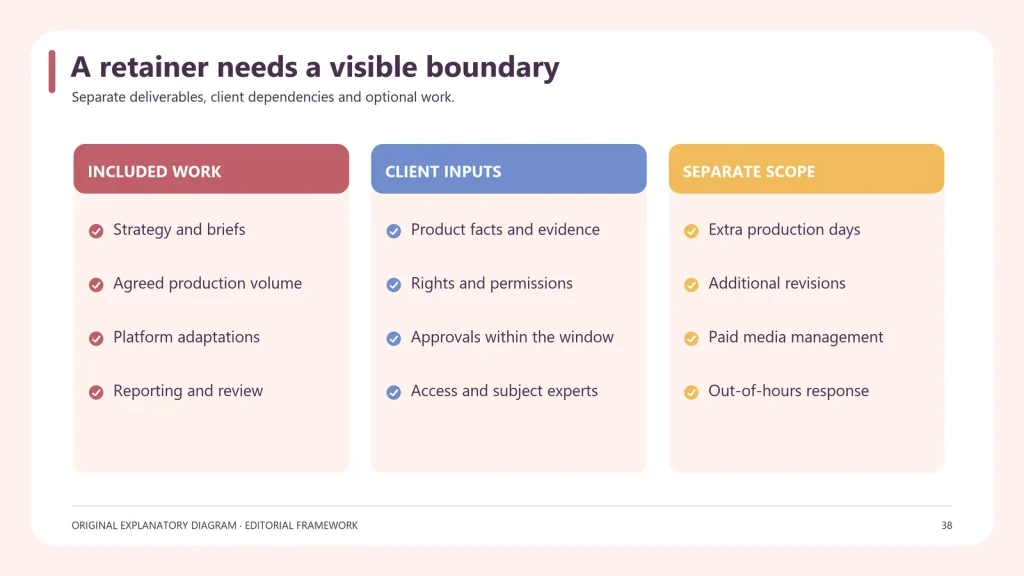
Give each agency the same sample month and ask it to mark included, optional, client-supplied, or excluded work. “Ten posts” is not a comparable unit when one proposal includes research, copy, design, scheduling, and reporting while another delivers captions. Compare the production system as well as the asset count.
Use a deliverables matrix with format, quantity, revision allowance, approval owner, destination, and final-file location. Ask what happens when a product update arrives late or a launch date moves. A clear exception rule is more useful than an assurance that the team will be flexible.
A low fee can be a reasonable choice for a capable in-house team that needs only production. A broader fee may make sense when the business needs planning and coordination. The question is whether the missing work has an owner and a realistic capacity, rather than whether one package has the longest list.
| Retainer area | Should specify | Typical ambiguity |
|---|---|---|
| Strategy | Audience, objectives, pillars, review cadence | ‘Strategy included’ with no artifact |
| Production | Asset count, formats, copy, design, video | One ‘post’ hides many tasks |
| Operations | Scheduling, publishing, approvals | Who supplies access? |
| Community | Hours, channels, escalation, tone | Response promise not defined |
| Reporting | Metrics, insights, decision meeting | Dashboard without action |
How to compare two retainers using one sample month
Keep the owner, evidence, and verification point beside every step.
- Write the business goal, audience, platforms, cadence, internal owner, and required approval dates.
- Turn the proposed retainer into a deliverables matrix with counts, formats, owners, and exclusions.
- Define the content research, brief, production, accessibility, localization, scheduling, and archive workflow.
- Set review rounds, feedback format, turnaround expectations, late-input rules, and escalation boundaries.
- Decide whether community response, creator coordination, paid support, and reporting are included or optional.
- Run a sample month through the calendar, approval, publishing, response, and reporting path.
- Review the scope with finance, marketing, legal, and the person supplying content or access.
- Record the change-order, renewal, handover, and cancellation process before signature.
Separate strategy from production
Strategy should leave an artifact that changes a decision: an audience brief, message hierarchy, channel role, or test plan. Production should leave approved assets in usable formats. Request one example of each, with confidential information removed. A recurring “strategy” meeting without a decision record is hard to evaluate.
Put a brief approval between planning and design. Confirm the audience, message, supporting evidence, next action, and required reviewers. If the purpose changes after design begins, classify the request as a new brief or a defined revision. This prevents the monthly asset allowance from being consumed by work nobody formally approved.
Specify the monthly content system

Trace one proposed asset from intake to archive. Who supplies the product facts? Who finds evidence? Who writes, designs, checks, approves, schedules, and corrects it? The calendar should show dependencies, including customer permission, a shoot, or a technical reviewer. A date alone does not make an asset ready.
Use a realistic sample mix. One expert interview might supply a short video, a document post, and several excerpts, provided each adaptation has a purpose and the necessary rights. Those are not automatically interchangeable with unrelated posts. Name the source asset, adaptation work, and review burden in the scope.
Keep editable files and the approval history in a shared location with agreed access. Good handover begins during normal production; it should not require reconstructing a month of decisions from personal messages when someone leaves.
Define platform adaptations and accessibility
Specify what changes between platforms: framing, aspect ratio, caption, text alternatives, subtitles, disclosure, link behavior, and destination. Ask the agency to adapt one idea for two channels and explain the material differences. Resizing a graphic does not establish that the meaning or next action still works.
Use a testable accessibility acceptance check. W3C’s WCAG 2.2 Recommendation, dated October 5, 2023, requires captions for prerecorded audio in synchronized media at Level A under Success Criterion 1.2.2, except for media that is a clearly labelled alternative to text. Success Criterion 1.4.3 sets minimum contrast of 4.5:1 for ordinary text and 3:1 for large text. These are specific standard criteria, not a claim that any social post or business automatically meets every accessibility or legal requirement. Read the caption criterion and contrast criterion.
Name the person checking captions, names, numbers, reading order, and the linked destination. Automated captions can be a draft, but specialist names or product terms still need checking. If the agency supplies only the visual, state who handles the platform’s accessibility fields at publication.
| Deliverable | Scope decision to record | Acceptance evidence |
|---|---|---|
| Original concepts | Monthly quantity and approved channels | Approved content calendar |
| Platform adaptations | Which formats, crops, and copy variants are included | Export and channel checklist |
| Captions and contrast review | Owner, languages, and correction responsibility | Caption file and final-export check |
| Revisions | Included rounds and approval deadline | Comment log and final approval |
| Community response | Coverage hours, escalation path, and exclusions | Response log and incident owner |
Set approvals, revisions, and client inputs

Choose one accountable approver and one consolidated feedback channel. Define factual corrections, preference edits, and a changed brief separately. A retainer can include a reasonable number of revision rounds while pricing a new concept separately; the contract should make that boundary understandable before the first disagreement.
Test the process with a fixed-date asset containing a claim that needs review. Establish the input deadline, review deadline, fallback, and person authorized to defer publication. If a reviewer is unavailable, move the date or use an already approved alternative. A deadline is not evidence that an unresolved claim is correct.
Decide whether community response is included
Publishing and response are different services. Define monitored channels, coverage hours, response categories, languages, and escalation. A production retainer may reasonably exclude replies, provided a client owner handles them. “Community management included” needs more detail than a line in a proposal.
Ask how the team would handle a product question, refund request, hostile comment, and journalist inquiry. Identify what can be answered from approved guidance and what must go to customer care, legal, or a designated spokesperson. Keep the response log limited to useful operational information and the applicable handling rules.
Make reporting useful for decisions
A monthly report should change the next calendar. Ask for a short decision page beside the dashboard: keep, revise, stop, investigate, with evidence and an owner for each recommendation. A rise in engagement is incomplete advice unless the team can explain which content job and audience it reflects.
Separate activity, audience response, and business action. Posts delivered show production; saves and replies suggest forms of interest; qualified enquiries require a destination and a definition. Preserve source, period, denominator, and known tracking gaps. A platform total should not silently become a sales claim.
Use content-level findings to change the next brief. If buyers repeatedly ask the same installation question, commission a clearer demonstration. If a format earns attention without useful next steps, review its purpose or destination. Ask the agency to show how one prior finding altered a subsequent asset, without requiring it to disclose another client’s confidential data.
List optional production and paid support

Price recurring production separately from shoots, talent, locations, travel, music, stock licensing, creator fees, paid distribution, and extra markets. A promise of “video included” remains incomplete until filming, editing rounds, deliverable formats, and usage are defined.
Keep media spend outside production totals unless the proposal explicitly combines them. State who owns the advertising account, audiences, tracking access, and source files. Before paying to distribute a creator asset, confirm that the usage permission covers the intended channel, duration, territory, and edits. Route contract questions to the appropriate reviewer.
Write an exit and change process
A workable exit should transfer final and editable assets, licence records, the upcoming calendar, open approvals, reports, and the account-access list. Decide what happens to scheduled posts and unanswered messages on the final day. Confirm ownership and permissions in the agreement rather than assuming every supplied file can be reused indefinitely.
For an ongoing scope change, record the requested deliverable, effect on existing work, timing, cost method, and approver. If the same exception recurs each month, revise the base scope at renewal. The retainer should describe the operation the team actually needs, rather than an increasingly fictional original package.Request a social media scope
| Change request | Clarify | Protects |
|---|---|---|
| Extra revision | Trigger and rate or limit | Timeline and quality |
| New platform | Research, format, access | Unplanned labor |
| Urgent post | Availability and approval | Expectation |
| Video shoot | Crew, location, usage | Rights and budget |
| Paid amplification | Media owner and spend | Scope boundary |
Frequently asked questions
What does a social media content agency retainer include?
A clear retainer may include strategy, research, copy, design, video, scheduling, reporting, and community work. The contract should define quantities, formats, owners, and exclusions.
Are revisions included?
They can be, but specify the number of rounds, what counts as a new brief, feedback deadlines, and the route for urgent changes.
Does content creation include video production?
Only when the scope names filming, editing, captions, music or rights, aspect ratios, locations, talent, and usage responsibilities.
Who supplies brand and product information?
The agreement should name the client inputs, access, approvals, subject-matter reviews, and the effect of late or incomplete information.
Is community management part of content production?
It is a separate operating responsibility unless the retainer states channels, hours, tone, escalation, and response boundaries.
How should agency reporting be judged?
Reports should connect defined activities to useful audience, engagement, enquiry, quality, or business decisions; a dashboard alone is not an insight.
Can Marketboo provide a modular retainer?
Marketboo can discuss a modular scope across social planning, content operations, paid support, SEO/GEO, and reporting after the goals and responsibilities are defined.
Conclusion
Choose a retainer by the work, rights, accessibility checks, review capacity, and change rules the team can verify. Ask the agency to price and document a representative month, then confirm every quantity against the actual statement of work.
Review a modular retainer with Marketboo