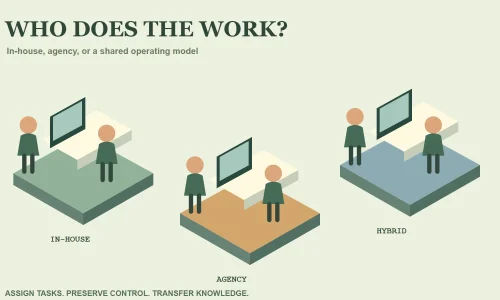
LinkedIn lead generation for B2B works when a team defines the accounts and buying roles it can serve, offers something useful to those buyers, and agrees how sales will handle each response. A submitted form is only one step; it is not the same as a sales-accepted lead or a meeting that took place. Before launch, align account criteria, form fields, CRM routing, ownership, and stage definitions. Then report submissions, accepted leads, booked meetings, and held meetings separately so the team can identify where follow-up or fit needs attention.

The funnel: five decisions with five evidence records
| Stage | Working question | Evidence to retain |
|---|---|---|
| Account | Is this company in the serviceable market? | List source, date, segment, exclusions |
| Role | Can the message reach a useful buying participant? | Function, seniority, geography |
| Offer | Does the exchange earn attention? | Asset, promise, eligibility |
| Form | Does the form collect only useful context? | Fields, notice, thank-you |
| Meeting | Was a real next conversation accepted? | Owner, timestamp, qualification |
Define the account and meeting you actually want
Start with an account you can serve, rather than a person likely to click. Write down industry, company size, geography, operating model, and the problem your offer addresses. Then list exclusions: existing customers, suppliers, competitors, or businesses outside your delivery area. A smaller usable list is more valuable than a large list that sales must clean after every campaign.
Consider an illustrative logistics campaign. The target is an operations leader at a 200–1,000-person carrier; the offer is a dispatch-workflow checklist. An accepted meeting requires a discussion of the current process and an agreed next step. A student downloading the same checklist is a content response, not an accepted sales lead. These are proposed qualification rules, not a reported Marketboo campaign result.
A trigger such as hiring or a funding announcement can justify research, but it cannot establish a buying project. Ask sales to validate a small account sample before launch. If the team repeatedly disagrees about whether an account fits, fix the definition before adding budget. Otherwise, creative testing will be mixed with a qualification problem.
Launch checklist: make every handoff accountable
Keep the owner, evidence, and verification point beside every step.
- Write the serviceable account definition, roles, offer, meeting criteria, owner, and review date.
- Validate the account and role list, exclusions, geography, permissions, and audience size before launch.
- Create one useful offer and map its promise, proof, fields, thank-you path, and follow-up expectation.
- Connect the form, CRM or lead sheet, enrichment step, owner, timestamp, deduplication, and error path.
- Launch one account and role hypothesis while preserving creative, budget, event, and sales context.
- Review delivery, completion, contact, qualification, and meeting evidence with marketing and sales.
- Record the decision to stop, revise, continue, or expand and name the next test owner.
- Recheck the handoff after any form, CRM, policy, audience, or campaign change.
| Signal | What it can tell you | What it cannot prove |
|---|---|---|
| Impression | Delivery opportunity | Buying intent |
| Content engagement | Topic attention | Account fit |
| Form submit | A completed action | A qualified lead |
| Contacted | A response attempt | Sales acceptance |
| Meeting | A scheduled conversation | Revenue causality |
Evidence note: Platform behavior, account settings, permissions, local rules, and service scope can change. Verify current documentation and qualified review before implementation.Build a LinkedIn lead-generation plan
Build a role-aware offer instead of a broad audience

A role-aware offer connects a responsibility to a useful next decision. An economic buyer might need a cost-of-change worksheet; a daily operator might need an implementation checklist; a technical reviewer might need an integration question list. The same account can contain all three, with different questions and different authority.
Keep the offer narrow enough to deliver its promise. A checklist should help a buyer inspect a process, not conceal a sales pitch behind an impressive title. Give sales the actual asset and ask what follow-up would be helpful after reading it. If the answer has no connection to your service, redesign the offer before judging campaign response.
Record role and offer versions together. An apparent improvement after changing both tells you little about which change mattered. Where practical, hold the account segment and destination steady while comparing two messages. Read the replies for misunderstood terminology as well as counting completions.
Turn a content offer into a useful lead form
A useful official starting point: LinkedIn’s best-practices page, checked October 15, 2026, recommends three to four fields; its specifications allow 12 questions in total, including up to three custom questions. This is platform guidance and a limit, not evidence that one field count maximizes results for every business. Begin with the questions needed for routing and qualification, then assess your own completion and acceptance data. LinkedIn form best practices; form specifications.
Make each field earn its place. A routing field determines who follows up; a qualification field changes the next action. Information collected merely because it might be useful later adds handling work without a defined business purpose. Agree on the field map and privacy notice before traffic arrives.
Match the confirmation screen to the promise. Deliver the checklist, explain the next contact, and offer scheduling only where it suits the visitor’s intent. A person requesting a document has not necessarily requested a discovery call. Check the live form settings and applicable requirements rather than treating profile data as a complete or verified buyer record.
Test the complete mobile journey: submission, confirmation, document access, record creation, owner assignment, and follow-up. Keep the form version beside the reporting cohort. If a new question reduces submissions but increases accepted leads, you need both measures to decide whether the change helped.
| Stage | Count to record | Definition owner |
|---|---|---|
| Form submitted | Unique submissions after the stated duplicate rule | Marketing operations |
| Sales accepted | Records meeting the agreed account, role, and need criteria | Sales and marketing |
| Meeting booked | Accepted records with a scheduled meeting | Sales |
| Meeting held | Meetings that occurred in the reporting period | Sales |
Design the enrichment and routing handoff
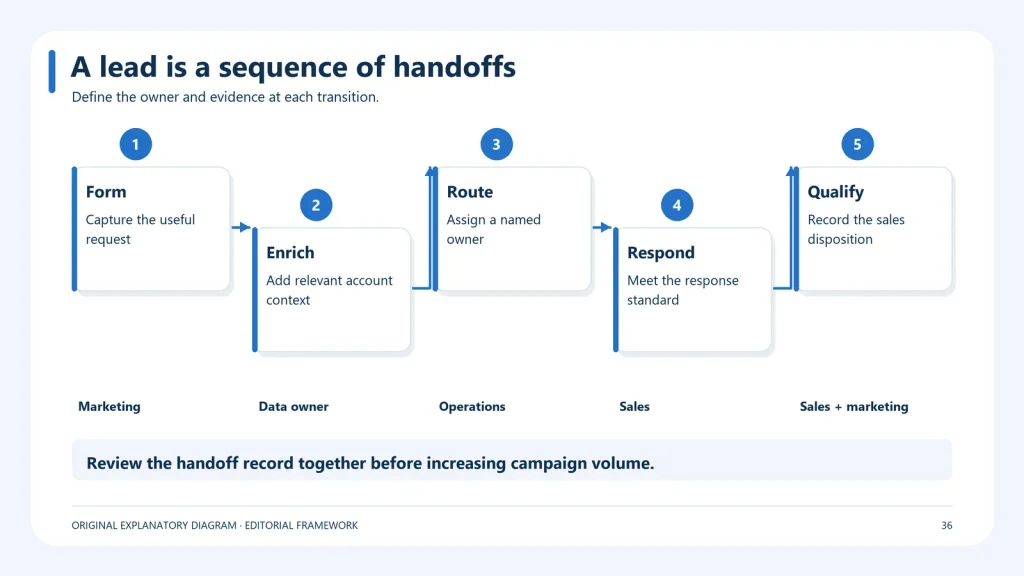
The handoff needs a field-level map: original value, destination field, transformation, responsible owner, and failure action. For example, a company name may need normalization before territory assignment. Preserve the submitted value so a reviewer can distinguish what the visitor provided from what an enrichment service inferred.
Write duplicate rules before connecting systems. An existing customer response might belong to account management, while an open opportunity may belong to its current owner. A duplicate form submission should not create a second “new lead.” Exceptions need a visible queue and a person accountable for resolving them.
Run three failure tests: a missing job title, a duplicate email, and an unavailable integration. Confirm that the record is retained appropriately, an alert reaches its owner, and recovery does not send duplicate messages. Review enrichment permissions and data handling with the responsible owner; a technically successful transfer does not settle those questions.
Set a response standard sales can keep
A response standard describes an observable action within defined working hours. State the first contact attempt, covered territories, holiday handling, escalation, and fallback owner. “Within one business day” remains ambiguous until those conditions are clear. Set a standard your team can staff and measure it with submission and attempt timestamps.
Judge usefulness alongside speed. A helpful reply acknowledges the requested asset, explains why the next step might matter, and lets the recipient choose. A generic calendar link can be fast while leaving the visitor’s question unanswered. Sample the messages and outcomes before attributing weak results entirely to the audience.
Report account progress without inflating intent
Use separate columns for submissions, sales acceptance, meetings booked, and meetings held. Retain cohort dates, market, account fit, duplicate rules, and records still awaiting review. A rate with an incomplete denominator can move simply because the sales queue has not caught up.
Suppose, purely as a worked example, a cohort contains 40 unique submissions, 12 accepted records, six bookings, and four held meetings. The submission-to-acceptance rate is 30%; booked-to-held is about 67%. Neither number is an industry benchmark. The example shows why reporting “six meetings” without saying booked or held hides a different operational question.
Reconcile a sample against the source records. Platform totals and CRM totals may disagree because of dates, duplicates, identity matching, or delayed updates. Show the difference explicitly. Do not fill an unobservable stage with an estimate and present it as a measured result.
Run a controlled LinkedIn lead-generation cycle
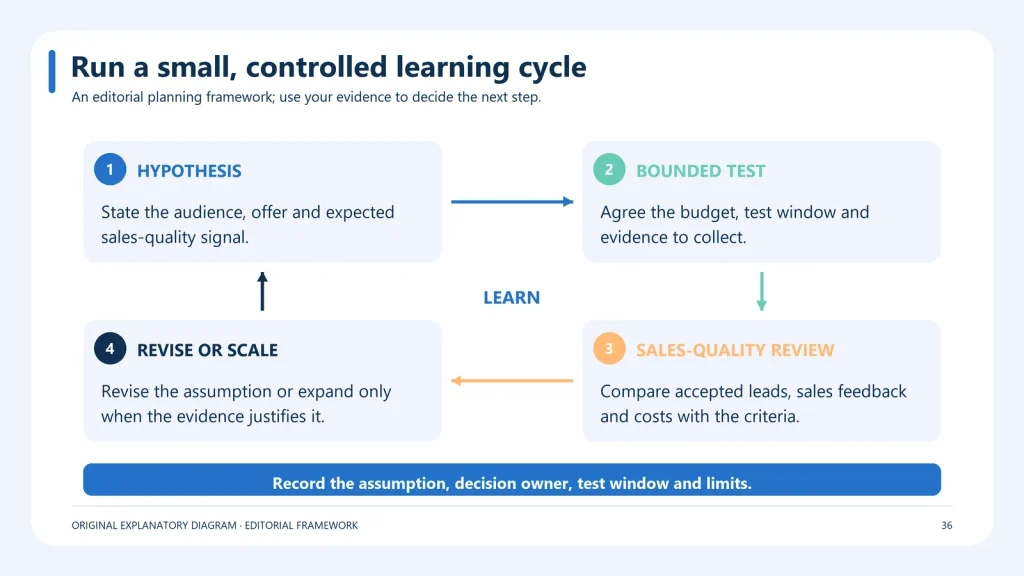
Write a one-page test brief: account hypothesis, role, offer, primary action, spend ceiling, owner, and review point. Define what evidence would support the idea and what would challenge it. Choose the observation window around delivery and follow-up capacity, rather than borrowing a universal number of days.
Pause immediately for a broken destination, lost records, an unstaffed handoff, or a policy concern. Revise the message when the right people misunderstand the offer; revise qualification when records consistently fall outside the agreed account definition. Expand only when the measured stages can be reconciled. A campaign that teaches you why an offer fails can still inform the next decision, without being described as successful lead generation.
Review quality with marketing and sales
Bring a small, representative record sample to a shared review. Include accepted, rejected, unanswered, and duplicate responses. Compare the original message, form answers, follow-up, and recorded outcome. A rejected account outside the service area calls for a different fix from a good-fit account without a current project.
Agree on a short set of reason codes and test them together before building a dashboard. If two reviewers classify the same record differently, discuss the rule. Consistent definitions will make the next creative or targeting decision more defensible than another layer of reporting.
Scale only the parts that remain explainable
Expand one constraint at a time: account coverage, buying role, creative, or budget. Check whether response staffing, record handling, and delivery capacity can absorb the change. Entering a different country may require a new language, offer, or approval process, so treat it as a new hypothesis.
Keep the previous cohort and change record available. If qualification deteriorates after expansion, you should be able to identify what changed and restore the earlier setup. The decision to scale should rest on usable business evidence and capacity, rather than the attractiveness of a single platform metric.
FAQ
What is LinkedIn lead generation?
It is the planned use of LinkedIn audience, content, forms, landing paths, and sales follow-up to create defined business conversations. The accepted lead and meeting criteria must be written first.
How should B2B teams define a target account?
Use a documented fit model covering market, size, geography, need, exclusions, and ownership. A company name alone is not a qualification rule.
Are LinkedIn Lead Gen Forms enough for qualification?
They can reduce a step, but the fields and follow-up still need to distinguish a submitted form from a qualified opportunity.
How many fields should a B2B form use?
Use the smallest set that routes or assesses the enquiry. Add a field only when its business use and permission context are clear.
How quickly should sales respond?
Set a response standard that the named owner can meet, then measure it with timestamps. Do not borrow a universal service promise.
Can LinkedIn lead generation guarantee meetings?
No. Audience fit, offer value, response quality, sales capacity, competition, and market conditions affect meetings.
How can Marketboo support the plan?
Use the framework in this guide to discuss a proposed scope with Marketboo. Confirm the current service, responsibilities, access, and deliverables in writing before work begins.
Conclusion
A LinkedIn lead-generation plan is ready when marketing and sales can define an acceptable account and meeting, trace each form record to an owner, and explain what the funnel numbers do—and do not—show. Start with one approved audience and offer, document the handoff, then expand only after the team can reconcile the stages.Review the sales handoff with Marketboo