

Direct answer: TikTok management costs depend on the work a provider agrees to own, so there is no single monthly rate that fits every company. A quote may cover planning, scripts, filming, editing, localization, publishing, community coverage, creator coordination, paid-media management, or reporting—in different combinations. Ask for each service fee and outside expense separately, then define monthly deliverable counts, video complexity, languages, revision limits, response hours, usage rights, and account access. Two offers that both say “eight videos” may describe very different jobs. Compare them against one written scope, and treat forecasts as assumptions rather than guaranteed views, leads, or sales.
A quote often arrives as one tidy number. The work behind that number is rarely tidy. One team may receive finished footage and schedule posts; another may research the market, write scripts, arrange a shoot, manage creator permissions, answer comments, and report on campaign traffic. Both could describe themselves as a TikTok management partner. The buyer’s first job is therefore to translate the headline fee into a map of responsibilities.
This guide is written from a procurement desk, where a useful comparison begins with units and exclusions. It does not publish a market-average price: the workbook brief provides no verified pricing dataset, and the project has no live keyword-volume feed. Any examples below are hypothetical planning aids, not Marketboo client results or rate recommendations. The purpose is to help a team ask for comparable proposals and understand where its budget would go.
Start with a scope, not a price benchmark
“Account management” is a label, not a deliverable. Before discussing a monthly total, describe the account’s job. Is it meant to explain a product, support a distributor network, recruit channel partners, build familiarity in a new market, or send qualified visitors to a sales page? Those aims call for different content and review processes. A product explanation may need an engineer to verify each claim; a behind-the-scenes clip may need a location plan and employee permissions; a campaign may need a landing-page link and a reporting convention.
Write down what success would look like in terms the company can actually observe. Separate the provider’s controllable outputs—approved scripts, edited files, scheduled posts, response logs—from outcomes that depend on audience interest, the offer, distribution, timing, or the website. That distinction makes a statement such as “monthly reporting included” more useful: the brief can say what the report covers and who will validate its business interpretation.
Scope should also name the people needed from the client. A supplier cannot responsibly verify a technical claim without an approved source or reviewer. The company may need to provide product samples, access to a facility, brand rules, approved terminology, and a response owner for questions. If those inputs are missing, the calendar may be delayed even when the agency fee itself is fixed.
Separate the monthly fee into cost centers
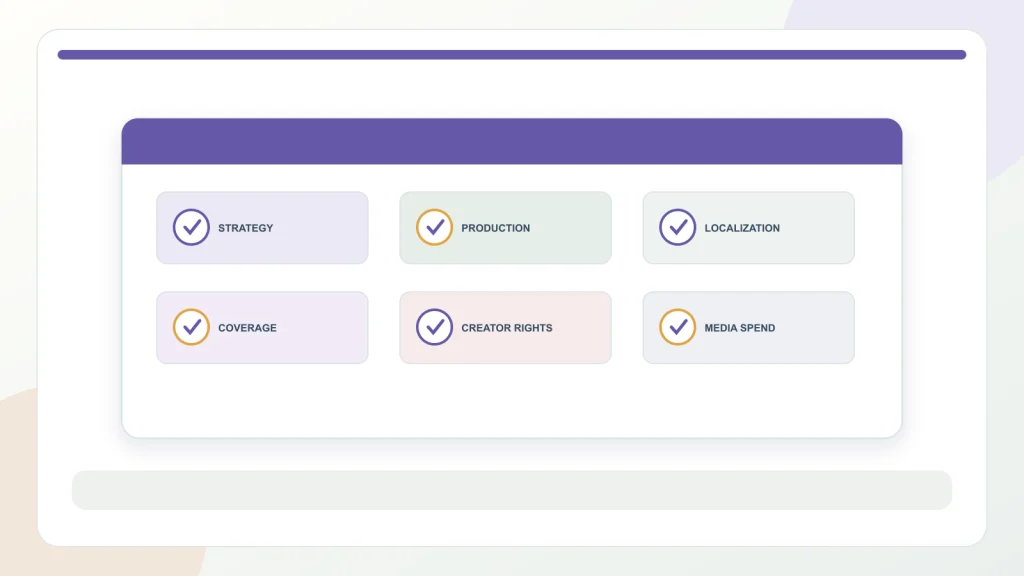
A practical budget has at least three layers: labor and management fees, project expenses, and money paid to a platform or third party. Keep them visible. A monthly management fee may cover recurring planning and coordination. A shoot may bring travel, location, equipment, or talent expenses. Creator compensation, music or footage rights, ad spend, taxes, and software seats may sit outside the fee. The contract should identify the payer and approval route for every category.
This separation is more than bookkeeping. If campaign performance later needs review, a team must know whether it is comparing labor cost, production cost, creator investment, or media spend. Combining all four in one line can hide what changed from one month to the next. It can also make a provider appear more expensive simply because its quote includes production costs that another supplier excluded.
| Cost center | Ask the provider to define | Typical boundary to make explicit |
|---|---|---|
| Planning and research | Markets, audience assumptions, content pillars, calendar, review cadence | New-market research, urgent campaigns, extra product lines |
| Writing and localization | Script count, languages, native-language edit, subtitles, voice work | Technical review, additional versions, rush turnaround |
| Production and editing | Remote edit or shoot, finished-video count, format, revision rounds | Travel, location, on-camera talent, raw files, complex graphics |
| Publishing and community | Posting volume, time zone, monitoring window, response authority | Weekend coverage, customer-service resolution, private messages |
| Creators and rights | Outreach, coordination, usage period, territory, paid reuse | Creator fees, whitelisting, new edits, extended licensing |
| Media and reporting | Ad operations, account owner, report fields, tracking setup | Platform spend, third-party tools, taxes, external analytics work |
Planning and creative research: define the recurring work
Strategy can be a one-time setup or a recurring service. A setup project might document the audience, content roles, voice, approval chain, and initial themes. Ongoing planning may require regular interviews, new campaign briefs, competitor observation, trend review, or calendar adjustments. Ask which activities are included each month and which happen only during onboarding. If a provider says “strategy included,” request the actual artifacts: a brief, calendar, concept notes, or review meeting.
The number of markets matters because localization is not simply a second caption file. A team serving two languages may need separate audience assumptions, examples, terminology checks, and approval owners. Additional product lines can also multiply research and fact review. Ask whether the quoted scope is based on one account, one brand, a set number of products, or a defined group of markets. That gives both sides a way to handle expansion without renegotiating every task informally.
Scriptwriting, filming, and editing are separate units

Video count is a weak unit when complexity varies. A short edit made from clean, approved footage is different from a filmed demonstration that needs a location, product handling, a presenter, several camera setups, and technical review. A quote should say whether a “video” means one finished export, one concept, a set of cuts, or a master plus adaptations. Include expected runtime, aspect ratio, subtitle treatment, cover frame, file type, and the number of revision rounds.
Clarify who supplies each source element. The client might provide a product, an expert, existing footage, a permitted facility, and approved claims. The provider might prepare questions, a shot list, crew, lighting, editing, voiceover, and graphics. When responsibility is shared, identify the handoff date and the person who confirms a usable asset. If footage arrives late or cannot be used, decide whether the calendar shifts, the provider edits alternate material, or the work becomes a change request.
Revision language deserves special attention. “Reasonable revisions” means different things to different teams. A better line states the number of rounds, the format for collecting feedback, who consolidates comments, and what counts as a material change. Correcting a typo is not the same as replacing a product claim after the video has been cut. A single consolidated review helps prevent several stakeholders from reopening an approved script one comment at a time.
Localization changes the editorial workload
Translation moves wording from one language to another; localization may reshape the hook, examples, units, references, and pacing so they make sense to a specific audience. The quote should identify which service is intended. It should also state whether the person checking the target-language copy is a fluent editor, a subject-matter reviewer, or both. Those roles solve different problems: natural phrasing does not verify a technical statement, and a technical reviewer may not be a skilled copy editor.
For multilingual projects, request a source script and version log so the team can see which text was approved, adapted, recorded, and published. Agree on product names, measurements, abbreviations, and words that should stay untranslated. If a voiceover is included, specify whether it is performed by a person, supplied by the client, or handled through a separate vendor. State how many languages and versions the monthly fee covers, and whether captions are burned into the image or delivered as a separate file.
Accessibility and localization overlap but are not interchangeable. If a video uses captions, the editorial brief should specify who checks names, numbers, terminology, and meaningful non-speech audio. W3C’s WCAG 2.2 Understanding document describes captions for prerecorded synchronized media and is dated October 5, 2023. That reference explains a standard’s intended meaning; it does not settle which legal requirements apply to a particular company or market. A qualified reviewer should assess that separately where needed.
Publishing and community coverage need hours and authority
Publishing work may include a final format check, caption, cover frame, schedule, link check, and an archive of what went live. Community management is a broader promise. It can mean monitoring, classifying comments, hiding spam under agreed rules, forwarding product questions, or writing public responses. Ask what the provider can do without approval and what must be escalated. A brand should not leave a contractor to improvise statements about stock, product performance, safety, refunds, delivery times, or legal issues.
Time zone and coverage window affect workload. If the audience is active while the client team is offline, decide whether the supplier monitors during specific hours, reports the next business day, or provides an agreed escalation path. “Daily community management” should say whether weekends and holidays count, whether direct messages are included, and how urgent issues reach the company. A response window is not the same as a guarantee that every question can be resolved within that window.
Access should follow the company’s own account and security process. The statement of work can name the account owner, the roles the provider needs, how approval works, and what happens at offboarding. Avoid sharing credentials through informal channels. The company should understand how a contractor’s access is granted and removed, and who confirms that scheduled work, files, and records have been handed back when the engagement ends.
Creator payments, usage rights, and paid reuse are distinct

Influencer or creator work can include discovery, outreach, negotiation, briefing, review, delivery coordination, payment administration, and rights tracking. Those services are not the same thing as the creator’s fee. Ask for the coordination charge and creator compensation separately, and have the company approve third-party spend before commitments are made. A provider should not treat a public post as permission for unlimited brand reuse.
Rights should be specific enough for a future editor to understand them. Record the deliverable, permitted channels, territory, usage duration, organic or paid use, edit permission, attribution, and any category exclusivity. Confirm who is responsible for music, location, likeness, product, and other third-party permissions. If paid amplification is contemplated, define it before the creator makes the content; authorization to publish a post does not automatically answer whether an advertiser may promote it elsewhere or for how long.
Disclosure rules are market- and platform-dependent. Treat an in-app label or a contract clause as one part of the review, not as a universal legal conclusion. The campaign owner should verify current platform policies and obtain qualified advice for the relevant jurisdiction and relationship. The editorial brief should preserve approval records, final files, and the scope of each permission so the team can answer questions later without relying on memory.
Paid-media management should not absorb media spend
Media budget is money used to buy distribution; the agency’s work to plan or manage that distribution is a service fee. Keep both visible. An offer may include creative testing, campaign setup, pacing reviews, audience configuration, link checks, and a report, while excluding the money paid to the platform. Another quote may combine management and media in one total. Ask for the account owner, who funds the account, how invoices are reconciled, and how changes to the daily or campaign cap are approved.
Where a company uses campaign-tagged links, set naming rules before launch. Pick consistent values for campaign, source, medium, and content so later reports do not split one campaign into several spellings. Test the complete path from a post to the destination page and confirm that the company’s analytics setup receives the intended values. A tagged URL is a tracking aid; it does not prove that every visit, lead, or sale will be attributed correctly.
Platform reporting and commercial reporting answer different questions. A platform may show a view or interaction under its own definitions. A website analytics setup may report a session. A sales system may recognize a qualified inquiry or booked order. Keep those records separate, state the time window and attribution approach, and avoid presenting a platform-reported conversion as final revenue without the company’s own reconciliation. The provider’s reporting fee should specify what data it can access and what it cannot verify.
Use a comparison matrix to make proposals comparable
Send every prospective provider the same brief and ask it to mark each service as included, excluded, or optional. Add a quantity and unit for every included item. If one company includes a shoot and another charges per day, compare both against the same assumed location and duration. If one includes three languages, compare the editor and approval responsibilities as well as the count. A spreadsheet with these fields often exposes the real difference sooner than a discussion of the grand total.
| Work item | Provider A | Provider B | Comparable unit to record |
|---|---|---|---|
| Planning and calendar | Included / excluded / option | Included / excluded / option | Markets, products, planning cycle |
| Scripts and review | Included / excluded / option | Included / excluded / option | Scripts, language, reviewer, revisions |
| Production | Included / excluded / option | Included / excluded / option | Shoot days, location, crew, expenses |
| Editing and versions | Included / excluded / option | Included / excluded / option | Final files, runtime, formats, language variants |
| Publishing and comments | Included / excluded / option | Included / excluded / option | Posts, coverage window, response authority |
| Creator work and rights | Separate fee and creator cost | Separate fee and creator cost | Deliverables, territory, duration, reuse |
| Media and reporting | Separate service and spend | Separate service and spend | Account, cap, report fields, attribution limits |
Ask what a forecast is based on

A proposal may include expected views, engagement, clicks, or leads. Request the assumptions behind each figure: account history, target market, content type, media budget, comparison period, and observation window. If there is no account baseline, label the forecast as a hypothesis for planning. Do not turn a single number into a contractual result unless the parties have defined the event, measurement source, conditions, and remedy in a way they can actually verify.
Audience context can help frame a discussion, but it cannot price a service. Pew Research Center’s report How Americans Use Social Media, published January 31, 2024, says 33% of U.S. adults surveyed in May 2023 reported using TikTok. That is a survey finding about U.S. adults. It does not describe global use, B2B buyers, an export market, the likely reach of a particular company account, or the fee a provider should charge. The result is dated background, not a buying forecast.
A useful pilot therefore sets a spend cap and a review date. Decide what the team will inspect—delivery quality, audience fit, profile visits, website sessions, qualified inquiries, or another business signal—and what would cause it to revise, pause, or extend the work. A small test can reduce uncertainty about workflow and creative fit, but it cannot remove all uncertainty about future distribution or sales.
Contract terms that prevent scope creep
Write down what counts as a change: adding a country or language, adding products, requesting a new shoot, replacing approved claims, increasing a revision count, moving a deadline forward, adding after-hours coverage, or extending a creator license. Specify who can authorize a change, how the provider prices it, and whether work pauses until the price and schedule are accepted. This is especially helpful when product, legal, sales, and brand teams all comment on the same file.
Asset ownership should be handled with the same care as deliverable counts. State what the company receives: finished exports, clean masters, raw footage, project files, captions, scripts, thumbnails, reports, and permission records. Identify any exceptions for third-party elements and the related license term. The provider should also explain how it organizes approvals and final versions. A transfer plan matters at the end of an engagement, when the company may need to continue publishing or hand the work to a new team.
Define the schedule around dependencies. Name the dates for client inputs, first cut, consolidated feedback, approval, and publication. If a product launch date changes, say how much notice the provider needs and which activities can move. A timeline that ignores expert availability or facility access is not a reliable production plan. The purpose of a contract is not to eliminate every surprise; it is to make the next decision clear when an assumption changes.
How to review a TikTok management proposal before signing
Use a short procurement sequence before the team agrees to a recurring fee. It keeps evaluation grounded in work and evidence rather than a polished deck. The steps below can be copied into a sourcing brief and adapted to the company’s approval process.
- Write the business task. Name the audience, target market, product or service, account starting point, and the action content is meant to support.
- Set the monthly output. Specify concepts, scripts, finished videos, runtime range, aspect ratio, languages, captions, and any versions.
- Assign inputs and approvals. Name who supplies footage, experts, claims, terminology, product access, brand rules, and final approval.
- Separate each fee. Request lines for strategy, production, editing, localization, publishing, community, creator coordination, media operations, and outside costs.
- Set quality and change rules. State revision rounds, file standards, approval deadlines, rush-work treatment, and the process for scope changes.
- Check rights and access. Record the owner of accounts and files, permitted creator use, paid reuse, third-party permissions, and offboarding steps.
- Define measurement. Agree on reporting fields, time windows, tagged-link conventions if used, data owners, and attribution limitations.
- Choose a review point. Set the pilot’s budget ceiling, review date, continuation criteria, and stop or revise conditions before work begins.
These steps do not select a provider on price alone. A proposal is more useful when it shows who will do the work, how the client participates, how changes are priced, and what evidence will be available at review. If two teams still look similar after scope normalization, compare the quality of their questions, the clarity of the production plan, and the proposed handoff—not an unsupported claim that one package is the industry standard.Need a second set of eyes on the operating scope? Review Marketboo’s social media management service overview to see whether the described responsibilities align with your team’s needs.
What return-on-investment math can and cannot tell you
Before judging a program, agree on which costs belong in the calculation. A fully loaded view might include the agency fee, production expenses, creator compensation, rights, media spend, tools, and internal staff time. A media-only cost per click answers a narrower question. Neither metric is automatically wrong; the problem is comparing unlike measures or calling one of them total acquisition cost when it leaves out labor and production.
Then define the outcome and its source. A “lead” might be a form submission, a sales-accepted inquiry, or a distributor conversation. A reported order could be associated with a discount code, a link, a CRM record, or a blended attribution model. Specify the observation window, treatment of repeat visits, cancellations, refunds, and offline sales. The finance team should confirm revenue and margin. A provider can report the data it can observe, but should not be asked to validate a sales record it cannot access.
Use a small set of complementary indicators. For instance, inspect whether the content reached the intended audience, whether viewers watched far enough to encounter the useful explanation, whether a link produced meaningful visits, and whether sales accepted the resulting inquiry. A high number at one stage can coexist with a weak result later. The review should ask what the sequence suggests, not claim that a single dashboard number explains causation.
It is also reasonable to evaluate delivery quality independently of business results. Were the promised files delivered on time? Did the supplier maintain approvals and rights records? Could internal reviewers use the material? Did the report explain caveats? These questions help diagnose whether a performance problem came from production, distribution, the offer, the audience, the landing page, or a measurement gap. They support a better next decision without pretending that content alone controls the entire funnel.
Common quote traps to resolve in writing
Look closely at words such as unlimited, full-service, optimized, and guaranteed. They sound reassuring but do not tell the buyer what is delivered. Ask what an unlimited revision means in hours and schedule, what a full-service team actually owns, what “optimized” work changes, and how a guarantee is measured. If the answer cannot be written in a scope table, it should not be treated as an accepted business term.
Another trap is assuming the lowest total is the best value. A low number could omit filming, languages, creator permissions, or reporting. A higher number might include expenses that the lower one leaves for the client to arrange. Compare the offer against internal capacity, the cost of missing inputs, and the value of the files and rights delivered. Price matters, but the unit being priced must be understood first.
Conclusion: compare TikTok management costs by responsibility
TikTok management costs become easier to assess when a quote is tied to concrete responsibilities: planning, writing, production, localization, publishing, community coverage, creator rights, media operations, and reporting. Use the same deliverable assumptions for each provider, separate the service fee from pass-through expenses, and record what is excluded. Then test the workflow with a defined review point before expanding the scope.
The primary question is not whether a proposal matches a supposed standard price. It is whether the work, approval burden, rights, and measurement plan fit the company’s actual goals and resources. Return to TikTok management costs as a scope question: identify what the monthly fee buys, what the company must supply, and which outcomes remain uncertain. That gives procurement and marketing a defensible basis for the next decision.
FAQ
How much do TikTok management services cost each month?
There is no single rate that applies across markets and scopes. Request itemized quotes that use the same video count, production assumptions, languages, coverage hours, revisions, rights, and outside expenses.
Does a management fee include TikTok ad spend?
Not necessarily. Ask the provider to show media money separately from its planning or management fee, identify the account owner, and explain who approves changes to the spend cap.
Is it useful to compare agencies by price per video?
Only after “video” is defined. Compare runtime, concept and script work, footage source, filming, editing, captions, language versions, cover frame, revisions, and rights.
Are creator fees usually part of a monthly retainer?
That depends on the agreement. Separate creator compensation from outreach and coordination, then record usage term, territory, paid reuse, and third-party permissions.
Can a provider guarantee views or sales?
A forecast should disclose its assumptions and measurement window. Treat views, leads, and sales as uncertain outcomes unless a verifiable definition and conditions are explicitly agreed.
What should a small company test first?
Start with a manageable scope that tests production, approvals, audience fit, tracking, and the handoff to sales. Set a budget ceiling and review date before the test begins.
How can a company tell whether the spend was worthwhile?
Compare the full cost against clearly defined delivery and business outcomes, while separating platform reporting from finance-confirmed results and noting attribution limits.
Ready to discuss the scope? Share your market, content workload, and approval needs with the Marketboo team to explore a suitable next step.
