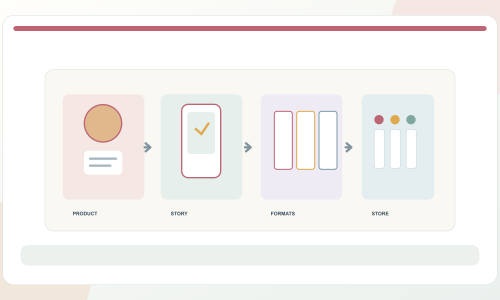
Direct answer
An effective Instagram content strategy for ecommerce brands gives each format a specific job in the shopping journey. Reels can introduce a use case; a carousel can answer a comparison question; Stories can carry timely updates; creator content can demonstrate a product in context; and a product page must complete the promise made in the post. Build the mix from customer questions, product evidence, creative capacity, inventory, rights, and measurement. Do not judge the strategy by posting frequency alone. Track the path from a content idea to a relevant store action, while treating reach and engagement as signals rather than proof of revenue.
An Instagram content strategy for ecommerce brands starts with one buyer question
The common planning mistake is to begin with a format list: three Reels, two carousels, daily Stories. That is a production schedule, not a content strategy. A merchandiser starts with what a shopper needs to understand before choosing. Is the product hard to size, install, compare, style, maintain, or trust? Does the customer need to see texture, scale, packaging, ingredients, compatibility, or an everyday use? The answer sets the editorial job. The platform format follows.
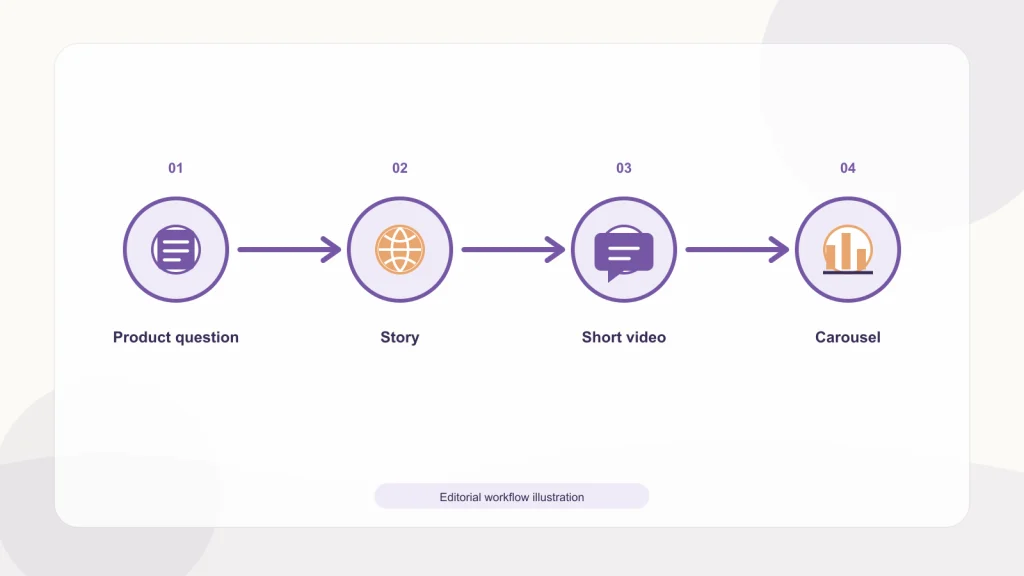
An Instagram content strategy for ecommerce brands should connect a real customer question to three layers: the evidence available, the clearest way to show it, and the next page or action that continues the experience. A video can show how a garment moves; a carousel can compare dimensions; a Story can announce a real stock or service update; a creator can show the product in an ordinary setting. Those roles are not interchangeable, even if the same item appears in each asset.
This approach matters because a post can attract attention while leaving a shopper uncertain. A visually polished image may not explain what comes in the box. A fast clip may show the product but omit an important limitation. A creator may demonstrate an item with styling that changes the perceived color or scale. The content brief should say what evidence the audience needs and what a viewer must not infer from the image.
A reach statistic, with the right boundaries
Pew Research Center’s 2026 U.S. fact sheet reports that 51% of U.S. adults say they ever use Instagram. Its national survey included 5,511 adults and was conducted January 30 through June 18, 2026; Pew reports an overall margin of error of ±1.8 percentage points. That is useful context for a U.S.-oriented marketing discussion. It is not a measure of shopping intent, buyer fit, Instagram-attributed sales, or use in every country.
DataReportal’s Digital 2025 report brings together global digital and platform advertising-reach estimates. Keep the term “advertising reach” attached to those figures. The estimates do not equal a count of unique active shoppers or the number of people who will receive organic distribution. A store should use its own target-country research, site data, customer questions, and platform insights to test whether the audience it wants is present.
The difference between a large platform audience and a useful product audience is not academic. A brand selling replacement parts may need maintenance staff and buyers with a particular specification. A homewares store may care about visual discovery and room context. A premium skincare company may need careful claim review and ingredient explanations. A single demographic label like “women 25–44” does not capture these jobs.
| Planning question | Evidence to examine | What not to infer |
|---|---|---|
| Does the audience use the platform? | Target-market research, first-party audience insights, customer interviews | That general usage means purchase intent |
| Does the content help evaluate the product? | Support questions, reviews, returns, product-page gaps, sales feedback | That likes equal product understanding |
| Can the team sustain production? | Available samples, creators, review capacity, inventory, rights | That a competitor’s frequency is necessary |
| Does the path continue on-site? | Link destinations, tagged sessions, product-page clarity, checkout behavior | That a platform view is a completed purchase |
Give each format one assignment
Think of formats as different editorial containers. The container affects how evidence is shown and how much context a viewer can absorb. It does not decide the goal by itself. Before the creative team shoots, write a one-line assignment: “Help a first-time buyer distinguish these two sizes by showing their scale next to a familiar object.” That sentence can guide script, framing, caption, and page link.
Reels: put a use or transformation in motion
Short video can show motion, sequence, scale, assembly, texture, or before-and-after steps. A useful Reel does not need an artificial hook if the visual demonstration itself is clear. Open with the question or outcome the clip answers. Show enough context to avoid a misleading crop. If a claim depends on a condition—surface, lighting, fit, setup, or product version—state it in the caption or voiceover.
Do not assume a short clip is self-explanatory. Many viewers watch without sound, and a fast edit can make a demonstration difficult to follow. Add captions or on-screen language where appropriate, check that the product remains visible, and provide a description that names the relevant product context. W3C’s WCAG 2.2 Recommendation includes caption criteria for prerecorded synchronized media; accessibility is a production requirement, not a decorative finishing touch.
Carousels: make comparison and reference easier
A carousel can divide an answer into steps or compare a small set of options. It can explain how a size is measured, what a bundle includes, or which accessory matches a model. Each panel should contribute a new piece of information. A useful final card may point to a fit guide or product detail page, but the earlier panels must still make sense when encountered separately.
Avoid turning a carousel into a paragraph broken across slides. Use direct headings, concise copy, clear image descriptions, and a reading order that survives mobile screens. A comparison should show the actual criteria—dimensions, materials, compatibility, included pieces—not vague labels such as “better” or “premium.” If two options have different use cases, say so rather than forcing a universal winner.
Stories: make temporary information precise
Stories can support timely updates, Q&A, reminders, launches, or a sequence that adds context to a longer asset. Because the format can disappear or be hard to find later, reserve it for information whose time horizon fits. An enduring instruction or product limitation should also live somewhere stable, such as a product page or help article.
Treat stickers, polls, and question prompts as research inputs with caveats. The people who choose to respond are not automatically representative of all customers. Record the question, audience, response window, and what the answer can legitimately tell you. Do not present a poll as a market survey unless the sampling design supports that claim.
Creator content: bring a point of view, not just a face
Creator partnerships can make a product visible in a context that feels different from a studio catalog image. The best brief leaves room for the creator’s credible way of explaining something while keeping product facts, offer terms, and disclosures accurate. Define whether the asset is sponsored, gifted, affiliate-linked, or otherwise connected to the brand. Agree on usage rights, paid amplification, territory, duration, edits, and approval before posting.
In the United States, the Federal Trade Commission’s revised Endorsement Guides address truthful endorsements and disclosure of material connections. The brand should check the current guidance and apply qualified legal review for market-specific obligations. A disclosure should be conspicuous enough for the placement and audience; a vague tag buried among hashtags can confuse viewers. The FTC’s Consumer Reviews and Testimonials Rule also addresses specified deceptive review practices, including certain fake or manipulated testimonials. Treat customer stories as evidence that needs permission, context, and accurate representation.
Product education: make the buying decision less opaque
Education can explain care, compatibility, ingredients, materials, sizing, setup, or how to select among variants. It should not disguise a sales claim as neutral advice. Separate verified product facts from the brand’s recommendation and make the basis for comparisons visible. If the product has limitations or is not right for some use cases, a direct explanation can protect the customer and the brand’s credibility.
Use customer-service language as a starting point, then check whether it represents a recurring issue. One unusual message may not deserve a full content series. A repeated question in support tickets, returns, store reviews, or sales chats can justify a permanent explanation. The content brief should note how the issue was identified and which product owner approved the answer.
| Format | Strong editorial job | Example prompt | Useful measurement question |
|---|---|---|---|
| Reel | Demonstrate motion, use, scale, or setup | “Show how this attachment changes the product’s use.” | Did viewers reach the part that explains the decision? |
| Carousel | Explain, compare, or create a saveable reference | “Compare these two sizes using the same dimensions.” | Were saves, shares, or product-page visits aligned with the goal? |
| Story | Carry a time-bound update or invite a question | “What should we explain before the launch?” | Did responses surface a question worth checking further? |
| Creator asset | Show a product in a relevant lived context | “Demonstrate the routine and state the partnership clearly.” | Did tagged or coded visits produce relevant actions? |
| Product education | Resolve an evaluation or post-purchase question | “Explain care, compatibility, or a common setup step.” | Did support questions or page behavior change in the expected direction? |
Build a small editorial system around the product
One month of social content does not need a new campaign idea for every day. Start with a source idea rooted in customer understanding, then create distinct executions for different purposes. A product question can yield a short demonstration, a comparison card, a creator explanation, a Story Q&A, and a durable FAQ on the store. Each version should have a reason to exist; do not multiply assets simply to fill a calendar.
Create a content record with the audience, question, product evidence, claim owner, format, language, call to action, rights status, destination, and review date. This makes reuse safer. If product specs change or an offer expires, the team can identify which assets are affected. It also helps ecommerce, customer support, and marketing share a consistent answer rather than improvise separately.
Content pillars are useful only if they guide decisions. “Lifestyle,” “education,” and “product” are broad buckets. Improve them by adding a buyer question and a boundary: “Show everyday use contexts, but do not imply waterproofing”; “Explain materials, using the current product sheet”; “Compare variants using size and compatibility, not superlatives.” A pillar should help a writer know what to make and what to verify.
The same discipline applies to visual identity. A feed may benefit from a recognizable treatment, but uniform design can become monotonous. Preserve clear product depiction, accessible contrast, and enough variety to communicate different jobs. The goal is not a perfect checkerboard; it is a library of useful material a customer can understand and the team can maintain.
Make shopping paths observable without promising attribution
A content asset should point to a page that continues its promise. If a clip demonstrates a specific model, link to that product or an appropriate comparison page—not a generic homepage. The destination should show the current product, clarify terms, and work on mobile. Check that creator links, campaign tags, discount codes, and product variants do not conflict.
Use a consistent naming convention for campaigns and links, and retain a record of how it was applied. The exact measurement tools available depend on the store’s setup and privacy choices. Distinguish platform-reported interactions from sessions recorded by analytics and orders recorded by commerce systems. Totals may not reconcile because the systems use different windows, definitions, consent states, and attribution models.
Assess several signals together: reach among a relevant audience, meaningful saves or shares, product-page visits, variant selection, add-to-cart actions, purchases, average order value, margin, returns, and support questions. No single number answers every question. A creator clip may introduce a product whose purchase occurs later through search or direct traffic. That can be reported as a possible assisted path, not proof that the clip caused the sale.
Hold the offer, landing page, and measurement stable when comparing creative ideas, where practical. If the discount changes at the same time as the content, results are difficult to interpret. Keep tests small enough for the team to execute and clear enough that a reviewer can say what changed. If volume is low, describe the observation without dressing it up as statistical certainty.
A product-story example, without invented results
Consider a hypothetical store selling a compact countertop appliance. Support receives recurring questions about capacity, cleanup, and whether the product fits under standard cabinets. The content team can plan around these questions without claiming that the content will increase conversion by a particular amount.
One Reel can show the appliance beside a common scale reference and demonstrate the lid removal. A carousel can show dimensions and list what is included. A creator brief can ask for an honest cleanup demonstration, with disclosure and rights agreed in advance. A Story can answer a launch-week question and direct users to a detailed setup guide. The product page can hold specifications and care instructions that should remain available after temporary posts expire.
The team’s review would check that the scale reference is accurate, the item shown is the current model, any performance claim is supported, and the creator’s experience is not edited into a broader promise. The link should land on the matching product variant and any promotion should show its current terms. Measurement can follow content interactions, tagged visits, product-page actions, orders, refunds, and the same support questions over a defined period.
This example illustrates a workflow, not a case study. It contains no real customer result. A publisher should label hypothetical examples as hypothetical, and any future case study should disclose its source, timeframe, channel, outcome definition, and permission.
How to plan next month’s Instagram content in seven steps
- Choose one commercial question for the month, such as fit, care, ingredients, compatibility, or how to choose among variants.
- Audit the product page, support questions, customer language, approved claims, image rights, and stock availability before briefing creative.
- Assign each format a distinct role: short discovery, save-worthy explanation, timely update, creator demonstration, or deeper education.
- Write an asset brief with audience, product fact, one idea, format, hook, proof, call to action, market adaptation, owner, and measurement signal.
- Review assets for truthful depiction, accessibility, disclosure, voice, rights, and current inventory or offer terms.
- Link each outbound or creator asset to an appropriate product or landing page and maintain consistent campaign labels in the analytics system.
- Review results by content role and audience action; keep, adapt, or retire the format based on repeated evidence rather than one viral result.
The planning pass should include people beyond the social team. Ecommerce owns the landing page and merchandising details. Customer support knows recurring confusion. Legal or compliance reviewers may need to see claims, creator disclosures, sweepstakes, or regulated product content. Creative producers know what can be filmed accurately. One person can coordinate, but each kind of knowledge should have a clear route into approval.
Where the agency fits—and what it does not replace
An external team can add structure when the company lacks a dedicated content producer, a consistent calendar, platform-specific creative, or a reporting routine. It cannot make unsupported product facts reliable, authorize the use of customer likenesses, or guarantee demand. The store still owns product accuracy, inventory, customer care, terms, and the commercial decisions behind the page.
Next step: Marketboo’s current service page describes social strategy, content planning and creation, community management, publishing/account coordination, and performance reporting. It is a first-party description of the company’s work. If those are the capabilities you need, review Marketboo’s social media management service and compare the proposed scope with your product, channels, approval capacity, rights, and measurement needs.
Next step: Before a campaign begins, bring one product, its current specifications, customer questions, markets, content assets, and store destination. You can contact Marketboo to discuss an ecommerce content plan. Ask how the team would adapt formats, what it needs from your staff, who approves claims, and how it would report uncertain attribution. The right process should be clear before the first shoot.
Keep campaign assets useful after a launch
A content strategy should decide what deserves to remain discoverable after the immediate campaign ends. A product demonstration that answers an installation or care question may have a longer useful life than a launch countdown. A temporary price reminder may expire as soon as the offer changes. Mark these lifespans in the asset record so an old post does not quietly keep circulating after its terms are no longer true.
Review the destination too. If a post links to a product that goes out of stock, decide whether it should remain, point to a substitute, or pause. Do not redirect every expired product to the homepage without checking whether that helps the shopper. Keep a clear route back from social content to current product information, and preserve a note explaining why a link was changed. Align this decision with merchandising and support so a shopper is not sent toward an unavailable variant or an outdated promotion.
Repurposing is useful when the information remains correct and the new context suits it. A creator clip may be a strong asset for a product page if rights allow that use. A carousel may become a customer-support reference if the wording survives without Instagram context. A Story may not make sense as a permanent guide. Content reuse should be a decision based on audience, rights, accuracy, and format—not an automatic checkbox in the calendar.
Give the content library a simple naming system. Record the product, market, language, format, date, owner, and rights status in fields that the next person can understand. Keep the original and approved version together; do not make an exported crop the only record of a source asset. If an agency hands over work, include editable files when the agreement covers them and note any third-party license that limits use.
This discipline pays off when the calendar changes quickly. A seasonal item can return next year only if its specifications, images, claims, and offer are checked again. A creator video that performed well may still need a new disclosure or usage permission before it appears in a paid placement. A small archive note is cheaper than asking a team to reconstruct the history after a question arises.
Store the final approved version beside its source facts and usage permissions. When the product team updates a specification, a reviewer can locate content that needs correction. When a rights window expires, a producer can find the affected assets. That archive protects continuity when a staff member or agency changes, and it keeps the next planning cycle from recreating work without knowing why it existed.
FAQ
What belongs in an Instagram content strategy for ecommerce brands?
A strategy connects audience questions and product evidence to a purposeful mix of short video, Stories, carousels, creator work, product education, and measurable landing paths. It should also define owners, review, and cadence.
Should every post link directly to a product?
No. Some content helps discovery or answers a question before a shopper is ready to choose. Give each asset one appropriate next step and make the product path clear when purchase intent is present.
Are Instagram product tags available to every store?
Do not assume so. Confirm current account eligibility, commerce setup, country availability, catalog accuracy, and destination behavior in the brand’s own account before designing around tags.
How often should an ecommerce brand post?
There is no universal cadence. Set a rhythm the team can produce, review, and sustain, then assess quality, audience signals, and store actions—not a competitor’s calendar.
How should creator content be measured?
Track the agreed deliverable, disclosure, tagged or coded visits where appropriate, content engagement, and downstream actions. Audience size alone does not establish incremental sales.
What should a small brand test first?
Start with one product and one audience question. Compare a few distinct creative hypotheses while keeping offer, destination, and measurement stable enough to interpret.
Can Instagram engagement predict store revenue?
Engagement shows an audience response, not revenue. Review tagged sessions, product-page behavior, orders, refunds, margin, and assisted paths with attribution limits stated.
Keep the product promise intact from post to checkout
An Instagram content strategy for ecommerce brands works best as a merchandising system: customer question, product evidence, creative format, review, shopping destination, and measurement. Each link in that chain affects how useful the experience feels. A beautiful asset cannot fix an unclear product page; a precise page cannot explain a product that no one discovers.
Start with a small set of questions the team can answer well. Give each format a distinct job, keep claims and creator relationships transparent, and build a route to the correct product information. Then read the results with care. If the audience responds but does not visit the store, investigate the link and offer. If visits happen without orders, examine the page, price, shipping, stock, and product fit before blaming the content.
The goal is not a feed that looks active at any cost. It is a set of product stories that helps the right shopper understand what is being offered and what to do next. Keyword volume for this topic remains unvalidated because the workbook contains no live search metrics.