

A multilingual SEO agency should coordinate accurate translation, market-specific localization, and technical signals for each language or regional page. These are related tasks with different acceptance checks: meaning and terminology, local proof and user needs, then URL, canonical, and alternate-language validation. Use Google’s localized-version guidance to review a real URL set, check reciprocal references and indexability, and have a qualified local editor review the page’s meaning. A QA pass rate describes only the URLs and criteria actually checked; it does not guarantee search visibility or conversion performance.

Diagnose the problem before selecting a multilingual SEO agency
A multilingual SEO agency should be able to identify whether the failure is linguistic, commercial, technical, or operational. Those problems need different remedies. A fluent page with the wrong offer needs local market input; a useful page disconnected from navigation needs implementation work; a stale price needs a reliable update owner.
Start a vendor discussion with a small set of affected pages and the customer task each should support. Ask for a diagnosis, proposed evidence, and acceptance check. A proposal that immediately recommends translating every page has skipped the more important question: which local pages deserve to exist?
Keep four different jobs separate

| Job | Question it answers | Example output |
|---|---|---|
| Translation | Does the target text preserve the intended meaning? | Reviewed terminology and copy |
| Localization | Does the experience fit this audience and task? | Suitable offer, examples, units and support route |
| Locale architecture | Where do versions live and how are they connected? | URL, navigation and alternate-page map |
| Maintenance | Who keeps local versions accurate after release? | Change alerts, owners and review cadence |
A locale is the audience context you choose to support, commonly described through language and, where relevant, regional distinctions. Define it in a written brief. Do not assume that one language always means one country, or that every country needs a separate page.
Failure pattern: fluent translation, weak local relevance
Compare the local page with the questions customers actually ask. Does the headline use their terminology? Is the product available? Does the proof address their concern? Can the customer see delivery, service, currency, and support information before taking the next step? Record specific mismatches rather than labelling the whole translation “low quality.”
Use a reviewer who can assess both the language and the task. Supply the source brief, approved terminology, audience, and claims that must remain unchanged. Where the local offer differs, route the decision to the commercial owner. A translator should not have to invent availability, prices, testimonials, or legal wording to make a page feel local.
Failure pattern: the wrong version reaches the user
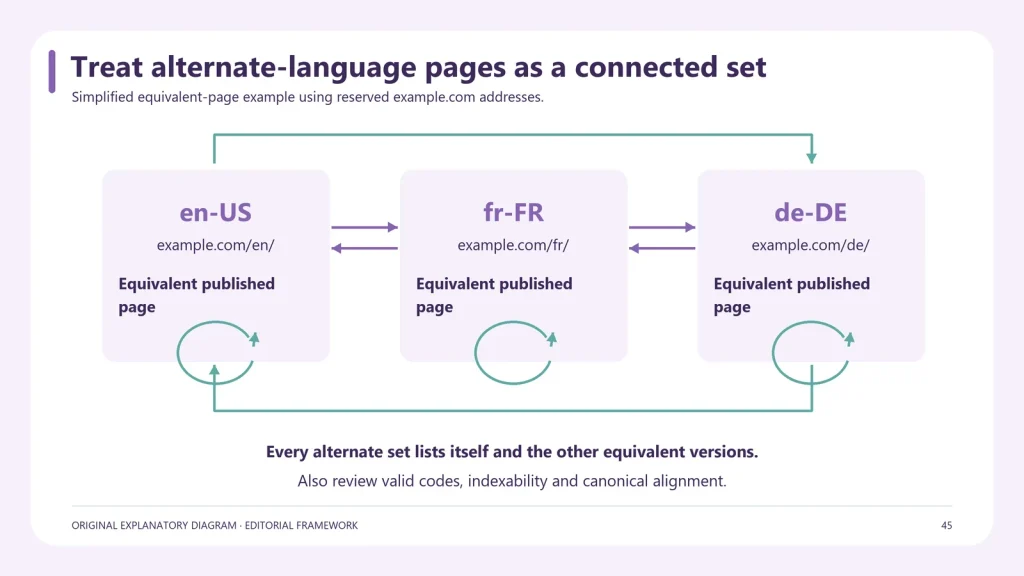
Map the affected page family before adding more annotations. List the actual URLs, intended audiences, indexability checks, canonical decisions, internal links, and alternate relationships. Inspect the mobile language selector and the next page in the journey. The error may be in a shared template or navigation rule rather than the translated paragraph.
Google’s localized-version guidance, updated September 21, 2026, states that each annotated language version must list itself and the other versions. It also says that if two pages do not both point to each other, their tags will be ignored. A practical check therefore follows a page pair in both directions rather than merely finding a hreflang tag on one page. This is an implementation rule, not a promise that a particular version will rank.
Google’s multi-regional guidance, updated December 10, 2025, recommends separate URLs for language versions and advises allowing users to choose another version rather than automatically redirecting them. Inspect the actual navigation and customer path alongside the annotations; a technically annotated page still needs a useful local experience.
Failure pattern: a language code is mistaken for a market plan
Keep the language-tag decision separate from the commercial decision. A code tells a system something about a version; it does not demonstrate local demand, product availability, or customer support. Record why two proposed versions need separate content and who will maintain the difference.
The same Google guidance specifies the language in ISO 639-1 format and an optional region in ISO 3166-1 Alpha 2 format. These are two-letter language and region code systems: en-GB combines English with the United Kingdom; GB alone is not a valid hreflang language value. Use the supported values in the current guidance rather than inventing a country shorthand.
IETF RFC 5646, published in September 2009, is the broader standards reference titled Tags for Identifying Languages. Language-tag standards and Google’s supported search annotations have different scopes. Check the specific implementation against Google’s guidance rather than assuming every language tag allowed by the broader standard is supported for hreflang.Review your multilingual SEO setup
Failure pattern: the page reads well but the task fails
Test the full path in the target language. Look for clipped buttons, untranslated errors, a form that resets the locale, a checkout that changes currency unexpectedly, and confirmation messages that send the user back to the wrong support team. Keep the test result tied to a URL, device, date, and reviewer.
Longer translated labels can also expose layout and accessibility problems. The dated 5 October 2023 W3C Recommendation of WCAG 2.2, Success Criterion 1.4.3, specifies minimum text contrast of 4.5:1 for normal text and 3:1 for large text, subject to its stated exceptions. Use this narrow criterion as one QA reference when localized designs change text or backgrounds; passing it alone does not establish overall accessibility or legal compliance.
Failure pattern: local versions quietly become stale
When a source page changes, identify which local pages depend on the changed fact. A price, availability statement, product specification, support route, or customer example may need immediate local review; a minor wording change may not. Put the change in a queue with a named owner, priority, and publication status.
A release should not be marked complete merely because the main-language page is correct. The local reviewer needs the changed source, a clear brief, and a way to record approval. If a version cannot be maintained, decide deliberately whether to revise, consolidate, withdraw, or redirect it after technical review.
Use a release gate that a reviewer can reproduce
| Gate | Reviewer | Evidence to retain |
|---|---|---|
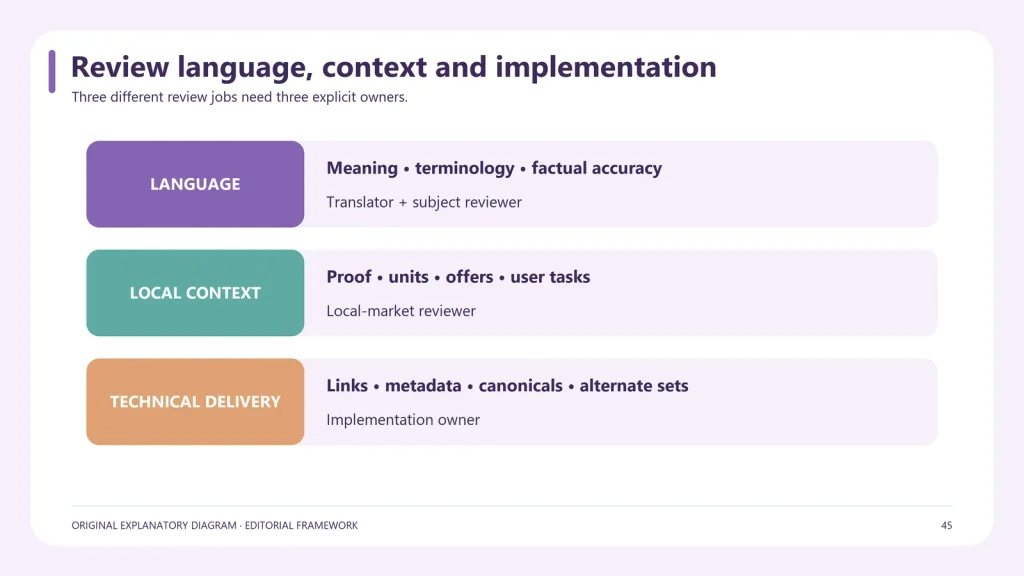
| Meaning and claims | Language and subject reviewer | Approved copy and unresolved questions |
| Offer and customer task | Local commercial owner | Availability and full-path test |
| URL and alternate relationships | Technical owner | Page-family map and current checks |
| Layout and accessibility | Design or accessibility reviewer | Device sample, defect and resolution |
| Ongoing accuracy | Content owner | Update trigger and next review date |
Sample more than the homepage: include a commercial page, an article, a form, an error state, and a recently changed template. This is an editorial sampling suggestion, not a claim that a small sample proves every page works. Expand the review when a shared defect is found.
Ask the agency to demonstrate a correction, not just an audit

Request a short walkthrough of one issue from diagnosis to verified release. The agency should explain the reader impact, its evidence, the proposed fix, who implements it, and what proves it was resolved. Ask how local reviewers participate and how future updates enter the same process.
Use that discussion when asking Marketboo about a multilingual review. Agree whether the scope covers diagnosis, local copy, implementation support, release checks, or ongoing maintenance. This guide does not verify that every activity is included in a current Marketboo package, and it does not claim a named technical expert has reviewed your site.
How to diagnose a multilingual publishing failure
Use these steps as a working sequence; agree responsibilities and verification before implementation.
- List the language, market, product, audience, user task, source page, reviewer, and success evidence.
- Choose a maintainable locale architecture and document ownership, reporting, redirects, canonicals, and templates.
- Create translation and localization briefs with terminology, examples, proof, policies, calls to action, and reviewers.
- Implement localized URLs, internal links, metadata, structured data, forms, support paths, and accessible content.
- Implement and QA hreflang references, reciprocal relationships, canonicals, valid destinations, and release timing.
- Test representative pages on desktop and mobile, including navigation, forms, errors, indexing signals, and analytics.
- Publish a governance calendar for source updates, translation, review, rollback, and change ownership.
- Review search, engagement, qualified actions, technical errors, and market feedback before adding locales.
FAQ
What is a multilingual SEO agency?
It combines language and market work with SEO architecture, localized content, technical signals, QA, measurement, and governance across locales.
Is translation the same as localization?
No. Translation moves meaning between languages; localization adapts examples, offers, proof, terminology, and user tasks to a market.
What is hreflang used for?
Hreflang helps search engines understand alternate localized versions when references are valid, complete, reciprocal, and aligned with the page and canonical setup.
Should every language use a country code?
Only when the content and audience are genuinely country-specific. Choose language and region targets from the business and user model.
How can teams prevent language pages from becoming stale?
Assign source, translator, reviewer, release, rollback, and update triggers. Keep a locale matrix and change log.
Can multilingual SEO guarantee international rankings?
No. Technical and editorial clarity can support discoverability, but market demand, competition, quality, trust, and operations vary.
How does Marketboo support multilingual SEO?
Ask Marketboo whether your proposed scope can cover diagnosis, local content, implementation support, or maintenance. Confirm the language reviewers, technical responsibilities, and actual inclusions directly.
Conclusion
Choose a multilingual SEO agency that can connect language quality, local relevance, implementation, and maintenance. Begin with the failure the reader experiences and require an acceptance check for the proposed remedy. Better language coverage is useful when the business can keep the entire local journey accurate and usable.Plan localization and hreflang QA with Marketboo