

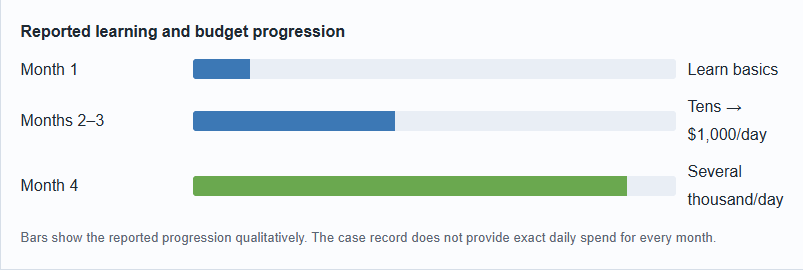
This Facebook ads coaching for beginners case follows a learner who started with no Facebook advertising experience. The reported progression moved from introductory study in month one, to daily budgets ranging from tens of dollars to $1,000 in months two and three, and several thousand dollars per day by month four. The value of the case is the staged learning curve: capability and budget grew together instead of scaling spend before the operator understood the account.
Training stories are often written as if confidence appears first and competence follows. This case points to a more practical sequence. The learner began at zero, learned the fundamentals, handled larger daily budgets over time, and eventually earned recognition from a client. That progression gives a future student something concrete to evaluate: what was learned, when the budget changed, and what evidence supported the next step.
Why the starting point matters
The client background is explicit: the learner had no prior Facebook advertising experience. That changes the coaching problem. A beginner does not only need a campaign setup. The learner needs a working mental model for objectives, audience signals, creative, budget control, conversion tracking, and follow-up.
Jumping straight to a large budget can hide gaps. A learner may know how to press “publish” without knowing which event to trust, why a cost changed, or whether the leads are usable. A staged program makes those decisions visible.
| Stage | Reported focus | Reported budget path | Capability question |
|---|---|---|---|
| Month 1 | Introductory learning | Not specified | Can the learner explain the account and conversion event? |
| Months 2–3 | Practical campaign work | From tens of dollars per day to $1,000 per day | Can the learner read results and make controlled changes? |
| Month 4 | More stable execution | Several thousand dollars per day | Can the learner manage scale and communicate with a client? |
A budget ramp is also a risk-control system
The budget progression is not valuable because a large number looks impressive. It is valuable because the learner had time to connect actions with outcomes. At a smaller budget, the operator can learn the reporting rhythm, identify weak creative, review lead quality, and practice the handoff to a client.
Meta’s business education resources are useful for learning the platform vocabulary, but training should not stop at platform mechanics. A capable operator can explain why a campaign is being run, what the conversion means, how a lead will be handled, and when a budget increase is justified.

What the learner’s client recognition adds
The case record says the learner received positive feedback, was recognized by a client, and received a monthly “salary” of RMB 100,000. Those statements should be treated carefully. The deck uses quotation marks around “salary,” and it does not identify whether the amount was compensation, a client retainer, commission, or another arrangement.
The strongest publishable version should therefore separate the verified learning progression from the income claim. The coaching outcome can be described as client recognition and increased responsibility. The financial figure should be published only after the learner and client approve the wording, currency, relationship, and period.
For prospective learners: Ask for the training milestones, reporting templates, review cadence, and examples of decisions made at each budget stage. A clear process is more useful than a dramatic income headline.
How to turn coaching into a repeatable operating skill
A beginner should finish each stage with evidence. That might be a documented test, a clean reporting sheet, a lead-quality review, or a client-approved change. The goal is to build judgment that survives outside the training session.
For the coach, the case also shows why feedback needs to be specific. “Good job” is not a learning record. A better review explains which decision improved the campaign, which assumption was wrong, and what the learner should monitor next.
For prospective learners: Request the learning milestones and reporting examples that show what the learner could do at each budget stage.
How to coach a beginner through a controlled Facebook ads ramp
- Start with the business goal and one clearly defined conversion event.
- Teach account structure, tracking, creative basics, and lead handling before scaling.
- Use small budgets to practice reading cost, quality, and response data.
- Increase spend only after the learner can explain the result and the risk.
- Review campaigns with a repeatable checklist instead of intuition alone.
- Document the learner’s independent decisions and the client outcome separately.
F A Q
Can someone with no Facebook advertising experience learn to manage campaigns?
The case record describes a learner who started from zero experience and progressed through staged instruction and budget increases. It is a case observation, not a guarantee.
How did the coaching program increase budget?
The reported path moved from introductory learning in month one, to daily budgets ranging from tens of dollars to $1,000 in months two and three, then several thousand dollars per day in month four.
Why increase budget gradually?
A staged ramp gives the learner time to understand tracking, creative, audience response, and lead quality before taking on larger spend.
What should a beginner learn before spending more?
They should understand the conversion event, budget controls, creative testing, audience review, lead handling, and basic reporting.
Does a larger daily budget prove campaign success?
No. Budget shows capacity to spend. Success requires stable economics, meaningful conversions, lead quality, and a process the learner can repeat.
What does the reported monthly income mean?
The deck says the learner was recognized by a client and received a monthly “salary” of RMB 100,000. The relationship, currency, and income definition should be confirmed before public use.
How should a coaching case study be evaluated?
Look for the learner’s starting point, skills gained, budget progression, campaign evidence, client responsibilities, and whether results remained stable after the training period.