This Facebook B2B lead generation for bearing manufacturers case covered more than 20 regions for a factory selling components to enterprise buyers, distributors, and agents. The campaign record says costs stayed stable and the share of valid B2B inquiries was high. The strongest lesson is the qualification model: international reach is useful only when the campaign can distinguish a purchasing conversation from a low-value form fill.
Industrial suppliers rarely need the largest possible audience. They need the right buyer, asking about the right product, with enough commercial detail for a salesperson to respond. A bearing factory may sell into multiple industries and markets, but the qualification standard still has to be clear. Otherwise, a report can celebrate “leads” that never become a quote.
Why B2B campaigns need a stricter definition of success
The factory’s starting problem was a familiar one: fake followers and junk inquiries. Those signals create two costs. The media budget pays for attention that does not represent demand, and the sales team spends time sorting conversations that should never have entered the pipeline.
The campaign objective was more specific than “get inquiries.” It targeted enterprise procurement teams, distributors, and agents. That distinction should appear in the form questions, message prompts, audience definition, and the final report.
| Campaign layer | Question to answer | Evidence to keep |
|---|---|---|
| Market | Which regions have sales coverage and product demand? | Region list, language, spend, and lead volume |
| Buyer | Is the person an enterprise buyer, distributor, agent, or another role? | Role field or documented conversation label |
| Product | Does the inquiry identify an application or part requirement? | Part number, use case, quantity, or specification |
| Commercial outcome | Can the team quote, qualify, or route the opportunity? | Response, quote, and sales-accepted status |
What the multi-region result shows
The supplied case record reports stable cost across more than 20 regions and a high share of valid B2B quality. That is a useful result because it points to consistency. A campaign can generate one inexpensive inquiry in a single market by chance. Holding a workable cost across a broad region set is a different management challenge.
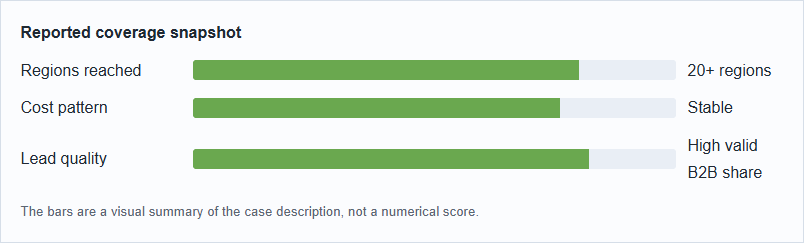
Publication warning: The case deck includes a range written as “0.02–1,” but it does not identify the metric, currency, or unit. Do not label it as cost per lead, cost per click, or any other measure until the source record is confirmed.
How to keep regional expansion from lowering lead quality
Start with sales capacity. A region should not be added simply because it is inexpensive in the ad account. If no one can answer in the local language or handle the buyer’s delivery and specification questions, the campaign may create a backlog rather than a pipeline.
Next, preserve comparability. Use a common definition of valid B2B inquiry while allowing the creative and audience details to change by market. A distributor looking for recurring supply is different from a one-time repair buyer. Both may matter, but they should not be mixed in the same success metric.
Finally, report the full chain. Show regions, spend, inquiries, valid inquiries, response rate, quotes, and sales-accepted opportunities. A global average can hide a strong market and a weak market inside the same number.
Useful next step: Ask the sales team to approve the qualification fields before launching regional tests. That single step keeps the media report connected to the commercial process.
What this bearing factory case proves
The case supports a focused claim: a Facebook campaign reached more than 20 regions while maintaining stable costs and a high share of valid B2B inquiries. It does not prove that every industrial advertiser can achieve the same outcome, and the undefined 0.02–1 figure should not be used as a headline statistic.
With the missing units and dates added, this can become a strong international B2B case study because it connects targeting, regional coverage, and lead qualification. Those are the details procurement-led businesses need when they evaluate an overseas marketing partner.
For regional teams: Ask regional sales owners to approve the buyer-role and product fields before expanding the campaign.
How to build a multi-region Facebook B2B inquiry campaign
- List the buyer roles and applications that count as qualified demand.
- Group regions by language, market potential, and sales coverage.
- Use form or message questions that filter for product and purchasing context.
- Assign each region a response owner and a clear follow-up route.
- Compare qualified-lead rate and cost by region, not only the global average.
- Publish results only after the metric, currency, dates, and attribution window are documented.
FAQ
What was the bearing factory trying to achieve?
The factory wanted enterprise buyers, distributors, and agents rather than low-quality inquiries.
How many regions did the case cover?
The case record says the campaign reached more than 20 regions. The exact list of regions should be confirmed before publication.
What result did the campaign report?
It reported stable costs across more than 20 regions and a high share of valid B2B lead quality.
What does the 0.02–1 figure mean?
The supplied deck does not define the metric, currency, or unit. It should be treated as unverified until the campaign export or account owner confirms it.
How should a bearing manufacturer qualify a B2B lead?
Ask for buyer role, application, part number, quantity, destination, timing, and company details. The exact fields should match the sales process.
Should every region use the same Facebook campaign?
A common structure can help comparison, but regional language, purchasing behavior, shipping economics, and buyer roles may require separate audiences or creative.
What proof would make this case study stronger?
Add spend, valid inquiry count, qualification rate, response time, region-level cost, quote rate, and the definition of a valid B2B inquiry.